- 310 pages
- English
- ePUB (mobile friendly)
- Available on iOS & Android
eBook - ePub
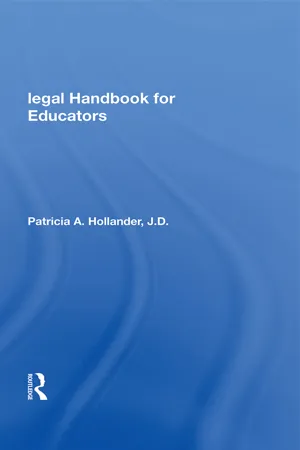
Legal Handbook For Educators
About this book
A welter of new laws, newly applied laws, and judicial decisions has altered the character of educational instruction and administration; in many respects, the nature of the faculty member's and administrator's legal responsibility has undergone a drastic change. At a time when grave risks exist in the failure to follow legally defined procedures,
Information
1.
New Legal Concepts in Historical Perspective: An Introduction
This chapter begins by highlighting a few new legal concepts that have had an impact on all educational institutions in some fashion. It then concentrates on the basic rights and responsibilities of administrators, faculty, and students, the legal differences between private and public educational institutions, and the legal structure of educational systems. Recommendations appear at the end of the chapter.
A major impetus for writing this book was the 1975 U.S. Supreme Court decision in Wood v. Strickland. It held that officials at public educational institutions could be personally liable for actions they knew or should have known deprived students or colleagues of well settled constitutional rights. Many educators had no knowledge of this decision; some paid little attention to it because it was a five-to-four decision. However, even such a divided opinion clearly signaled that attention was being turned to a historically unique personal injury in the field of education—the intentional constitutional tort. Numerous cases have cited Wood since 1975. Generally, courts have found that constitutional rights have been violated. But the courts have been reluctant to find that the constitutional right involved was so well settled at law that personal liability should be assessed against individual educators. As the law becomes more well settled, of course, reluctance to award personal damages may decrease.
The Wood decision reinforced my belief that all educators, public and private, should be encouraged to become more familiar with new laws, regulations, and court decisions in order to review their own policies and procedures and try to avoid unnecessary loss of time and money responding to legal claims. Their efforts are much better spent, in my opinion, in getting on with the educational endeavor. Indeed, educators have the opportunity of using constitutional, contract, and other legal requirements as teaching tools. This may not make compliance with regulations and judicial decisions any more palatable or less time consuming, but it may move some of the cost of complying onto the benefit side of the ledger. A dean of academic or student affairs or a school principal or teacher who sets up and operates a disciplinary system that meets legal due process standards is providing an invaluable educational experience.
Education has become a major focus of litigation in the United States today. Courts have been confronted with unprecedented questions regarding the basic educational, academic function itself. Students and parents have challenged the quality of the education being offered, for example. This has occurred at elementary, secondary, and college and university levels, resulting in calls for competency-based educational policies. Experimental research involving recombinant DNA and nuclear energy has been challenged on grounds of safety and morality. Lawsuits have involved employment problems related to the institution’s role as employer. Faculty and administrators have raised countless questions, ranging from the institution’s right to lay off employees in times of financial exigency to matters of compliance with equal employment opportunity laws and regulations. Rights to due process relating to academic as well as employment matters also have been asserted as never before by students, faculty, and administrators.
The impact of all this litigation on individual educators and on educational institutions has increased dramatically in the last several years. In addition to the Wood decision, public institutions were hit hard by the Supreme Court’s 1976 decision in Fitzpatrick v. Bitzen It held that public institutions were not shielded by Eleventh Amendment immunity from payment of money damages in those instances where Congress specifically legislated that states could be so penalized. The court found that Title VII of the Civil Rights Act of 1964 provided for exactly that kind of penalty against public treasuries. Therefore, states have become liable for payment of back pay, just like private employers.
Private institutions, too, are being sued more frequently. Using the theory that a contract exists between students or employees and the institution, suits have alleged breach of contract as the basis for seeking remedies for claims involving academic or employment matters.
The traditional distinctions between public and private institutions still exist, of course. At private institutions the relationship between the institution and its students and staff is largely a contractual one. At public institutions, the relationship includes obligations relating to constitutional rights as well as to contract rights. Public institutions are affected by sunshine laws, nondiscrimination statutes, requirements of due process, and possible personal liability for depriving persons of constitutional rights.
Some blurring of the private-public distinction has developed. Court decisions have found that particular private institutions are involved in state action because of the amount of public funding and regulation involved. These institutions then must be aware of their students’ and staff’s constitutional rights. Also, private institutions that receive federal financial assistance are obligated to abide by federal nondiscrimination laws affecting educational and employment practices, such as Title IX of the Education Amendments of 1972 or Title VII of the Civil Rights Act of 1964.
Educators at higher education institutions often have thought of themselves as having quite different concerns than educators at elementary and secondary schools, and vice versa. Today, this is true only in a limited sense. In the realm of law, there are many more similarities than dissimilarities. All educators are affected by new laws and legal concepts regarding accountability for quality and regarding financial exigency, rights of handicapped persons, and safety and health.
New Legal Concepts Affecting Education
Openness and fairness are salient characteristics of the new legal concepts which affect trustees, superintendents, school board members, institutional administrators, faculty members, and other education officials today. The objection may be raised, of course, that these concepts are hardly new. True. The newness is the specific language in various recent statutes and court decisions recognizing and extending the legal definitions of honesty and justice. Clear legal imperatives now exist to deal with students and professional colleagues openly and fairly. A number of new enforcement procedures and remedies also exist. They include sanctions by the federal government, such as withdrawing federal funds and contracts. There are also sanctions through the courts, such as injunctions to expunge records, orders to provide hearings or to reinstate students or personnel, and awards of money damages against institutions and individual officials, sometimes personally.
Full Disclosure
Consumerism has appeared in the academic marketplace. Requirements for truthful advertising of educational services is one form consumerism takes. For example, students today have a right under regulations such as those of the Guaranteed Student Loan Program to have full disclosure of information about academic programs, faculty, financial costs, and placement possibilities for certain vocationally oriented programs of study, such as medicine, law, and nursing, before they take a loan for tuition.
Sunshine laws in all states require that public decisions be made in open meetings and public records be open to public scrutiny. All public educational institutions are affected by these sunshine laws, as are those private institutions engaging in state action because they receive a substantial amount of state funding or regulation. Courts are being asked to determine which institutional bodies are covered, i.e., governing boards, presidents, superintendents, principals, faculty. Another question is what constitutes a meeting. Are informal as well as formal meetings covered? Is secret balloting still permitted?
Fair Practices and Nondiscrimination
Fair practices in recruitment, admissions, treatment, and employment, as well as nondiscrimination in dealing with students and employees, are surely among the most legislated of academia’s concerns. Age, sex, race, color, national origin, and religion—and more recently, physical and mental handicaps—are all subjects of civil rights laws that have an impact upon educational institutions. Such laws will be treated more fully in later chapters.
Financial Exigency
Proof of bona fide financial exigency has led most courts to permit institutions to implement proposals for reorganization and retrenchment which affect such matters as faculty tenure, contract renewals, and compensation, as well as student admissions and tuition rates. These issues are discussed in Chapters 3 and 5.
Due Process
Due process to protect constitutional rights must be afforded by all public educational institutions. A significant example is that students have been found to have a property interest in their public education, and therefore they cannot be deprived of it by disciplinary suspensions or expulsions without due process. This results from the Fourteenth Amendment to the U.S. Constitution, which provides that no state shall deprive a person of life, liberty, or property without due process. If no due process is provided, students may seek legal redress.
Equal protection under the Fourteenth Amendment must be given student organizations at public institutions. Homosexual student groups, for instance, have litigated successfully their right to be recognized on an equal basis with other student groups.
Class Actions
A class action is a legal procedure whereby a lawsuit may be filed against an institution or person by a plaintiff on behalf of a whole “class” of persons who have suffered the same injury. This mechanism permits redress in many situations where suit by an individual plaintiff would be too costly and impractical.
Computers
Computers have added a number of new dimensions to the academic scene. Protecting privacy of material which has been programmed and stored in computers is one kind of problem; an example would be the abuse of student and personnel records.
Quite another use of computers is found in class action lawsuits. Previously, a class might have been decertified by a court on the basis of the onerous burden of identifying the individual members of the class and the amount of damages due to each. Today, with basic information available on the school’s computer, that task is relatively simple. In Samuel v. University of Pittsburgh (1976) just such a situation arose when a class consisting of female married students was permitted to recover damages against the university for its improper assessment of them at the out-of-state tuition rate rather than the resident rate. This case is discussed further in Chapter 3.
Sources of Basic Rights and Responsibilities
Legal bases for rights and responsibilities of persons in educational institutions stem from a number of clearly defined sources. Among these are (1) constitutions (federal and state), (2) statutes and executive orders (federal, state, and local), (3) contracts between the parties, (4) professional standards recognized by the parties, (5) policies of governing boards, schools, and departments, and (6) handbooks setting forth rules affecting students, faculty, and administrators.
Constitutions
The federal and state constitutions are sources of basic rights for all persons in public institutions. The First, Fourth, and Fourteenth Amendments to the U.S. Constitution, for instance, are familiar sources of constitutional rights relevant to public educational institutions.
The First Amendment was involved in the landmark of Tinker v. Des Moines Independent School District (1969). It reiterated that students do not leave their constitutional rights at the schoolhouse door. This case involved public school students’ First Amendment rights to freedom of expression. The U.S. Supreme Court found that students had First Amendment protection to express their feelings about the Vietnam war by wearing black armbands to school. The Court said in Tinker that to interfere with such a basic constitutional right the school would have to show that the wearing of the armbands “materially and substantially” interfered with the requirements of appropriate discipline at the school. The test of proving “material and substantial” interference was not met by the school in the Tinker case.
The Fourth Amendment protection against unreasonable search and seizure often is invoked by students as a bar to searches of their school lockers or dormitory rooms. It also protects against invasions of privacy.
The Fourteenth Amendment protects persons against loss of life, liberty, or property by action of government officials without due process of law. It is relied upon often by faculty and administrators as well as by students. When an employment contract exists at a public school, it is a property right protected by the due process clause of the Fourteenth Amendment. Therefore, notice and hearing are required. The case of Perry v. Sindermann (1972) had to do with a nontenured teacher’s Fourteenth Amendment right to due process when his alleged property right to continued employment was in jeopardy. The Supreme Court held that a form of de facto tenure arose from an implied contract created by language in institutional publications, a statute, and by the behavior of the parties. Such tenure could arise from an explicit written contract as well.
Public school administrators also have Fourteenth Amendment due process protection of their contractual rights. In one case, a board of trustees attempted to terminate the services of a college president during the term of his contract without due process. The court held in Hostrop v. Board of Junior Colleges (1975) that notice and hearing were required in such a deprivation of a property right.
Responsibilities arising from constitutional rights. Responsibilities go along with constitutional rights. Obviously, if one person has a right to due process, another person has the responsibility to provide it That responsibility has become a particularly heavy one. Personal liability for damages now may be assessed against educators at public schools who do not meet the responsibility of knowing when constitutional rights exist and making sure they are not violated. The doctrine of sovereign or absolute immunity of the state forme...
Table of contents
- Cover
- Half Title
- Title
- Copyright
- Dedication
- Contents Summary
- Detailed Contents
- Preface
- 1. New Legal Concepts in Historical Perspective: An Introduction
- 2. Due Process and Personal Liability; Other Legal Liability
- 3. Recruitment, Admission, and Financial Obligations of Students
- 4. Treatment of Students: Academic Life and Student Life
- 5. Faculty and Administrators: Recruitment, Hiring, and Collective Bargaining
- 6. Treatment of Faculty and Administrators: Academic and Employment Issues
- 7. Funding and Facilities
- Appendixes
- Index of Cases
Trusted by 375,005 students
Access to over 1.5 million titles for a fair monthly price.
Study more efficiently using our study tools.
Frequently asked questions
Yes, you can cancel anytime from the Subscription tab in your account settings on the Perlego website. Your subscription will stay active until the end of your current billing period. Learn how to cancel your subscription
No, books cannot be downloaded as external files, such as PDFs, for use outside of Perlego. However, you can download books within the Perlego app for offline reading on mobile or tablet. Learn how to download books offline
Perlego offers two plans: Essential and Complete
- Essential is ideal for learners and professionals who enjoy exploring a wide range of subjects. Access the Essential Library with 800,000+ trusted titles and best-sellers across business, personal growth, and the humanities. Includes unlimited reading time and Standard Read Aloud voice.
- Complete: Perfect for advanced learners and researchers needing full, unrestricted access. Unlock 1.5M+ books across hundreds of subjects, including academic and specialized titles. The Complete Plan also includes advanced features like Premium Read Aloud and Research Assistant.
We are an online textbook subscription service, where you can get access to an entire online library for less than the price of a single book per month. With over 1.5 million books across 990+ topics, we’ve got you covered! Learn about our mission
Look out for the read-aloud symbol on your next book to see if you can listen to it. The read-aloud tool reads text aloud for you, highlighting the text as it is being read. You can pause it, speed it up and slow it down. Learn more about Read Aloud
Yes! You can use the Perlego app on both iOS and Android devices to read anytime, anywhere — even offline. Perfect for commutes or when you’re on the go.
Please note we cannot support devices running on iOS 13 and Android 7 or earlier. Learn more about using the app
Please note we cannot support devices running on iOS 13 and Android 7 or earlier. Learn more about using the app
Yes, you can access Legal Handbook For Educators by Patricia Hollander in PDF and/or ePUB format, as well as other popular books in Education & Education General. We have over 1.5 million books available in our catalogue for you to explore.