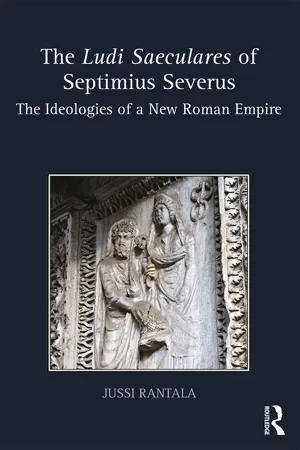
This is the first monograph to examine in detail the Ludi Saeculares (Secular Games) of Septimius Severus and argues that the games represented a radical shift from Antonine imperial ideology. To garner popular support and to legitimise his power, Severus conducted an intensive propaganda campaign, but how did he use the ludi to strengthen his power, and what were the messages he conveyed through them? The central theme is ritual, and the idea of ritual as a process that builds collective identity. The games symbolised the new Severan political and social vision and they embodied the idea of Roman identity and the image of Roman society which the emperor wished to promote. The programme of the games was recorded in a stone inscription and this text is analysed in detail, translated into English and contextualised in the socio-political aims of Septimius Severus.
eBook - ePub
The Ludi Saeculares of Septimius Severus
The Ideologies of a New Roman Empire
- 206 pages
- English
- ePUB (mobile friendly)
- Available on iOS & Android
eBook - ePub
p.1
1 Introduction
The task
The often idealised era of Roman history, the reign of the ‘good’ Antonine rulers during the second century, eventually came to a halt with Marcus Aurelius’ death in CE 180. Soon after, in CE 193, a civil war broke out. Eventually, Septimius Severus, commander of the Pannonian1 legions, rose to power by crushing both of his main opponents: Pescennius Niger and (a little later) Clodius Albinus. The fact that an emperor took control by means of civil war was a highly exceptional event for the Romans of the period, as there had not been a civil war for over a 100 years. After the war of CE 69 (‘the year of the four emperors’), which saw the birth of the Flavian dynasty, major civil disturbances had been very much absent from Rome.2 As a result, Severus, a usurper from North Africa who had become the new emperor and founder of a dynasty, had to seek various ways to secure, justify and legitimise his power. To achieve these goals, he carried out purges among his political enemies, began a lavish building programme in the capital and held public festivals.3
This study concentrates on one of the main events of Septimius Severus’ reign, the Ludi Saeculares (Secular Games) of CE 204. The festival was a remarkable occasion, a magnificent and extremely rare religious ritual, which was only supposed to be officially celebrated once in 100 (or 110) years. As a result, it provided the emperor with an excellent opportunity to highlight the special nature of his reign. The task of this study is to evaluate the role of the Ludi Saeculares, not only as a single religious event but as a phenomenon which was part of a wider process: the creation of an imperial ideology for Septimius Severus’ own ends and for the new dynasty he created.4 The aim is to find out how Severus used the ludi to legitimise his power: that is, during the creation of a new dynasty which he established by means of a civil war. To be more specific, this study examines which messages he conveyed through the means of this religious festival, and how he consequently justified his power; in other words, I here deal with the ideas and values that Severus employed and brought forth through the means of the celebrations as he created and reformed an ‘imagined community’. As we shall see, the Ludi Saeculares can be viewed as an identity-defining ritual, and as the manifestation of a new age, which symbolised the values of the Roman commonwealth.
p.2
A description of the games’ rituals survived on a large inscription which was erected in the Campus Martius. As much of it has been preserved, we possess a good deal of information on the manner in which the games were conducted. This research is therefore based on this piece of evidence. However, it should be stressed that this study is not a line by line commentary of the inscription. Instead, it concentrates on the key points of the programme of the Ludi Saeculares, evaluating how the spectacle was used in building and strengthening Septimius Severus’ power and dynastic ambitions.
The Severan Ludi Saeculares were part of a long tradition of games: by CE 204 they had already been celebrated at least six times. The Augustan and Claudian games had, in a similar manner, been recorded in inscriptions, and it is very probable that other imperial games were as well. The tradition of the games was thus well known and the recorded rituals were therefore very similar (but not identical, as we shall see). Indeed, the importance of the idea of traditionalism for Roman religious rites should be kept in mind while analysing the Severan inscription. The legitimisation of the rituals as ‘real’ or ‘genuine’ was not so much based on theological dogmas, but rather on the claim that the way they were celebrated was part of a long tradition.5 Indeed, the lack of theology is a very characteristic feature of Roman state religion, in comparison to Christianity, for example. There were apparently no holy texts giving clear answers to religious problems (as Christians had); in other words, there appear to be no strict religious dogmas. We do possess writings from Classical antiquity which could be considered as theological, such as Cicero’s De divinatione and De natura deorum, but these are first and foremost philosophical texts. The traditional cultic system, on the other hand, continued for centuries despite the philosophers’ discussions.
The central aspect of Roman religion was ritual action, and especially sacrifice. The lack of a theological system in sacrifice is especially noteworthy; for example, the question of the position of the gods in ritual was perhaps dealt with in philosophical discussions, but it probably never affected the performance of the ritual itself. This differs from Christianity, as Christians emphasised theology and dogma over ritual.6 Even a clergy was lacking in Roman traditional religion: there were priests, but their duty was mainly to perform and organise the religious rites and celebrations ordered by politicians, usually by the senate. It is also important to remember that politics and religion could not really be separated in Roman society – religious festivals were civic festivals as well.7 As a consequence, even if the celebrations did have an official meaning of some sort, in practice the significance of the ritual altered very much in different times, because of changing social or political situations. Indeed, even a ritual which remained similar in terms of its performance could be interpreted differently according to the period in which it was performed.8 In turning to the Roman calendar, for example, we see that a lot of religious festivals were celebrated annually – much more often than the Ludi Saeculares.9 However, it seems that even in these cases there was room for new interpretations. This occurred because there was no strict narrative thread, no ‘grand story’ or such, in Roman religion that could link the festivals together and provide fixed meanings for these occasions. In other words, a religious ritual, which was performed in a very similar manner throughout the centuries, probably had a very different significance for a peasant in archaic Rome and for someone living in the capital centuries later.10 In the scope of this study, it is thus essential to note the uniqueness of the rituals, and their close relation with their own time, as well as the values of the period. As a consequence, when evaluating the significance of a religious festival – and especially in the case of an extremely rare celebration such as the Ludi Saeculares – we must always examine the contemporary social and political context as well.11
p.3
The imperial Ludi Saeculares were traditionally considered as a celebration marking a transition from an old period to a new, superior, Golden Age. It is probable that this idea was also relevant to the Severan games, as the civil war period had been over for some time and circumstances had become relatively peaceful. In this sense, the Ludi Saeculares of CE 204 were a manifestation of new, peaceful era (as had been the case for the Augustan games in 17 BCE). In addition, the games traditionally consisted of a grand scale purificatory ritual. In the Augustan – and most likely in the Severan celebrations too – this signified that the community left dark memories of the civil war period behind.12 All in all, the games were connected to a period of crisis and change. For this study, this is a noteworthy aspect: it has been claimed that it is often during ages of anxiety that communities start to evaluate, re-evaluate and even invent, some very fundamental questions, like those of one’s identity. Identity, in reality, only becomes a problem when something previously considered as stable begins to change as a result of uncertainty and suspicion.13 Rome was indeed, sociologically, a very fragile construction, at constant risk of collapsing into chaos (like civil war). Avoiding such social anarchy thus required an ongoing reproduction of Roman identity.14 As the Ludi Saeculares were a ritual related to the memory of a major crisis, it accordingly seems likely that the occasion contributed to defining the identity of the communitas.
The question of identity is a complicated one. It can be described as an abstract concept associated with the loyalty of an individual to a larger group, based on cultural, national, political, sexual or other similar grounds.15 Benedict Anderson (1983) considered states as imagined communities: he argued that most of the people living within society never personally meet, and most do not even know most of the individuals living within their own community, yet people nonetheless consider themselves as members of the same commonwealth to which they identify themselves.16 For cohesion, a community therefore needs common ...
Table of contents
- Cover Page
- The Ludi Saeculares of Septimius Severus
- Title
- Copyright
- Dedication
- Contents
- List of Figures
- Acknowledgements
- Abbreviations
- 1 Introduction
- 2 From the Antonine Era to the Severan Dynasty
- 3 Organising the Ludi Saeculares
- 4 The Opening Night and day
- 5 Day Two: Women take the Stage
- 6 The Third Night and Day: The Empire of the Sun and the Moon
- 7 The Closing Acts: The Carmen Saeculare and the Trojan Games
- 8 Conclusion
- Appendix 1: The Inscription Commemorating Septimius Severus’ Ludi Saeculares
- Appendix 2: Records of the Severan Ludi Saeculares
- Appendix 3: The Rituals of the Ludi Saeculares of CE
- Appendix 4: The History of the Ludi Saeculares
- Index
Trusted by 375,005 students
Access to over 1.5 million titles for a fair monthly price.
Study more efficiently using our study tools.
Frequently asked questions
Yes, you can cancel anytime from the Subscription tab in your account settings on the Perlego website. Your subscription will stay active until the end of your current billing period. Learn how to cancel your subscription
No, books cannot be downloaded as external files, such as PDFs, for use outside of Perlego. However, you can download books within the Perlego app for offline reading on mobile or tablet. Learn how to download books offline
We are an online textbook subscription service, where you can get access to an entire online library for less than the price of a single book per month. With over 1.5 million books across 990+ topics, we’ve got you covered! Learn about our mission
Look out for the read-aloud symbol on your next book to see if you can listen to it. The read-aloud tool reads text aloud for you, highlighting the text as it is being read. You can pause it, speed it up and slow it down. Learn more about Read Aloud
Yes! You can use the Perlego app on both iOS and Android devices to read anytime, anywhere — even offline. Perfect for commutes or when you’re on the go.
Please note we cannot support devices running on iOS 13 and Android 7 or earlier. Learn more about using the app
Please note we cannot support devices running on iOS 13 and Android 7 or earlier. Learn more about using the app
Yes, you can access The Ludi Saeculares of Septimius Severus by Jussi Rantala in PDF and/or ePUB format, as well as other popular books in History & Ancient History. We have over 1.5 million books available in our catalogue for you to explore.