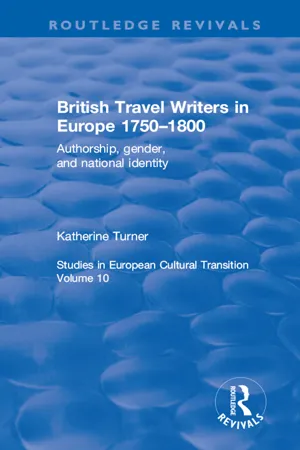
This title was first published in 2001: Hundreds of European travelogues produced by British travellers between 1750 and 1800 remain out of sight in most libraries and have generally been out of print since the 18th century. While many people with a working knowledge of the 18th century are familiar with works including Sterne's "A Sentimental Journey" and Smollett's "Travels through France and Italy", those produced by less "literary" travellers are largely unknown. This study aims to recreate the world of 18th-century travel writing in order to illuminate its central role in shaping Britain's emerging sense of national identity - an identity which proves to be more complex an less homogeneous than some cultural and historical studies would suggest. The author finds that the developing discourse of national character is bound up with questions of gender: national and authorial virtue are projected in terms of appropriately gendered behaviour, for male and female travel writers alike. In turn, gender intersects with class, most obviously in the tendency to denigrate aristocratic travellers as effeminate and celebrate the more manly activities of the middle-class traveller. These then - national identity, authorship and gender - are the central preoccupations of the study
eBook - ePub
British Travel Writers in Europe 1750-1800
Authorship, Gender, and National Identity
- 284 pages
- English
- ePUB (mobile friendly)
- Available on iOS & Android
eBook - ePub
British Travel Writers in Europe 1750-1800
Authorship, Gender, and National Identity
About this book
Information
Chapter 1
The world, the texts and the critics
The aim of this chapter is to recreate the geographical, political and cultural contexts within which British accounts of Europe were produced, read and reviewed between 1750 and 1800.
In terms of geographical scope, European travelogue is relatively limited, given that this was an age of increasing global exploration which spawned an extensive literature of its own. However, as the chapter’s opening section will argue, the limited geographical scope of the texts with which this study is concerned is inversely related to the genre’s wide congregation of authors, and its expansive potential for textual ingenuity. Indeed, while much of the period’s literature of voyage and exploration is self-consciously couched in the language of Enlightenment empiricism, that of European travel is markedly more open to the expressive and individualistic possibilities of first-person narrative. These possibilities are further enlarged during the second half of the century, as the classical discourse which had dominated the literature of European travel gives way to less exclusive registers, both reflecting and encouraging the activities of increasing numbers of middle-class travellers in Europe.
Geography is always, of course, bound up with politics, and the political outlines of European travel 1750–1800 will be briefly outlined, showing how events such as the Seven Years War and the French Revolution influenced both the scope and the style of travel writing, prompting travellers to investigate new areas of Europe and to address, for example, the political and affective influence of Rousseau’s theories or of Dutch humanitarianism.
Shifting political sympathies during this period are closely related to developing concepts of British national identity. The emergence of the discourse of individuality and eccentricity will be traced in some detail, since it is not only central to an understanding of British travel writing in general, but also, and especially, it is a strongly enabling framework within which otherwise invisible or anonymous writers are empowered to forge an authorial identity. The public literary arena, especially as supervised by the Monthly and Critical Reviews, is influential in accommodating and even encouraging the cheerful proliferation of distinctively characterized travel writers during the second half of the eighteenth century.
This proliferation is largely a middle-class phenomenon, just as the emergent discourse of national character tends to be appropriated by the middling sort, often in explicit challenge to the perceived effete anonymity of aristocratic cosmopolitanism. The discourse of patriotic middle-class masculinity is just one of a range of discursive registers available to travel writers, which the chapter’s closing section will briefly delineate. Travel writing could accommodate a wide range of discourses – for example, those of mercantile common sense, natural history, cultural consumption, valetudinarianism – which, taken together or separately, offered an excitingly wide range of narrative and stylistic options to aspiring writers.
Expanding worlds, expressive possibilities
The global context of British travel during the eighteenth century is vast. Between 1750 and 1800 alone, the known world expanded at a prodigious rate.1 Cook’s comprehensively documented discoveries opened up a new continent and entirely new peoples for Western investigation, provoking religious and philosophical disorientation.2 Trading interests in India started to put in place the machinery which would eventually underpin the Raj and indeed the British Empire as a whole. Wars were fought in the Americas and the Caribbean, and British investment in the slave trade and its associated profits continued to increase. Related interests meant that the western shores of Africa became increasingly familiar to the British public (although the interior of the dark continent remained largely unknown, as the disbelief which greeted James Bruce’s Travels to Discover the Source of the Nile in 1790 illustrates). And countries hitherto lurking on the mysterious fringes of civilized Europe became increasingly familiar through the journeyings and publications of merchants into Russia and Turkey, archaeologists into the Mediterranean and Near East, and diplomats, scientists and historians into the remoter areas of Scandinavia, Iberia, and Eastern Europe.
The published literature of such travels – quite apart from more incidental coverage in newspapers, journals and imaginative fiction – was extensive. Even if it was not widely read in its original format (generally heavy and expensive quartos, often sponsored by institutions such as the Admiralty, in Cook’s case, or the Society of Dilettanti), its value was acknowledged. Reviewing Hawkesworth’s Account of Cook’s voyages in 1773, the Critical Review observes that the work’s publication ‘under the auspices of government’ demands ‘more minute examination than is usually exercized by the generality of readers’, since the editor has paid ‘greater attention to the purpose for which the work might be useful, than to the gratification of general curiosity’.3 The fact that Hawkesworth was paid a controversial £6,000 may also lie behind this reviewer’s stringency.4 Similarly, the Critical in 1769 welcomes an informative account of the Spanish West Indies, declaring that ‘We look upon every well authenticated original geographical description, like that before us … as forming part of a great Mosaic composition, which … must at last exhibit to us a complete picture, or somewhat very near it, of the terraqueous globe, and consequently interesting to all mankind, but to the learned in particular’.5 The materials of this ‘great Mosaic’ were popularized for the non-learned reading public not only through the Reviews, but also by the twenty-five or so multivolume collections of voyages and travels which appeared during the eighteenth century. In 1777, the Monthly Review pronounces one such collection, the Modern Traveller, ‘well calculated for the million, but particularly for young persons: as no kind of reading is more pleasing, and at the same time more instructive. They may, therefore, with great propriety be given as presents to the younger reader of either sex.’6 Smollett’s Compendium of Authentic and Entertaining Voyages (7 vols, 1756) was one of the earliest and most influential compilations, inaugurating ‘a succession of concise, orderly, convenient, and inexpensive collections, designed to make these important historical materials available to the mass of readers’, which ‘gradually reduced the disorderly mass of travel-literature to the form of static, systematized accounts of particular countries’.7 In these works, it is not uncommon for the original first-person narration to be replaced by an objective third-person (such is certainly Smollett’s editorial method), and for all subjective observations and personal colouring to be either removed, or modified into generalizing statements.
This procedure may be related to the Enlightenment impulse, influentially formulated by Foucault, to forge a ‘general science of order’, bringing together the grammars and discourses of different scientific fields, and constructing a monolithic European centre of knowledge.8 However, this discursive realm exists in parallel with a precisely opposite tendency in British travel writing that describes more familiar, European territories. In this branch of the genre narrative ingenuity, even authorial oddity, become crucial components of the text’s interest (the full, political implications of this trend will be addressed later in this chapter), and the prevailing tendency is therefore against uniformity. Smollett’s own Travels through France and Italy (1766) offers a well-known example of ill-tempered self-dramatization, a procedure completely at odds with his editorial mode as compiler of collections. Well before 1766, in fact, we find evidence that Smollett had a keen sense of these two distinct modes of travel writing: in 1753–4 (while simultaneously working on the Compendium) he edited the first-person narrative of Alexander Drummond’s Travels within Europe and the Levant, which cultivates a whimsical narrative persona who is sentimentally attached to his pet chameleon (of which he executes a charming sketch, included amongst the otherwise erudite and archaeological plates), and distinguished by an erotic interest in female beauty (whether in the flesh or in the form of antique sculpture). A contemporary reviewer remarks on the surprisingly ‘sprightly turns, which one would not expect from a man so much in years as the author represents himself.9
If Smollett’s career provides evidence of the genre’s twin poles, we find them existing within the same volume in Boswell’s Account of Corsica, which opens with a compilation of extant writings on Corsica before proceeding to Boswell’s own Journal of his visit, and the biographical Memoirs of Pascal Paoli. Johnson, always alert to the preferences of the common reader, favoured the latter sections: ‘Your history [the Account] was copied from books; your journal rose out of your own experience and observation. You express images which operated strongly upon yourself, and you have impressed them with great force upon your readers’.10 In 1771 Charles Burney omitted ‘miscellaneous observations’ from his The Present State of Music in France and Italy, but fleshed out the sequel, The Present State of Music in Germany, the Netherlands, and United Provinces (1773) with descriptive passages and anecdotes of life on the road in European society, including Boswellian conversations with Rousseau and Diderot. This, he says, ‘procured me many more readers than mere students and lovers of music’.11 The Monthly Review commends the additional material and observes that ‘the present narrative is more connected and flowing, as well as more frequently diversified, by the insertion of many observations of a miscellaneous nature’.12
The preference of the general reading public for personalized, playfully literary accounts of European travels (which were also smaller and cheaper than the encyclopaedic variety of voyage and exploration literature) is particularly evident once middle-class tourism begins to take off during the 1760s.13 On a practical level, travel on the Continent became increasingly comfortable in the second half of the century, with improving roads, inns, and means of transport.14 Ordinary travellers, as well as aristocratic owners of private vehicles, could now travel with reasonable ease and safety, at least in the better-known parts of Europe (Eastern Europe, Iberia and Russia remained dangerous and arduous itineraries, travelled mainly by the well-connected, in possession of letters of introduction to courts along the way). Comparative military calm after 1763 made Continental travel still more appealing. The 1763 Treaty of Paris, although seen as controversial and submissive in some quarters, was broadly welcomed. It not only brought an end to immediate hostilities, but also bestowed immense territorial gains (in the Americas) and international prestige on Britain. So, while the peace made Continental travel physically more feasible, victory rendered it patriotically enjoyable. Travellers of the ‘middling sort’ explored France and the Low Countries in increasing numbers, and those who could afford it ventured further afield into the German and Italian states. Guidebooks soon appeared to exploit this new gap in the market, both reflecting and influencing the development of certain favoured routes around Europe. If during the first half of the century recreational travel was dominated by the classical Grand Tour, during the second (although Grand Tourists continued their activities) it was appropriated by a far more diverse body of travellers. The middling sort tended to travel with wives, families and colleagues, and thus presented a different ensemble from the hierarchical and masculine make-up of the aristocrat’s travelling household, which would have included his tutor and an array of servants.
This mid-century change in the social make-up of European tourists is naturally reflected in the literary discourses which dominate published travelogues. Until around 1750, the discursive fields of travel literature were overwhelmingly masculine and, generally (at least in European contexts), classical. Richard Lassels, in the ‘Preface’ to The Voyage of Italy (1670), to which many later travellers refer, declares that ‘I write to young men, and for them’; and, rhetorically anticipating a reader’s objection ‘that I fill my booke with too much Latin’, he points out ‘that I am writing of the Latin country; and that I am carving for Schollers, who can digest solid bitts, having good stomacks’.15 Classic learning and classic ground are the central concerns. In similar vein was Addison’s Remarks on Several Parts of Italy (1705), which rapidly became the most popular and influential eighteenth-century travel book, running to at least thirteen editions before 1800. (Revealingly, however, ten of these are before 1770, and the three further editions between 1770 and 1800 all appear within collections of canonized travel writings.) The ‘Preface’ to Remarks outlines the classical procedure, as Addison explains that
before I entered on my voyage I took care...
Table of contents
- Cover
- Half Title
- Title Page
- Copyright Page
- Table of Contents
- General Editors’ Preface
- Acknowledgements
- Introduction
- 1 The world, the texts and the critics
- 2 Class, character and controversy in the 1760s and 1770s
- 3 Sentimental travels: ‘so much the ton’
- 4 The rise of the woman travel writer
- 5 Revolution and revision: the 1790s
- Epilogue
- Bibliography
- Index
Trusted by 375,005 students
Access to over 1.5 million titles for a fair monthly price.
Study more efficiently using our study tools.
Frequently asked questions
Yes, you can cancel anytime from the Subscription tab in your account settings on the Perlego website. Your subscription will stay active until the end of your current billing period. Learn how to cancel your subscription
No, books cannot be downloaded as external files, such as PDFs, for use outside of Perlego. However, you can download books within the Perlego app for offline reading on mobile or tablet. Learn how to download books offline
Perlego offers two plans: Essential and Complete
- Essential is ideal for learners and professionals who enjoy exploring a wide range of subjects. Access the Essential Library with 800,000+ trusted titles and best-sellers across business, personal growth, and the humanities. Includes unlimited reading time and Standard Read Aloud voice.
- Complete: Perfect for advanced learners and researchers needing full, unrestricted access. Unlock 1.5M+ books across hundreds of subjects, including academic and specialized titles. The Complete Plan also includes advanced features like Premium Read Aloud and Research Assistant.
We are an online textbook subscription service, where you can get access to an entire online library for less than the price of a single book per month. With over 1.5 million books across 990+ topics, we’ve got you covered! Learn about our mission
Look out for the read-aloud symbol on your next book to see if you can listen to it. The read-aloud tool reads text aloud for you, highlighting the text as it is being read. You can pause it, speed it up and slow it down. Learn more about Read Aloud
Yes! You can use the Perlego app on both iOS and Android devices to read anytime, anywhere — even offline. Perfect for commutes or when you’re on the go.
Please note we cannot support devices running on iOS 13 and Android 7 or earlier. Learn more about using the app
Please note we cannot support devices running on iOS 13 and Android 7 or earlier. Learn more about using the app
Yes, you can access British Travel Writers in Europe 1750-1800 by Katherine Turner in PDF and/or ePUB format, as well as other popular books in Theology & Religion & Religion. We have over 1.5 million books available in our catalogue for you to explore.