- 182 pages
- English
- ePUB (mobile friendly)
- Available on iOS & Android
eBook - ePub
Industrial Wastewater Treatment
About this book
Managing wastewater is a necessary task for small businesses and production facilities, as well as for large industrial firms. Industrial Wastewater Treatment: A Guidebook presents an approach to successful selection, development, implementation, and operation of industrial wastewater treatment systems for facilities of all sizes. It explains how to determine various properties about wastewater, including how it is generated, what its constituents are, whether it meets regulatory requirements, and whether or not it can be recycled. It describes methodologies for developing and maintaining a suitable treatment program, determined by the type of company under consideration. Examples of treatment systems which have been installed in various types of businesses over the past several years are presented in a manner that clearly illustrates successful treatment methods.
Information
1 How To Use This Book
Introduction
Many businesses generate wastewater. Sometimes the wastewater must be treated before discharge to the sewer. How do you go about deciding if you need a wastewater treatment system? If you do need one, how do you put it in? There is more to wastewater treatment than installing a piece of equipment. It is important to understand if and why a treatment system is needed, and to be aware of your options, in order to select the type of system most compatible with your shop’s operations.
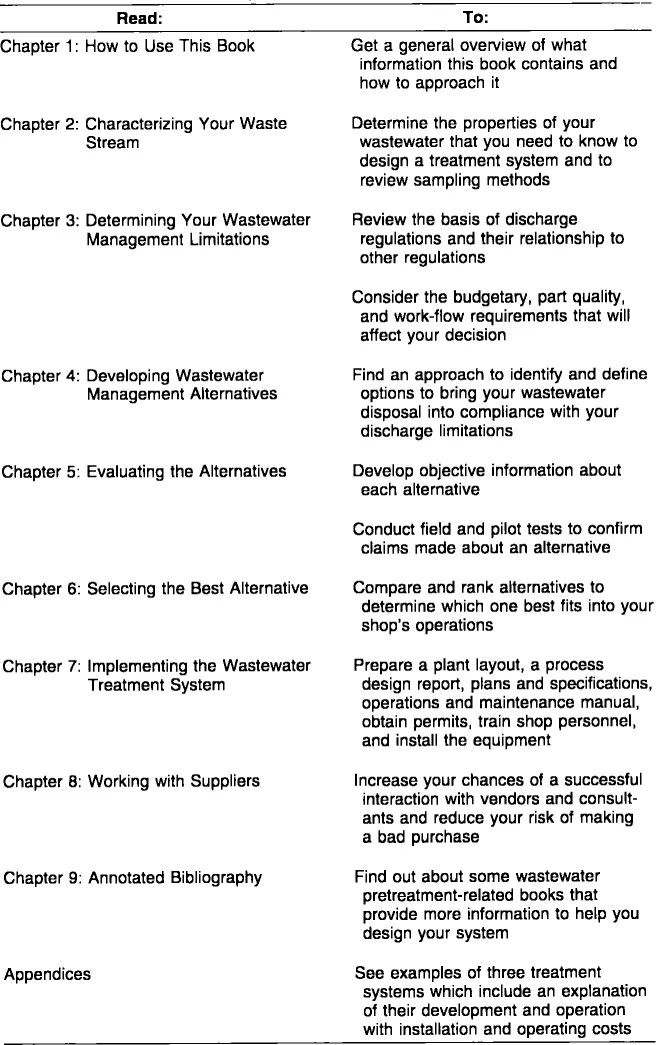
This book is intended to help those who are faced with putting in a wastewater treatment system and to explain the methodology to others concerned with industrial pretreatment. The approach presented in this book applies to the design and implementation of a treatment system of any size. Organized as a step-by-step guide, the chapter outline presented below provides a brief overview of the steps involved, from start to finish. Gloss over it now, and refer to it later, if you ever feel overwhelmed or uncertain about what comes next. Each of the chapters that follows amplifies one of the steps in the process. You may not need to read the entire book, depending on where you are in the process, but if you understand the basic steps and are systematic, you can be successful. Table 1 gives a overview of the process and indicates which chapters provide information about a particular topic.
Take an organized, objective approach to implementing your wastewater treatment system. Determine your wastewater management limitations and characterize your waste stream. Develop wastewater management alternatives and evaluate them. Select the best alternative and implement the wastewater treatment system, if you have to. For advice, help, and ideas, talk with others who have put in systems, work with vendors, read books and literature. Finally, meet with the agencies that regulate your facility before you invest a lot of time and money.
Table 1 How to Find Your Way Through This Book
Examples of three systems that were installed to treat relatively small discharges are given. They include treatment of oily and metal-bearing wastewater by evaporation or chemical precipitation. Both small and large facilities may be able to apply them directly to their situation. The small-scale examples are given because much of the available literature deals with the treatment of larger flows and large facilities. The processes, especially the chemical precipitation process, can readily be scaled up for larger flows.
Book Outline
Chapter 2: Characterizing Your Wastewater
This chapter explains how to determine how the waste is generated, how much is generated and what it contains. The waste stream must be characterized to determine if it will meet regulatory requirements, and to design a process which can effectively reduce, recycle, or treat the waste if it does not. If the waste is not adequately characterized, the chosen method of waste minimization, treatment, or disposal may not work at all.
At a minimum the following must be known: (1) rate of waste generation and waste volumes, and (2) contaminants and their concentrations, including pH, metals, and organics content.
Chapter 3: Determining Your Wastewater Management Limitations
You must know your limitations. Before you decide how to proceed with your wastewater problem, make sure you understand its nature. Perhaps the most important restriction is compliance with wastewater discharge limitations.
Chapter 3 summarizes the potential regulations, process concerns, and economic considerations that define the boundaries of wastewater management decisions. The characteristics of the waste must be compared to the discharge limitations (if the waste is to be sewered), the air pollution control requirements (if the waste is emitted to the atmosphere), or the disposal criteria (if the waste is to be landfilled or incinerated). If the waste is to be recycled it must be acceptable to the recycling company.
The following items must be considered:
Shop constraints
Your budget
Part quality requirements
Workflow requirements
Regulations pertaining to
Sewer discharge
Solid waste disposal
Hazardous waste disposal
Air pollution control
Industrial hygiene and safety
Recycler’s requirements
Treatment, storage and disposal facility (TSD) requirements
Chapter 4: Developing Wastewater Management Alternatives
Before building a treatment plant, you must be certain a treatment plant is the best alternative. Other alternatives should be identified. Can the waste stream be modified by a change in the industrial process? Would it be more cost effective to ship the waste offsite to a TSD for treatment?
If a wastewater treatment system is the most viable alternative, your next step is to identify the most applicable treatment technologies. Resources that can help you to determine what technologies are available are described. Many suppliers offer a variety of treatment equipment. Reference books, textbooks, and U.S. Environmental Protection Agency (EPA) manuals suggest an assortment of wastewater treatment methods.
The methodology used to develop wastewater management alternatives includes:
Changing the process to reduce or eliminate the waste stream
Segregating waste streams to reduce the volume of waste to handle and/or allow effective treatment
Identifying applicable technology Examine case studies Contact suppliers
Contact shops that produce wastes similar to yours
Use the library to find applicable articles
Use trade associations
Contact regulatory agencies for information
It is important to get an overview of the available technology. Having a variety of alternatives to compare and contrast can help you to make an informed decision. Every technology has its drawbacks. You need to be able to choose the one that benefits you the most.
Chapter 5: Evaluating the Alternatives
This chapter explains how to go about evaluating the identified wastewater management alternatives. Before making your selection:
Determine the reason for building the plant
Examine alternatives to building the plant
Visit other shops that have systems similar to yours
Bench test selected technologies
If needed, pilot test the most promising processes
Consider
Effectiveness and economics
Capital and operating costs
Space requirements
Is the equipment a good fit for the technical level of the shop personnel?
Reliability of the system
Flexibility of the system
Quality of technical support from vendor
Disposition of waste treatment residual
Compare costs and benefits of in-house treatment vs. sending the waste to an off-site treatment company
Do not rely on hearsay; check it out yourself
An ill-conceived treatment system may not work, may not be cost effective, may be a nightmare to run, or may look so bad that it does not gain the confidence of a visitor. Following the outlined steps will reduce the risk associated with putting in a wastewater treatment system.
Chapter 6: Selecting the Best Alternative
This chapter examines the selection of an appropriate wastewater management alternative based on the particular needs of your shop. It explains how to do a cost assessment and how to prepare a system design. You will probably want to choose the most cost-effective alternative which has the highest probability of keeping you in compliance with the regulations.
Chapter 7: Implementing the Wastewater Treatment System
This chapter takes you from the concept to the hardware on the shop floor. To implement the system the following must be accomplished:
Prepare a plant layout
Size the equipment according to waste volume information
Provide spill-containment structures
Comply with building and fire codes
Ensure that the system is operator-friendly
Prepare a report that documents the system design
Prepare plans and specifications
Prepare an operations and maintenance manual
Obtain the necessary permits
Train shop personnel
Install the equipment
Start up and evaluate the system
Document system performance
The purpose of the design report is to document the work done to develop or redesign the waste treatment system. The report should be complete and detailed enough that a person familiar with waste treatment can assess whether an adequate job was done in selecting the waste treatment process chemistry and equipment. The report should contain, at minimum, a concise summary of the characteristics of the waste stream, a description of the procedure used to select the treatment process, and a description of the treatment process.
Plans and specifications for the waste treatment system should be prepared. The plans and specs are used to ensure that the finished plant will be built to minimum standards, to obtain supplier quotations, to allow the construction manage...
Table of contents
- Cover
- Half Title
- Title Page
- Copyright Page
- The Author
- Acknowledgments
- Contents
- Dedication
- 1. How To Use This Book
- 2. Characterizing Your Wastewater
- 3. Determining Wastewater Management Limitations
- 4. Developing Wastewater Management Alternatives
- 5. Evaluating The Alternatives
- 6. Selecting The Best Alternative
- 7. Implementing The Wastewater Treatment System
- 8. Working With Suppliers
- 9. Annotated Bibliography
- Appendix 1. Boatyard Wastewater Treatment Example
- Appendix 2. Automotive Machine Shop Wastewater Treatment
- Appendix 3. Oily Wastewater Treatment Example
- Index
Trusted by 375,005 students
Access to over 1.5 million titles for a fair monthly price.
Study more efficiently using our study tools.
Frequently asked questions
Yes, you can cancel anytime from the Subscription tab in your account settings on the Perlego website. Your subscription will stay active until the end of your current billing period. Learn how to cancel your subscription
No, books cannot be downloaded as external files, such as PDFs, for use outside of Perlego. However, you can download books within the Perlego app for offline reading on mobile or tablet. Learn how to download books offline
Perlego offers two plans: Essential and Complete
- Essential is ideal for learners and professionals who enjoy exploring a wide range of subjects. Access the Essential Library with 800,000+ trusted titles and best-sellers across business, personal growth, and the humanities. Includes unlimited reading time and Standard Read Aloud voice.
- Complete: Perfect for advanced learners and researchers needing full, unrestricted access. Unlock 1.5M+ books across hundreds of subjects, including academic and specialized titles. The Complete Plan also includes advanced features like Premium Read Aloud and Research Assistant.
We are an online textbook subscription service, where you can get access to an entire online library for less than the price of a single book per month. With over 1.5 million books across 990+ topics, we’ve got you covered! Learn about our mission
Look out for the read-aloud symbol on your next book to see if you can listen to it. The read-aloud tool reads text aloud for you, highlighting the text as it is being read. You can pause it, speed it up and slow it down. Learn more about Read Aloud
Yes! You can use the Perlego app on both iOS and Android devices to read anytime, anywhere — even offline. Perfect for commutes or when you’re on the go.
Please note we cannot support devices running on iOS 13 and Android 7 or earlier. Learn more about using the app
Please note we cannot support devices running on iOS 13 and Android 7 or earlier. Learn more about using the app
Yes, you can access Industrial Wastewater Treatment by J.D. Edwards in PDF and/or ePUB format, as well as other popular books in Technology & Engineering & Environmental Management. We have over 1.5 million books available in our catalogue for you to explore.