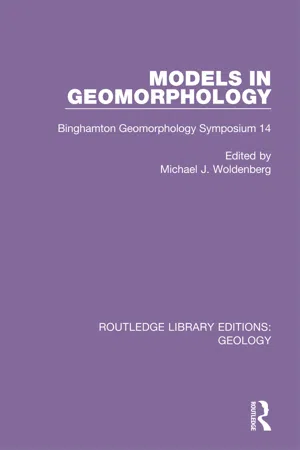
This book, first published in 1985, arises from the 14th Binghamton Geomorphology Symposium. The chapters here illustrate the use of models in various areas of research in geomorphology.
- 456 pages
- English
- ePUB (mobile friendly)
- Available on iOS & Android
eBook - ePub
1
The Antarctic Ice Sheet: a surface model for satellite altimeter studies
David J. Drewry, Neil F. McIntyre and Paul Cooper
Introduction
At the beginning of the International Geophysical Year in 1956 little was known of the configuration of the Antarctic Ice Sheet and still less about the dynamic and thermodynamic processes that govern the flow and stability of large ice masses. The continuous presence of a number of nations in Antarctica has enabled major programs of research to be undertaken to understand the largest ice sheet on Earth. Oversnow traverse campaigns, carried out principally by American and Soviet scientists, were able to determine ice thickness at scattered locations by seismic shooting and gravity observations that revealed an ice sheet of significant depth overlying a land surface of diverse topography.
Surface altitudes were measured crudely by barometry and occasionally by leveling. A pattern emerged, similar to that discovered earlier in Greenland, of a central flattened dome up to 4 km in elevation, with steep coastal regions and a mosaic of flanking ice shelves (the latter unique to Antarctica). Early surface measurements also included mean annual temperature and (by a variety of steadily improving techniques) mean annual snow accumulation on the continent. Few ice flow velocities were measured due to the absence of fixed points of reference such as rock outcrops. The lack of velocity data has proved a continuing, major shortfall since it prevents measured and calculated ‘balance’ velocities from being compared in order to assess the mass budgets of the ice sheet.
By the mid 1960s investigations were also underway on some of the major ice shelves and the first attempts to drill through the ice sheet were being made. Deep drilling to recover cores for a host of mechanical and chemical studies has proved to be one of the most exciting and scientifically rewarding projects in glaciology; however it has also proved to be one of the most costly and frustrating because drilling technology has consistently failed to keep pace with the expanding demands of scientists. Also, in the late 1960s, methods of measuring ice thickness were developed which use electromagnetic rather than acoustic energy sources.
At the commencement of the 1970s considerable detail was emerging on the character of the ice sheet. Drilling had penetrated over 2000 m at Byrd Station in West Antarctica revealing a glacioclimatic history stretching back into the last interglacial. Radio echo sounding (RES) from aircraft by a British-American project became a routine activity for mapping ice thickness and subglacial bedrock over the continent. In addition a number of international programs were being formulated to take glaciological research a significent step forward by focusing upon specific problem areas. The Ross Ice Shelf Project developed as a U.S.-led study of the 0.5 M km2 floating ice shelf in the Ross Sea and involved geophysical studies (seismic, gravity, resistivity measurements), glaciological investigations (velocities using the new satellite doppler technique, accumulation and ice core drilling) and oceanographic observations both beneath and in front of the ice shelf. The International Antarctic Glaciological Project (IAGP) began as a series of coordinated national activities in East Antarctica, undertaking velocity, mass balance, surface glaciochemistry, radio echo sounding ice thickness and drilling work over an area of some 5 M km2. Although there is still no complete reconnaissance of Antarctica for certain parameters (e.g. ice thickness, surface accumulation, velocity), sufficient data at a first order of precision are now available to allow ice dynamics and deep temperatures to be moderately well understood for the paleoenvironmental interpretation of ice cores (Robin 1983) and modeling of the response of some sectors of the Antarctic to climatic and ocean forcing (Budd & Smith 1981, 1982). The next stages are to increase the level of accuracy of glaciological measurements (see Table 1.1) from that presently achievable, in order to obtain full continental coverage of critical parameters, to address key scientific questions raised during the preceding 30 years of research (such as the stability of West Antarctica), to determine significant changes in ice volume and to integrate ice sheet behavior with models of global climate (Warren 1982).
It is clear that remote sensing from space can offer the possibility of gathering much of the necessary critical data, continuously and on a continental basis. Robin et al. (1983) have listed the contributions that satellite techniques can make towards collecting the glaciological parameters listed in Table 1.1. Of particular importance to glaciology has been the development of high-accuracy radar altimetry. With an instrument precision of a few tens of centimeters and a final height measurement accuracy of 1–2 m over smooth ice areas radar altimetry has the promise of yielding, within a few months, more extensive and accurate data on ice surface topography and slopes, grounding line location, ice fronts and even ice shelf thickness and bottom melting rates. The quality and quantity of the data would be superior to any obtained so far and, in contrast with the past, these measurements could be collected in only a few months.
Such data would provide a synoptic view of ice sheets which in turn would allow ice-volume changes to be carefully monitored. Indeed, no other method comes near to providing such extensive and accurate data, and the capability of monitoring elevation changes over the required time scales of months to decades. The precision of radar altimetry is such that the principal component of the world’s water balance (i.e. ice sheets) can be monitored considerably more accurately than the remaining components. Changes could be detected long before an unambiguous sea level signal from the melting of ice sheets was recognizable (NERC-SERC 1983).
Table 1.1 Required observations for study of ice sheet shelves.
| Parameter | Required Resolution | Currently Achieved Resolution | Current Antarctic Coverage (%) |
| (1) Surface morphology | |||
| (i) large-scale | 1.0m | 5.0m (satellite altimetry, geoceiver) | 20 |
| 60m (barometric altimetry) | 70 | ||
| (ii) small-scale | 0.5m | 2–10m | 1 |
| (2) Ice thickness | 5.0m | 10–30m | 40 |
| (3) Temperature | 1K | 1K | 50 (low density) |
| (4) Accumulation/ablation | |||
| (i) surface | 0.1m | 0.5m | 50 (low density) |
| (ii) bottom | 0.1m | 1.0m | a few points |
| (5) Velocity field | |||
| (i) surface | 0.5 m/a | 0.5–2.0m/a | a few points |
| (ii) bottom & internal | 0.1m/a | – | – |
| (6) Dimensional fluctuations | |||
| (i) thickness | 0.1–0.5m/a | 0.5–10m/a | a few points |
| (ii) margin position | 10m/a | 10m/a (survey, aerial photo) 100m/a (Landsat) | a few points & coastal sections |
| (7) Snowl... |
Table of contents
- Cover
- Half Title
- Title Page
- Copyright Page
- Table of Contents
- Preface
- Acknowledgments
- List of Tables
- Contributors
- 1 The Antarctic Ice Sheet: a surface model for satellite altimeter studies
- 2 The Antarctic Ice Sheet: an analog for Northern Hemisphere paleo-ice sheets?
- 3 Geological models for the configuration, history and style of disintegration of the Laurentide Ice Sheet
- 4 Patterns of glacial erosion and deposition around Cumberland Sound, Frobisher Bay and Hudson Strait, and the location of ice streams in the Eastern Canadian Arctic
- 5 Forward and inverse models in sea-level studies
- 6 Coastal terraces generated by sea-level change and tectonic uplift
- 7 Computer models of shoreline configuration: headland erosion and the graded beach revisited
- 8 Sediment transport in relation to a developing river delta
- 9 Simulation of slope development and the magnitude and frequency of overland flow erosion in an abandoned hydraulic gold mine
- 10 A model for the evolution of regolith-mantled slopes
- 11 Topologic properties of delta distributory networks
- 12 Optimal models of river branching angles
- 13 Models of fluvial activity on Mars
- 14 Channel networks developed by groundwater sapping in fine-grained sediments: analogs to some Martian valleys
- 15 Ground ice models for the distribution and evolution of curvilinear landforms on Mars
- 16 Wind abrasion on Earth and Mars
- Index
Trusted by 375,005 students
Access to over 1.5 million titles for a fair monthly price.
Study more efficiently using our study tools.
Frequently asked questions
Yes, you can cancel anytime from the Subscription tab in your account settings on the Perlego website. Your subscription will stay active until the end of your current billing period. Learn how to cancel your subscription
No, books cannot be downloaded as external files, such as PDFs, for use outside of Perlego. However, you can download books within the Perlego app for offline reading on mobile or tablet. Learn how to download books offline
Perlego offers two plans: Essential and Complete
- Essential is ideal for learners and professionals who enjoy exploring a wide range of subjects. Access the Essential Library with 800,000+ trusted titles and best-sellers across business, personal growth, and the humanities. Includes unlimited reading time and Standard Read Aloud voice.
- Complete: Perfect for advanced learners and researchers needing full, unrestricted access. Unlock 1.5M+ books across hundreds of subjects, including academic and specialized titles. The Complete Plan also includes advanced features like Premium Read Aloud and Research Assistant.
We are an online textbook subscription service, where you can get access to an entire online library for less than the price of a single book per month. With over 1.5 million books across 990+ topics, we’ve got you covered! Learn about our mission
Look out for the read-aloud symbol on your next book to see if you can listen to it. The read-aloud tool reads text aloud for you, highlighting the text as it is being read. You can pause it, speed it up and slow it down. Learn more about Read Aloud
Yes! You can use the Perlego app on both iOS and Android devices to read anytime, anywhere — even offline. Perfect for commutes or when you’re on the go.
Please note we cannot support devices running on iOS 13 and Android 7 or earlier. Learn more about using the app
Please note we cannot support devices running on iOS 13 and Android 7 or earlier. Learn more about using the app
Yes, you can access Models in Geomorphology by Michael J. Woldenberg in PDF and/or ePUB format, as well as other popular books in Physical Sciences & Geography. We have over 1.5 million books available in our catalogue for you to explore.