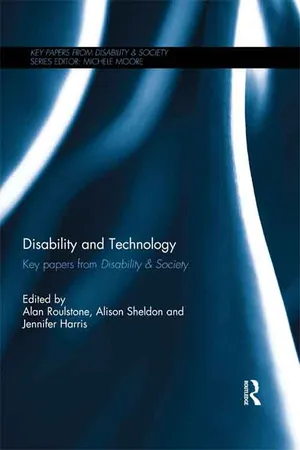
This edited collection brings together keynote articles from the journal Disability & Society to provide a comprehensive and though-provoking exploration of the place of technology in disabled people's lives, documenting and analysing the growing impact of technology on disability and society over recent decades. The authors explore theoretical, empirical and moral dilemmas that arise with the changing relationship between technological change and the lives, aspirations and possibilities of disabled people. The volume is organised into three parts which consider early foundational work connecting disability and technology; key empirical studies related to the optimum use of technologies for independence and inclusion; and new moral and social dynamics thrown up by technological developments for disabled people's lives.
eBook - ePub
Disability and Technology
Key papers from Disability & Society
- 190 pages
- English
- ePUB (mobile friendly)
- Available on iOS & Android
eBook - ePub
Disability and Technology
Key papers from Disability & Society
About this book
Information
Communications
Technology—empowerment
or disempowerment?
PATRICIA THORNTON
Social Policy Research Unit, University of York, Heslington, York, United Kingdom
ABSTTRACT Developments in communication technology can reduce dependence on others and facilitate independent living for disabled people. Recently developed telephone-based services allow users to call up help quickly, as and when they need it. But the dominant model of provision emphasises vulnerability, assumes a need for protection and imposes rules about appropriate use. The article identifies the influence of manufacturers and providers of communication alarms in perpetuating paternalistic approaches to services for older disabled people and limiting the potential for user determination of need. Emergent models which aim to facilitate user-control face low expectations among users, the entrenched attitudes of providers and the dominance of the market in influencing practice. The mixed economy of social care is likely to increase the gap between providers’ interests and users’ needs.
Introduction
There is a growing consensus that people who need personal or practical help at home on a daily basis should be able to say when and by whom that help is given. It is increasingly recognised, too, that standard, routinely provided services cannot cater for fluctuating or unpredictable needs and can be as institutionalising as the institutional care that community care policies seek to avoid. We can now see pilot initiatives, such as the Haringey On-call Support Project (Zarb, 1991), which aim to facilitate control by disabled people over their care or support services at home. But, as yet, little attention has been given to the mechanisms needed to effect user-control over the nature and timing of support. In particular, how can users best make their non-routine or urgent needs known and be confident of a response to their wishes? What sort of communications system is needed to let users call up the help they want at times they themselves choose?
In this context new technology will have a central function. New telephone-based communication systems now offer people in their own homes a means of communicating with the providers of care services and are thought to be one of the few technological innovations to have had any impact on the range of home-based support services for older disabled people (Baldock, 1991). These systems, generically termed ‘community alarms’ in the UK, ‘care phones’ in Sweden and ‘personal response systems’ in the USA, overcome some of the limitations of the ordinary telephone: the technology includes a portable trigger and speech amplification so that the user can make a call without having to access the telephone; and calls are guaranteed an answer from staff at a central point who then arrange for someone to visit the user if required.
On the face of it, this type of technological innovation has the potential to fill the communication gap between a user who requires assistance and a source of help. Moreover, as the user takes the initiative in requesting a service, it may offer more scope for users themselves to define their needs and appropriate responses to them. But provision of the means of communication alone does not, as Harbert (1992) has claimed, necessarily place “a measure of power and control firmly in the hands of service users”. The means is only one part of the communication system. Technology cannot be seen as standing alone, isolated from its cultural dimensions (Cornes, 1991). As I have argued elsewhere (Thornton with Mountain, 1992) at least three elements are necessary if communications technology is to have a part to play in offering users control over their services. First, the service user needs an accessible, reliable and easy to use means of communication between the home and those who will provide the assistance. Secondly, the people who provide the help must be acceptable and include a range of competencies, to meet diverse needs for assistance. Finally, the service system must let users themselves define need and legitimate use and not impose rules about its purpose.
Of these three elements the first has received most attention. Communications technology in recent years has become more reliable, accessible and easier to use. The equipment remains relatively standard, however, and although portable triggers have become lighter to carry and easier to manipulate they still depend on a degree of manual dexterity in the user. The second element—a pool of people available to respond to any request for help—is less well developed, for reasons which will be elaborated shortly. The third element, user-led definition of use is marked by its absence within the vast majority of ‘community alarm’ services. Most services which combine a means of communicating the request for help with an appropriate source of help are conceived and delivered within a narrow and restrictive set of rules about their purpose and function, effectively limiting the benefits to the users.
This article draws on evidence from a pluralistic study of the effectiveness of communication alarm services (Thornton with Mountain, 1992) carried out by the Social Policy Research Unit (SPRU) to report the experiences of older disabled users and to show how the dominant model of service provision fails to address the range of communication needs. I ask why, in contrast to the potential of new technology as an opportunity for user-control, communication alarm services typically operate within narrow definitions of their purpose and impose constraints on their use. The article outlines the evolution of the technology and identifies the influence of manufacturers and providers on the design and delivery of the service system as a whole. It draws on the research to show how constraints on use not only limit the effectiveness of the service but also perpetuate and reinforce paternalistic approaches to service delivery. I ask whether services dominated by manufacturer and provider interests can meet current expectations of user control and create more flexible and responsive support for people who wish to live independently but must rely on others for physical help.
Current Practice
Typically, communication alarm services are designed, promoted and delivered as emergency services for old people living alone. The operational priority is to provide a rapid response to physical injuries, often associated with falls, and to health emergencies where medically qualified attention is needed urgently. Although this article relates principally to provision in England and Wales, with, it is estimated, the largest proportion of alarm users in the population, this characterisation of typical services appears to be true worldwide. An overview of presentations at the first international symposium on personal response systems (PRS) noted that “across all countries primary users of PRS are women in their 70’s and 80’s, living alone, burdened with cardiac and musculoskeletal problems or subject to falls” (Dibner, 1991, p. 6).
Although the technology became available to people living outside grouped supported housing only in the last decade, most local authorities can now offer a communication alarm service. Services in England and Wales are run almost exclusively by housing departments, although a handful of social services departments run their own and some are jointly managed. Users get to have the service through a number of possible routes. They can subscribe directly to a service run by a housing department; or they can have provision arranged through a social services department, or, less commonly, a health authority. Home alarm equipment is not sold in shops but is available for purchase directly from some manufacturers for those users who are able to arrange and supervise their own team of supporters to respond when help is asked for. Because privately purchased equipment also links into operator centres run by public authorities private users find themselves subject the same philosophies and practices.
These communication services are set up to treat calls for help as potential life-threatening emergencies. They aim to eradicate fallibility in both the technology and in the staff who serve the system. Services either employ staff such as mobile wardens or call on a ready pool of individuals known to users. Ambulance services may be called on if other response services are unavailable. Some communication alarm services will respond to other kinds of call for assistance, providing their ability to respond to ‘real emergencies’ is not compromised. Staff will often act out of compassion to help people requiring personal care but it is unusual for the service to be viewed primarily as a means of assisting with personal care needs. Commonly, help with self care is considered to intrude on the remit of nursing or care staff employed by other departments. An independent scheme in Tower Hamlets appears to have had few emulators in its proclaimed purpose of filling the gap in out-of-hours and weekend care services, employing staff formally sanctioned to help people to bed or to use the lavatory (Pellow, 1987). A minority of services will communicate messages via the operator from users to other parts of the service system but this is usually an ‘extra’, rarely openly promoted.
Although the objectives and functions of communication alarm services are not often spelt out officially—because of the incremental and opportunistic way in which most have developed, as I will show below—most assume a taken-for-granted approach to operationalising the boundaries of their activities. Two assumptions dominate: potential users are older people living alone ‘at risk’ of injury, accident or sudden medical emergencies; and the role of the technology is to assuage their ‘fear’ of such events and to protect them against life-threatening consequences. The themes of fear, vulnerability and risk pervade promotional material directed by both manufacturers and providers at potential users; services commonly offer ‘round the clock protection’ or ‘protection for people living alone’. One pamphlet, produced by a manufacturer for use by a local authority, calls a heart attack “the moment feared most by every elderly person—when, without help, they might be without hope”.
Origins
The coincidence of manufacturers’ interests and providers’ organisational values has determined the shape of provision.
Communication alarm technology was not initially developed to meet the needs of people in the community. Needs and problems were not identified in advance of the search for appropriate technology (Shalinsky, 1989). The industry began with the introduction of communication systems within purpose built blocks or clusters of local authority housing intended primarily for elderly people. Once the idea of a communication link between occupants and a warden had been established, technological methods of achieving that link became increasingly sophisticated. The rapid growth of sheltered housing provision in the 1960s and 1970s attracted manufacturers in a competitive environment. The housing providers’ interests were dominated by staffing considerations, rather than by tenants’ needs; emphasis lay with increasing efficient use of the warden resource (Butler, 1989).
Further developments in technology meant that calls from several housing complexes could be routed to a single ‘control centre’, not merely to a site warden, via the telephone communication network. Equipping these offered a new opportunity for manufacturers. Although the basic equipment could be relatively simple and inexpensive, the drive to refine and improve upon communications technology led to increasing sophistication, including linked data bases holding details of callers, software for recording activity on the system, and multiple terminals to cope with anticipated demand. Moreover, advances now meant that equipment installed in ordinary ‘dispersed’ housing, and not just in ‘schemes’, could be linked to central control stations. A new market in the community had opened up.
The establishment of central control systems added to providers’ ability to make more efficient use of wardens who did not now need to be located within the housing complexes. The enormous capacity of the control centre technology meant that new users could be accommodated at little extra cost, especially where users nominated their relatives or neighbours to respond to their calls, instead of subscribing to the mobile warden service. The new dispersed technology also enabled housing departments to expand their welfare role in a period of increasing pressure to justify a continuing and distinct role, as the traditional functions of local authority housing departments were squeezed by government policies. The Griffiths report (Griffiths, 1988) incited debate about who was best placed to run alarms schemes (Oldman, 1989) and proposals to reorganise local government also encouraged housing authorities to highlight their role as welfare providers.
Thus, communications technology did not become available to people living in ordinary housing in the community first and foremost as a response to their individual needs. Rather, manufacturers and housing providers were acting on generalised assumptions about the communality of need among older and disabled people. This ‘special needs’ view of the world is implicit in manufacturers’ approach to the market: it assumes that if people suffer chronic ill-health, are old or disabled they ‘need’ an alarm service (Clapham & Smith, 1990; Thornton, 1992). It is, of course, in the interests of the market to have as inclusive as possible a definition of ‘need’. The attitude is deeply ingrained, leading to the invention of a phenomenon “denial of need” (Dibner, 1991) to explain the lack of demand for the technology. Housing departments, the principal providers of communication alarm services in England and Wales, traditionally have operated overtly within the special needs tradition, most notably in the provision of sheltered housing for elderly people and adapted accommodation for disabled people. As departments’ ability to offer sheltered accommodation became constrained, alarm services meant that “one of the benefits of sheltered housing could be extended to people in their own homes” (Tinker, 1991, p. 21).
The policy of allocating services on the grounds of age or disability alone reinforces negative images of dependent populations and encourages the paternalistic practice of offering protection found in ‘sheltered’ housing and in alarm services. Local council traditions of ‘looking after the elderly and disabled’ remain strong, and services which demonstrate the care and protection provided retain their appeal for elected members (Butler, 1985). Indeed, local councils are still held publicly to account on those occasions when tenants in special category accommodation—and now those with an alarm service—are found dead. Protection is the business of the manufacturers too: they also make smoke alarms, intruder devices, door entry phones and, indeed, some alarms incorporate such features.
Consequences for Users
The previous sections have attempted to explain why communication alarm services promote the protection and reduction of risk of elderly people and why they aim to confine their uses to physical, life-endangering emergencies. I will turn now to consider the consequ...
Table of contents
- Cover
- Half Title
- Series
- Title
- Copyright
- Contents
- Citation Information
- Notes on Contributors
- Series Editors’ Preface
- 1. Communications Technology—empowerment or disempowerment?
- 2. In Whose Service? Technology, Care and Disabled People: the case for a disability politics perspective
- 3. Information and Communication Technologies and the Opportunities of Disabled Persons in the Swedish Labour Market
- 4. Enacting disability: how can science and technology studies inform disability studies?
- 5. The use, role and application of advanced technology in the lives of disabled people in the UK
- 6. A common open space or a digital divide? A social model perspective on the online disability community in China
- 7. Increases in wheelchair use and perceptions of disablement
- 8. Back to the future, disability and the digital divide
- 9. Disability, identity and disclosure in the online dating environment
- 10. ‘I know, I can, I will try’: youths and adults with intellectual disabilities in Sweden using information and communication technology in their everyday life
- 11. Implants and ethnocide: learning from the cochlear implant controversy
- 12. Cyborg anxiety: Oscar Pistorius and the boundaries of what it means to be human
- Conclusion
- Index
Trusted by 375,005 students
Access to over 1.5 million titles for a fair monthly price.
Study more efficiently using our study tools.
Frequently asked questions
Yes, you can cancel anytime from the Subscription tab in your account settings on the Perlego website. Your subscription will stay active until the end of your current billing period. Learn how to cancel your subscription
No, books cannot be downloaded as external files, such as PDFs, for use outside of Perlego. However, you can download books within the Perlego app for offline reading on mobile or tablet. Learn how to download books offline
Perlego offers two plans: Essential and Complete
- Essential is ideal for learners and professionals who enjoy exploring a wide range of subjects. Access the Essential Library with 800,000+ trusted titles and best-sellers across business, personal growth, and the humanities. Includes unlimited reading time and Standard Read Aloud voice.
- Complete: Perfect for advanced learners and researchers needing full, unrestricted access. Unlock 1.5M+ books across hundreds of subjects, including academic and specialized titles. The Complete Plan also includes advanced features like Premium Read Aloud and Research Assistant.
We are an online textbook subscription service, where you can get access to an entire online library for less than the price of a single book per month. With over 1.5 million books across 990+ topics, we’ve got you covered! Learn about our mission
Look out for the read-aloud symbol on your next book to see if you can listen to it. The read-aloud tool reads text aloud for you, highlighting the text as it is being read. You can pause it, speed it up and slow it down. Learn more about Read Aloud
Yes! You can use the Perlego app on both iOS and Android devices to read anytime, anywhere — even offline. Perfect for commutes or when you’re on the go.
Please note we cannot support devices running on iOS 13 and Android 7 or earlier. Learn more about using the app
Please note we cannot support devices running on iOS 13 and Android 7 or earlier. Learn more about using the app
Yes, you can access Disability and Technology by Alan Roulstone, Alison Sheldon, Jennifer Harris, Alan Roulstone,Alison Sheldon,Jennifer Harris in PDF and/or ePUB format, as well as other popular books in Education & Education General. We have over 1.5 million books available in our catalogue for you to explore.