- 629 pages
- English
- ePUB (mobile friendly)
- Available on iOS & Android
eBook - ePub
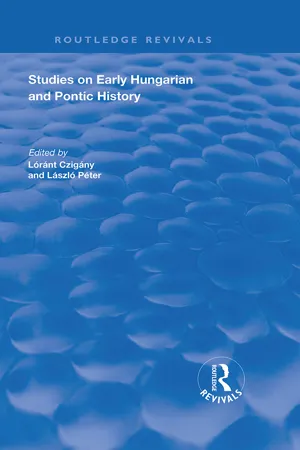
Studies on Early Hungarian and Pontic History
About this book
Published in 1999, Professor C.A. Macartney was one of the foremost 20th-century authorities on the history of the Danube basin. His life's work included the re-examination of the sources relating to early Hungarian and Pontic history. This selection of his studies (some of them hardly accessible because they were published in wartime conditions) illuminates one of the dark corners of medieval Europe and tackles controversial questions in the history of the nomadic steppe peoples, such as the Magyars, Pechenegs, Kavars and Cumans. Macartney's treatment of the earliest Hungarian written sources and their interpretation laid the foundation for his shorter book, The Medieval Hungarian Historians. The present volume brings together for the first time, and indexes, his series of detailed studies on this material; penetrating in both its analysis and scholarship, this work remains indispensable for our understanding of the period and its historiography.
VII
The Lives of St Gerard
I
The Lives of St. Gerard contain some of the most interesting material extant in any form, not only on the history of Hungary in the 11th century, but on the missionary work and organisation of the Church during the same period. We can, however, only make use of this information to the extent to which we are satisfied of its authenticity and antiquity; and on that point, unfortunately, distinguished scholars have expressed grave doubts. The present essay constitutes an attempt to re-examine these disputed questions in the light of certain new considerations. It also suggests what effect the conclusions to which it arrives may have on the answers to be given to certain enigmas in Hungarian history.
The Life of St. Gerard has come down to us in two versions: a Vita Minor1 and a Vita Major.2 Of these, the Vita Minor is a comparatively straightforward piece of work. It mentions briefly Gerard's origin (c. 1); his arrival in Hungary and his detention there by St. Stephen, followed by his retirement for 7 years to the hermitage of Bél (c. 2); his appointment as bishop to Marosvár and foundation there of the Church of St. George (c. 3); the endowment of and ceremonials in that church (c. 4); details of the Saint's holy life (cc. 5—7); his sermon against Samuel Aba (cc. 8—9); his prophecies of coming trouble (c. 10); his martyrdom (c. 11); his subsequent reburial in Marosvár (a 12) and canonisation under Ladislaus I (c. 13).
1 Acta Sanctorum Sept. VI (Sept. 24th), pp. 722-4.
2 Endlicher, Monuments Arpadiana pp. 205 ff. There is also a series of Lectiones based on the V. Minor (Endlicher pp. 202-4).
All critics accept the Vita Minor as an old and authentic work. It must have been composed not before 1083, since it refers to St. Stephen and St. Gerard himself, who were canonised in that year, as saints. It is in any case prior to the 13th century, when the Lectiones based upon it were already in use; and Kaindl3 argues from the fact that it shows no acquaintance with the Life of St. Stephen, which was composed about 1100 A. D., that the Vita Minor was written at roughly the same time. St. Ladislaus, who was canonised in 1192, is mentioned at the very end, under the simple title of „rex". This, again, is an indication of an early date, since the people held Ladislaus for a saint long before his official canonisation. It seems most probable that the Vita was composed during the episcopate of that Laurence, 5th Bishop of Marosvár after Gerard himself, who is mentioned in c. 12, i. e., at the end of the 11th century.
3 Studien zu den ungarischen Geschichtsquellen, XIII (1902) p. 26.
The Vita Major is a much more ambitious composition. It begins with an account of the Saint's parentage (c. 1). His father goes on a pilgrimage to the Holy Land (c. 2), Gerard passes his youth in a Venetian monastery (c. 3). He is sent to study at Bologna University (c. 4). He is elected abbot (c. 5). He decides to go on pilgrimage to Jerusalem„ and his colleague Rasina persuades him to go via Hungary (c. 6). His friends Maurus of Pécs and Anastasius of Várad take him to Fehérvár, where Stephen promises to make him Bishop of Marosvár (Csanád) as soon as he has conquered that city from „his enemy Achtum" (c. 8). Stephen detains Gerard and makes him tutor to the young Emeric; he then spends 7 years in a hermitage at Bél (c. 9; cf. V. Mi. c. 2.). Achtum is defeated and slain, and the Greek Monastery of St. George founded at Oroszlán (c. 10). Gerard is recalled and made missionary-bishop (c. 11; cf. V. Mi. c. 3). Preachers from various districts go to Marosvár. The foundation of Oroszlán is retold. Gerard and his monks put up temporarily of the new monastery of St. George. C. 12 is a further account of the work of conversion and education, in which various monks take part, particularly one Magister Waltherus, who is in charge of the training of the neophytes at the monastery. Cc, 13—14 go back to the words of V. Mi. cc, 4—5, except that they regularly refer to the church and not the monastery. Cc. 14—174 cover the same ground as V. Mi. cc. 7-10, but with long independent passages. Against this, a long pious interlude in the V. Mi. c. 10 is omitted. There follows another short independent passage, after which comes in cc. 19-20 an account of Gerard's martyrdom, in which the account of the V. Mi. is worked into a different one, much of which is identical, word for word, with that given by the National Chronicle (B 81-4).5 In c. 21 comes a fuller account of the Saint's re-interment which, it is emphasised, takes place not in the Monastery of St. George, but in the Church of the Blessed Virgin. c. 22: miracles performed by the corpse; canonisation under St. Ladislaus; cf. V. Mi. c. 12. The V. Ma. gives Ladislaus his title of Saint. C. 23 is a postscript describing the extension of the monastery in 1361 by Elizabeth, widow of Charles of Anjou, and her death and burial in 1381.
4 In Endlicher's text there is no c. 16 or c. 18, while the first sentence of c. 19 belongs properly to the previous chapter.
5 Under „B" will be understood here the text of the Chronicoa Budense so described in the edition of Scriptores Rerum Hung.
The composition and authenticity of the V. Ma. are far more dubious than those of the shorter version. The editor of the Acta SS. described the additional material sweepingly as „plane ridicula et fabulosa"; it has been combined with the authentic Vita Minor, to give a result which is „prorsus monstrosa".6 Kaindl, broadly speaking, agreed, and condemned whole-sale all the early chapters, and much of the later additional material. He thought, however, that c. 10, although interpolated in the 16th century, was itself an old and homogeneous story.7 The general view of commentators has, in fact, been to reject all material found in the V. Ma. for which authority cannot be adduced from elsewhere, e. g., from the V. Mi. or the National Chronicle.
6 op. cit. p 714.
7 op. cit.
From this view there has, in recent years, been one dissentient. M. Müller, in article appearing in 1913,8 believed the Achtum story to be the work of a contemporary; firstly on account of its vivid character, and secondly because of its mention of Greek monks, of whom, he said, a later writer would have known nothing; or if he had, he would not have mentioned them. Moreover, the centre of the V. Ma., covering cc. 8-23, must, he argued, be older than the V. Mi. itself, because on the 42 occasion on which the V. Ma., where it is independent of the V. Mi., mentions St. Stephen, it only twice calls him saint. In one of these two passages (the beginning of c. 11) the text is practically identical with that of the V. Mi. while in the other (the beginning of c. 8) the name of the Blessed Virgin occurs, so that a copyist may easily have been led into inserting the epithet independently. So, too, the name of Emeric occurs twice, and only on the second occasion, where the text recalls that of the V. Mi., is the epithet „sanctus" used.
8 A nagyobb Gelért-legenda forrásai és keletkezése: Századok, 1913. pp. 355ff, 419ff.
Hence Müller concluded that the passages in question had been composed at a date anterior to the canonisation of Ss. Stephen and Emetic, i. e., before 1083. He believed the author to have been either the Waltherus who figures so prominently in the narrative, or a friend of his.
Contrary to the usual belief, Müller thought that in these-passages, which resemble extremely closely the corresponding passages in the V. Mi., the V. Mi. had epitomised the V. Ma. He therefore regarded this central portion of the V. Ma. as containing within itself the original Life of St. Gerard, as composed by a contemporary. The V. Mi. was an independent extract, made up shortly after 1083. The present text of the V. Ma. was the result of an attempt to re-combine this extract with the original. In the earlier portion, the author has tried to reconcile the two where they differed; in the latter, he took one version or the other.
The Achtum story in s. 10 formed a part of the Waltherus narrative. It could not, as Kaindl suggested, be a wholly independent story, because cross-references occur to it in other chapters (c. 8: donec debellabo Achtum inimicum meum; c. 11; c. 15; c. 22: que fuerat quondam de uxoribus Achtum). Cc. 1—3 were the work of a late editor in Venice; cc. 4—7 the result of that editor's working on the „Waltherus" story: c. 23, of course, a late addition.
He believed the author of the Waltherus story to have been also the original source of the account of Gerard's martyrdom in cc. 19—20. The compiler of the V. Ma. then took the story back from the Chronicle. The objection that if B. had known the text at all, he would have quoted more of it, he answered by adducing B' words in his c. 63 „ut acta ne agamus et exposita ne exponamus".
Müller's article had hardly appeared when it was answered by Madzsar,9 who gave it very short shrift. As regards the Achtum story in c. 10, he argued that precisely this episode does not bear the marks of contemporary authorship. The tongue motif is clearly fabulous; it is a not uncommon legendary episode, occuring inter alia in the Tristram Saga. The Oroszlán dream is a familiar type of the onomastic derivation. Moreover, Madzsar denied that the fallure to call Stephen ȞSaint" meant anything, since in the passages in question he is hardly ever called by his name, but almost always by the title of „rex", in which, according to Madzsar, the omission of the title „sanctus" means nothing. The Life of St. Stephen itself is not consistent in adding the title. It was, moreover, unfortunate for Müller that to prove that the V. Mi. had summarised the V. Ma. he had chosen precisely a passage (the story of the singing serving-maid in V. Mi. c. 7 V. Ma. c. 14) where Madzsar proved without difficulty that the V. Ma. had on the contrary, been combining two stories. In general, Madzsar objected to the theory of summarisation, that the name of Waltherus would not have been omitted. He thought the general picture of the early life of the Church too rosy; on the other hand, c. 15 hinted at abuses which, he thought, did not become current so early as the 11th Century. In short, the whole of the V. Ma., except where it drew on the V. Mi. or on old chronicles (as in cc. 19—20 and also in c. 10) was a work of pure imagination, not older than the 14th century.
9 I. Madzsar, Szent Gellért nagyobb legendájáról: Századok, 1913. p. 502 ff.
It was unfortunate that Müller did not return to the charge. His theory was not properly thought out, and it is easy to prove that in certain passages he attributes to „Waltherus" material which must have had a different origin. Nevertheless, it is equally certain that he was in fact on the right lines. The V. Ma. is composed of many sources, which have been blended at different stages, and with varying degrees of completeness; but one of them, and a very important one, is certainly an extremely ancient one, and itself the source of the V. Mi. Our main task will be to segregate this source, and to determine its limits.
In company with all other critics, I make a free present to the 14th century of the last chapter, and also of the first three which, as Kaindl showed (and the editor of the Acta SS before him) contain numerous anachronisms. Another passage which is undoubtedly an addition from an entirely different source, is that describing Gerard's martyrdom. The passage is question begins abruptly (c. 19) with the words „cum ergo", in which the word „ergo" is entirely out of place in its context. The essentially secular narrative which opens with these words runs, in my opinion, as far as the words „juxta Visegrád" in c. 21: the point up to which the verbal resemblances with the National Chronicle are close. During this passage, it is quite obvious that the compiler of the V. Ma. is combining two sources, one of which resembles the text of the V. Mi., the other, of B. (cc. 81—6). Thus according to the V. ...
Table of contents
- Cover
- Series Title
- Series Title
- Title
- Copyright
- Contents
- Acknowledgements
- Preface
- Carlile Aylmer Macartney, 1895-1978
- A Select List of C.A. Macartney's Works
- I The End of the Huns Byzantinisch-Neugriechische Jahrbücher 10 (Berlin, 1934)
- II On the Greek Sources for the History of the Turks in the Sixth Century Bulletin of the School of Oriental and African Studies 11 (London, 1944)
- III The Attack on 'Valandar' Byzantinisch-Neugriechische Jahrbücher 8 (Berlin, 1930)
- IV On the Black Bulgars Byzantinisch-Neugriechische Jahrbücher 8 (Berlin, 1930)
- V The Petchenegs Slavonic and East European Review 8 (London, 1930)
- VI The Eastern Auxiliaries of the Magyars Journal of the Royal Asiatic Society (1969) (Cambridge, 1969)
- VII The Lives of St Gerard Studies on the Earliest Hungarian Historical Sources 1, Études sur l'Europe Centre-Orientale 18 (Budapest, 1938)
- VIII The Composition of the Zágráb and Várad Chronicles and their Relationship to the longer Narrative Chronicles Studies on the Earliest Hungarian Historical Sources 2, Études sur l'Europe Centre-Orientale 18 (Budapest, 1938)
- IX The Relations between the Narrative Chronicles and other Historical Texts Studies on the Early Hungarian Historical Sources 3 part 1, Études sur l'Europe Centre-Orientale 21 (Budapest, 1940)
- X The Attila Saga, the Hun Chronicle, and T Studies on the Early Hungarian Historical Sources 3 part 2, Études sur l'Europe Centre-Orientale 21 (Budapest, 1940)
- XI The Hungarian Texts Relating to the Life of St Stephen Studies on the Early Hungarian Historical Sources 3 [recte 4], Études sur l'Europe Centre-Orientale 21a (Budapest, 1940 [1942])
- XII The Interpolations of the Chronicon Posoniense and the Genealogy of Almus in the Chronicon Budense Studies on the Early Hungarian Historical Sources 4 [recte 5], Études sur l'Europe Centre-Orientale 21a (Budapest, 1940 [19421)
- XIII Unrecognised Components of the Chronicon Budense Studies on the Earliest Hungarian Historical Sources 6 (Oxford, 1951)
- XIV The Origin, Structure and Meaning of the Hun Chronicle Studies on the Earliest Hungarian Historical Sources 7 (Oxford, 1951)
- XV The Hungarian National Chronicle Medievalia et Humanistica 16 (Denton, Texas 1964)
- XVI Dlugosz et de le Chronicon Budense Revue d'histoire comparée (Budapest, 1946)
- XVII The First Historians of Hungary Hungarian Quarterly (Budapest, 1938)
- Index
Trusted by 375,005 students
Access to over 1.5 million titles for a fair monthly price.
Study more efficiently using our study tools.
Frequently asked questions
Yes, you can cancel anytime from the Subscription tab in your account settings on the Perlego website. Your subscription will stay active until the end of your current billing period. Learn how to cancel your subscription
No, books cannot be downloaded as external files, such as PDFs, for use outside of Perlego. However, you can download books within the Perlego app for offline reading on mobile or tablet. Learn how to download books offline
Perlego offers two plans: Essential and Complete
- Essential is ideal for learners and professionals who enjoy exploring a wide range of subjects. Access the Essential Library with 800,000+ trusted titles and best-sellers across business, personal growth, and the humanities. Includes unlimited reading time and Standard Read Aloud voice.
- Complete: Perfect for advanced learners and researchers needing full, unrestricted access. Unlock 1.5M+ books across hundreds of subjects, including academic and specialized titles. The Complete Plan also includes advanced features like Premium Read Aloud and Research Assistant.
We are an online textbook subscription service, where you can get access to an entire online library for less than the price of a single book per month. With over 1.5 million books across 990+ topics, we’ve got you covered! Learn about our mission
Look out for the read-aloud symbol on your next book to see if you can listen to it. The read-aloud tool reads text aloud for you, highlighting the text as it is being read. You can pause it, speed it up and slow it down. Learn more about Read Aloud
Yes! You can use the Perlego app on both iOS and Android devices to read anytime, anywhere — even offline. Perfect for commutes or when you’re on the go.
Please note we cannot support devices running on iOS 13 and Android 7 or earlier. Learn more about using the app
Please note we cannot support devices running on iOS 13 and Android 7 or earlier. Learn more about using the app
Yes, you can access Studies on Early Hungarian and Pontic History by C.A. Macartney,László Péter in PDF and/or ePUB format, as well as other popular books in History & World History. We have over 1.5 million books available in our catalogue for you to explore.