Textile Reinforced Concrete
eBook - ePub

Textile Reinforced Concrete

  1. 473 pages
  2. English
  3. ePUB (mobile friendly)
  4. Available on iOS & Android
eBook - ePub

Textile Reinforced Concrete

About this book

Textile reinforced concrete (TRC) has emerged in recent years as an attractive new high performance cement-based composite. Textiles can significantly improve the mechanical behavior of cement matrices under static and dynamic conditions, and give superior tensile strength, toughness, ductility, energy absorption and protection against environmental degrading influences.

Flexibility with fabric production methods enables the control of fabric and yarn geometry. This, along with the ability to incorporate into the fabric a range of yarns of different types and performances, as well as cement matrix modifications, enables design of the composite to a wide range of needs.

The book is intended to provide a comprehensive treatment of TRC, covering the basic fundamentals of the composite material itself and the principles governing its performance on a macro-scale as a component in a structure.

It provides in-depth treatment of the fabric, methods for production of the composite, the micro-mechanics with special attention to the role of bonding and microstructure, behavior under static and dynamic loading, sustainability, design, and the applications of TRC composites.
Frequently asked questions

Yes, you can cancel anytime from the Subscription tab in your account settings on the Perlego website. Your subscription will stay active until the end of your current billing period. Learn how to cancel your subscription.
No, books cannot be downloaded as external files, such as PDFs, for use outside of Perlego. However, you can download books within the Perlego app for offline reading on mobile or tablet. Learn more here.
Perlego offers two plans: Essential and Complete
  • Essential is ideal for learners and professionals who enjoy exploring a wide range of subjects. Access the Essential Library with 800,000+ trusted titles and best-sellers across business, personal growth, and the humanities. Includes unlimited reading time and Standard Read Aloud voice.
  • Complete: Perfect for advanced learners and researchers needing full, unrestricted access. Unlock 1.4M+ books across hundreds of subjects, including academic and specialized titles. The Complete Plan also includes advanced features like Premium Read Aloud and Research Assistant.
Both plans are available with monthly, semester, or annual billing cycles.
We are an online textbook subscription service, where you can get access to an entire online library for less than the price of a single book per month. With over 1 million books across 1000+ topics, we’ve got you covered! Learn more here.
Look out for the read-aloud symbol on your next book to see if you can listen to it. The read-aloud tool reads text aloud for you, highlighting the text as it is being read. You can pause it, speed it up and slow it down. Learn more here.
Yes! You can use the Perlego app on both iOS or Android devices to read anytime, anywhere — even offline. Perfect for commutes or when you’re on the go.
Please note we cannot support devices running on iOS 13 and Android 7 or earlier. Learn more about using the app.
Yes, you can access Textile Reinforced Concrete by Alva Peled,Arnon Bentur,Barzin Mobasher in PDF and/or ePUB format, as well as other popular books in Technology & Engineering & Civil Engineering. We have over one million books available in our catalogue for you to explore.

Chapter 1
Introduction

1.1Structure, properties, and application

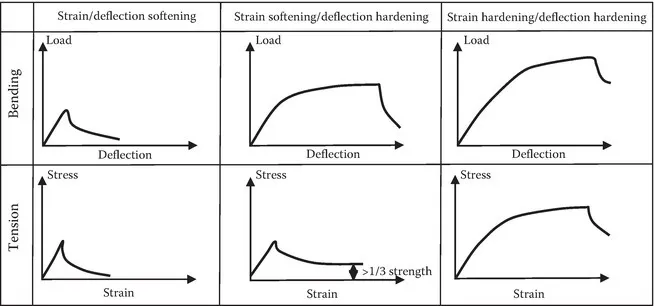
Textile-reinforced concrete (TRC) has emerged in recent years as a new and valuable construction material (Brameshuber, 2006, 2010; Curbach and Heeger, 1998; Hegger et al., 2006a). It is made with a continuous textile fabric that is incorporated into a cementitious matrix consisting of a Portland cement binder and small-size aggregates. This material can be categorized as a strain-hardening or strain-hardening/deflection-hardening cement composite, using the classification outlined in Figure 1.1.
image
Figure 1.1Schematic description of strain softening, strain hardening (in tension), and deflection hardening (in bending) on FRC composites. (From Bentur, A. and Mindess, S., Fibre Reinforced Cementitious Composites, Taylor & Francis, London, U.K., 2007; Adapted from Naaman, A.E., Strain hardening and deflection hardening fibre reinforced cement composites, in A.E. Naaman and H.W. Reinhardt (eds.), Fourth International Workshop on High Performance Fibre Reinforced Cement Composites, HPFRCC 4, RILEM Publications, Paris, France, 2003, pp. 95–113.)
The strain-hardening cement composites can be obtained by a variety of modes, ranging from special formulations using short and dispersed yarns to continuous textile fabrics. The advancement in the developments of such composites is based to a large extent on a more in-depth understanding of the micromechanics of such systems, enabling the achievement of strain hardening with the use of a modest content of fiber reinforcement, less than 10% by volume, and in many instances even going below 5% (Bentur and Mindess, 2007; Reinhardt and Naaman, 2007; Toledo Filho et al., 2011). This, of course, provides a much more cost-effective composite, making its application much more feasible.
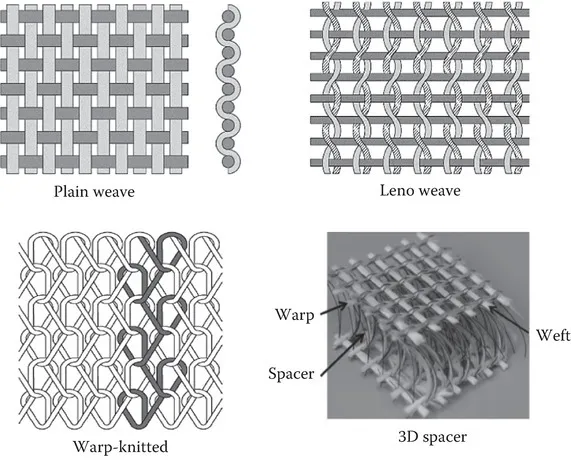
Strain-hardening composites consisting of discrete short reinforcement (yarns, fibers) require special tailoring of the reinforcement and the matrix to achieve the strain-hardening effect through the control of micromechanical interactions. This requires special control of the particle grading of the matrix and the use of high-performance chemical admixtures. In TRC, the sophistication is in the textile fabric, with regard to its geometry and the type of yarns used, or hybridization of yarns of different properties to optimize reinforcing efficiency (Gries et al., 2006) (Figure 1.2).
image
Figure 1.2Fabrics of different types.
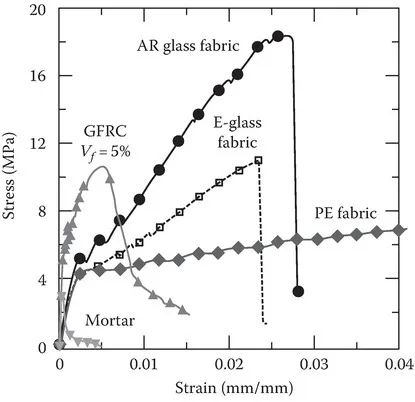
The cementitious matrix for TRC, although of high quality, is not the kind that requires very stringent formulation or use of ingredients that are drastically different than conventional ones. Thus, with a largely conventional cementitious matrix, it is possible to obtain an impressive range of mechanical properties, having elastic–plastic behavior at one end and a very effective strain hardening at the other (Figure 1.3).
image
Figure 1.3Stress–strain curves of TRC of different fabrics compared to unreinforced matrix and sprayed fiber–cement composite, GFRC. (After Peled, A. and Mobasher, B., ACI Mater. J., 102(1), 15, 2005.)
Strain-hardening cement composites made with short yarns have the advantage that their production is simple and site friendly as compared to the production of components with TRC. Yet, a major advantage of TRC is the continuity of the yarns providing inherently high efficiency and reliability, which is so essential for structural and semistructural applications. This advantage is further enhanced when considering the flexibility in producing textile fabrics that can be tailored for structural performance, static and impact, by optimization of the use of high-performance yarn...

Table of contents

  1. Cover
  2. Halftitle Page
  3. Series Page
  4. Title Page
  5. Copyright Page
  6. Contents
  7. Authors
  8. 1 Introduction
  9. 2 Textiles
  10. 3 Fabrication of TRC
  11. 4 Micromechanics and microstructure
  12. 5 Mechanical performance under static conditions
  13. 6 Mechanics of TRC composite
  14. 7 Flexural modeling and design
  15. 8 High rate loading
  16. 9 Durability of TRC
  17. 10 Repair and retrofit with TRC
  18. 11 Innovative applications of textile reinforced concrete (TRC) for sustainability and efficiency
  19. Index