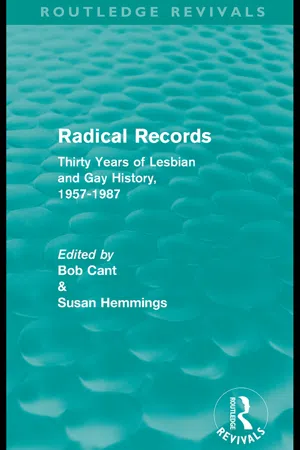
The period between the publication in 1957 of the liberalising Wolfenden Report and the introduction in 1987 of the homophobic Section 28 was characterised by unprecedented optimism and political activism among lesbians and gay men in Britain. But the law and its shortcomings never determined their whole political and cultural agenda and Radical Records explores the diverse and sometimes conflicting attempts of lesbian and gay people to build a new world for themselves and those they loved. The contributors recount their own personal narratives of how they struggled to re-define their identities, to explore non-traditional expressions of intimacy, to reclaim public spaces, to engage with the HIV epidemic, to build alliances and, generally, to make radical transformations of their lives. The re-issue of this important work, first published in 1988, gives its readers an opportunity to re-visit that turbulent time through the voices of its participants.
eBook - ePub
Radical Records (Routledge Revivals)
Thirty Years of Lesbian and Gay History, 1957-1987
- 266 pages
- English
- ePUB (mobile friendly)
- Available on iOS & Android
eBook - ePub
Radical Records (Routledge Revivals)
Thirty Years of Lesbian and Gay History, 1957-1987
About this book
Information
1
Introduction
Bob Cant and Susan Hemmings
I
Susan Hemmings: This book is a history book. The lives and struggle of lesbians and gay men are at last being recorded, not just as ‘coming out’ stories, but in terms of full, politically active struggle. During the past few years we have seen a steady movement to archive the experiences of older lesbians and gay men, with writings, audio-tapes, videos and films. This book is part of that desire to record, before it is too late, our recent efforts to change our lives and the wider context in which we live them, before a pall of silence falls on the important events of the post-Wolfenden era.
The history of a movement (or, as it is in our case more accurately, a complexity of movements) is more than the sum of the personal histories of its individual participants. But, until those stories are told, we cannot make sense of it all. Nor is any history book particularly gripping or inspiring that leaves out the heart of the matter: changing, growing people, in relationship to each other and under the conditions of the time. A book like this can give us the opportunity to make history: to describe our lives and to reflect simultaneously upon ourselves as social and political beings.
When we embarked on this project in early 1985 there was still a climate of considerable optimism among lesbians and gay men. Although the Metropolitan Authorities and the Greater London Council had just been abolished, the support engendered within them for aspects of lesbian and gay concerns had placed some of our politics on the public agenda in a way that was quite new in British history. Meanwhile new alliances within the trade union movement (such as the mutual political benefits experienced in the Lesbians and Gays Support the Miners Campaign), as well as the growing number of lesbians and gay men working on issues of oppression in both local government and voluntary organizations, gave many more of us a chance to learn about, and to be influential within, sites of public policy-making from which our ideas had previously been entirely excluded.
Many lesbian feminists, mostly those from the radical feminist tradition which has always remained sceptical of working in mainstream, male-dominated sectors, did not feel particularly optimistic about any of these opportunities. They interpreted them rather as co-options and coercions. In fact, most of us who were optimistic also retained a healthy scepticism, while at the same time gaining experience—and sometimes, for us, extraordinarily regular and respectable paycheques for doing what we had for years been doing for free. While both the optimists and the cynics worried about the corrupting power of the paycheque and of funding, because of its ability to undermine the power of voluntary commitment to the movements in which we had all been so involved, this period brought about a new generation of lesbians and gays with experience in public administration—its possibilities and its limitations.
Bob Cant and Susan Hemmings: This was also a time when a public concert of homophobia returned in a strength that perhaps young lesbians and gays had not previously experienced. Day after day the media attacked us, through exploiting fears about AIDS, as British deaths rose. The media again fanned the flames with constant stories of money spent on lesbian and gay projects, especially when it was, as it rarely was, anything to do specifically with Black lesbians, and especially when it had anything to do with giving information, fair and square, to school students.
Because our existence is now so much a matter of public ‘concern’, even if our issues are completely distorted, it is more important than ever for our history to be documented —and to be available. There are those of us who have been working for many years for lesbian and gay rights, working as well to explore the relationships between our oppression under heterosexism and the other oppressions which affect both ourselves and other people in society. We need to take stock, to look back, and to assess what we have learnt and how we can exploit it for further progress. Those who have more recently become lesbian or gay—whether young gay men or lesbians, or older people who have changed their sexuality—also need to know what has gone before, and because our history is suppressed, it is up to us to tell them. This book is also for heterosexuals, particularly those on the left, who have much to learn. For too long sympathetic heterosexuals have (when not actively opposing our work) hidden behind façades of tolerance, never questioning the roots of their sexuality or the patterns of their own relationships, never supporting our campaigns, and— giving nothing—learning nothing from the radicalism which has been part and parcel of our advance and, indeed, our survival.
All these issues, and many more, are explored by the contributors to this book. Clearly, as editors, we are on the left, and define ourselves as socialists, although Susan has never been aligned to any party. So we wanted the book to contain themes relevant to socialism. Not all our contributors define themselves as socialists. Some may prioritize certain issues over others, and almost certainly some would strongly disagree with some of the paths of progress proposed by others in the book. There are also contrasting—and sometimes irreconcilable—analyses of what it is that fundamentally causes society to be so split and to give privileges to so few.
Susan: However, we have not aimed to make the book from one perspective. It is meant to reflect the reality of the political enterprises in which we have been engaged, and to bring out the splits, the stops and starts, the uncertainties, as well as our planned and lasting projects and our spectacular, euphoric moments of success. We know, too, that the book has gaps: it can’t be comprehensive. And it’s quite untidy, like real history is: however you read it—right the way through in order, or picking out the bits which appeal to you, you’ll come across the same issues, the same events, even the same venues, but each time as part of someone else’s perception, someone else’s political growth.
You will read a nostalgic report of Gay Liberation in one place—followed by a cutting critique elsewhere. And there’s a geographical spread. Then the contributors themselves: spanning a wide age-range, with the older contributors able to give us much important documentation fast vanishing from our collective memory, and the younger ones able to remember vividly the short-lived revival of seventies’ student politics, everyone pinpointing what it was—in the political climate of the moment—that confirmed within them their lesbian or gay pride and strength.
Many of the contributors haven’t written before (a few are seasoned writers): again, we wanted to have new voices, and we also wanted to ensure an authenticity that comes from a fresh approach to the subject, and that doesn’t try to neaten up what should be left ragged and suggestive, nor to marshal everything into a convenient polemic.
So while we hope this is a highly readable history book, it may well be one in which you, as the reader, have to do some of the work, as you trace the themes, recognize the repetitions, piecing together—perhaps from your own memory of the events mentioned, and the feelings identified —your very own interpretation of the events of the past thirty years which have been so influential on our lives as lesbians and gay men.
II
Bob: There were, during the seventies’ a number of celebrated cases of lesbians and gay men being dismissed when they refused to continue concealing their sexuality. Employees who saw themselves as progressive were often just as homophobic in practice as those from whom one would have expected reactionary behaviour. One such case, which symbolized many of the issues at stake, was that of John Warburton, the teacher sacked in 1974 by the Labour-controlled Inner London Education Authority (ILEA) for refusing to lie when his pupils—teenage girls—asked him questions about his sexual identity. A report in Gay News had led him to believe that ILEA, which defined itself as the most progressive education authority in the country, would not discriminate against gay teachers. His dismissal made it clear, that while they might not dismiss teachers whom they knew to be closeted, they would not tolerate teachers who challenged the homophobic climate in schools.
John Warburton was not reinstated. This defeat, however, rather than marking the end of the struggle for lesbian and gay rights in the Labour movement, represented the beginning of a new period of self-organization. Groups which had been set up, particularly in public sector unions, began to mobilize support around some general principles of civil rights for lesbian and gay workers. Conference resolutions often became a focus of such activity and in the late seventies a number of unions, starting with the National Union of Journalists (NUJ), debated and passed resolutions of support for their lesbian and gay members. This succeeded in generating a public consensus among trade union activists that we should not be victimized on account of our sexuality.
A number of workers—in teaching, in social work, in local government—have begun to look at the way their profession endorses society’s view that heterosexuality is not only the superior, but even perhaps the only natural form of sexuality. Even to make such a critique meets with enormous resistance from people who may, in a liberal way, have formerly been allies but now feel obliged to defend patterns of institutionalized heterosexism. Liberal and reactionary alike, they often share the view that the lesbians or gay men who criticise the heterosexism operating within their own profession or their own workplace are endangering whatever else has been won in terms of equal rights. When we challenge heterosexism, it is easier for others to labels us as ‘extremists’.
The collectivism of the Labour movement is, however, unique in British society. It represents a whole history of working people coming together to resist their exploitation, to improve their standard of living, to make their working conditions safe, to enrich the quality of life of their communities and to defend their weaker members. It is that living tradition of collectivism that makes lesbians and gay men continue to struggle within that context. Sometimes there are major victories. The achievements of the GLC and the formal support of lesbian and gay rights by the Trades Union Congress and the Labour Party Conference in 1985 were not simply fortuitous. They reflect the drawing together of a number of collectivist traditions.
It would be foolish to suggest that many in the Labour movement are not uneasy about these developments. The fact that the economistic traditions of Labour are being challenged not only for their heterosexism but also their racism, their sexism and their ableism makes this sense of unease profound. The common ground that exists between the politics of the Labour movement and the politics of oppression ensures that these attempts to create a new collectivist politics will continue.
III
Bob: The major focus of gay male politics has for many years been coming out. For a man to admit that he desired other men was to endanger himself. He became a laughing-stock, a hate figure, an outcast, a legitimate target for violence. The bravery of the first men to come out and thus reject some of their male privilege is unquestionable. Their declaration made it clear that their homosexuality was not just an occasional activity but an identity. For much of this century gay men have perceived their homosexuality as a condition into which they were born. It served as a useful defence against the claim that homosexual activity was a wilful, and therefore curable, perversion. With the development of a movement, and of greater confidence, more gay men began to see their homosexuality as a social identity. Much of the politics of the early seventies was about the construction of communities within which this identity could be sustained. In the city centres and the campuses, this role was taken on by GLF; in the suburbs and the smaller cities and towns it was taken on by CHE; in Scotland by SMG. All of these organizations were open to women as well as to men but right from the start most were, with some remarkable, short-lived exceptions such as Lancaster GLF in 1972–3, male dominated.
The process of community construction began simply by bringing people together into groups. Group meetings helped people to develop the confidence to organize more public events such as socials and dances. The pages of Gay News in the early and mid-seventies chronicle the growth of an increasingly open social self-organization. ‘Out of the Closets’ became more than just a slogan as these social events ceased to be isolated phenomena and ceased to be confined to cellars and private clubs. Originally very much part of the movement, they became less so as gay entrepreneurs opened up discos in the upstairs rooms of pubs around the country. The cheap and friendly Tricky Dicky discos in north-east London and Essex have been among the most durable and most successful of this trend. By the mid-seventies the focus of the burgeoning gay male community was moving away from the political meeting towards publicly acknowledged pubs and discos.
The process of apparent de-politicization developed further with the emergence of the mega-disco. Ron Peck’s 1978 film, Nighthawks, ended with the central character entering such a club whose all-encompassing atmosphere of controlled light and sound seemed to offer the potential of fulfilling every fantasy, of enlivening every dream. Gay men had become not just a political force or a community but also a market. Although the Pink Economy in Britain has never achieved the scale of its US counterpart, it has tapped the spending power of gay men successfully and generated a new service industry. The quest for the realization of gay male fantasies would not have been possible without the de criminalization of some homosexual acts and, even more, without the growth of gay politics, but those who now controlled the form of the quest were light years away, in terms of political consciousness, from the earlier campaigners. No-one who is in any way dependent on an environment which is the object of constant police interest can be totally apolitical, but as the gay male scene grew in prosperity so organized politics in the community appeared to dwindle.
The image of affluent hedonism was, however, far from being the reality of most gay men’s lives. Most were unable to belong to the world of the Pink Economy—although many of us made use of it. Many more continued to be closeted and the number of men arrested on criminal charges for which there is no heterosexual equivalent continued unabated. The ‘permissive’ society may have permitted more tolerance for parts of the gay male ghetto but even that was fragile—and normally conditional on ‘good behaviour’.
The advent of AIDS seemed likely to endanger the fragile tolerance. The premature deaths of gay men in the industrialized world led to a revival of prejudice and homophobia, as well as enormous fear among gay men themselves. Commentators predicted (some gleefully) the end of gay male lifestyles, but they proved to be wrong. AIDS, on the contrary, stimulated a new sense of resistance among gay men. The development of a Safer Sex culture, the growth of support networks, the lobbying of governments, the links formed with other AIDS-affected groups all revealed a political energy in the gay male community that had seemed possibly absent and certainly on the wane.
All of this was only possible because of a dimension of the gay male experience that had been hidden from the outside world—the development since the gay movement, of friendship patterns and social networks that embraced both the ‘political’ and ‘non-political’ alike. Nameless and undefined, these networks acquired a new purpose and took on more public forms in the struggle against AIDS. What the AIDS crisis has revealed is that gay men have learned to care for one another not just on an individual level, but also as members of a community. Everyone knew that sex had come out of the closet since the early seventies, but it was the AIDS crisis that helped everyone realize that affection and public values among gay men had come out as well.
IV
Susan: Coming out—and dealing with the ramifications on both personal and political levels—has been a key theme in most books dealing with gay and lesbian issues, and most of the contributors here will give their own accounts of this radicalizing act and its effect on their lives. What is perhaps clearer in many of the women’s pieces, more than the men’s, is that coming out is a continuous act, with clusters of meanings and implications, depending on the oppressions affecting us and the current attitude of the state towards sexuality, the family and ‘morality’—as well as pressures of unemployment, housing and general social policy.
The exhilarating release of coming out with the Gay Liberation waves of the early seventies, or within the Women’s Liberation Movement of the mid-seventies is documented here—but so is the painful realization that if you are other than white, middle class and male there may well be serious consequences. Valued support from family sources which you may well have depended upon before to survive racism, for example, might be thrown away as you move, in a state of optimism, into a gay or lesbian community, only to experience racist acts and attitudes, including having your difference denied and ignored. Several pieces document this process: it is significant that it is mainly lesbians, rather than gay men, who are open to describing it carefully and forcefully. This is because it has been in the l...
Table of contents
- Dedication
- Contents
- Acknowledgments
- 1 Introduction
- 2 Battling for Wolfenden
- 3 Scotland: against the odds
- 4 Memoirs of an anti-heroine
- 5 A community of interests
- 6 Coming to terms
- 7 Separatism: a look back at anger
- 8 Faltering from the closet
- 9 The importance of being lesbian
- 10 Living on the fringes— in more ways than one
- 11 Oi! What about us?
- 12 ‘Irrespective of race, sex, sexuality…’
- 13 Voices in my ear
- 14 The liberation of affection
- 15 Amnesia and antagonism: anti-lesbianism in the youth service
- 16 Lesbian mothers—the fight for child custody
- 17 Parrot cries
- 18 Normal channels
- 19 The should we, shouldn’t we? debate
- 20 One step to heaven?
- 21 Somewhere over the rainbow…
- 22 No going back
Trusted by 375,005 students
Access to over 1.5 million titles for a fair monthly price.
Study more efficiently using our study tools.
Frequently asked questions
Yes, you can cancel anytime from the Subscription tab in your account settings on the Perlego website. Your subscription will stay active until the end of your current billing period. Learn how to cancel your subscription
No, books cannot be downloaded as external files, such as PDFs, for use outside of Perlego. However, you can download books within the Perlego app for offline reading on mobile or tablet. Learn how to download books offline
Perlego offers two plans: Essential and Complete
- Essential is ideal for learners and professionals who enjoy exploring a wide range of subjects. Access the Essential Library with 800,000+ trusted titles and best-sellers across business, personal growth, and the humanities. Includes unlimited reading time and Standard Read Aloud voice.
- Complete: Perfect for advanced learners and researchers needing full, unrestricted access. Unlock 1.5M+ books across hundreds of subjects, including academic and specialized titles. The Complete Plan also includes advanced features like Premium Read Aloud and Research Assistant.
We are an online textbook subscription service, where you can get access to an entire online library for less than the price of a single book per month. With over 1.5 million books across 990+ topics, we’ve got you covered! Learn about our mission
Look out for the read-aloud symbol on your next book to see if you can listen to it. The read-aloud tool reads text aloud for you, highlighting the text as it is being read. You can pause it, speed it up and slow it down. Learn more about Read Aloud
Yes! You can use the Perlego app on both iOS and Android devices to read anytime, anywhere — even offline. Perfect for commutes or when you’re on the go.
Please note we cannot support devices running on iOS 13 and Android 7 or earlier. Learn more about using the app
Please note we cannot support devices running on iOS 13 and Android 7 or earlier. Learn more about using the app
Yes, you can access Radical Records (Routledge Revivals) by Bob Cant,Susan Hemmings in PDF and/or ePUB format, as well as other popular books in Social Sciences & LGBT Studies. We have over 1.5 million books available in our catalogue for you to explore.