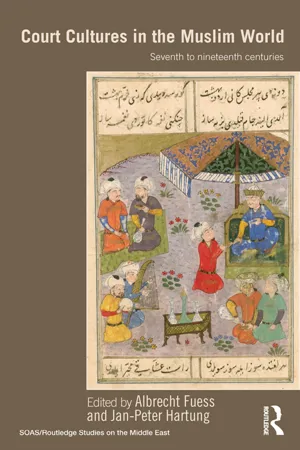
Court Cultures in the Muslim World
eBook - ePub

Court Cultures in the Muslim World

Seventh to Nineteenth Centuries

  1. 494 pages
  2. English
  3. ePUB (mobile friendly)
  4. Available on iOS & Android
eBook - ePub

Court Cultures in the Muslim World

Seventh to Nineteenth Centuries

About this book

Courts and the complex phenomenon of the courtly society have received intensified interest in academic research over recent decades, however, the field of Islamic court culture has so far been overlooked. This book provides a comparative perspective on the history of courtly culture in Muslim societies from the earliest times to the nineteenth century, and presents an extensive collection of images of courtly life and architecture within the Muslim realm.

The thematic methodology employed by the contributors underlines their interdisciplinary and comprehensive approach to issues of politics and patronage from across the Islamic world stretching from Cordoba to India. Themes range from the religious legitimacy of Muslim rulers, terminologies for court culture in Oriental languages, Muslim concepts of space for royal representation, accessibility of rulers, the role of royal patronage for Muslim scholars and artists to the growing influence of European courts as role models from the eighteenth century onwards. Discussing specific terminologies for courts in Oriental languages and explaining them to the non specialist, chapters describe the specific features of Muslim courts and point towards future research areas. As such, it fills this important gap in the existing literature in the areas of Islamic history, religion, and Islam in particular.

Frequently asked questions

Yes, you can cancel anytime from the Subscription tab in your account settings on the Perlego website. Your subscription will stay active until the end of your current billing period. Learn how to cancel your subscription.
No, books cannot be downloaded as external files, such as PDFs, for use outside of Perlego. However, you can download books within the Perlego app for offline reading on mobile or tablet. Learn more here.
Perlego offers two plans: Essential and Complete
  • Essential is ideal for learners and professionals who enjoy exploring a wide range of subjects. Access the Essential Library with 800,000+ trusted titles and best-sellers across business, personal growth, and the humanities. Includes unlimited reading time and Standard Read Aloud voice.
  • Complete: Perfect for advanced learners and researchers needing full, unrestricted access. Unlock 1.4M+ books across hundreds of subjects, including academic and specialized titles. The Complete Plan also includes advanced features like Premium Read Aloud and Research Assistant.
Both plans are available with monthly, semester, or annual billing cycles.
We are an online textbook subscription service, where you can get access to an entire online library for less than the price of a single book per month. With over 1 million books across 1000+ topics, we’ve got you covered! Learn more here.
Look out for the read-aloud symbol on your next book to see if you can listen to it. The read-aloud tool reads text aloud for you, highlighting the text as it is being read. You can pause it, speed it up and slow it down. Learn more here.
Yes! You can use the Perlego app on both iOS or Android devices to read anytime, anywhere — even offline. Perfect for commutes or when you’re on the go.
Please note we cannot support devices running on iOS 13 and Android 7 or earlier. Learn more about using the app.
Yes, you can access Court Cultures in the Muslim World by Albrecht Fuess, Jan-Peter Hartung, Albrecht Fuess,Jan-Peter Hartung in PDF and/or ePUB format, as well as other popular books in History & European Medieval History. We have over one million books available in our catalogue for you to explore.

Information

Publisher
Routledge
Year
2014
Print ISBN
9780415573191
eBook ISBN
9781136917806

Table of contents

  1. Cover
  2. Half Title
  3. Title Page
  4. Copyright Page
  5. Table of Contents
  6. List of figures
  7. List of Contributors
  8. Introduction
  9. PART I Politics
  10. PART II Patronage
  11. Index