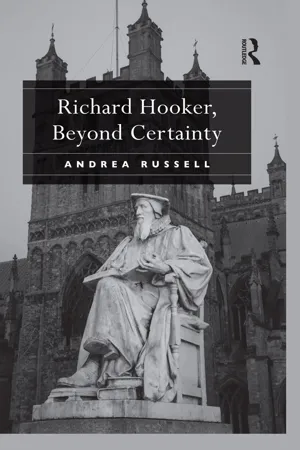
In spite of the differing, and often conflicting interpretations, there have been several constants – beliefs about Hooker and his work – that have remained virtually unchallenged throughout the centuries. Richard Hooker, Beyond Certainty examines and calls into question three of these constants. The first to be challenged is the fundamental belief that Hooker is attached securely to the English Church and that their identities are so interwoven that to speak of one is to speak of the other. The second is that Hooker's prose – his unique writing style and powerful rhetoric – can be ignored in the process of assessing his theology. The third is the widely-held belief that, as the 'champion of reason', Hooker's faith is essentially rational and that God is perceived and experienced primarily through the intellect. Challenging the truth of each of these statements leads to an uncertainty about Hooker which, rather than negating scholarship, allows research to be liberated from the dominance of categorisation. Such a change, it is suggested, would acknowledge that Hooker's theology transcends Anglican studies and allows his radical thinking to reach a wider audience.
- 202 pages
- English
- ePUB (mobile friendly)
- Available on iOS & Android
eBook - ePub
Richard Hooker, Beyond Certainty
About this book
Information
Chapter 1
Richard Hooker: Defender, Apologist and Champion of the Church?
Introduction
Richard Hooker has long been synonymous with the identity of the Church of England. His Lawes has been seen as the classic statement of the Church’s careful positioning of itself as a via media between Geneva and Rome. Or, more recently, he has been identified as a champion of Reformed Protestantism, translating the ideas of the Continental reformers into English theology.
There is, however, a difficulty with both these approaches, which goes beyond the simple fact that they are contradictory. This difficulty lies in the disjuncture between his works and his reputation, between the complexity, subtlety and flexibility of his ideas and his monolithic, even iconic status. In short, Hooker, when read carefully, never quite subscribes to the straitjackets, stereotypes and labels that interpreters and readers of his works have, over the centuries, pinned on him with such certainty.
When the Oxford Movement adopted Hooker as its champion, it affirmed a view of Hooker that has survived until the present day. This group of High Church Anglicans sought a figure who would establish the veracity of their claims to a distinctive identity – an identity that was different from both Genevan and Roman Catholic doctrine and discipline and yet was a clear inheritor of the apostolic order. They found such a figure in Richard Hooker and ‘it was (their) approach that effectively defined Hooker’s reputation as the epitomization of the Anglican tradition’.1
Keble famously enshrined this view of Hooker as the defender of via media Anglicanism in his edition of Hooker’s works published in 1836.2 This has been a lasting legacy, remaining virtually unchallenged until the middle of the twentieth century and continues to have its supporters, most notably the editors of the Folger edition of Hooker’s works who interpret Hooker in a more nuanced and yet still distinctively Anglican manner. ‘Although W. Speed Hill, the general editor, suggested that Keble’s edition now seems “unduly narrow in the focus of its commentary and unduly pious in its retention of Walton’s Life as the gateway to the Laws of Ecclesiastical Polity” most of the editors continued to treat Hooker as the quintessential Anglican divine.’3
However, historians such as Tyacke, Collinson and Milton in the twentieth century have shown that the classical via media interpretation of the Elizabethan Church is anachronistic, reading into the sixteenth century later Anglican beliefs and positions. Far from being a via media, the Church was broadly Calvinist in doctrine, of one voice with her Continental counterparts even whilst differing in ceremony and hierarchy. The Church’s identity was still being forged and formed, and Puritans, many of whom (but by no means all) were also Presbyterians, were not on the fringe of the Church but very much at its centre and involved in the decisions that were being taken.
Reformed theology is no longer identified squarely with Puritanism, as if it remained essentially the province of marginal groups, divorced from the mainstream of the English Church in this period. It now appears that most of the educated church men who held positions of any significance under Elizabeth and James I were fundamentally Reformed in their theological outlook.4
One result of this fresh understanding of the sixteenth century was that Hooker’s reputation as the defender of the via media was called into question. Crudely, if Hooker was defending the Elizabethan Church and this was not via media, then he could not be espousing that particular position. Through the work of Atkinson, Kirby and Simut a new image of Hooker emerged, still linking him with the identity of the Church but this time as a champion of the ‘Magisterial Reformers’ – a man in line with Luther and Calvin whose aim was to defend the Church against the misunderstandings of Reformed theology that lay at the heart of the calls for change. Kirby concludes that ‘(a)t all levels of the controversy, Hooker presents himself unequivocally as a proponent of both patristic orthodoxy and of the principles of the magisterial Reformation’.5 Atkinson critiqued Hooker’s views regarding the authority of Scripture, reason and tradition and concluded that Hooker is, as his book’s title put it, a ‘Reformed Theologian of the Church of England’.6 Simut has taken this conclusion a step forward through his study of Hooker’s views regarding justification and soteriology, placing him squarely within a Reformed understanding of these doctrines.7
Whilst Kirby, Atkinson and Simut are certainly breaking with the prevailing view of Hooker, there is much in fact that binds them to their predecessors. Although they profess to have recovered the true Hooker from amidst the layers of purposeful and accidental misinterpretation, they too attach him to the Church of his day, as apologist and defender. They are therefore the latest in a long line of supporters and critics who have linked Hooker’s theological identity with that of the Church. Brydon, in his study of Hooker’s early reputation, points out that such a position had become so embedded that by the end of the seventeenth century Hooker was an abridged emblem for the Church.8 In fact, almost from the time of his death there were claims that to speak of Hooker was to speak of the Church – its theology, discipline and identity. Indeed, over the years the two have become so interwoven that changes in understanding relating to one, has inevitably affected how we understand the other. So, for example, in the Preface to Atkinson’s book McGrath could write that now Hooker had been reclaimed for Reformed theology he should be read by present-day Anglican evangelicals who are seeking to shape the Church in a time of conflict and change.
There is no doubt that Richard Hooker is one of the most important writers in the history of the Church of England. Yet he has remained neglected by those who stand to gain most from reading and appropriating him – namely the evangelical wing of that church … The vision which Hooker encourages for modern evangelicalism is that of a movement which is deeply grounded in and nourished by Scripture, yet strengthened and sustained by a sense of solidarity within Christian orthodoxy down the ages. It is a deeply attractive and encouraging vision, which will unquestionably contribute to the growing maturity of evangelicalism within the Church of England.9
The irony is obvious but the call to heed Hooker, now he has ‘changed sides’, links this new wave of Hooker scholarship to what has gone before and retains Hooker as an icon for the Church – a flag waver for one’s preferred ‘orthodoxy’. Atkinson concludes his book by stating:
It has been my intention in this book to argue that Hooker’s debt to the Reformation was much greater and more profound than has been generally recognized. I have also argued that Hooker’s celebrated use of reason, tradition and Scripture was not something unique either to Hooker in particular or to Anglicanism in general. If this is the case then both Hooker’s theological position and the modern understanding of the Church of England’s true theological position need to be re-examined. It is my hope that this book might act as a small catalyst to that end.10
When the identity of the Anglican Church is once again in question, Hooker returns to the spotlight and his views are marshalled to support those claiming an authentic return to ‘Anglican’ values and beliefs.11
But Hooker cannot be both via media and a mouthpiece for Calvinism; both High Church Anglican and a close ally of Luther and a supporter of the two realms theory. Voak comments:
Either one must accept that only one of these two views is basically correct, and the other a historical misconception, or one must somehow arrive at a compromise that incorporates both these uneasy polarities. It is not surprising therefore, that much recent Hooker criticism should have divided along just these lines. Unfortunately, works adopting a conciliatory approach have tended to agree uncritically with both these views of Hooker, so developing an unacknowledged paradox rather than a satisfactory synthesis.12
This difficulty is often addressed by focusing once again upon the nature of the Church Hooker was championing, either from the historical angle or from Hooker’s writings, and scholarship then follows the familiar circle of allowing Hooker and the institution to shape each other. But there is an even more fundamental question to be addressed here: is this reciprocal relationship between Hooker and the Church, espoused by opposing sides in this debate and lying at the crux of most Hooker scholarship, as firm as we are led to believe? Do either the events of his life and those occurring in the wake of his death or his written words, convincingly support this conclusion? The answers to these questions are crucial if we are to critique the present academic impasse.
Hooker’s Life
If we consider Covell’s defence of Hooker’s work, published in 1603, as our primary evidence, then the answer to these questions would seem to be yes.13 In this text Covell sought to defend the Lawes against the criticisms levelled against it in the anonymously produced A Christian Letter, published in 1599.14 What is worth noting is that Covell wrote as if Hooker was the voice of the Church, a man defending the establishment against those who sought to claim power and change its identity. This publication suggests that Hooker’s identity was, at the time of his death, already interwoven with that of the Church.
Hooker and the Temple
This conclusion appears to be further supported when we consider Hooker’s career, and especially his term as Master of the Temple Church in London. In his altercations there with the Presbyterian Walter Travers, who was Reader at the Temple Church when Hooker took up office, Hooker appears to articulate the Church’s position against those who sought further reformation. There are obvious parallels here with the wider political scene, where calls for reform were increasingly being voiced and initial desires to change the Church from within were evolving, for some, into calls for separation. The clash between Hooker and Travers presents a microcosm of the problems facing a Church in which a whole spectrum of views was represented. In order to understand this dispute and the implications for Hooker, it is essential to appreciate the surrounding historical context.
In the last quarter of the sixteenth century the Church of England was attempting to establish a state of equilibrium after the tempestuous events of the previous decades in which Protestantism and Roman Catholicism had fought for primacy as the throne changed hands. The reinstatement of Protestantism under Elizabeth meant a return from exile for those who had fled to the Continent, but this was not a time of re-establishing Protestant norms but rather a period of flux as the theological and ecclesiastical implications of the English Reformati...
Table of contents
- Cover
- Dedication
- Title
- Copyright
- Contents
- Abbreviations
- Preface
- Introduction
- 1 Richard Hooker: Defender, Apologist and Champion of the Church?
- 2 Hooker’s Style and Rhetoric
- 3 Hooker and Certainty
- Conclusion
- Bibliography
- Index
Trusted by 375,005 students
Access to over 1.5 million titles for a fair monthly price.
Study more efficiently using our study tools.
Frequently asked questions
Yes, you can cancel anytime from the Subscription tab in your account settings on the Perlego website. Your subscription will stay active until the end of your current billing period. Learn how to cancel your subscription
No, books cannot be downloaded as external files, such as PDFs, for use outside of Perlego. However, you can download books within the Perlego app for offline reading on mobile or tablet. Learn how to download books offline
Perlego offers two plans: Essential and Complete
- Essential is ideal for learners and professionals who enjoy exploring a wide range of subjects. Access the Essential Library with 800,000+ trusted titles and best-sellers across business, personal growth, and the humanities. Includes unlimited reading time and Standard Read Aloud voice.
- Complete: Perfect for advanced learners and researchers needing full, unrestricted access. Unlock 1.5M+ books across hundreds of subjects, including academic and specialized titles. The Complete Plan also includes advanced features like Premium Read Aloud and Research Assistant.
We are an online textbook subscription service, where you can get access to an entire online library for less than the price of a single book per month. With over 1.5 million books across 990+ topics, we’ve got you covered! Learn about our mission
Look out for the read-aloud symbol on your next book to see if you can listen to it. The read-aloud tool reads text aloud for you, highlighting the text as it is being read. You can pause it, speed it up and slow it down. Learn more about Read Aloud
Yes! You can use the Perlego app on both iOS and Android devices to read anytime, anywhere — even offline. Perfect for commutes or when you’re on the go.
Please note we cannot support devices running on iOS 13 and Android 7 or earlier. Learn more about using the app
Please note we cannot support devices running on iOS 13 and Android 7 or earlier. Learn more about using the app
Yes, you can access Richard Hooker, Beyond Certainty by Andrea Russell in PDF and/or ePUB format, as well as other popular books in Theology & Religion & Christianity. We have over 1.5 million books available in our catalogue for you to explore.