eBook - ePub
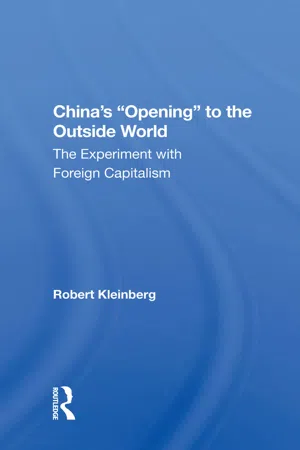
China's Opening to the Outside World
The Experiment with Foreign Capitalism
- 278 pages
- English
- ePUB (mobile friendly)
- Available on iOS & Android
eBook - ePub
About this book
This book is an attempt towards developing an understanding of China's "policy of opening up to the outside." It includes a study that focuses on three important Chinese foreign economic policies: policies that concern foreign investment, international trade, and Special Economic Zones.
Information
1
Introduction
We never permit the use of foreign capital to develop our domestic resources as the Soviet revisionists do, never run undertakings in concert with other countries and also never accept foreign loans. China has neither domestic nor external debts.
—People's Daily, Beijing, Jan. 2, 19771
Ours is an independent and sovereign socialist state. We have never allowed, nor will we ever allow, foreign capital to invest in our country. We have never joined capitalist countries in exploring our natural resources; nor will we explore other countries' resources. We never did, nor will we ever, embark on joint ventures with foreign capitalists.
—Red Flag, Beijing, March, 19772
Two years after the death of Chairman Mao, the People's Republic of China began a policy of "opening up to the outside world." Instead of dividing the world into socialists and capitalists, or exploiters and exploited, China now engages in trade and investment relations with every kind of country to increase its national productive capacity. But the fact that its new economic relations are predominantly with capitalist nations does not mean that China now accepts the reasoning of liberal free trade or capitalist ownership. The opening up policy instead is a return, in economics, to the most potent factor in the creation of new China itself--nationalism.
For China, opening up means the adoption by the state of new methods to promote national economic strength, methods that replace class warfare and deny the likelihood of global class conflict. The state now encourages the involvement of foreign partners in China's economy, at a price and subject to government laws and polices. China offers special concessions to those who bring capital and technology, knowing that capitalist nations have the most to provide. Such measures have facilitated rapid growth and led to some local economic success stories. Some of these successes, however, have had destabilizing effects that challenged the government to devise new methods of control. To manage the balance between local initiative and central intervention during economic reform has proven an impossibly complicated task for the state.
Despite that problem, China's opening up is a development likely to be emulated by other countries ruled by Communist Parties—even where those Parties have not been overthrown in favor of pluralism, as happened in Eastern Europe just prior to publication of this book. Each of the state socialist countries is hampered by the sluggish growth pattern of state-run economies. Each will therefore have a strong interest in China's largely successful experiment with modifying socialism to allow foreign capitalist participation. If China succeeds in securing large amounts of capital and technology, speeding up national growth, yet protecting Party rule and state control of industrial production, it may well influence even the more hardline Communist countries. They will have a huge, unavoidable example of how to increase national economic strength while maintaining Party privileges and political rule. Eastern Europe and the Soviet Union will have an even greater interest in emulating China's foreign economic reforms, now that they are turing away from old-line orthodoxy.
Besides being socialist, China belongs to another group: the world's poor nations. For them, the opening of China will be of the greatest interest as well. If China's opening up succeeds, it will refute Lenin's theory (most of which he borrowed from an English reformer, Hobson) that the poor undeveloped nations of the world are the victims of exploitation by the rich, necessarily culminating in conflict and war among the exploiters. The Chinese hope to show that they can, far from being exploited, manage foreign capitalism for national profit within their socialist borders. China now has the richest capitalist states competing to invest in a domestic market from which they cannot repatriate profits; to offer technology and equipment at the lowest price; to make loans at below-market rates of interest; and to welcome Chinese state-produced exports into their own markets while China rigorously restricts its imports. These accomplishments offer hope to other poor countries that attempt similar strategies. True, China is unusual among them; its huge population is a constant temptation to foreign businessmen who have goods to sell (although they have learned that the domestic market remains limited in its purchasing power). Other developing countries that cannot offer such temptations, however, may well find their own sources of national bargaining power, combined with lures of markets and resources, and reassess their relations with international business.
For Western countries, China's policy will contribute to the widespread concern about the trade policies of newly industrializing countries. Chinese trade protectionism will arouse frustration in the West and diminish confidence in the universality of liberal free-trade principles.
In an era when even close allies, such as the United States and Japan, encounter constant friction about alleged and threatened international trade barriers; when Western Europe's Common Market poses the threat of becoming a jointly protectionist bloc; and when the U.S. uses trade restrictions to add muscle in East-West quarrels, the successful use of a protectionist import substitution policy by the world's largest nation is hardly auspicious for a liberal trading order.
China's opening will be decisive to the success of its national development. It will have worldwide effects. What kind of opening is it and what does this reveal about the Chinese state?
A Hypothesis About the Opening Up Policy
The duiwai kaifang zhengce, "policy of opening up to the outside," refers to a set of Chinese foreign economic policies after 1978 that invite and control outside participation in national development. The Chinese reject the term "open door" (menhu kaifang), which conveys the very different relations that existed in the imperialist era. That was a term Americans invented.
A Chinese dictionary defines kaifang as to "lift a ban, restriction, etc." or "open to traffic or public use." it has an additional meaning: "come into bloom."3 The translation "opening" or "opening up" is not far off. Since the term is neutral about the extent or kind of opening, there is no objection to the Chinese usage.
China's opening has included several policies. This study focuses on three of the most important: policies that concern foreign investment, international trade, and Special Economic Zones. These are crucial parts of a set of reforms that also included accepting foreign aid and concessionary loans; sending thousands of graduate students abroad to study; letting foreigners travel quite freely in China; and allowing the Chinese people, through the state controlled mass media, to see and learn somewhat more (though still far from a full, objective picture) of the outside world. Regarding these policies and their guiding principles, three broad sources of information are available to Western scholars. First, Chinese publications (some available in translation) contain discussions of policies by Party officials and scholars. From these one can determine the range of acceptable debate, possible future directions of policy, and current guiding ideas. However, except in a few cases, it is far more difficult to ascertain which officials stand where in Party debates about the opening up policy. Second, the Chinese government publicizes many policies affecting foreigners, including laws, rules, plans and economic priorities. A diminishing number of regulations and policies affecting foreigners in China have remained "internal" or secret, subject to Party regulations that prohibit Chinese scholars making them available to foreign colleagues. Third, more economic statistics are becoming available annually. Although some Chinese experts do not consider them wholly reliable because they depend on official local reports with no independent verification, published statistics are useful for comparative purposes. Publication of some sensitive statistics has been delayed. For example, until the mid-1980s it was difficult to find out how much foreign exchange the various provinces earned, because this revealed too much about interprovincial imbalances and central-provincial relations. Although this situation is improving, there are still gaps in available information from any of the above sources, and a study of China's opening up policies should draw on all three types of materials.
To collect facts, however, is not suffcient for understanding the significance of China's opening policy. That requires an investigation of its purposes, scope, and development.
A pioneering work in international political economy by Robert Gilpin4 is extraordinarily useful for comprehending Chinese policies. Gilpin's book discusses world economic trends and their influence on the foreign economic policies of nations. He observes that as America's relative economic stature diminishes, the international trading order is under increasing challenge from economic nationalism, or neomercantilism. The more each nation moves toward protectionism or other forms of state interference with international trade and investment, the more incentive other nations have to do the same.
It is what the world economic structure encourages in individual states that provides more than a clue about Chinese policy. The People's Republic, determined to raise its economic position in the world, looks at the rapidly developing states of East Asia and finds that all of them (the single exception being British Hong Kong) have relied on extensive direct state interference in foreign trade and investment matters. In such an environment it should not be surprising that China, too, has become a neomercantilist state.
To embrace economic nationalism is to leave other principles behind. Liberals lose their faith in reduced trade and investment barriers, and find convenient exceptions. Marxist China's ideology, too, withers. Marxism can justify alignment with the Soviet Union and dependence on its aid (China's opening of the 1950s). It can, when amended, justify national self-reliance, trade with poor countries, and promoting global revolution (Mao in the 1960s). But when two-thirds of all trade is with capitalists, and they provide virtually all outside investment in national development—when China no longer promotes revolution in Asia, but invests for profit in Australian5-then Marxism declines from ideology to slogans of excuse. As an American observer remarks, "Chinese Communist political leaders have shorn socialism of its socialist meaning."6 What becomes of the inevitable worldwide conflicts between rich and poor classes, the inevitable crises of capitalism, the unification of the oppressed until they overthrow bourgeois capitalism? AU of these move into the ever-receding future. China now sees more attractive practical opportunities.
The opportunities the Chinese are turning to grasp are not those of an international system of growing laissez-faire harmony, but of competitive calculation and political action to promote state interests. If China now trades for equal advantage with socialist and capitalist states, it misleads some Westerners, who hope that expanded international trade is a prelude to or even a cause of domestic liberalization. But China accepts neither the premises of international liberalism (that international economic competition can be harmonious and universally beneficial, when divorced from politics), nor its policies (encouraging trade and financial interdependence), nor its predictions (that the benefits of international economic relations will reduce the predominance of state power).
A study of China's opening policies will not only reveal their neomercantilist character, but can provide a model of state reaction to evolving international economic conditions. This study will analyze several of China's economic opening up policies and then compare them. Each of these policies has consisted of an initial solicitation of outside involvement, codified in new laws, followed by central government attempts to control the results. This becomes complicated because some of the economic results of policies are unanticipated ones, and because there are no precedents for a reforming Communist state to follow in response. Nevertheless, a comparison of several different policies will show a pattern: after the initial relaxation of controls, and the growth period that follows, there is always a reassertion of central control to promote the state's perceived interests-before the cycle starts again with another loosening up.
Misconceptions About China's Economic Opening
A clear analysis of China's opening up since 1978 should avoid certain misconceptions. The most widespread misunderstanding about China, especially in the United States prior to June, 1989, has been that it is moving inexorably towards liberalization. This view rests on the assumption that various reforms enacted by Deng Xiaoping's government drive each other forward with increasing momentum.
One of the most persuasive statements of this argument summarized as follows:
China is now in the process of becoming a more open society. Decentralizing, quasi-market reforms, if they continue, are bound to produce a more liberal political and social climate in China.... The intellectual and legal revolutions, as well as the 'open door' policy, will also stimulate a more liberal trend within China.7
Put briefly, the argument runs like this: when China starts to produce and import more consumer goods, it raises popular economic expectations. That broadens public support for foreign trade to get imported goods, which in turn necessitates efficient production of exports. That in turn requires pushing agricultural and urban reforms that restore competition and private incentives. Political support for these reforms comes from thousands of highly-tra...
Table of contents
- Cover
- Half Title
- Title
- Copyright
- Contents
- List of Tables
- Abbreviations Used in Notes
- Preface
- 1. INTRODUCTION
- 2. THE IDEOLOGICAL PRINCIPLES OF CHINA'S OPENING UP POLICIES
- 3. OPENING UP AND LOCAL DEVELOPMENT IN SHENZHEN SPECIAL ECONOMIC ZONE
- 4. SHENZHEN'S RELATIONS WITH THE NATIONAL ECONOMY
- 5. THE MANAGEMENT OF FOREIGN TRADE: DECENTRALIZATION, ADJUSTMENT, AND READJUSTMENT
- 6. THE OPENING UP IN FOREIGN TRADE: RESULTS AND NEW PROBLEMS
- 7. CHINA'S NEW FOREIGN INVESTMENT POLICIES
- 8. FOREIGN INVESTMENT POLICIES AND LAWS: SOME KEY ISSUES
- 9. ECONOMIC RESULTS OF FOREIGN INVESTMENT POLICY
- 10. CONCLUSION
- Selected Bibliography
- Index
Trusted by 375,005 students
Access to over 1.5 million titles for a fair monthly price.
Study more efficiently using our study tools.
Frequently asked questions
Yes, you can cancel anytime from the Subscription tab in your account settings on the Perlego website. Your subscription will stay active until the end of your current billing period. Learn how to cancel your subscription
No, books cannot be downloaded as external files, such as PDFs, for use outside of Perlego. However, you can download books within the Perlego app for offline reading on mobile or tablet. Learn how to download books offline
Perlego offers two plans: Essential and Complete
- Essential is ideal for learners and professionals who enjoy exploring a wide range of subjects. Access the Essential Library with 800,000+ trusted titles and best-sellers across business, personal growth, and the humanities. Includes unlimited reading time and Standard Read Aloud voice.
- Complete: Perfect for advanced learners and researchers needing full, unrestricted access. Unlock 1.5M+ books across hundreds of subjects, including academic and specialized titles. The Complete Plan also includes advanced features like Premium Read Aloud and Research Assistant.
We are an online textbook subscription service, where you can get access to an entire online library for less than the price of a single book per month. With over 1.5 million books across 990+ topics, we’ve got you covered! Learn about our mission
Look out for the read-aloud symbol on your next book to see if you can listen to it. The read-aloud tool reads text aloud for you, highlighting the text as it is being read. You can pause it, speed it up and slow it down. Learn more about Read Aloud
Yes! You can use the Perlego app on both iOS and Android devices to read anytime, anywhere — even offline. Perfect for commutes or when you’re on the go.
Please note we cannot support devices running on iOS 13 and Android 7 or earlier. Learn more about using the app
Please note we cannot support devices running on iOS 13 and Android 7 or earlier. Learn more about using the app
Yes, you can access China's Opening to the Outside World by Robert Kleinberg in PDF and/or ePUB format, as well as other popular books in Politics & International Relations & Asian Politics. We have over 1.5 million books available in our catalogue for you to explore.