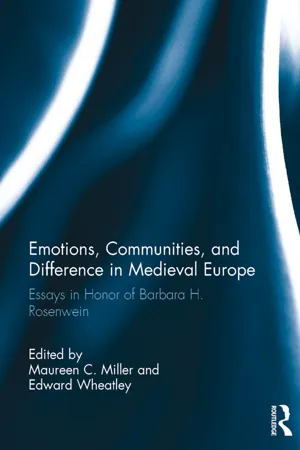
This book of eleven essays by an international group of scholars in medieval studies honors the work of Barbara H. Rosenwein, Professor emerita of History at Loyola University Chicago. Part I, "Emotions and Communities," comprises six essays that make use of Rosenwein's well-known and widely influential work on the history of emotions and what Rosenwein has called "emotional communities." These essays employ a wide variety of source material such as chronicles, monastic records, painting, music theory, and religious practice to elucidate emotional commonalities among the medieval people who experienced them. The five essays in Part II, "Communities and Difference," explore different kinds of communities and have difference as their primary theme: difference between the poor and the unfree, between power as wielded by rulers or the clergy, between the western Mediterranean region and the rest of Europe, and between a supposedly great king and lesser ones.
eBook - ePub
Emotions, Communities, and Difference in Medieval Europe
Essays in Honor of Barbara H. Rosenwein
- 224 pages
- English
- ePUB (mobile friendly)
- Available on iOS & Android
eBook - ePub
Emotions, Communities, and Difference in Medieval Europe
Essays in Honor of Barbara H. Rosenwein
1 A road to the history of emotions
Social, cultural, and interdisciplinary approaches to the Middle Ages, c. 1966–2016
Medieval emotions was one of three “current trends in history and theory” showcased in a panel at the 2016 meetings of the Medieval Academy of America, and at the center of this session, and the lively discussion it provoked, was the work of Barbara H. Rosenwein.1 From the 1998 publication of her volume Anger’s Past, Rosenwein has both critiqued the assumptions underpinning studies of medieval emotions and developed her own methodological and theoretical approach to the history of emotions.2 One can see some glimmerings of this interest in the inner life and its outward expression in her very first published article on Cluniac liturgy as ritual aggression,3 but in truth her road to the history of emotions passed through other topics. Rosenwein’s scholarship is rich and varied, full of experimentation and exploration of ideas, methodologies, and sources. While it is less common to encounter such a diversity of interests in one career, several characteristics and themes prominent in Rosenwein’s work are more broadly representative of developments in medieval studies over the second half of the twentieth century and the opening decade and a half of the twenty-first. The interdisciplinarity of her scholarship, its emphases on religion and other aspects of society, and its focus on social groups, are more widely evident in recent approaches to the medieval past. Both the broader resonance and impact of Rosenwein’s work, moreover, make manifest the enduring value of focusing on social groups and interactions.
Interdisciplinarity
The discipline of history has long had an imperial sense of its own purview: the entire past was the historian’s domain. Into the early twentieth century, however, its practitioners privileged only a limited swath of this ample past. Politics, particularly the high politics of polities and rulers, and elite intellectual activity, the great ideas of philosophers and theologians, dominated historical narration.4 The emergence of several new disciplines over the late nineteenth and early twentieth centuries engaged with the past in different ways and, either implicitly or explicitly, challenged history’s dominion. Archeology, for example, expanded the very extent of the known past while developing new scientific tools to find and date artifacts.5 Other new disciplines, while addressing the present, used the past to articulate and test theories. For sociology’s founder, Auguste Comte (1798–1857), history was merely a method of sociology, the “final science,” and for Max Weber (1864–1920), the past was essential to his rationalization thesis.6 The prominence of evolutionary theory in the early development of anthropology also engaged the past, and even after evolutionary approaches to the study of culture were rejected – for example, by Franz Boas (1858–1942) and his students in relation to race – this new social science embraced the study of historical processes in the development and contact of cultures.7 Psychoanalysis – most influentially in Freud’s Civilization and Its Discontents – also drew on the past in articulating theories of personal development.8
The most influential twentieth-century movement within historical studies, the Annales, responded to this ferment of the emergence of new social sciences by calling for histoire totale. Key here for medievalists was Marc Bloch, who as a student was part of Max Weber’s Vienna circle, and whose classic La Société féodale (1939) drew upon sociology, art, literature, and geography. Defining history as “the science of men in time,” Bloch asserted that “the variety of historical evidence is nearly infinite.”9 Although one might see history’s move toward interdisciplinarity as a mere reassertion of disciplinary hegemony, other disciplines, of course, did not cede the field: this was tremendously fruitful in the study of the Middle Ages. Even before Bloch and the annalistes articulated their influential ideal of “total history,” medievalists formed multi-disciplinary alliances – such as the Medieval Academy of America, founded in 1925 – and by the 1960s exchanges among chronological allies gave birth to numerous interdisciplinary programs in medieval studies.10
Barbara Rosenwein entered the University of Chicago in 1962 and both her undergraduate and graduate studies were deeply influenced by its interdisciplinary “Core Curriculum.”11 The interdisciplinary character of her work is evident in both its theoretical engagements and in the sources utilized. From her earliest publications Rosenwein overtly drew on theoretical perspectives from other disciplines. “Feudal War,” her very first article, used psychoanalytic theory to conceptualize Cluny’s relentless liturgy as ritualized aggression, while Rhinoceros Bound, her first monograph, invoked the Durkheimian concept of anomie to explain gifts to Cluny as a socially constructive response to rapid social change and political disorder in tenth-century Francia.12 Her second monograph, To Be the Neighbor of Saint Peter, drew upon anthropological theory – particularly, Marcel Mauss’s observations on the “potlatch” of the Trobriand islanders – to understand the social meaning of Cluny’s property and Negotiating Space used anthropological work on tapu (taboo) to explore immunities.13 Rosenwein’s most recent work has moved from the social to the natural sciences for theoretical insights. In Generations of Feelings she turns to the field of genetics and its concept of gene mosaicism to understand how and why individuals express emotions differently depending on their environment.14
In her use of sources, Rosenwein also crossed disciplinary boundaries. Teaching, apparently, liberated her to move beyond the usual documentary and hagiographical sources that are the mainstays of Cluniac studies. In the very first edition of her highly successful textbook, A Short History of the Middle Ages, images as well as words are evidence. The provincialization of the late Roman empire is presented through a sculpted head from Palmyra and a tombstone from near Carthage; the Franks Casket visualizes the amalgamation of Roman, Jewish, Christian, and Germanic traditions in the eighth century.15 The study of emotions further widened her evidentiary interdisciplinarity. First came poetry, in Emotional Communities, and then, in Generations of Feeling, troubadour songs, tomb sculptures, and manuscript illuminations, paintings of Christ’s passion, and musical diagrams illustrating Gerson’s theory of passions.16
This interdisciplinary broadening of source bases characterized work in medieval studies more generally. A very early harbinger in history was Ernst H. Kantorowicz’s The King’s Two Bodies: A Study in Medieval Political Theology (1957), which drew upon polemical tracts, images, and liturgical works.17 Studies of the history of medieval liturgy were, more generally, in the vanguard of employing manuscript illustrations and architecture as sources.18 Images – visual, literary, and cultural – were also an early fruitful theme in historical work on the Middle Ages: from images of peasants in art, sermons, and didactic literature to images of the women in chansons de geste and in medieval art.19 Historians’ use of visual and material sources intensified from the 1990s. The work of Caroline Walker Bynum, for example, focused predominantly on textual sources in the 1980s, but began taking artifacts and images into account in Fragmentation and Redemption: Essays on Gender and the Human Body in Medieval Religion (1991) and The Resurrection of the Body in Western Christianity, 200–1336 (1995). Her scholarship in the new millennium has focused intensively on visual and material sources in relation to texts.20
Beyond the discipline of history, the utilization of sources normally the purview of other fields was equally intense and fruitful. The work of art historian Jeffrey F. Hamburger, for example, has brought together art, theology, and women’s history in a particularly compelling fashion.21 The relationship between images and ideas has been very productively explored, as has the role of architecture, artifacts, and images in ritual.22 Musicologists too have become more prominent within medieval studies as they have engaged more systematically with historical and material sources.23 Scholars of the varied medieval literatures, Latin and vernacular, have also drawn creatively on new sources.24
The interdisciplinary theoretical borrowings evident in Rosenwein’s scholarship have also been more widely practiced in medieval studies. Historians such as Emmanuel Le Roy Ladurie in his book Montaillou, village Occitan de 1294 à 1324 and Jean-Claude Schmitt in his Le Saint lévrier, applied the ethnographic tools of cultural anthropology to medieval communities, and those studying medieval rituals and ceremony engaged extensively with anthropological and sociological theories.25 Theories from these disciplines have also been fruitfully applied to medieval literature, particularly the drama.26 Psychoanalytic theory has had a more limited impact, mainly within gender studies.27 Although in literary studies psychoanalytic readings are not as common as they were in the second half of the twentieth century, monographs using this theoretical approach continue to appear.28 The turn to the theories and methods of the natural sciences, however, has gained considerable traction. Within history, the study of epidemics of infectious diseases, particularly the great pandemics of plague at either end of the Middle Ages – the first, called “Justinianic,” from 541 to 750 and the second, the “Black Death,” which struck with great force in the mid-fourteenth century but also recurred frequently over the next four centuries – has enlivened debate over what pathogens were at work and how societies responded.29 Michael McCormick’s “Initiative for the Science of the Human Past” at Harvard University has been sponsoring work on climate change and has other collaborations afoot on historical genetics, while Patrick Geary at the Institute for Advanced Study is leading a project to use genetic data to revise our understanding of the migrations of peoples.30 The natural sciences have been integral to the relatively recent appearance of two areas of scholarship addressing medieval literature: animal studies and disability studies.31
Religion and other aspects of society
Rosenwein began her career studying medieval religion through the history and sources of the great Burgundian monastery of Cluny and its dependencies. Her interest, however, was more in religious behaviors and institutional practices as a lens on society, as expressions and fulfillments of human needs, than in theology or mentalities. Cluny’s emphasis on custom and law in monastic practice affirmed stability in a period of rapid social change.32 Its relations with donors “worked as social glue,” creating connections and interrelations “in an age of fragmentation and social dislocation.”33 Even as her research agenda broadened, religious practice and thought remained significant to it: ecclesiastical exemptions are treated extensively along with royal immunities in her Negotiating Space, and in her books on emotions religious figures (Augustine, Gregory the Great, Thoma...
Table of contents
- Cover
- Title
- Copyright
- Contents
- List of figures
- List of contributors
- Preface
- Acknowledgments
- List of abbreviations
- 1 A road to the history of emotions: Social, cultural, and interdisciplinary approaches to the Middle Ages, c. 1966–2016
- 2 Bibliography of the works of Barbara H. Rosenwein, 1974–2016
- Part I Emotions and communities
- Part II Communities and difference
- Index
Trusted by 375,005 students
Access to over 1.5 million titles for a fair monthly price.
Study more efficiently using our study tools.
Frequently asked questions
Yes, you can cancel anytime from the Subscription tab in your account settings on the Perlego website. Your subscription will stay active until the end of your current billing period. Learn how to cancel your subscription
No, books cannot be downloaded as external files, such as PDFs, for use outside of Perlego. However, you can download books within the Perlego app for offline reading on mobile or tablet. Learn how to download books offline
Perlego offers two plans: Essential and Complete
- Essential is ideal for learners and professionals who enjoy exploring a wide range of subjects. Access the Essential Library with 800,000+ trusted titles and best-sellers across business, personal growth, and the humanities. Includes unlimited reading time and Standard Read Aloud voice.
- Complete: Perfect for advanced learners and researchers needing full, unrestricted access. Unlock 1.5M+ books across hundreds of subjects, including academic and specialized titles. The Complete Plan also includes advanced features like Premium Read Aloud and Research Assistant.
We are an online textbook subscription service, where you can get access to an entire online library for less than the price of a single book per month. With over 1.5 million books across 990+ topics, we’ve got you covered! Learn about our mission
Look out for the read-aloud symbol on your next book to see if you can listen to it. The read-aloud tool reads text aloud for you, highlighting the text as it is being read. You can pause it, speed it up and slow it down. Learn more about Read Aloud
Yes! You can use the Perlego app on both iOS and Android devices to read anytime, anywhere — even offline. Perfect for commutes or when you’re on the go.
Please note we cannot support devices running on iOS 13 and Android 7 or earlier. Learn more about using the app
Please note we cannot support devices running on iOS 13 and Android 7 or earlier. Learn more about using the app
Yes, you can access Emotions, Communities, and Difference in Medieval Europe by Maureen C. Miller, Edward Wheatley, Maureen C. Miller,Edward Wheatley in PDF and/or ePUB format, as well as other popular books in History & European Medieval History. We have over 1.5 million books available in our catalogue for you to explore.