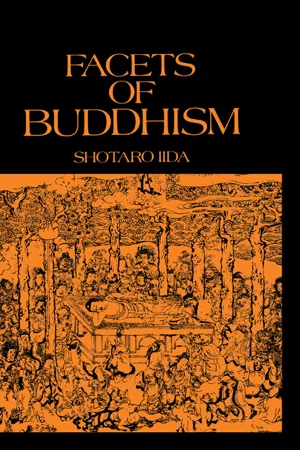
The author presents a selection of papers written over the last twenty or so years, spanning the period from early research into the then nearly unknown Madhyamika writer Bhavaviveka or Bhavya, amongst Tibetan refugees in India, up to the recent past where there interests have, perhaps, somewhat broadened to include comparative religion. The author has moe or less left the essays in their original form and has introduced some consistency in the citing of the names of Japanese scholars in order to aid the English speaking reader unfamiliar with Japanese.
- 256 pages
- English
- ePUB (mobile friendly)
- Available on iOS & Android
eBook - ePub
Facets Of Buddhism
About this book
Information
CHAPTER VII
Buddhist Idealism
Reflected in the Sea of Fertility (Hōjō no UMI) of Yukio Mishima (1925-70)*1
ON NOVEMBER 25, 1970 after hearing of MISHIMA Yukio’s suicide, a Chinese professor asked Iida, “I have been giving a course on Japanese literature, for I can read and write Japanese. But I am not so sure now. Please tell me the reason why the Japanese commit suicide so easily?” Iida replied, “No man commits suicide easily, not even the Japanese novelists. However one thing can be said—while the Chinese think “We live only once,” the Japanese tend to say, “We die only once!” For example even on the joyous occasion of the New Year, issues of the Japanese literary magazines were, as noted by SAEKI Shōichi,2 full of death motifs. Mishima was a prime example of this attitude of ‘dating with death’, or shi ni shitashimu. He was fascinated by death and the idea of dying. Mishima committed seppuku, the Japanese ritual suicide, on the morning after the completion of his only tetralogy, The Sea of Fertility. He was indeed faithful to the model of ‘Mishima’ aestheticism, i.e. “The death reveals itself at the height of life.”3 Much has been written about the meaning of his death by many, from a prime minister to novelists, critics and psychologists. Some call him a fanatic nationalist who hysterically committed seppuku in a vain attempt to restore pre-war militarism under the Emperor. Surprisingly few words came from Buddhist scholars except for an essay by MIYASAKA Yūsho, one of the leading scholars in the field. We share his words:
On and after that day and even now, countless people are dying in numerous ways. But there has never been such a case where a novelist’s death gave birth to such lively discussion. While it is a ‘crazy death’ for the man on the street, it is a “literary, political and meaningless death” for some. As for me, it does not matter. The crux of the matter is the fact that Mishima brought home for us anew the subject of ‘death’, an ancient question that is perpetually reborn in many ways.4
In his last work, Mishima utilized several important Buddhist themes as mediums through which the tetralogy was unfolded. However, many diverse opinions have sprung up concerning the actual success of his initial intentions. The literary critics who are not well versed in the complexities of Buddhist thought sometimes have the tendency to discount or even reject the reality of Buddhist influence in modern Japanese literature. On the other hand, the students of Buddhism are not lacking in their fair share of ‘wrong views’, when they are too deep in their introspection in the futile hope of finding some profound meaning, in order to satisfy their egos.
A case in point: at a recent exhibition of “The Woodcuts of Munakata Shikō” in Victoria and Vancouver, B.C. Canada, Mrs. Joan Stanley-Baker, Curator of the Greater Victoria Art Gallery wrote: “It would be foolish as well as futile to look for deeper meaning in Buddhist context in Munakata’s oeuvre.”5 At the same time however, her insufficient descriptions of the Buddhist themes of Munakata’s works greatly diminished the enjoyment and proper appreciation of the viewers. For example a work entitled “(31) Fish, Flower and Female Buddha” could have been more meaningful if its correct description, i.e., Gyoran Kannon (Kannon With a Fish-Basket), was given. This woodcut was influenced by the following story:
In Sung China, a beautiful lady was selling fish in a market. As hundreds of men proposed to her, she replied, “I will teach all of you the Kannongyō and whoever can chant it by tomorrow morning will be my husband.” Twenty men completed the task. The next requirement was the Diamond-sutrā and ten men were able to recite the second morning. Finally one man was able to chant the ‘Lotus-sūtra’. The morning after the wedding ceremony, she died leaving her golden collar bone. As a monk verified this noble deed of Kannon, many became the followers of her steps of insight and compassion.6
Thus, this piece of Munakata’s work eloquently reveals not only his creativity but also the profound influence of the Kannon-cult on the lives of the Asian peoples past and present. Analogously, The Sea of Fertility requires a proper understanding of Buddhist elements for the full appreciation of this unique tetralogy. We strongly maintain that without such an understanding of Buddhism it is premature to criticize Mishima as Marleigh Ryan does:
The reader would not have been so troubled by the author’s understanding of Buddhism had the philosophy not been laid on with so heavy a hand. Whatever else he may have been, Mishima was certainly not subtle. Throughout the tetralogy we are offered simplistic essays on Buddhism, Hinduism, and even one protracted discourse on reincarnation in Western philosophy, all resembling nothing so much as excerpts from an inept graduate student’s term paper.7
No one, even after Thirty Years of Buddhist Studies,8 has a complete understanding of Buddhism as Ryan rightly mentions in the following paragraph:
Buddhism is a religion and philosophy of such incredible complexity, susceptible to so vast a range of variations, that almost anything affirmed or denied about it may be correct in some sense.9
As far as Mishima and Buddhism in the tetralogy is concerned, our questions and examinations should focus on:
- Mishima’s understanding and representation of ‘Buddhist Idealism’ which is called the ‘Hosso-Yuishiki’ in Japan.
- Is Mishima’s understanding of ‘Buddhist Idealism’ correct? If so, then is that understanding properly expressed in his tetralogy, from a literary point of view?
In this combined effort, while Iida is mainly responsible for the first point, Hagiwara will deal with the second. At any rate, free from the previously mentioned extremes of the depreciation (apavāda) and inflation (samāropa) of reality, as Buddhist philosophers call it, we intend to make a ‘right view’ or samyag-dṛṣṭi of the Buddhist elements, particularly ‘Buddhist Idealism’, in The Sea of Fertility. Our view falls into the following aspects:
- The Uniqueness of the Theme of ‘Buddhist Idealism’ in the History of Japanese Literature.
- The Outline of, and Buddhist Elements in, The Sea of Fertility.
- An Analysis of Mishima’s Tetralogy.
1. The Uniqueness of the Theme of ‘Buddhist Idealism’ in the History of Japanese Literature
Zen and the Pure-land traditions are two familiar and stable sources of the inspirations for the Japanese novelists. From even only as recent as the Meiji Restoration, we notice three waves of Zen ‘boom’ generated by writers and novelists. Among them, the first wave was originated by the Kusamakura of NATSUME Sōseki (1867-1916). Thanks to him, even the unsuis (Zen novices) of Zen monasteries in Kamakura, Kyoto and Eiheiji and Sōjiji were deeply impressed by the work, and they started memorizing the first chapter of the Kusamakura along with the Hannya-shingyō or ‘Heart-sūtra’. This was succeeded by the second wave stirred by NISHIDA Kitarō, D.T. Suzuki, WATSUJI Tetsurō and HASHIDA Kunihiko during the Taishō-Shōwa period. The third and recent Zen ‘boom’ can be traced to Nishio Minoru who made Dōgen’s and Shinran’s religious works into ‘people’s literature’ (kokumin bungaku). This in turn generated a literary controversy between Tokieda and Katō shūichi. As for the Pure-land tradition, we should perhaps first mention the works of KAMURA Isota in which he not only wrote of his private life (shi-seikatsu), but also of his shameful secrets when he says:
Liberation is seen, according to my conviction, in a figure which gazes at one’s own figure (sugata) which is nothing but the mess of afflictions (bonnō or kleśa)—pains of death, sorrows of separation, and the attachments to the opposite sex…. everything is fake. Nembutsu is the only truth. Namuamidabutsu.10
Kamura’s style and thought was kept alive by the works of KURATA Hyakuzō (his Shukke to Sono Deshi or ‘The Priest and His Disciple’) TAKEDA Taijun and NIWA Fumio, to name only three.
The system of ‘Buddhist Idealism’ (the Hossō-Yuishiki) is considered to be one of the conundrums of the traditional Buddhist Studies in Japan. The following saying was prevalent among the monk-scholars, “Momokuri sannen kaki hachinen, Yuishiki sannen kusha hachinen”. (As for the fruition of plants, it takes three years for peaches and chestnuts and eight years for persimmons. The same goes with the Yuishiki studies and the Abhi- dharma-kośa). The system of ‘Buddhist Idealism’ is difficult enough just to understand, let alone to try to adapt its complex system to the novel form! As far as we are aware, no writer has had either the ambition or courage to represent the ‘Buddhist Idealism’ in their works except for Mishima in his tetralogy. By this fact alone, we maintain that The Sea of Fertility po...
Table of contents
- Cover
- Half Title
- Title Page
- Copyright
- Contents
- Introductory Note
- I. Buddhist Studies over the Himalayan Hills
- II. Re-turning Gautama’s Wheel
- III. Notes on Buddhist Causation and Tolerance
- IV. Towards a Second Look at Visual Mode in Buddhist Tradition
- V. A Contribution Towards the ‘Sudden’ vs. ‘Gradual’ Controversy by Bhiksu ’Phags Pa (1235-80)
- VI. Buddhist Dimensions in the Japanese Nō Play, Yamamba (Old Woman of the Mountains)
- VII. Buddhist Idealism Reflected in The Sea of Fertility (Hōjō no Umi) of Yukia Mishima (1925-70) with Takao Hakiwara
- VIII. A Far Eastern Hermeneutic Criterion
- IX. “A Lotus in the Sun”—An Aspect of the Soka Gakkai in Japan
- X. Buddhist and Sūfī Philosophers in ‘Emptiness and Action’—toward Transcendent Unity of Mysticisms
- Index
Trusted by 375,005 students
Access to over 1.5 million titles for a fair monthly price.
Study more efficiently using our study tools.
Frequently asked questions
Yes, you can cancel anytime from the Subscription tab in your account settings on the Perlego website. Your subscription will stay active until the end of your current billing period. Learn how to cancel your subscription
No, books cannot be downloaded as external files, such as PDFs, for use outside of Perlego. However, you can download books within the Perlego app for offline reading on mobile or tablet. Learn how to download books offline
Perlego offers two plans: Essential and Complete
- Essential is ideal for learners and professionals who enjoy exploring a wide range of subjects. Access the Essential Library with 800,000+ trusted titles and best-sellers across business, personal growth, and the humanities. Includes unlimited reading time and Standard Read Aloud voice.
- Complete: Perfect for advanced learners and researchers needing full, unrestricted access. Unlock 1.5M+ books across hundreds of subjects, including academic and specialized titles. The Complete Plan also includes advanced features like Premium Read Aloud and Research Assistant.
We are an online textbook subscription service, where you can get access to an entire online library for less than the price of a single book per month. With over 1.5 million books across 990+ topics, we’ve got you covered! Learn about our mission
Look out for the read-aloud symbol on your next book to see if you can listen to it. The read-aloud tool reads text aloud for you, highlighting the text as it is being read. You can pause it, speed it up and slow it down. Learn more about Read Aloud
Yes! You can use the Perlego app on both iOS and Android devices to read anytime, anywhere — even offline. Perfect for commutes or when you’re on the go.
Please note we cannot support devices running on iOS 13 and Android 7 or earlier. Learn more about using the app
Please note we cannot support devices running on iOS 13 and Android 7 or earlier. Learn more about using the app
Yes, you can access Facets Of Buddhism by Shotaro Iida,Iida in PDF and/or ePUB format, as well as other popular books in Theology & Religion & Eastern Philosophy. We have over 1.5 million books available in our catalogue for you to explore.