First published in 1980. This collection of carefully selected extracts from primary texts seeks to show what the Romantics themselves held Romanticism to be. The movement is thus defined in terms of the writers' own views of their art both in general principle and in practical terms. This title will be of interest to students of literature.
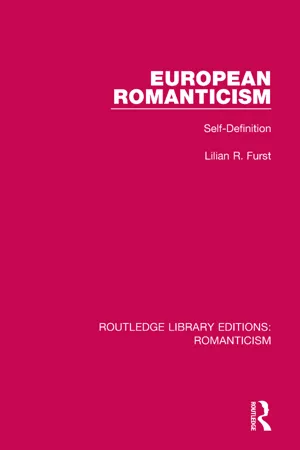
- 170 pages
- English
- ePUB (mobile friendly)
- Available on iOS & Android
eBook - ePub
About this book
Information
PART II
ROMANTIC ART: THE GUIDING PRINCIPLES
THE FUNCTION OF ART
WILHELM HEINRICH WACKENRODER
I know, however, of two wonderful languages, through which the Creator has granted man the means of grasping and comprehending divine matters in their full force, in so far as that is at all possible for mortal creatures (not to seem presumptuous). These languages speak to our inner selves, but not with the aid of words; suddenly, and in wondrous fashion, they move our whole being, permeating every nerve and every drop of blood in us. One of these wonderful languages is spoken by God alone; the other is spoken by a few chosen among men, whom He has annointed as His favourites. I am referring to: Nature and Art.
[…]
Art is a language quite different from nature, but it too, in similarly mysterious and secret ways, exercises a marvellous power over the human heart. Art speaks through pictorial representations of men, and uses a hieroglyphic language, whose signs we recognise and understand through their exterior. But in the visible figures which it presents, the spiritual and the sensuous are merged in such a touching and admirable manner, that the whole of our selves and every fibre of our being is again moved and stirred to the core.
[…]
One of these languages, which the Almighty Himself speaks from eternity to eternity, the language of ever living, infinite nature, raises us through the immensities of space directly to the Divinity himself. Art, however, which by the meaningful combination of coloured earth and a little moisture recreates the human shape in ideal form within a narrow, limited space (a kind of creative act that has been granted to mortals) — art opens up to us the treasures in the human breast, turns our gaze inwards, and shows us the invisible, I mean all that is noble, sublime and divine, in human form.
[…]
Art represents the highest human perfection. Nature, as far as it is perceptible to the human eye, is like a fragmentary oracular utterance from the mouth of the Divinity. If one may speak so familiarly of such things, one might perhaps say, that God views the whole realm of nature or the entire universe in the same way as we see the work of art.
Ich kenne aber zwei wunderbare Sprachen, durch welche der Schöpfer den Menschen vergönnt hat, die himmlischen Dinge in ganzer Macht, soviel es nämlich (um nicht verwegen zu sprechen) sterblichen Geschöpfen möglich ist, zu fassen und zu begreifen. Sie kommen durch ganz andere Wege zu unserm Inneren als durch die Hülfe der Worte; sie bewegen auf einmal auf eine wunderbare Weise unser ganzes Wesen und drängen sich in jede Nerve und jeden Blutstropfen, der uns angehört. Die eine dieser wundervollen Sprachen redet nur Gott, die andere reden nur wenige Auserwählte unter den Menschen, die er zu seinen Lieblingen gesalbt hat. Ich meine: die Natur und die Kunst.
[…]
Die Kunst ist eine Sprache ganz anderer Art als die Natur; aber auch ihr ist durch ähnliche dunkle und geheime Wege eine wunderbare Kraft auf das Herz des Menschen eigen. Sie redet durch Bilder der Menschen und bedient sich also einer Hieroglyphenschrift, deren Zeichen wir dem Äussern nach kennen und verstehen. Aber sie schmelzt das Geistige und Sinnliche auf eine so rührende und bewunderungswürdige Weise in die sicht-baren Gestalten hinein, dass wiederum unser ganzes Wesen und alles, was an uns ist, von Grund auf bewegt und erschüttert wird.
[…]
Die eine der Sprachen, welche der Höchste selber von Ewig-keit zu Ewigkeit fortredet, die ewig lebendige, unendliche Natur, ziehet uns durch die weiten Räume der Lüfte unmittel-bar zu der Gottheit hinauf. Die Kunst aber, die durch sinn-reiche Zusammensetzungen von gefärbter Erde und etwas Feuchtigkeit die menschliche Gestalt in einem engen, begrenzten Raume, nach innerer Vollendung strebend, nachahmt (eine Art von Schöpfung, wie sie sterblichen Wesen hervorzubringen vergönnt ward) — sie schliesst uns die Schätze in der menschlichen Brust auf, richtet unsern Blick in unser Inneres und zeigt uns das Unsichtbare, ich meine alles, was edel, gross und göttlich ist, in menschlicher Gestalt.
[…]
Die Kunst stellet uns die höchste menschliche Vollendung dar. Die Natur, soviel davon ein sterbliches Auge sieht, gleichet abgebrochenen Orakelsprüchen aus dem Munde der Gottheit. Ist es aber erlaubt, also von dergleichen Dingen zu reden, so möchte man vielleicht sagen, dass Gott wohl die ganze Natur oder die ganze Welt auf ähnliche Art, wie wir ein Kunstwerk, ansehen möge.
(Herzensergiessungen eines kunstliebenden Klosterbruders, pp. 52–5.)
NOVALIS
Poetry elevates each individual phenomenon through an original association with the rest of the whole — and if philosophy through its positing of laws prepares the world for the effective impact of ideas, then poetry, as it were, is the key to philosophy, its purpose and its significance — for poetry shapes the beautiful social order — the world family — the beautiful establishment of the universe.
Just as philosophy by means of system and state strengthens the forces of the individual through the forces of humanity and the universe, making the whole an organ of the individual and the individual an organ of the whole — so does poetry in relation to life. The individual lives in the whole and the whole in the individual. Through poetry the highest accord and interactivity comes into being, the closest communion between the finite and the infinite.
Die Poesie hebt jedes Einzelne durch eine eigentümliche Verknüpfung mit dem übrigen Ganzen — und wenn die Philosophie durch ihre Gesetzgebung die Welt erst zu dem wirksamen Einfluss der Ideen bereitet, so ist gleichsam Poesie der Schlüssel der Philosophie, ihr Zweck und ihre Bedeutung; denn die Poesie bildet die schöne Gesellschaft — die Weltfamilie — die schöne Haushaltung des Universums.
Wie die Philosophie durch System und Staat die Kräfte des Individuums mit den Kräften der Menschheit und des Weltalls verstärkt, das Ganze zum Organ des Individuums und das Individuum zum Organ des Ganzen macht — so die Poesie in Ansehung des Lebens. Das Individuum lebt im Ganzen und das Ganze im Individuum. Durch Poesie entsteht die höchste Sympathie und Koaktivität, die innigste Gemeinschaft des End-lichen und Unendlichen.
(Fragmente des Jahres 1798, Gesammelte Werke, No. 807, vol. III, pp. 22–3.)
* * * * *
Poetry is the great art of the building of transcendental health. The poet thus is the transcendental doctor.
Poetry shunts and shifts pain and pleasure — desire and aversion — fallacy and truth — health and disease. It intertwines everything for its great purpose of purposes: the elevation of mankind above itself.
Poesie ist die grosse Kunst der Konstruktion der transzendentalen Gesundheit. Der Poet ist also der transzendentale Arzt.
Die Poesie schaltet und waltet mit Schmerz und Kitzel — mit Lust und Unlust — Irrtum und Wahrheit — Gesundheit und Krankheit. Sie mischt alles zu ihrem grossen Zweck der Zwecke: der Erhebung des Menschen über sich selbst.
(Fragmente des Jahres 1798, Gesammelte Werke, No. 818, vol. III, p. 25.)
* * * * *
Poetry is the genuine absolute Reality. That is the kernel of my philosophy. The more poetic, the truer.
Die Poesie ist das echt absolut Reele. Dies ist der Kern meiner Philosophie. Je poetischer, je wahrer.
(Fragmente des Jahres 1798, Gesammelte Werke, No. 1247, vol. III, p. 141.)
* * * * *
Poetry is representation of the spirit — of the inner world in its totality. Its medium already, words, hint at this for they are the outer revelation of that inner realm of power.
Poesie ist Darstellung des Gemüts — der innern Welt in ihrer Gesamtheit. Schon ihr Medium, die Worte, deuten es an, denn sie sind ja die äussre Offenbarung jenes innern Kraftreichs.
(Fragmente aus den letzten Jahren 1799–1800, Gesammelte Werke, No. 2857, vol. iv, p. 256.)
* * * * *
Should not poetry be nothing other than inner painting, music etc.? Modified, it is true, by the nature of the spirit.
In poetry, which is in a sense only an appropriate mechanical instrument, one seeks to bring forth inner moods and pictures or contemplations, perhaps even spiritual dances etc.
Poetry = the art of moving the spirit.
Sollte Poesie nichts als innre Malerei und Musik etc. sein? Freilich modifiziert durch die Natur des Gemüts.
Man sucht mit der Poesie, die gleichsam nur das mechanische Instrument dazu ist, innre Stimmungen und Gemälde oder Anschauungen hervorzubringen, vielleicht auch geistige Tänze etc.
Poesie = Gemütserregungskunst.
(Fragmente aus den letzten Jahren 1799 1800, Gesammelte Werke, No. 2907, vol. iv, p. 267.)
* * * * *
The feeling for poetry has much in common with the feeling for mysticism. It is the feeling for the particular, the personal, the unknown, the arcane, the revelatory, the perforce adventitious. It portrays the unportrayable. It sees the invisible, senses the impalpable.
Der Sinn für Poesie hat viel mit dem Sinn für Mystizismus gemein. Er ist der Sinn für das Eigentümliche, Personelle, Unbekannte, Geheimnisvolle, zu Offenbarende, das Notwendig-Zufällige. Er stellt das Undarstellbare dar. Er sieht das Unsichtbare, fühlt das Unfühlbare.
(Fragmente aus den letzten Jahren 1799 1800, Gesammelte Werke, No. 3056, vol. iv, p. 302.)
WILLIAM WORDSWORTH
Aristotle, I have been told, has said that Poetry is the most philosophic of all writing: it is so: its object is truth, not individual and local, but general, and operative; not standing upon external testimony, but carried alive into the heart by passion; truth which is its own testimony, which gives competence and confidence to the tribunal to which it appeals, and receives them from the same tribunal. Poetry is the image of man and nature.
(Preface to ‘Lyrical Ballads’, Poetical Works, vol. ii, pp. 394–5.)
* * * * *
Poetry is the first and last of all knowledge — it is as immortal as the heart of man. If the labours of Men of science should ever create any material revolution, direct or indirect, in our condi- tion, and in the impressions which we habitually receive, the Poet will sleep then no more than at present; he will be ready to follow the steps of the Man of science, not only in those general indirect effects, but he will be at his side, carrying sensation into the midst of the objects of the science itself. The remotest discoveries of the Chemist, the Botanist, or Mineralogist, will be as proper objects of the Poet’s art as any upon which it can be employed, if the time should ever come when these things shall be familiar to us, and the relations under which they are contemplated by the followers of these respective sciences shall be manifestly and palpably material to us as enjoying and suffering beings. If the time should ever come when what is now called science, thus familiarised to men, shall be ready to put on, as it were, a form of flesh and blood, the Poet will lend his divine spirit to aid the transfiguration, and will welcome the Being thus produced, as a dear and genuine inmate of the household of man. — It is not, then, to be supposed that any one, who holds that sublime notion of Poetry which I have attempted to convey, will break in upon the sanctity and truth of his pictures by transitory and accidental ornaments, and endeavour to excite admiration of himself by arts, the necessity of which must manifestly depend upon the assumed meanness of his subject.
(Preface to ‘Lyrical Ballads’, Poetical Works, vol. ii, pp. 396–7.)
* * * * *
The appropriate business of poetry, (which, nevertheless, if genuine, is as permanent as pure science,) her appropriate employment, her privilege and her duty, is to treat of things not as they are, but as they appear; not as they exist in themselves, but as they seem to exist to the senses, and to the passions.
(Preface to ‘Lyrical Ballads’, Poetical Works, vol. ii, p. 410.)
* * * * *
The commerce between Man and his Maker cannot be carried on but by a process where m...
Table of contents
- Cover
- Half Title
- Title Page
- Copyright Page
- Original Title Page
- Original Copyright Page
- Table of Contents
- Preface
- I. Concepts and Definitions
- II. Romantic Art: The Guiding Principles
- III. Romantic Art: Form and Genre
- IV: Data
Trusted by 375,005 students
Access to over 1.5 million titles for a fair monthly price.
Study more efficiently using our study tools.
Frequently asked questions
Yes, you can cancel anytime from the Subscription tab in your account settings on the Perlego website. Your subscription will stay active until the end of your current billing period. Learn how to cancel your subscription
No, books cannot be downloaded as external files, such as PDFs, for use outside of Perlego. However, you can download books within the Perlego app for offline reading on mobile or tablet. Learn how to download books offline
Perlego offers two plans: Essential and Complete
- Essential is ideal for learners and professionals who enjoy exploring a wide range of subjects. Access the Essential Library with 800,000+ trusted titles and best-sellers across business, personal growth, and the humanities. Includes unlimited reading time and Standard Read Aloud voice.
- Complete: Perfect for advanced learners and researchers needing full, unrestricted access. Unlock 1.5M+ books across hundreds of subjects, including academic and specialized titles. The Complete Plan also includes advanced features like Premium Read Aloud and Research Assistant.
We are an online textbook subscription service, where you can get access to an entire online library for less than the price of a single book per month. With over 1.5 million books across 990+ topics, we’ve got you covered! Learn about our mission
Look out for the read-aloud symbol on your next book to see if you can listen to it. The read-aloud tool reads text aloud for you, highlighting the text as it is being read. You can pause it, speed it up and slow it down. Learn more about Read Aloud
Yes! You can use the Perlego app on both iOS and Android devices to read anytime, anywhere — even offline. Perfect for commutes or when you’re on the go.
Please note we cannot support devices running on iOS 13 and Android 7 or earlier. Learn more about using the app
Please note we cannot support devices running on iOS 13 and Android 7 or earlier. Learn more about using the app
Yes, you can access European Romanticism by Lilian R. Furst in PDF and/or ePUB format, as well as other popular books in Literature & English Literary Criticism. We have over 1.5 million books available in our catalogue for you to explore.