The Gulf States are the focus of great international interest – yet their fabulous evolution from pearl-fishing to oil-drilling, their individuality and variety, are screened by a thick cloud of petro-dollars. This book, first published in 1989, tells the story of their formation, their evolution from colonial dependency to statehood, and their transformation by oil. The result is an informed and balanced picture of the political, economic, religious and cultural character of the area. It is also a story of the powerful families and their sheikhs that have had to hurry these states into the modern world; of the interchanging role of political and economic dependence, the influence of the oil industry, the influx of workers from abroad, and the varying forces acting on the Gulf States.
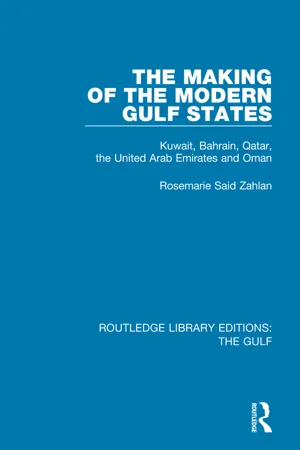
eBook - ePub
The Making of the Modern Gulf States
Kuwait, Bahrain, Qatar, the United Arab Emirates and Oman
- 180 pages
- English
- ePUB (mobile friendly)
- Available on iOS & Android
eBook - ePub
The Making of the Modern Gulf States
Kuwait, Bahrain, Qatar, the United Arab Emirates and Oman
About this book
Information
1 The Gulf in History
The Land of Paradise
The Gulf region is one of the oldest continuously inhabited places in the world. According to ancient tradition, a fish-man, Oannes, swam up the Gulf, bringing with him the gifts of civilization. Five thousand years ago, its western coast was the centre of a flourishing civilization: that of the idyllic land of Dilmun whose landmarks are still in the process of being discovered. It was sacred to the Sumerians who venerated it in their poetry, referring to it alternatively as the Land of Paradise, the Land of the Living, and the Home of the Gods. It has been suggested that it was to Dilmun that the hero-king of the great Epic of Gilgamesh travelled in search of the survivor of the Universal Deluge; for Dilmun was the home of the god Ea, the friend of man.
Dilmun covered most of eastern Arabia and present-day Bahrain. It was a fertile and arable land with abundant water supplies; its irrigation and other agricultural activities were amongst the earliest to be known. It was not only a great religious and cultural centre, but also an important trading nation. Then, as today, its strategic location was one of its greatest assets: it lay between the great civilization of Sumer to the north and the Indus Valley to the east, taking in the ancient centre of Magan (Oman today) to the south. During the third and second millennia, the merchants of Dilmun carried a wide variety of goods between the east and the Mesopotamian city-states.
Dilmun was closely linked with Sumer, but it was not a dependency. Besides being a significant entrepôt, it produced two principal exports with which the Gulf region has been associated ever since: dates, the fruit of the palm trees which grow there in abundance; and the beautiful, luminous pearls of the Gulf waters, the 'fish-eyes' of the ancient texts.
Since those days, the destiny of the Gulf states has been linked with the centres of world power. Recent evidence has suggested, moreover, that the Gulf was the original homeland of the Phoenicians; their links with Egypt and Persia, the great powers of the day, obviously continued a well-established tradition.
But not only the Arab side of the Gulf was active. The Persian or eastern coast came into its own during the sixth century sc when the first Persian Empire was founded by Cyrus the Great. From that time to the present, political events in the Gulf have been punctuated by rivalry between the eastern and western coasts, between the Persians and the Arabs. Over this long period of time, a considerable intermingling of the two peoples has taken place. The Persians have lived on the Arab side to partake of the rich trade going on there, to escape political or commercial exploitation at home, or as a result of conquest, and the Arabs have lived on the Persian side for similar reasons. The result today is that the coastal populations of both sides of the Gulf contain a mixture of Arabs and Persians.
Alexander the Great had ambitions to build an empire in western Asia, and to this end he dispatched his admiral, Androsthenes of Thasos, to survey the Gulf region. The early death of Alexander, however, put an end to these plans. They were revived during the Roman period when the Emperor Augustus assigned Gaius Caesar, his adopted son and heir, to mount a campaign in Arabia: a number of 'strategic studies' were prepared for this. But during the periods of the Greek and Roman empires, the focii of their respective policies were in Europe, Africa and the eastern Mediterranean. Thus the Gulf region did not assume the same strategic importance it had enjoyed during the Babylonian period. This importance was revived in the seventh century AD with the birth of Islam. The Arabs were then propelled to international prominence.
The Arabian Nights
In the eighth century AD, Baghdad became the capital of the Abbasid caliphate. The Arab side of the Gulf once again became a major entrepot for goods; it was also an important communications, strategic and financial centre. The court of Baghdad was a luxurious one, and the merchants of the Gulf provided it with a wide variety of goods: textiles and spices from India; porcelain, drugs and textiles from China. The exquisite pearls of the Gulf, amongst the most perfect in the world, were very much in demand at this time, for this was the era of The Arabian Nights, and of Caliph Haroun al-Rashid. The pearling industry, which had evolved over the centuries, became highly sophisticated and reflected the scientific and technological inclinations of the period. Detailed maps of the pearling banks were drawn up; so too were astonishingly thorough lists of the varieties of pearls available, including their shapes, weights and prices.
Trade at this time depended on the skills of the Arab navigators whose sailing ships regularly travelled the 6,000-mile journey to China. The story of Sindbad the Sailor in The Arabian Nights was based on their experiences. To re-create the extraordinary story of those early Arab sailors, Tim Severin undertook an epic voyage in 1980. He constructed a ship in the old way- using timber held together with coconut rope - and with a crew which included Omani sailors, he followed Sindbad's route from Oman to China. His experiences were recorded in his fascinating book, The Sindbad Voyage (London, 1982).
One of the thriving commercial centres of the Gulf during the early Abbasid period was Sohar in Oman. It is said to have been a very beautiful city whose population was made up of both Persians and Arabs. Less important, but active none the less, was Muscat. Once Baghdad became established as the capital of the Abbasid Caliphate, several commercial centres sprang up in the north of the Gulf; of these, Basra was perhaps the most notable. But the political upheavals caused both by the Zanj (slave) revolution which began there in 868, followed by the rebellion of the Qarmatians, with headquarters in the Bahrain islands, brought with them a serious disruption of trade. Alternative locations for the lucrative import-export activities were found on the Persian side of the Gulf from the early eleventh century onwards.
Siraf was the first of the major trading centres to evolve on the eastern coast. Its people, Arabs and Persians, continued the tradition of sailing to and from India and China. Siraf was succeeded in commercial importance by the island of Kishm, just over 60 kilometres (100 miles) away. Its population was predominantly Arab, as were its rulers. The next and possibly the most impressive of the trading emporia in the Gulf was the island of Hormuz which attained its apogee militarily and commercially from the early fourteenth century until the advent of the Portuguese.
The authority of Hormuz extended to several places on the Arab and Persian coasts, including the Bahrain islands whose pearls provided one of the main sources of Hormuz's income. But it was its strategic position at the mouth of the Gulf which was its most important characteristic, for otherwise it lacked water and had very little vegetation. Its place in the history of the Gulf is memorable. It was remarkably rich, with a large and varied population whose nucleus was, once again. Arabs and Persians. Its traders carried merchandise east and west, and its prosperity was manifestly obvious to all travellers who arrived there.
The beginnings of European colonialism
The prosperity of Hormuz, however, went into decline with the entry to Gulf waters of the Portuguese. It was the successful circumnavigation by Vasco da Gama of the Cape of Good Hope during the late fifteenth century which ushered in the era of European penetration. For subsequently the Portuguese made their push to the east, and the Gulf became coveted by foreign powers because of its strategic position on the rich route to India.
For the next four centuries, the Gulf became inextricably linked with the commercial and political rivalries of western countries: Portugal first, then Holland and France, and finally Britain. To this was added the rivalry of the Ottoman Empire; from the early sixteenth century when Baghdad and then Basra became a part of the Empire, the Gulf became an added concern of the Porte.
Portuguese domination of the Gulf reached its zenith during the sixteenth century. Albuquerque first took Muscat, thereby controlling most of the ports on the southern and eastern coasts of Oman; then Hormuz was captured in 1514, ushering in the decline of that great centre. Bahrain was added to the Portuguese possessions less than a decade later. Before long, the Portuguese were in full command of the great spice and silk route to India.
With time, however, two forces were to threaten Portugal's position severely and ultimately cause its withdrawal from the region. The first was that of the Ottomans, who had already defeated the Portuguese at Jeddah in 1517, thereby curbing their expansion in the Red Sea. The Ottomans then tried, unsuccessfully, to dislodge the Portuguese from Hormuz. The second force was that of Shah Abbas, the great Safavid ruler of Persia, whose rise to power was concurrent with his ambition to dominate Gulf waters. His first victory was in 1602 when he overran Bahrain; and then his final objective, to take back Hormuz, was brought about with the help of the English East India Company with which he had made an alliance.
It was not long before the Dutch and French East India Companies became involved in the region in an effort to offset the new foothold gained by the English. The whole of the seventeenth century was dominated by intense rivalry between the representatives of these three European companies.
In the meantime, both Arabs and Persians were gradually re-adjusting to their international environment. The arrival of the Portuguese had been a new experience for the region: for the first time, an outside power had held sway there. Although foreign powers were to retain their position in the region for close to 500 years, they had to struggle against opposition from local forces anxious to regain some of the lost territories.
The focus was Bahrain and Muscat, the two most important places on the Arab coast. Local powers began to contest European possession of them towards the middle of the seventeenth century. The first major battle occurred in 1660 when Muscat was regained from the Portuguese by the Yaaribah tribe of Oman; a few decades later, the same tribe successfully dislodged the Persians from Bahrain. But they were not to hold Bahrain for very long. For when Nadir Shah came to power in 1736, he was determined to extend his rule to both shores of the Gulf, like other strong rulers of Persia before and after him. To this end he built a navy and in 1753 he wrested control first of Bahrain and later of Muscat. The Persians. however, did not rule Muscat for long: they were finally expelled by the military forces of the (Arab) Governor of Sohar, Ahmad bin Said, the founder of the AI bu Said dynasty which rules Oman today. The AI bu Said consolidated their rule and regained for Oman its former position as a great trading centre. By the nineteenth century it had become a maritime empire under one of its greatest rulers, Said bin Sultan AI bu Said (1807-56).
The eighteenth-century framework
Almost concurrently with the establishment of the AI bu Said in Oman during the mid-eighteenth century, two major events occurred which were to have a lasting influence on the Gulf states. The first of these was Clive's victories in India which established British dominance on the north-eastern coast of India, thus paving the way for further penetration of the sub-continent: this was to lead to the growth of British interests in the Gulf as a means of protecting its trade route to India.
The second event was the rise in central Arabia of the Wahhabi movement (named after its founder, Shaikh Muhammad ibn Abdel Wahhab), which was later to expand throughout the Arabian peninsula. Its basic ideology was to effect a return to the original principles of Islam; its main theological tenet was the oneness or unity of God. The Wahhabis forged an alliance early on with the AI Saud who ruled Dariyyah in Nejd (central Arabia). This alliance has been maintained and remains the basis of the Kingdom of Saudi Arabia today.
The ultimate emergence of British interests in the Gulf and the birth of the Wahhabi-Saudi movement together provided the framework for the modern Gulf region. Within this broadly based framework, a large number of processes occurred over the next 200 years which were to shape the Gulf states as we know them today.
One such process was the rise of the Qasimi (plural Qawasim) tribal confederacy which was achieving fame and notoriety well beyond the confines of Gulf waters. Their headquarters alternated over the years between Sharjah and Ras al-Khaimah (in the UAE today), and their power extended to both the Persian and Arab coasts. They commanded a remarkably large fleet, equipped for trade as well as warfare. It was said to have had around 900 vessels, many of which were swifter than European ships, and its naval force consisted of about 8,000 fighting men.
The appellation of 'pirates', which was given to the Qawasim by the Europeans from the seventeenth century on, has caused considerable controversy in recent times. Only in the past three or four decades have the citizens of the UAE become fully acquainted with the image projected of them in the past as sea faring bandits; and they have since attempted to correct what they consider to be a misrepresentation of fact. The present Amir of Sharjah, Sultan Muhammad AI Qasimi, has researched the avail able records of the period; the results of his work have gone a long way to refuting the old image of the Qawasim, of which he is a member. His work was undertaken originally in the form of a Ph.D. dissertion at the University of Exeter, and was published in a recent book entitled The Myth of Arab Piracy in the Gulf (London, 1986).
The term is, of course, relative, and seems to have been used by English and Dutch traders who were angered when the Qawasim established a trading station on the island of Kishm off the Persian coast in the eighteenth century. The English East India Company had a major trading interest at the neighbouring station of Bandar Abbas and therefore stood to lose a fair amount on its customs dues and the Qasimi station. In order to ensure British supremacy in the immediate vicinity, therefore, a British naval expedition attacked and raided Kishm. The reason given for the attack and the consequent seizure of goods and money was to redress the balance of the loss in customs dues. The war between the Qawasim and the British had started.
The power of the Qawasim grew, rather than abated, throughout the eighteenth century. Moreover, they became allied with the Wahhabis, whose first major expansion reached the eastern coast of the Arabian peninsula; thereafter, the Qawasim can be regarded as having become the naval extension of the Wahhabi movement. This included the obtaining of tribute for the safe passage of merchant vessels.
The death knell of the Qawasim was sounded in 1809 when the British launched an expeditionary force against their principal headquarters in Ras al-Khaimah. Ras al-Khaimah was briefly occupied and most of the Qasimi fleet, which was lying off the town, was destroyed. This act of violence so incensed the Qawasim that they retaliated, rallying the neighbouring shaikhs of Umm al-Qaiwain, Ajman, Abu Dhabi, Dubai and Bahrain to their cause.
The Trucial system
They were ultimately to discover that they were no match for British sea power. In 1820, after a devastating siege of Ras al Khaimah by British forces which was followed by the destruction of the entire Qasimi fleet, the trucial system was set in motion. The Qawasim and the shaikhs of Ajman, Umm al-Qaiwain, Abu Dhabi, Dubai and Bahrain capitulated and signed separate agree ments with the British government. Each was known as the General Treaty of Peace and in it each shaikh bound himself to abstain from 'piracy' on land and at sea. By the same token, Britain made it clear that it had no territorial or political ambitions in the area and that it would not interfere in local affairs.
The General Treaty of Peace constituted the genesis of the Gulf states as separate political units; and of their shaikhs as independent rulers, for that is how they were reflected in their new relationship with Britain. The Gulf states had thereby entered into 'treaty relations' with Britain.
The extent of these separate political units - and consequently how far the authority of their rulers extended- was not considered until over 100 years later when the oil companies became interested in the region. In the meantime, British interest focused on coastal areas because of the sea route between Britain and India.
The 1820 treaty protected British vessels from attack, but it did not prevent warfare at sea between the coastal tribes, so in 1835, the chiefs of Abu Dhabi, Dubai, Sharjah and Ajman signed a one-year truce in which they undertook to report any aggression to the British authorities rather than retaliate themselves. The truce was renewed the next year and at various intervals until 1853 when the Perpetual Maritime Truce was signed and the shaikhs undertook to call a halt to all hostilities at sea.
The states whose rulers had signed the Perpetual Maritime Truce became known as Trucial states, a name which persisted until 1971 when they united to form the federation called the United Arab Emirates. Two main groupings have dominated the Trucial states: the Qawasim and the Bani Yas. The latter are a land power, different branches of which rule over Dubai and Abu Dhabi. Because seafaring had been the most important activity until the treaties with Britain, the Qawasim had been the dominant force on the coast.
One of the most significant repercussions of the new relationship with Britain was the gradual decline of the Qawasim, whose seafaring activities, the basis of their power, were curtailed, and the subsequent rise of the Bani Yas. By the end of the nineteenth century, the latter assumed a position of primary importance in ...
Table of contents
- Cover
- Title
- Copyright
- Original Title
- Original Copyright
- Contents
- Introduction
- 1 The Gulf in History
- 2 The Emergence of the Gulf States
- 3 Representative Government in Kuwait
- 4 Political Developments in Bahrain
- 5 The Political Order
- 6 The Ruling Families of Kuwait, Bahrain and Qatar
- 7 The Ruling Families of the United Arab Emirates
- 8 The Ruling Family of Oman
- 9 Saudi Arabia, the Powerful Neighbour
- 10 The International Setting
- Appendix: The Ministers of the Gulf States
- Index
Trusted by 375,005 students
Access to over 1.5 million titles for a fair monthly price.
Study more efficiently using our study tools.
Frequently asked questions
Yes, you can cancel anytime from the Subscription tab in your account settings on the Perlego website. Your subscription will stay active until the end of your current billing period. Learn how to cancel your subscription
No, books cannot be downloaded as external files, such as PDFs, for use outside of Perlego. However, you can download books within the Perlego app for offline reading on mobile or tablet. Learn how to download books offline
Perlego offers two plans: Essential and Complete
- Essential is ideal for learners and professionals who enjoy exploring a wide range of subjects. Access the Essential Library with 800,000+ trusted titles and best-sellers across business, personal growth, and the humanities. Includes unlimited reading time and Standard Read Aloud voice.
- Complete: Perfect for advanced learners and researchers needing full, unrestricted access. Unlock 1.5M+ books across hundreds of subjects, including academic and specialized titles. The Complete Plan also includes advanced features like Premium Read Aloud and Research Assistant.
We are an online textbook subscription service, where you can get access to an entire online library for less than the price of a single book per month. With over 1.5 million books across 990+ topics, we’ve got you covered! Learn about our mission
Look out for the read-aloud symbol on your next book to see if you can listen to it. The read-aloud tool reads text aloud for you, highlighting the text as it is being read. You can pause it, speed it up and slow it down. Learn more about Read Aloud
Yes! You can use the Perlego app on both iOS and Android devices to read anytime, anywhere — even offline. Perfect for commutes or when you’re on the go.
Please note we cannot support devices running on iOS 13 and Android 7 or earlier. Learn more about using the app
Please note we cannot support devices running on iOS 13 and Android 7 or earlier. Learn more about using the app
Yes, you can access The Making of the Modern Gulf States by Rosemarie Said Zahlan in PDF and/or ePUB format, as well as other popular books in Social Sciences & Regional Studies. We have over 1.5 million books available in our catalogue for you to explore.