![]()
A Four Faces of Child Abuse
The ancient Roman god Janus had only two faces. Sadly, child abuse has many faces. Limitation of space only allows us to look at four. So such important areas as emotional abuse and failure to thrive have had to be omitted. As sexual abuse causes so much anxiety this area of work has been given extra focus.
![]()
2 The First 'Great Concern' — Physical Abuse
The more knowledge one has the less sure one becomes. This is precisely the position with our understanding of physical abuse of children. Literally millions of words have been written on the subject. Building on some comments by Lask (1987), what tends to happen when a body of knowledge starts to accrue is a journey through four stages.
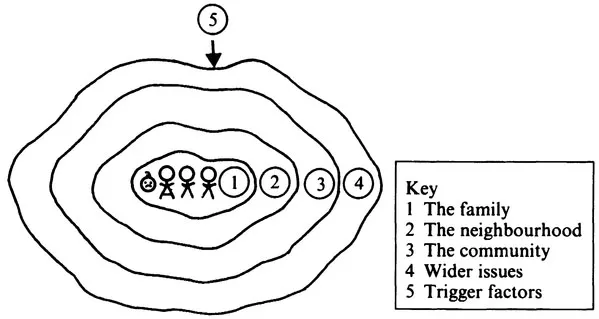
The first is the pioneering stage when professionals start to campaign to bring a problem to the notice of colleagues. Then comes the period when everyone tries to climb on the bandwagon. This is followed by the omnipotence period when the profession creates its own gurus who jet around the country lecturing to prestigious conferences. Lastly, comes the fourth stage, which at the time of writing, is where we are now in the case of physical abuse of children. This is the time of disillusionment when we become less sure - even admitting our lack of certainty. 'Yet despite all that has been written, our state of knowledge is not good' (Jones et al 1987). To gain understanding amidst the shifting sands it helps to establish at least one sure platform from which to start. Some constructs may help. (See Figure 2.1.)
First Construct — Moving Circles
Without falling into the trap of blaming the victim it should be taken into account that there may be things about the child, the child's behaviour, or at least in the parents' perception of the child's behaviour that results in a negative response from the parents or caretakers. This in turn pulls from the child a negative response. Child, parent and wider caretakers thus become part of a family system (1), which interacts with the neighbourhood circle (2), which in turn responds and is affected by the community (3), and wider issues (4). Without pushing the construct too far, it is like a mobile hanging from the hood of a baby buggy, it moves in the wind and creates unique patterns and shapes.
Physical abuse of children is caused by a variety of interacting and interlocking forces. All may appear well. The tinder wood is dry and there is no sign of fire. Then a trigger factor becomes the match. The fire is lit.
The trigger factor may occur a thousand miles away. An accountant in Chicago looks at the books of a subsidiary firm in a small town in the UK. It isn't making a profit. It must close. Joe has a role in this firm. He is proud of the firm's football team and of his work as shop steward. Suddenly after years of loyal service he is out of work. He never saw himself as a child carer but now his wife has to work. In his world the man is the breadwinner but her skills are in demand. Joe feels washed up, devalued and most importantly of all, angry. His marriage, which has always been tenuously balanced, starts to come apart at the seams. Michael, his toddler, who was the reason for the marriage in the first place, is particularly bothersome. Suddenly Joe loses control and attacks the child.
Historical Perspective
Child abuse is as old as time itself. The practice of infanticide was widely accepted among ancient and prehistoric peoples as a legitimate means of dealing with unwanted children. Hilarion's instructions to his wife Alis (1 B.C.) were 'If, as may well happen, you give birth to a child, if it be a boy let it live, if it be a girl expose it' (De Mause 1974). Sexism indeed! The Greek dramatist Euripides recounts that infants were exposed on every hill and roadside 'a prey for birds, food for wild beasts to rend' (Robin 1982). Though Tardieu wrote a paper in Paris in 1860 about his findings on 32 children who were killed by whipping and burning, John Caffey (1946), a radiologist, is usually given credit for initiating the medical world's first 'great concern'.
He noted in 1946 multiple fractures to the long bones of six children suffering from chronic subdural haematoma. It is interesting and says a lot about the attitudes at the time that he was mystified as to the cause. Silverman in 1953 suggested in a later article that it was due to negligence on behalf of the caretakers but softened his observations by suggesting that the injuries may be due to 'accident proneness' (Silverman 1953). It was too painful to consider the parents may be reponsible.
Kempe, with four of his colleagues, coined the phrase 'the battered baby syndrome'. We should be grateful to Kempe (1962) as often it needs a dramatic label to ensure public attention. Something that has been going on for years can then be studied and possible solutions discovered. However he has also left us with the unfortunate legacy of a terrible temptation to see child abuse victims as always young. No one is interested in the six foot victim with a way-out hairstyle. He/ she cannot possibly be abused!
Why?
Adolescents
Referring back to the figure on p 14, let us start, in the very centre of our first circle (1). The battered child could be an adolescent. Abuse can begin for the first time at this age. Adolescence as a developmental stage can bring a new element into a situation. Garbarino (1980) suggests that this is most common in families when the child was originally indulged by the parents. Parents thus expect excessive dependence and compliance from their offspring. As the child reaches adolescence both parents and children elicit frustration, resistence and anger from each other. The adolescent wants now to be his or her own person. This is when the parents can respond by becoming violent. In half of the cases studied by Garbarino where adolescents were reported for the first time as abused, there was no previous childhood history of abuse.
The saddest group (40 per cent) however, were cases reported for the first time when the child was adolescent but where abuse had been going on throughout the whole of childhood.
The third pattern of adolescent abuse included situations where parents had always used physical chastisement, but as the adolescent was getting bigger, had greater confidence and increased independence, the parents, perhaps feeling they were losing control, escalated their punishments to frightening levels. It is often a last-ditch stand to save a family from real or imaginary disgrace from a 'disobedient' son or daughter.
Sometimes the tables are turned. Parents who have always severely abused, build up considerable resentment in their children. One day the children reach the stage when they can actually resist. This is when they turn on the parent. In cases of matricide and patricide always look first to see if it is the result of long-standing abuse (Mones 1985).
The last pattern to be found in cases where adolescents had been abused is where parents had problems around issues of dependence, autonomy and social control, when the young person was a toddler. The problems of the 'terrible twos' resurrect when the young person reaches adolescence. Now the outcome is more destructive. According to Carlson
a relationship has been observed between being abused as an adolescent and externalizing or antisocial behaviours, the most common of which is physical aggression or violence .... The consequences are also manifested in internalizing behaviour such as withdrawal, depression, suicidal thoughts ... and self destructive behaviours such as substance abuse (Carlson 1991).
Physical factors
A hyperactive child can become a focal point of the parents' aggression. If there are family and friends around, the parents may be able to cope. If the parent is isolated and already has feelings of low self-esteem she/he experiences an inability to cope, thus confirming all the feelings of low self-image and inadequacy.
Parents may have longed for a responsive bright-eyed child and then it turns out to be placid and unresponsive. It is not necessarily the severely handicapped child that is the focal point of aggression since parents can in these circumstances get a lot of support from services, friends and family. More problematic can be the situation where there is a slight handicap: a child say, with a hearing problem. We tend to discipline by tone of voice. If a child cannot pick up the subtle change of tone, a negative interaction can begin. 'He hears when he wants to' was the angry comment made to me by one mother.
A child's particular pitch of cry can challenge the self-control of adults the world over - from Bangkok to Basingstoke. Nothing, but nothing stops it. A parent can try everything. To some parents, however, the child seems to be rejecting the very essence of their care. They longed for the day they could cuddle the baby. It turns out to be a non-cuddler. To add insult to injury, it spits out its food. The child may be seen as the wrong sex or believed to be different in some way. For instance James' mother overhead a conversation in the hospital which implied, she thought, there was something wrong with her son. She began to insist he was different. Certainly his odd haircut and untidy clothes were in sharp contrast to the presentation of his pretty sisters. Shortly after the birth of the third child she admitted she had tried to strangle James.
The child may become a symbol
Some people make excellent partners but cannot take into a relationship a third person - a child. The child then becomes a symbol of the broken relationship. 'All was well till you arrived.' A child can be seen as a bearer of trouble and bad luck; born at a time of crisis. Or a child can be a reminder of a painful past. Donna had been beaten by her father for stealing. She was eventually sent to prison in adulthood for theft. She then settled into a respectable relationship. Then when her child stole 50p from her boyfriend's trousers hanging over a chair, all her painful past flashed through her mind and she attacked the child, breaking his collar bone.
Bonding
It would be going over the top to suggest that if bonding doesn't take place in the first 30 minutes of life the child will be battered. However bonding, though always remembering the comments of Sluckin (1983), is crucial. If parents and child have suffered experiences that interfere with the attachment it can create significant difficulties. Jones (1987) cites the case of Brenda, aged 26 who was effective in her job and meticulous in her home. She successfully reared a placid and obedient little girl but her second child was a premature boy who had to spend three weeks in an incubator in a neonatal unit many miles from the parents' home. She didn't establish an emotional relationship with the child. As so often happens she blamed the victim, saying she found him unresponsive and difficult. She attempted to strangle him one night 'after many weeks of sleeplessness because of his crying.'
The difficulty with all the studies that have been published is that though we can perhaps distinguish 'abusing parents from the total population' (Jones et al 1987) the features are not significantly different from those parents having general problems with their children. However to aid study, a second construct may be helpful.
Second Construct — The House
Think of a house that has many rooms. In each room can be found parents or caretakers who may be more vulnerable to abusing their children.
Hostile pedigree
Go through the front door and into the first room of the house. Here I would put parents who have been brought up in an atmosphere of emotional deprivation where they have been unloved, assaulted themselves, where violence has been the main way of problem solving in their homes. They have no model of love and have often been bonded in hate to parents who denigrate them as people or as parents. They cannot break free, their parents keep them tied in a relationship that undermines them and their parenting skills. This often leads to hostility towards all authority figures, to seeing the world as distrustful, and to a good deal of unprocessed anger. Such people may present well as workers and friends, to adults. However when children are born, and especially during the toddler stage, the child appears to hold the key to the cupboard of anger, which when it is unlocked can envelope the child.
Excessive dependence needs
Close the door and go along the corridor, to the room containing the group of parents who have excessive dependence needs - searching for love at any price. They cannot maintain relationships as they drain everyone dry, workers included. They are so desperate to keep a relationship that when the violent partner moves in they will sacrifice the child to keep the partner (as has been found in so many inquiry reports).
Role reversal
Proceed to the next room and here I would put the people who demonstrate the phenomenon of role reversal. All their unsatisfying lives they have longed for the time when they will have a child who will magically transform their whole world. Babies of course don't do that, at least not in the way we expect. Children are demanding creatures. The parent then experiences the child's demands as irritating and unwelcome. The more the child is ignored, the more the child claws for attention. The child who was going to make all things well and good, is seen as a little monster. Once this line of thinking develops, the child is seen as deserving of attack.
Too high expectations
In the next room would be adults who have too high expectations of children's developmental milestones. They expect the child to be clean too quickly, to walk too soon. At a very early age they expect the child to know right from wrong. One mother with a child of three months angrily said 'He knows right from wrong - he's just being difficult to get back at me.'
Rigid and obsessive
It's time we went upstairs. In the front bedroom I would put parents who are rigid and obsessive. They have coped successfully, sometimes very successfully, with their professional lives. Then baby arrives. They read all the right manuals but this new little person skews their well-ordered existence and untidies their beautifully kept home. The child throws his meal on the floor. It is mopped up. He then wets the shiny parquet floor. It is mopped up. Then the last straw, he sicks all over the expensive wall covering. Perfect routines and domestic standards are thrown into chaos. The child is battered.
Marital conflict and stress
We rush on quickly to the next bedroom. Lorber (Lorber et al 1984) teases out marital conflict and family discord as a predisposing factor to physical violence. Millner and Wimberley (1980) and Whipple and Webster-Stratton (1991) talk about the effects of being under a high degree of stress. Lily's marriage was on the...