- 237 pages
- English
- ePUB (mobile friendly)
- Available on iOS & Android
eBook - ePub
About this book
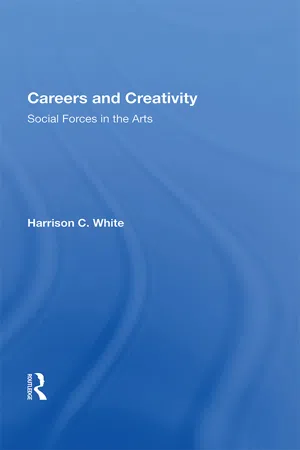
How much does art provide escape from everyday life, and how much does it aid in controlling life? How are art worlds built and maintained? Are new styles the creations of whim or genius? Or are stylistic changes the product of the social and political world in which the artist lives? How does art itself shape these worlds? How are art worlds built
Information
1
Introduction
Artworks shape and are shaped by our very identities, from before a hit song first captures us in adolescence to our being awed by the headquarters architecture of a possible employer. Artworks and performances—be they painting or music or dance or story—help orient us also to who others are. We are brought together and kept apart by social formulas and identities that the arts help to represent and even to shape, whether as flower and dress ceremonials or as oil portraits of founders of some shared corporate identity.
Works of art furthermore help us find who we want to be and how to control, or seem to control, both nature and the social groups that are always being reconstructed around us. Punk rock fans can testify to this and so can tuxedo-clad first-nighters at the Metropolitan Opera. Thus artworks are also coin of manipulation that can serve to embed people and groups into hierarchies, be these of domination or of admiration. Beauty and entertainment are two possible outcomes from the arts, but first the arts serve to overawe and mystify us by imputing new levels of reality.
Long ago, artists emerged as the agents who led the rest of us to artworks, and they developed thereafter as specialist members of distinctive art worlds. In the past few centuries, artists in some fields gained the status of professionals, with claims for cognitive training and expertise greater than that of their clients. Just in the past century, in some arts certain artists also were proffered as geniuses, and certain groups of artists were proffered as making up an avant-garde whose visions and processes of creation should seize our attention as a public. Regardless, the production of artworks continues through all such fireworks to be bound up in networks of brokerage and reception in and across various art worlds.
Both in arts for the populace and in arts for elites, star systems have emerged to offer enormous disparities in reward and recognition across artists and artworks. Such systems compete with alternative systems centered around education or around careers sponsored by governments and other bureaucracies. But even stars, together with their masterworks, result as much from social machinery as from cultural sensitivities and may be only of the passing moment.
So I aim beyond particular reputations and artworks, and even particular arts, as I build toward a heightened appreciation of how social forces and cultural production in an art shape one another—and especially how they change only together (Chapter 4). In the final two chapters I examine how arts are becoming new vehicles of exploration in identities for selves and for other social formations as new publics develop for new professions. Creativity and career shape but also are shaped by broader socio-cultural constraints and opportunities.
Excitement and entertainment are part of art, which is a matter of the surface as well as the depths of life. Let us begin with a frothy example in which current social life is captured, and dissected, within an art. We will also note backstage arrangements for production and then proceed to introduce in this chapter a sociological perspective for the exploration of social forces in the arts.
The Small World of Social Networks
As I began this manuscript, I happened to see Six Degrees of Separation, a Broadway hit starring Stockard Channing. John Guare’s title for the play takes off from some social science results of the 1960s, from Stanley Milgram’s probes of what he called the “Small World.” Stockard Channing, playing the lead character, Ouisa, muses that you can reach almost anyone else in our country in about six links. Social networks are implicit as the skeleton for this Small World of Milgram and Guare. They also are central to this book.
Like many other plays, this one offers sociology in three layers. First, it portrays, with crackling wit, some very New York types (including a nude male hustler) in interactions that build upon one another in ways that seem universal. Second, the troupe seizes us on behalf of another level, or realm, of reality through its magic, its labor of art—just as sociology and anthropology attempt (in much more ponderous fashion) to convince one of both unseen impacts from a larger context and the fragility and effort going into construction of everyday reality among persons. Third, the play’s own scene, its backstage, drips with social stigmata begging for sociological interpretation.
The theater is the Vivian Beaumont within Lincoln Center—on Broadway but not quite “Broadway.” Lincoln Center is a quango (quasi-autonomous nongovernmental organization)—neither government nor business but yet not the artists’ own either. The only names in lights are those of patrons, affixed permanently on the plazas and buildings their donations created. Tax dollars did contribute too, but only New York, not the United States, gets name recognition—and even then not in lights.
Arts as wholes come to be, and stay, separate through responses across audiences. Whole separate real arts appear in issue 12 of the ninety-first volume of Playbill: The National Theatre Magazine. This magazine licenses issues also in Boston, Dallas, Florida, and Washington/Baltimore. (Note that the word “theater”, as opposed to “theatre”, refers to movies and such.) We learn that the Vivian Beaumont Theater company itself has had a succession of lives, separated in tum by “several dark seasons” before a new director (or, lately, a new producer) steps forward.
Ouisa, in the play, is of two minds. She finds comfort in this six-step closeness to any other person yet is bemused at how to know about one’s own networks. Ouisa and her husband are art dealers, posh art dealers, and they gamble on their skills at making such contacts in the processes of acquiring and then speculating in Sotheby-quality paintings. She orients to ties, just as the male hustler orients to and gambles upon mores of acquaintanceship.
The abstraction of relations as ties in a network has always been true in reckoning kinship, as in “meet my cousin’s wife.” Like the rest of us in current social life, artists are woven together in networks through ties of acquaintance of various sorts—and we all have come to recognize this. Today, sociometry of acquaintanceship has penetrated general consciousness.
A special sort of tie has become equated with particular behaviors and attitudes as reported in stories of relations so that the elements of networks are stereotyped stories—such as acquaintance, enmity, dependence. Network becomes a verb, and we tell stories in network terms; so, for example, Ouisa could speak in terms of one network of social acquaintance and another network of business dealings and yet another of personal antagonism. But “networking” is just more dull sociologese until it is brought to life as actual process before one’s eyes in the magic land of theatre.
Sociologists have found that Ouisa’s particular region of the Small World is quite compartmentalized as well as specialized. For one thing, to guard against an expanding supply, a dealer may prefer that the painter be dead; such dealers need never see live artists. These dealers rely on critique of art developed about the swirls of acrylic on the canvas rather than on the social swirls among artists and their students and collaborators in studios.
The pecking order of actors stepping forward in tum for applause at the end of the evening was meticulously kept. This was despite the alphabetical listing in the program of all but the three stars, and these three are spread out together just below the director and the producer at the top. Yet Stockard Channing, no mistake, is the star: She is prime mover, even down to signaling scene changes, and of course she steps up last, to the loudest applause, because this New York audience is knowing.
Succession in roles is meticulously noted. Several slips were inserted into the program identifying the understudies appearing that night for four (of a total of seventeen) roles in place of their usual players. Three of the understudies were proclaimed by career—each had from eight to twenty lines of credits in previous plays, with Broadway productions listed first, then Off Broadway, then Off-Off Broadway, then regional (largely League of Resident Theatres like the Guthrie in Minneapolis), only then film, and last of all television. But at least TV did appear, unlike dinner theatre, summer stock, and other peripheral stage billings. The fourth understudy had actually just moved (up, naturally) to a vacancy, from the role of Hustler to the role of MIT wonk being hustled, so his proclamation of thirteen lines (mostly Off-Off Broadway) was already in the Playbill.
The various notes included in the Playbill for Six Degrees of Separation discuss a variety of arts. There is a piece on college education for future careers of dancers (whose vocation, though consuming, is all too brief in years), followed by reviews of high fashion and, on one of the last pages of the Playbill, reviews of the London theatre scene. These latter reviews were written in an in-the-know tone and presupposed audiences widely interested in several arts, both vulgar and refined, pure and applied. If only that were true!
Ostentation and Exclusion
Celebrations of identities, and accountings of relations, in works of arts come to be mediated by agents of increasing variety and independence, artists and others. These agents do, however, continue to give viewers some focus on and rooting in particularly significant social groupings. This is a continuing process down to our day—a day in which we are likely to think in terms of social strata and classes as the sites of appreciation of particular art.
This process is also a devolution into segregated enclaves, which can be ethnicities—and can also be worlds of science and learning, or of art for that matter. Part of this devolution is defusing and deconstructing sacredness. As objects of personal and home decoration descend from ritual ones, vestiges of sacredness remain. For example, today’s split between professional and amateur is a cultural displacement of sacredness that is often explored in art.
Wealth and social prestige are other vestiges of sacredness. Return to the Playbill for Six Degrees of Separation. In its last pages, the Playbill be-came quite literally a social treasure trove. It listed patrons of the theatre by strata, from $100,000 and more down through six further levels to $1,000 and more. Then came a more elegant statement, of patrons for the overall Lincoln Center for the Performing Arts, but listed now in chronological order, by when they gave. There was a separate listing of corporations that donated, in circles of leadership from Outstanding, at $150,000 and more, down four levels to Pacesetters, at $25,000 and more, and three steps later at Donors, which cut off at $3,000 and more.
Do the arts and their works sustain invidious hierarchy in general? An evolutionary perspective can suggest answers. The central thread of any animal society, among wolves as among chickens, is comparability. Comparability is achieved within these most primitive societies as strict pecking orders. One hen defers to another without explicit fighting or challenging; it defers in eating and walking, not to mention sex. Each such pecking order yields strict interlockings among announcements and celebrations by the contending identities. Pecking order becomes strict hierarchy and as such remains the simplest way to achieve the comparability that is the meaning of the social.
Actions interact with ceremonial formulas for action in and as any social institution such as a pecking order, which may be reflected in artworks. This remains as true today in any of the dozens of art worlds in New York City as it proves to be among aborigines on Groote Eylandt (an obscure island of aborigines off the Australian coast), who have been studied exhaustively by anthropologists. A social institution is some pattern that persists among endless challenges for control. Such a pattern is robust and tends to absorb the continuing fresh actions. In part the pattern does so by celebrating and announcing them by the use of arts.
Tribes don’t stay separate. Superdisciplines put tribes together in all sorts of ways, but always tending toward a simplest order—a linear order echoing pecking orders. It might be a caste system or a slave system or later an empire. Art helps to certify being higher and to regulate being lower. Achieving comparability is the key, for without it there are no relations but only physical encounter and destruction. Paradoxically, the simplest way to comparability is strict hierarchy. In more complex societies it becomes a stratification if not a rigid class system. There always are humans, as there are chickens, swarming to be at the top of the heap.
Beyond simple tribes, ostentation seems commonly to be at the root of art. Ostentation is the format of social ordering. Sculpture continues to be a good example. While holding a guide to outdoor sculpture, I can wander all over New York seeing persons (almost entirely men) made great, literally and figuratively. Many were long dead when the work was commissioned, and there the ostentation was by the patron (civic or private) as well as the sculptor, perhaps for the celebration of the city (or some particular institution) as such.
For long eras, nobody thought of art in our current sense: There was no term for art and no term for beauty. Instead there was the sense of size and glitter and rarity and wondrous feats of shaping and realism—all as celebrations and announcements. In the early era of commercial empire, for example, along with Pericles’ acropolis and its statues were the festivals of Greek plays paid for—as “liturgies”—by the wealthy of the day in lieu of taxes and in honor of honor.
Elites are like the downtrodden in attempting to announce identity, but they go further and act so as to impose the superiority of their identity vis-à-vis preexisting elites as well as everyone else. For example, the Boston Brahmins reasserted hegemony last century in a city awash in immigrants and “new men”, that is, those who have become recognized as significant persons; so did the New York City elite. Each used a combination of methods: building (both literally and figuratively) new institutions of art, and doing so for several arts, notably orchestral music, opera, and the fine arts. In this process, canons for style and genre were reshaped along with the meaning and social uses of the museum and the concert hall.
Identities and Artists
Proclaiming particular identities and announcing particular relations are two main impetuses to the production of artworks. Identity arises from a primordial and continuing urge to control, which can be seen always and in all contexts. For example, a new child on a playground has an overriding need to find some sort of stable social footing so that the child can know how to act in an otherwise chaotic social world. Only occasionally does this lead to bullying. Identity in this first sense is the expression in social context of the same urge for secure footing that in physical settings induces behavioral patterns of posture. A group’s identity in this first sense is its solidarity, and in seeking celebration it helps build art.
A second and more elaborate and quite distinct sense of identity is akin to “face.” It is identity achieved and expressed or operationalized as part of some distinct social discipline or group in which each member has a face just because it is a social face, one of the set of faces that together make up that discipline. The group or discipline may range from loose to strict. A simple example is a group at a table in a dormitory dining room. Chances are that these students know each other and are accustomed to eating together often, and so have come to tend to take certain stances—one as topic selector, another as clown, and so on—and may celebrate themselves by story or other work. The naming of each such identity—the process of establishing “face”-is perhaps the first particular art to emerge.
Naming goes with levels. The earliest name was “us” and presumably the earliest art proclaimed “us” as an aspect of our endless attempts to control nature and other “us”s. Today something like this can be seen in the culture of remaining aboriginal peoples, who are hunters and gatherers. Identity always is a matter of levels; it induces distinct levels. One’s own identity is achieved only as part of a larger identity into which it is inducted and of which it is a reflection. Identity in this second sense appears in our usual idea of the individual: as an actor in a role that supplies preferences to guide the actor toward goals. Ordinary life induces levels not visible but not unlike distinct levels of reality in theatre. Culture provides aids:
In their metaphoric interaction with society, cultural objects organize and illuminate social concerns by presenting the structure of the particular concerns in an arena removed from everyday life … a cultural work enables human beings to examine the dilemmas represented and assess the solution offered, in terms of attitude or behavior, without being distracted by the complexities and randomness of...
Table of contents
- Cover
- Half Title
- Series Page
- Title
- Copyright
- Contents
- List of Illustrations
- Preface
- Acknowledgments
- 1 Introduction
- 2 The Pre-Raphaelites
- 3 Narratives and Careers
- 4 Six Major Shifts of Style
- 5 Creativity and Agency
- 6 Paths Through Broadway
- 7 Professionals and Publics
- 8 Conclusion
- References
- About the Book and Author
- Index
Trusted by 375,005 students
Access to over 1.5 million titles for a fair monthly price.
Study more efficiently using our study tools.
Frequently asked questions
Yes, you can cancel anytime from the Subscription tab in your account settings on the Perlego website. Your subscription will stay active until the end of your current billing period. Learn how to cancel your subscription
No, books cannot be downloaded as external files, such as PDFs, for use outside of Perlego. However, you can download books within the Perlego app for offline reading on mobile or tablet. Learn how to download books offline
Perlego offers two plans: Essential and Complete
- Essential is ideal for learners and professionals who enjoy exploring a wide range of subjects. Access the Essential Library with 800,000+ trusted titles and best-sellers across business, personal growth, and the humanities. Includes unlimited reading time and Standard Read Aloud voice.
- Complete: Perfect for advanced learners and researchers needing full, unrestricted access. Unlock 1.5M+ books across hundreds of subjects, including academic and specialized titles. The Complete Plan also includes advanced features like Premium Read Aloud and Research Assistant.
We are an online textbook subscription service, where you can get access to an entire online library for less than the price of a single book per month. With over 1.5 million books across 990+ topics, we’ve got you covered! Learn about our mission
Look out for the read-aloud symbol on your next book to see if you can listen to it. The read-aloud tool reads text aloud for you, highlighting the text as it is being read. You can pause it, speed it up and slow it down. Learn more about Read Aloud
Yes! You can use the Perlego app on both iOS and Android devices to read anytime, anywhere — even offline. Perfect for commutes or when you’re on the go.
Please note we cannot support devices running on iOS 13 and Android 7 or earlier. Learn more about using the app
Please note we cannot support devices running on iOS 13 and Android 7 or earlier. Learn more about using the app
Yes, you can access Careers and Creativity by Harrison C. White in PDF and/or ePUB format, as well as other popular books in Social Sciences & Sociology. We have over 1.5 million books available in our catalogue for you to explore.