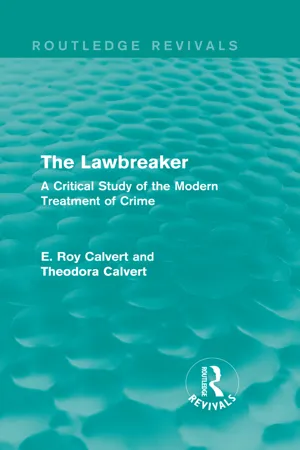
The early 21st century saw better prison conditions and a lower imprisonment rate however public worry over supposed increasing violent crime as perpetuated by the media in the 1930's led to a return to harsher sentences and fuller prisons. Originally published in 1933, The Lawbreaker analyses British penal methods of the time and of the past to discover the most effective ways to treat prisoners and reduce crime as well as identifying where more research is needed to obtain a balance between punishment and rehabilitation. This title will be of interest to students of Criminology and Sociology.
eBook - ePub
The Lawbreaker
A Critical Study of the Modern Treatment of Crime
- 304 pages
- English
- ePUB (mobile friendly)
- Available on iOS & Android
eBook - ePub
About this book
Information
CHAPTER 1
Why Do We Punish?
The problems associated with present-day crime and its treatment cannot be understood without some knowledge of the precise nature of crime and the purpose of the State in combating it.
The essence of crime is its anti-social character. An act is made a crime because the State considers it to be anti-social, so that what is called our penal system is the sum total of all those measures of punishment1 taken by the State to protect itself against anti-social behaviour. “According to the most generally accepted writers—as, for instance, Beccaria, Blackstone, Romilly, Paley, Feuerbach—this hope of preventing the repetition of the offence is not only a main object, but the sole permissible object, of inflicting a criminal punishment.“2
In fact, of course, this aim has never been, and is not to-day, the single purpose of our treatment of crime, and though an inquiry into the history of punishment would carry us farther afield than is desirable in this volume, some understanding of the origin of our punishments is necessary.
Origins of Punishment
Much punishment can be traced directly to primitive instincts and had its genesis in the earliest days of community life.
Crime was regarded in one of two ways, either as a wrong done to some individual or his family, or as an offence to some deity. In the first event it was met by a payment by way of compensation or fine, but in the second it could only be met by a sacrifice of some kind, extending in serious cases to the offender’s life or limb. The sociologist may trace these twin ideas underlying the development of punishment and running through its history,1 and it is at all times well to remember that even in these days the conception of sacrifice is not absent from many current ideas about punishment, especially capital and corporal punishment.
In early times punishment was unlimited in degree and carried out, not by the community, but by the person wronged or by his relatives. The lex talionis of the Mosaic law, an eye for an eye and a tooth for a tooth, generally regarded to-day as vindictive and barbarous, was in reality an advance on previous practice, since it decreed that the retribution should have some relation to the offence committed. It should be “an eye for an eye”, and not a life for an eye. As primitive communities developed, the right to punish was taken out of the hands of individuals because experience showed that privately inflicted retribution made the maintenance of ordered social life difficult. It is not without interest that in all probability the community first assumed the right to punish to protect itself, not against the lawbreaker, but against the anti-social consequences of privately inflicted revenge.
In these early days there was little distinction between crime and sin. “The notion of an offence against the State is of entirely modern growth, and the theory that punishment is imposed for the sake of reforming the criminal and deterring others from following his example is even still more modern.”1 The reasons and theories which men have put forward belong to a much later period when the need was felt for explaining conduct which began as purely instinctive reactions. Instinct and theological concept have had far more to do with the evolution of our penal methods than logical thought about social necessity. Many punishments with a primitive and instinctive origin have been defended as necessary for the protection of Society long after their retention has in fact ceased to be in the best interests of the community. Take, for example, the principle of retribution, which has done so much to shape our penal system and is still used in justification of some of our penalties. Retribution is only another word for revenge, and is a primitive instinct rationalized by religious thought. It has nothing to do with the interests of the community except in sofar as it may be advocated, on deterrent grounds, as the most effective method of protecting Society, in which case it ceases, of course, to be an aim, and becomes a method, justified not for its own sake but on grounds of expediency to achieve some other end. But in early times it was an end in itself, and was extended to animals and even things. Thus Xerxes scourged the Hellespont with 300 lashes because a storm wrecked his bridge.1 In 1386, at Falaise, a sow was “sentenced to be mangled and maimed in the head and forelegs and then hanged for having torn the face and arms of a child, and thus caused its death”.2 The church bell at La Rochelle was whipped and buried in the earth in 1685, for having assisted heretics, but was subsequently rebaptized and restored.3 Even to-day the same idea persists in much contemporary thought about punishment. When a lawbreaker is severely punished for some offence which has aroused public abhorrence, people say instinctively, “he has got his deserts”, or “it serves him right”.
Another idea of punishment closely associated with retribution is the satisfaction of justice. This also is primitive in origin and closely connected with the idea of sacrifice. It is conceived that an abstract thing called justice has been outraged by an immoral act. The scales of justice have been upset. This can only be set right by meting out an equivalent amount of punishment to restore the balance. Such punishment may actually be against the real interests of the community measured in terms of protection and security, but it is considered essential to satisfy justice. And this view persists to-day. Recall the expression when an offender is put on probation instead of being sent to prison, “he got off.” “The principle,” says Professor Sidgwick, in a discussion of this subject,
“that punishment should be merely deterrent and reformatory, is, I think, too purely utilitarian for current opinion. That opinion seems still to incline to the view that a man who has done wrong ought to suffer pain in return, even if no benefit result to him or to others from the pain.”1
It is necessary to realize that such a conception is associated with moral judgments and not with the protection of Society from anti-social behaviour. No sound theory therefore about crime and punishment is possible unless it is based upon a clear understanding of the distinction between crime and sin.
Crime and Sin
Crime is not synonymous with sin, which is a violation of the moral law. Most crimes are necessarily immoral and many sins therefore are crimes. But equally many sins, including some of the most serious, are not crimes. When the individual, faced with two courses of thought or action, one of which he recognizes to be on a higher plane than the other, chooses the lower he violates the moral law and sins. Sin is the conscious choosing of the lower of two moral alternatives. And many sins, such as avarice or heartless selfishness, may be practised with impunity outside the criminal law, a fact which is of importance when we come to consider the moral basis of punishment.
Though crime is anti-social, not all anti-social acts are criminal. Knowingly to convey infectious disease is an anti-social act, but, at any rate in this country, it is rarely criminal.1 An anti-social act only becomes a crime when the law makes it so. But law is codified public opinion as registered by the majority, and majorities are sometimes apathetic and often wrong. Many acts not now regarded as antisocial were made into crimes by majorities in the past, and history is full of instances where men who went to prison were good citizens, not sinners but saints. There is also a curious “time lag” about the recognition of some anti-social acts. For example, theft is still considered more serious than dangerous driving, which actually is a much graver social menace. All this is of importance because it shows that the standard of judgment determining whether an act be criminal or not is by no means final. When a man sins he knows that he sins; if he is unaware of the immorality of his act, it is no sin. A man may commit a crime without realizing it, though ignorance is no defence. Again, his anti-social act may be the outcome of circumstances beyond his control and not the result of conscious choice, though this too is seldom any defence. Moreover, Society may punish as crimes to-day acts which to-morrow may be regarded quite differently and not be considered anti-social.1
But though many sins are not crimes it remains true that most crimes are sins, and crime carries with it therefore an element of moral condemnation. This fact has occasioned much confusion in regard to our treatment of crime. Our penal methods have been associated in men’s minds for many centuries with theories as to the divine punishment of sin. In punishing the lawbreaker men have regarded the State as God’s instrument for punishing the sinner.
When it is realized that many of the most grievous sins are not crimes, and not therefore punishable at law, it at once becomes apparent that to justify severe penalties for acts because of their immorality when they happen to be crimes, and yet to leave unpunished other acts equally or more immoral because they are not regarded as crimes, is to make a mock of all morality. It cannot be too strongly urged that the State is not primarily concerned with acts which are immoral because of their immorality, but because of their anti-social nature. In punishing crime, the State should be concerned with suppressing anti-social behaviour and not with exercising moral judgments.
It is sometimes said that one element in the punishment of crime should be the “satisfaction” of the injured party or his relatives. This is true only in sofar as it means that the injured party should be reasonably satisfied that the steps taken record public disapproval of the crime and are likely to prevent its repetition. But in sofar as it implies that the State should act as the injured party’s agent in inflicting revenge for its own sake, this is based upon a false view of the State’s function in punishment. Moreover, as we have seen, it is illogical when applied only to crimes, since retribution by the State, if justified at all, should be imposed for all sins and not only such sins as are also crimes. It is said that the absence of such “satisfaction” would encourage direct action against the offender. This was the difficulty in suppressing duelling, but there is no serious danger that the law and public opinion which successfully stamped out that antisocial practice should fail to subordinate private feeling to public interest in the treatment of crime.
Retribution Unscientific and Unjust
Quite apart from the fact that ideas of punishment associated with retribution and the satisfaction of justice are primitive or theological conceptions which should have no place in determining the State’s attitude to crime, modern science has shown them to be unscientific and far from just. “The fuller,” says Professor McDougall, “becomes our insight into the springs of human conduct, the more impossible does it become to maintain this antiquated doctrine [of retribution].”1 The same is true of the idea of vindicating justice. Psychology is showing us that most crimes are greatly influenced either by physical or psychological abnormality or by social factors over which the individual may have comparatively little control. It is merely superficial to speak of justice in the abstract, for justice can only be measured in relation to responsibility.
Modern science is teaching us that responsibility is relative, and that we are all in some measure what our heredity and environment have made us. Moral judgments must be relative too. A man is “good” or “bad”, not as he attains proximity to some absolute moral standard, but in the degree to which, within the limited area of freedom which he possesses, he gains mastery or loses control over such adverse hereditary and environmental tendencies as seek to influence him. To judge conduct apart from a consideration of such forces as heredity and environment is, in a very real sense, unjust. In some instances true justice would place not the offender but Society in the dock, for denying him decent conditions of life. To realize these facts is not to deny the existence of free will, but to recognize that the individual’s degree of responsibility varies in relation to his past inheritance and experience. From these considerations, it follows that retributive and vindictive punishments are fundamentally unjust and a positive hi...
Table of contents
- Cover
- Title
- Copyright
- Original Title
- Original Copyright
- Dedication
- Contents
- Introductory
- Preface to the Second Edition
- 1. Why do we Punish?
- 2. Present-Day Crime and its Causes
- 3. The Machinery of Justice
- 4. Prison, Yesterday and To-Day
- 5. What is Wrong with our Prisons
- 6. Probation, Fines, and Restitution
- 7. Young Offenders
- 8. Women Offenders
- 9. Corporal Punishment
- 10. The Death Penalty
- Conclusion
- Appendix
- Notes to the Second Edition, 1945
- Bibliography
- Index
Trusted by 375,005 students
Access to over 1.5 million titles for a fair monthly price.
Study more efficiently using our study tools.
Frequently asked questions
Yes, you can cancel anytime from the Subscription tab in your account settings on the Perlego website. Your subscription will stay active until the end of your current billing period. Learn how to cancel your subscription
No, books cannot be downloaded as external files, such as PDFs, for use outside of Perlego. However, you can download books within the Perlego app for offline reading on mobile or tablet. Learn how to download books offline
Perlego offers two plans: Essential and Complete
- Essential is ideal for learners and professionals who enjoy exploring a wide range of subjects. Access the Essential Library with 800,000+ trusted titles and best-sellers across business, personal growth, and the humanities. Includes unlimited reading time and Standard Read Aloud voice.
- Complete: Perfect for advanced learners and researchers needing full, unrestricted access. Unlock 1.5M+ books across hundreds of subjects, including academic and specialized titles. The Complete Plan also includes advanced features like Premium Read Aloud and Research Assistant.
We are an online textbook subscription service, where you can get access to an entire online library for less than the price of a single book per month. With over 1.5 million books across 990+ topics, we’ve got you covered! Learn about our mission
Look out for the read-aloud symbol on your next book to see if you can listen to it. The read-aloud tool reads text aloud for you, highlighting the text as it is being read. You can pause it, speed it up and slow it down. Learn more about Read Aloud
Yes! You can use the Perlego app on both iOS and Android devices to read anytime, anywhere — even offline. Perfect for commutes or when you’re on the go.
Please note we cannot support devices running on iOS 13 and Android 7 or earlier. Learn more about using the app
Please note we cannot support devices running on iOS 13 and Android 7 or earlier. Learn more about using the app
Yes, you can access The Lawbreaker by E. Roy Calvert,Theodora Calvert in PDF and/or ePUB format, as well as other popular books in Social Sciences & Criminology. We have over 1.5 million books available in our catalogue for you to explore.