Originally published in 1973, this book reconstructs the political and economic organization and the social life of the Tio kingdom at the end of the 19th century by means of a critical synthesis of documentary and ethnographic data. Based on a detailed study of rich docuemntary sources and fieldwork, it analyses the persistent features of Tio social organization and political relations as well as the extensive economic changes associated with the development and later decline of caravan trading at Stanley Pool. It is fully illustrated with maps, tables and diagrams. This book shows the importance for both anthropoligical theory and historical interpreation of obtaining comprehensive data on the state of a particular society at a given time.
eBook - ePub
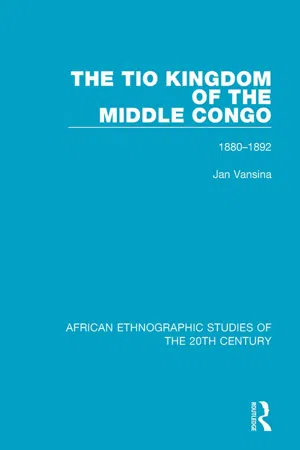
The Tio Kingdom of The Middle Congo
1880-1892
- 606 pages
- English
- ePUB (mobile friendly)
- Available on iOS & Android
eBook - ePub
About this book
Information
Part I
The Little Society
The most elementary observation of Tio society in the 1880s obliges us to distinguish between a small-scale society and overarching structures which are political and economic. One would be tempted to distinguish with Tönnies between community (Gemeinschaft) and society (Gesellschaft), and at first the distinction seems to be admirably suited to the Tio data. Yet we have preferred to use the terms little society or neighbourhood and wider or large-scale society consisting of ‘overarching structures’ instead. For many of the characteristics attributed by Tönnies to both types of social groupings are not applicable to this situation without distortion. Face-to-face relationships remain important in the wider society, and kinship plays a paramount role in the operation of the political structures. The overarching structures moreover do not form one single ‘Gesellschaft’.
With Redfield one might distinguish between a Great Tradition and a Little Tradition and indeed this is found in the Tio case. But Red-field’s attention was turned more to cultural data, the transmission of ideas, emotions, values, and the like, which are not examined in depth in this work, because so many data about them are lacking for the 1880s. In addition there is more than one Great Tradition and the relations between Great and Little Tradition do not conform to Redfield’s views. So we preferred to adopt a simple descriptive terminology which reflected the Tio situation better.
The available data about the little society force us to follow a description which deals first with kinship organization, then with settlements and marriage. After this sketch of the social organization, the economics of subsistence, which give its relatively closed character to the little society, are examined. After which the impact of beliefs, values, and cognition concludes this first part. This sequence is not intended to imply that it is our belief that available kinship groups moulded the economic organization or that either or both are the only true independent variables over time to which the ‘superstructures’ have to adapt themselves without ever taking any initiative. At this point the order followed merely seems the best suited for a clear statement, which focuses on the description of a society.
Chapter II
Kinship
Smaller groups of Tio society were and are still organized around kinship relations. The principles underlying structures based on kinship can be best approached through an examination of the terminology of kinship. Indeed, a componential analysis of the Tio terms does show in what they differ from each other, which categories of meaning are combined to produce the whole set of terms covering the semantic field dealing with kinship. The Tio terms were clearly linked to status and roles, and from there one can move to a representation of the two major structures based on kinship, the ndzo or matrilineage and the ibuuru or bilateral group. An additional reason to start with the terminology is the fact that most of the terms are given by Sims and Calloc’h, whereas standard patterns of behaviour are not and the structures are not very well described.1 Yet for purposes of presentation a description of the structures will be given first.
1. The matrilineage and the kindred
Three types of groupings based on kinship existed : the matrilineage ndzo, the bilateral kindred ibuuru, and the residential groups ula. The latter, being founded on residence as well, and more so than on kinship, will be left for the next chapter. For the former two groups, their structure, the institutions in which they played a major role,2 and a sketch of the typical behaviour between members in basic relationships within the group are presented.
Ndzo, ‘the house’, was a corporate lineage group including all the living descendants in the matrilineal line of a common ancestor, usually not more than two generations away from the oldest members of the lineage. These ancestors were irrelevant for the group, except for one or more of the mother’s brothers of the oldest living member of the group. In fact, then, a matrilineage counted at most six generations in depth and four among the living, which was not rare because girls married early.3
There was nothing normative about the specific depth of a lineage, and sometimes ndzo would split up earlier, when the group had become too big, or harboured one ambitious man too many. In such a big group the struggle for leadership did produce tensions and splits, and when a death occurred it was attributed to the sorcery the would-be leaders used against each other. It was then time to split. But sometimes a group which was not very big would split, simply because there had been a violent quarrel. One case was remembered in 1963 when men quarrelled and split before they had grandchildren. The size of a ndzo was also variable. For a quarrel did not necessarily erupt when a ndzo grew large. Its leaders might get along well, or one of them might dominate the others so much that they did not want to break away.
The procedure for splitting off was to cut a banana tree aaciir obiõ, which also settled the quarrel which had led to the split. A banana leaf was given for both parties to hold. Then it was formally cut, usually by the chief of the land. Later the parties drank wine together to show they would not make each other fall ill. A split would be decided on only after the diviners had shown that one half of the ndzo was massively bewitching the other half, so that separation was the only solution. Lineages did not belong to clans. They were not identified by name, there was no praise name (ãmbili) attached to them, nor any food prohibition. Their identity was only marked by the fact that they had formal leaders: the ‘chiefs of the house’: mpfõ andzo or ‘owners of the house’: ngandzo. And when the ndzo had to be identified it would be named by the name of its head.
The mpfõ andzo was theoretically the oldest male of the lineage, an elder brother, mother’s brother, or mother’s mother’s brother to the others. But, in practice, the son of such a man could be the head and such an arrangement was even preferred since he was then not part of the ndzo and therefore could not be a party to any disputes inside the group. Such a mwaana be iboolo ‘child of a man’ would also not be afraid of accusing members of the ndzo openly if they bewitched one another, which they did often. For the same reason one often appointed a slave of the mpfõ andzo to succeed after the death of his master. That the sons of the son of a mpfõ andzo or the son of a slave could ever succeed was in dispute in 1963. In fact houses such as Ubwoono’s were known in which the succession since his birth around 1890 had been strictly matrilineal. It then became evident that cases where the succession was not fully matrilineal were hard to find. The ideal norm it seemed in 1963 was to appoint a son but in reality it was not done much.
Everyone dealt in fact with more than one mpfõ andzo. Besides the one in the matrilineage, there was the head of the house of one’s father, where a person was mwaana be iboolo. This person was almost as important for an individual as the first one. Thus in the case of Marcel (1960s) his own mpfõ andzo Avila was much less relevant than Ngaayüo, the head of his father’s ndzo. And there is no indication at all that this situation is of recent making.
Moreover, the term mpfõ andzo could be used by anyone to designate his own maternal uncle, or the eldest among them. By 1963 it was evident from an event that a mother’s brother acknowledged some responsibility for his sister’s son, but not for the sister’s son of his sister’s son.4 The house must then be seen as a collection of small groups, comprising a set of brothers with the same mother and their sister’s sons. Just as a person belongs both to a family of procreation and a family of orientation, he belonged to two such sets of mother’s brother/sister’s son. This vision would explain statements like Ngateo’s: ‘When the children are small, they replace the mpfõ andzo by those of their father and mother. Those can then make okuu (ritual).’ The oldest brother would eventually become mpfõ andzo when the mother’s brothers had all died.
The facts support the notion that the matrilineage operated essentially within two generations, mother’s brothers and sister’s sons, and in 1963 most of the ndzo of adults conformed to this pattern. The greater ndzo was an imbrication of the smaller ones, called ipei indzo ‘pieces of the house’. The advantage of postulating such a structure is also that it explains why the specific role of the mpfõ andzo is so vague compared with the role of nguboolo ‘mother’s brother’. Furthermore the situation conforms very well with the strong insistence on alternating generations found both in the terminology and the general kin behaviour.
The mpfõ andzo and everyone’s nguboolo fulfilled the same tasks. They represented the matrilineage at the inquest okuu which was held in case of severe illness of any of the members and where all the other members promised not to bewitch the patient or to desist from doing so, if they accepted responsibility for the illness. If one of the members was killed and a feud erupted both the mpfõ andzo and the nguboolo had to participate, even if they did not live in the settlement of the victim. Both also acted in matters of bridewealth, counter-bridewealth, and inheritance.
The inheritance of women and matters concerning bridewealth were in fact the only specific business related to the ndzo to the exclusion of the kindred. The ndzo were essentially a group of wife-takers and wife-givers. The inheritance of goods did not concern them. One other specific custom linked to the matrilineage was the habit of some to deposit goods and currency with their nguboolo. There was no compulsion. As long as the mpfõ andzo had them, he could use the funds for expenses he himself had incurred and even to defray costs incurred by another member of the lineage, but the latter practice required the explicit approval of the depositor. Further the mpfõ andzo seems to have collected tribute (ingkura) for the political chiefs and during the colonial period taxes were gathered this way, rather than on the basis of residence. In later years this was a prerogative of the mpfõ andzo not of all nguboolo, but it may not always have been so. For the nguboolo could sell his sister’s son into slavery if he needed the funds and the child’s father could not give them. He was, say the informants, supposed to get the agreement of the mpfõ andzo, but in the actual cases cited, no mpfõ andzo appeared beyond the maternal uncle himself. Lastly the succession to certain chiefdoms of the land, especially on the Wũ plateau, was strictly matrilineal. On the Mboõ plateau this was not a universal rule, since in some cases sons also succeeded.
Justice within the ndzo was administered by the mpfõ andzo or a nguboolo, if quarrels had erupted within the house, and according to the genealogical position of the quarrellers. A sign of the corporateness of the whole ndzo was also the fact that if anyone had been killed by another member of the ndzo, no feud could erupt and compensation was set by the mpfõ andzo. In addition most of the mpfõ andzo were ‘big men’ and heads of their own settlements. As such they often transmitted their leadership t...
Table of contents
- Cover
- Half Title
- Title Page
- Copyright Page
- Dedication
- Table of Contents
- List of Maps
- List of Charts
- List of Plates and Figures
- List of Diagrams
- Preface
- Acknowledgements
- I Introduction
- Part I The Little Society
- II Kinship
- III Residential Groups
- IV Marriage
- V The Economics of Subsistence: Production
- VI The Economics of Subsistence: Domestic Life
- VII Fortune and Misfortune
- VIII The Flow of Life
- IX The Inner World
- Part I Conclusion
- Part II The Wider Society
- X The Great Congo Trade
- XI The Commercial Economy
- XII The Protectors: Lords and Squires
- XIII The Resolution of Conflict
- XIV The King and His Realm
- XV The Kingdom Under Iloo
- Part II Conclusion
- Part III A Perspective through Time
- XVI Tio Society To 1880
- XVII Social Change Among the Tio of Mbe (1880–1964)
- Part III Conclusion
- APPENDICES
- Reference Material
- Index
- Glossary of Tio Words
Trusted by 375,005 students
Access to over 1.5 million titles for a fair monthly price.
Study more efficiently using our study tools.
Frequently asked questions
Yes, you can cancel anytime from the Subscription tab in your account settings on the Perlego website. Your subscription will stay active until the end of your current billing period. Learn how to cancel your subscription
No, books cannot be downloaded as external files, such as PDFs, for use outside of Perlego. However, you can download books within the Perlego app for offline reading on mobile or tablet. Learn how to download books offline
Perlego offers two plans: Essential and Complete
- Essential is ideal for learners and professionals who enjoy exploring a wide range of subjects. Access the Essential Library with 800,000+ trusted titles and best-sellers across business, personal growth, and the humanities. Includes unlimited reading time and Standard Read Aloud voice.
- Complete: Perfect for advanced learners and researchers needing full, unrestricted access. Unlock 1.5M+ books across hundreds of subjects, including academic and specialized titles. The Complete Plan also includes advanced features like Premium Read Aloud and Research Assistant.
We are an online textbook subscription service, where you can get access to an entire online library for less than the price of a single book per month. With over 1.5 million books across 990+ topics, we’ve got you covered! Learn about our mission
Look out for the read-aloud symbol on your next book to see if you can listen to it. The read-aloud tool reads text aloud for you, highlighting the text as it is being read. You can pause it, speed it up and slow it down. Learn more about Read Aloud
Yes! You can use the Perlego app on both iOS and Android devices to read anytime, anywhere — even offline. Perfect for commutes or when you’re on the go.
Please note we cannot support devices running on iOS 13 and Android 7 or earlier. Learn more about using the app
Please note we cannot support devices running on iOS 13 and Android 7 or earlier. Learn more about using the app
Yes, you can access The Tio Kingdom of The Middle Congo by Jan Vansina, Jan Vansina,R. Mauny,L. V. Thomas in PDF and/or ePUB format, as well as other popular books in Social Sciences & Anthropology. We have over 1.5 million books available in our catalogue for you to explore.