- 354 pages
- English
- ePUB (mobile friendly)
- Available on iOS & Android
eBook - ePub
About this book
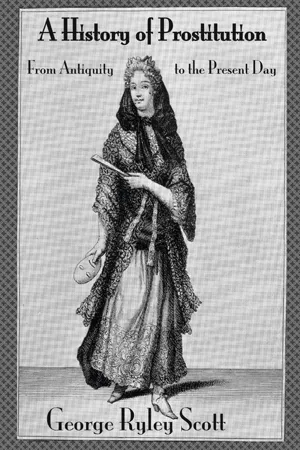
This scientific survey of history of prostitution from antiquity to the twentieth century is one of the first comprehensive studies of this sociological phenomenon of our time. George Ryley Scott writes this treatise in reaction to the lack of literature on the subject at this time, dismissing the only volumes available as outdated, fragmentary or prejudiced- as they were often sponsored by reformist groups. Thus, Scott presents us with a refreshingly honest and nonbiased view of prostitution as it was throughout history up until its first publishing in 1936.
Information
PART I
THE CAUSES OF PROSTITUTION
A HISTORY OF PROSTITUTION
CHAPTER I
THE QUESTION OF DEFINITION
IT IS a capital error to start an examination without defining exactly what one intends to examine. It is essential, before we can deal with prostitution, that we should know exactly what a prostitute is.
Writers on the subject in the past have differed widely in their attempts at definition. Paul Lacroix classed as prostitutes all women who were guilty of intercourse outside the married state; similarly Wardlaw, writing in 1842, defined prostitution as “the illicit intercourse of the sexes.” On the other hand the popular conception of a prostitute as a woman who temporarily loans the use of her body to a miscellany of men in return for money is obviously too narrow and restricted; as is also Webster's dictionary definition, “to give up to lewdness for hire.55 In most cases essential factors to come within the meaning of prostitution are held to be immoral relations with at least two men contemporaneously, and for gain in each case.
It is as important to differentiate between a mistress and a prostitute as it is to differentiate between a married woman and a prostitute. The woman who lives with a man for an extended period, even though she forsakes him or is forsaken by him, and becomes the mistress of another man, is no more a prostitute, at this particular stage in her life, than a married woman who obtains a divorce and marries another man is a prostitute. She may have been a prostitute before or she may become one later, but this does not affect the point. Thus to include mistresses in the category of prostitutes is to give to prostitution too wide a scope. Actually these points may not be of any great practical importance in England; but in France and in certain other countries where prostitutes are inscribed, the distinction is one of considerable significance.
On the other hand, to limit prostitution to those who are entirely dependent for their livelihood upon promiscuous intercourse is at once too narrow and too illogical a definition. For these constitute but a fractional part of the vast army of women who indulge in promiscuous sexual relations as a sideline or a part-time occupation, and in many instances for other reasons than those connected with pecuniary reward. The distinction between the amateur and the professional is always conceded to be a distinction of money. In its ultimate analysis it is a meaningless distinction. It overlooks the fact that one may be willing to do something, whether distasteful or not does not matter, for some form of reward or recompense other than coin of the realm. Money is merely a token. The wealthy hobbyist or amateur has invariably some “object” other than pure altruism. The fact that there is no cash transaction does not necessarily mean the work, in popular parlance, is done for nothing.
These amateur prostitutes, as they may be conveniently called, are increasing in all civilised countries, year by year, and, as we shall see, are continually intruding more and more upon the professional prostitute's preserves.
The contention that the disgust associated with prostitution in the mind of any respectable member of society really lies in the sex-lust which manifests itself in every transaction, and not in the mere fact that it is a trade, fails to take into account that the same argument applies to many State- and Church-authorised marriages; just as the other contention that there can be no act of prostitution where a monetary transaction does not take place overlooks the fact that few marriages are free from financial taint and economic considerations.
Any true definition, in contradistinction to a legal definition, of a prostitute would embrace both the professional and the amateur fornicator. The law and, in the main, the Church and the public, in their rulings, take no cognisance of anyone other than the woman who makes a living exclusively out of promiscuity. The popular supposition that the role of marriage precludes the possibility of prostitution, while in accordance with the law's interpretation, seems at variance with an ethical or a sociological viewpoint.
In indulging in promiscuous intercourse the prostitute is influenced in part or whole by some incentive other than or in addition to love or passion. The prostitute is seldom a nymphomaniac, though the nymphomaniac may become a prostitute. Nor does the absence of love from the prostitute's professional dealings imply that she is incapable of love. The twin popular assumptions that every prostitute is a volcano of lust towards all the men she can attract, and coincidentally incapable of feeling anything resembling love for any individual man, are both fallacies. It is because the prostitute, despite the fact that she may be loaning her body to man after man without any voluptuous sensations, is capable of feeling real love for one individual man that, in some cases, is explainable the apparently inexplicable fact that it is common enough for a prostitute to herself keep what is termed a “ fancy man. ”
Many observers contend that the absence of the love element is the one essential factor that stamps the woman as a prostitute. It is argued that a vital element in prostitution is that the woman derives no pleasure from her sexual escapades, but is concerned solely with the fees she receives in return for her services.
It seems to me, however, that the question of pleasure or otherwise cannot logically or justifiably enter into any definition of what constitutes a prostitute. Further there appears to be little in the way of actual facts to support this assumption of universal insensibility, and even the microscopic amount which does exist seems to be founded upon the most dubious premises. We all know well enough that every pleasure loses its pristine flavour if it is repeated often enough or continued long enough, and there is not the smallest doubt that prostitutes who have followed the profession for years on end can derive little or no pleasure from the sexual relations to which they are so accustomed. But then it is doubtful if many married women, after regular repetitive sexual relations over a long period of years, get any pleasure from the act. The crux of the matter lies in the question of whether the prostitute, at the commencement of her career, derives pleasure from the sex act? And the answer, I venture to submit, is that in nine instances out often she does experience pleasure. She makes, in many cases, a point of combining business with pleasure, to the extent of selecting for her partners in sexual enjoyment those willing to bestow upon her money or its equivalent.
Pleasure in connection with the sex act does not necessarily imply love. Love is entirely another thing. Most men who resort to prostitutes for sexual satisfaction experience pleasure, but relatively few fall in love with the women who are mainly instrumental in providing this pleasure. The prostitute, once she is regularly embarked upon her career, rarely experiences love in the course of her work.
The female harlot, therefore, in contradistinction to the married woman (in theory, at any rate) and to the mistress, offers the use of her body to various men in exchange for money or its equivalent, and apart from or in addition to any thought of love. In many instances she goes through the sexual act and its concomitants devoid of any pleasurable feelings whatever; often, indeed, her feelings for her temporary lover are dislike or even hatred. That she performs her part in the transaction competently and apparently passionately is not, as is so often thought, evidence of her sensuality or lust; it is merely a tribute to her skill as a professional love-maker.
It is true that many married women have no feelings of love for their husbands even at the time of marriage; it is equally true that soon after marriage thousands of wives develop frigidity and anœsthesia sexualis towards the men they are supposed to love. In these cases the only thing that distinguishes the role of such a woman from that of a prostitute is that one man has contracted for the use of her body, and that the contract is sanctioned and upheld by Church and State.
There is, too, the question of the male prostitute. Prostitution is not exclusively a woman's profession; nor are those who consort with and support prostitutes members of the male sex exclusively. Male prostitutes, often euphemistically described as gigolos, are employed and paid by women; catamites are employed by homosexual and perverted men. Thus our definition of a prostitute must include both sexes, and bearing this essential point in mind, as well as our previous observations, we arrive at the following: A prostitute is an individual, male or female, who for some kind of reward, monetary or otherwise, or for some form of personal satisfaction, and as a part- or whole-time profession, engages in normal or abnormal sexual intercourse with various persons, who may be of the same sex as, or the opposite sex to, the prostitute.
CHAPTER II
THE SOCIAL STANDING OF THE PROSTITUTE
TO-Day men and women of respectability alike look upon the prostitute with contempt or pity, or both. Even men who are largely responsible for the profession's existence, and who affect the society of its practitioners in drinking lounges and night clubs, when in the company of female relatives or friends refrain from any discussion of prostitution, are studiously careful not to patronise any cafes which cater for women of easy virtue, and greet with icy stares the filles de joie with whom they have spent the previous night. The prostitute is often referred to as a “moral outcast,” and, generally speaking, the reaction of polite society to her is analogous to its reaction towards an ugly family skeleton which one would like to bury decently.
So universal is this attitude that it is not unnatural there is an impression abroad that this same reaction towards the prostitute has always been current. It is a mistaken assumption. The prostitute's profession has not always been a shameful profession. To the contrary, at one time the harlot was an object of reverence and adoration, as anyone who is well acquainted with the Bible and contemporary literature should know. In fact, at one time, in certain races, according to Lord Avebury, prostitutes were in even higher regard than were legitimately married women. In Athens they held the highest possible rank; in Vesali, too, the “chief of the courtesans” received a degree of veneration approaching that given to those of holy or chieftain blood. Even to-day, in Japan, and among certain primitive races, the profession of the prostitute is not one of shame.
The Kedēshōth mentioned in the Bible were prostitutes attached to the Canaanite temples, and were held in the highest reverence by the worshippers. Temple prostitutes, in all countries, and at all times, have been highly thought of, and in cases where this service to their god was of a temporary nature, found no difficulty in effecting marriages. According to Strabo, among the ancient Armenians, who prostituted their daughters to the service of their god, these temporary harlots married without the slightest smudge upon their characters. Again the Babylonian women were similarly not looked down upon. To the contrary they were considered to be women who, in the true spirit of religious devotion, sacrificed their lives to the service of their god; and as such received a degree of veneration and of respect that is usually reserved for those moving in the most exalted circles.
All of which goes to show that the practice of professional prostitution under the licence of religion was viewed through a vastly different pair of spectacles from those which are turned upon it to-day. But I shall have more to say on this subject when I come to deal with sacred prostitution in a later stage of this inquiry.
In Japan the prostitute is not looked down upon as she is in all European countries. No vulgar or derogatory terminology is used in referring to her. For instance, there is not, in the Japanese language, anything equivalent to the English whore1 or harlot. The word which we translate as prostitute really signifies “temporary wife.” Many of the girls attached to the maisons de plaisir in Japan in later years marry and live in conditions of the utmost respectability.
In India prostitutes were never looked upon as in any sense of the word degraded or immoral creatures. According to Meyer, “the Hindu has always sung the praises of ‘the public woman’ as the very type and embodiment of perfect womanhood.”2
Much of this toleration of intercourse outside the married state is due to the males in many primitive races valuing neither virginity itself nor the exclusive right to sexual connection with any particular woman. In many savage tribes, as a mark of honour, a male guest is allowed by the husband or father to sleep with his wife or his daughter.
With the advent of civilisation and the patriarchal system such a thing became plainly intolerable. But, recognising that, to the majority of men, the provision of a temporary love partner constitutes a source of pleasure, in many civilised countries it became customary to provide guests of honour with high-class prostitutes or courtesans. We see evidence of this in the custom in Germany and other countries in the Middle Ages of giving visiting members of royal houses free entry into the brothels of the city. In 1434, on his visit to Ulm, King Sigismund was escorted through the gates of the city by prostitutes. In the sixteenth century, any foreign envoys visiting the Swiss town of Zürich were entertained at table not by the town officials and their wives but by the town officials and certain picked harlots from the city brothels. And although anything of this nature would not be tolerated to-day, there have been instances, even in recent years, where, in certain foreign cities, on occasions when meetings and conferences were held, the provision of special facilities, or the extension of existing ones, for enabling visitors to come into contact with prostitutes were apparently “overlooked” by the authorities.
Coincidentally with the English concept of degradation and shame is the firmly established idea that every prostitute is necessarily a girl of the feeblest mentality, in many cases little removed from an actual imbecile. Tarnowsky, a Russian authority on sex, held the view that professional prostitutes, as a result of their heredity coupled with arrested or incomplete development, were mental degenerates. Most students of the subject in the past have formed somewhat similar conclusions to that of Tarnowsky. Among more modern researchers, Talmey, in a recent edition of his book Love, comes to the conclusion that “defective mentality is responsible for the presence of prostitutes.”
I am of opinion, however, that there are the strongest grounds for supposing these views to have been greatly exaggerated. For the most part they have been based upon the researches of social, moral and religious workers, or upon the statistics furnished by Magdalen hospitals, prisons, rescue homes and the like. In consequence they are drawn from observations concerned with the lowest class of prostitute only, and they give a quite false impression as regards prostitution as a whole. There have always been very considerable numbers of prostitutes of normal mentality and education, as anyone who has come in contact with the better class of women, and the more successful, must admit. Dr. Wolbarst, referring to this very matter, says: “We are told that prostitutes are below normal in intelligence. I have had professional dealings with many, and believe this statement is not true.”1 To-day, whether the fact be palatable or the contrary, the intelligence...
Table of contents
- Cover
- Half Title
- The Kegan Paul Library of Sexual Life
- Title Page
- Copyright Page
- Table of Contents
- List of Plates
- Preface
- Part I—The Causes of Prostitution
- Part II—History of Prostitution
- Part III—Prostitution To-Day
- Bibliography
- Index
Trusted by 375,005 students
Access to over 1.5 million titles for a fair monthly price.
Study more efficiently using our study tools.
Frequently asked questions
Yes, you can cancel anytime from the Subscription tab in your account settings on the Perlego website. Your subscription will stay active until the end of your current billing period. Learn how to cancel your subscription
No, books cannot be downloaded as external files, such as PDFs, for use outside of Perlego. However, you can download books within the Perlego app for offline reading on mobile or tablet. Learn how to download books offline
Perlego offers two plans: Essential and Complete
- Essential is ideal for learners and professionals who enjoy exploring a wide range of subjects. Access the Essential Library with 800,000+ trusted titles and best-sellers across business, personal growth, and the humanities. Includes unlimited reading time and Standard Read Aloud voice.
- Complete: Perfect for advanced learners and researchers needing full, unrestricted access. Unlock 1.5M+ books across hundreds of subjects, including academic and specialized titles. The Complete Plan also includes advanced features like Premium Read Aloud and Research Assistant.
We are an online textbook subscription service, where you can get access to an entire online library for less than the price of a single book per month. With over 1.5 million books across 990+ topics, we’ve got you covered! Learn about our mission
Look out for the read-aloud symbol on your next book to see if you can listen to it. The read-aloud tool reads text aloud for you, highlighting the text as it is being read. You can pause it, speed it up and slow it down. Learn more about Read Aloud
Yes! You can use the Perlego app on both iOS and Android devices to read anytime, anywhere — even offline. Perfect for commutes or when you’re on the go.
Please note we cannot support devices running on iOS 13 and Android 7 or earlier. Learn more about using the app
Please note we cannot support devices running on iOS 13 and Android 7 or earlier. Learn more about using the app
Yes, you can access A History of Prostitution by George Ryley Scott,Scott in PDF and/or ePUB format, as well as other popular books in Social Sciences & Anthropology. We have over 1.5 million books available in our catalogue for you to explore.