- 224 pages
- English
- ePUB (mobile friendly)
- Available on iOS & Android
eBook - ePub
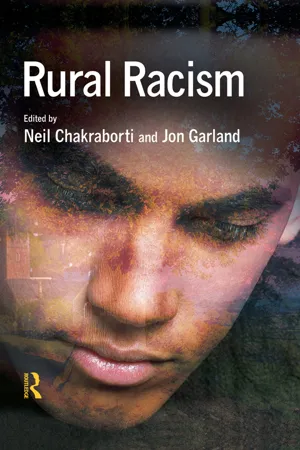
Rural Racism
About this book
Rural issues are currently attracting unprecedented levels of interest, with the debates surrounding the future of 'traditional' rural customs and practice becoming a significant political concern. However, the problem of racism in rural areas has been largely overlooked by academics, practitioners and researchers who have sought almost exclusively to develop an understanding of racism in urban contexts. This book aims to address this oversight by examining notions of ethnic identity, 'otherness' and racist victimisation that have tended to be marginalised from traditional rural discourse.
Information
Part 1
Contextualising Rural Racism
Chapter 1
Rurality and racialised others: out of place in the countryside?
Ethnicity and the ‘unusual’ countryside
A recent report by Raekha Prasad (2004) in the Guardian newspaper deployed an orthodox shock tactic to highlight the complex interconnections between ethnicity and rurality in the British countryside. Three people are pictured in the piece, posing against the background of a lake by a forest, and the banner asks ‘What's unusual about this scene?’. The answer to the conundrum lies neither in the unspoilt solitude of the place, which might be expected to display the crowded nature of the rural honeypot, nor in the absence of the high-technology boots, anoraks and rucksacks which typically denote the paraphernalia of ‘serious’ walkers enjoying a highly embodied and entirely acceptable cultural experience of the countryside. No, the representation of ‘unusual’ in this context is signified by the clear non-white ethnicity of the subjects of the photograph – their ‘Asian-ness’ is stereotypically suggested in clothing, headgear, the men's beards and so on – and the intended shock counterposes the expectation that the countryside is typically a white domain.
To acknowledge that the presence of ethnic minorities in rural scenes is ‘unusual’ is one thing, but Prasad's report proceeds to identify more sinister links between rurality and ethnicity via vox-pop testimonies from black and Asian Britons who have variously found themselves ‘disowned by rural England’ (ibid.: S2). Andrea Levy, a black novelist, tells us that ‘In the countryside I am so acutely aware of what I look like, not because people are hostile or unfriendly, but just because you are different. I always get the feeling when I walk into a country pub that everyone is looking at me, whether they are or not. You are glowing with colour’ (ibid.: S3). Benjamin Zephaniah, a black poet, talks of the time when he was staying on a friend's farm and went out for a jog within the boundaries of the farm. ‘When I got back to his house, the place was surrounded by police, a helicopter circling above. “We have had reports of a suspicious jogger” the police said’ (ibid.: S2). Lemm Sissay, a black poet who was fostered and brought up in the country, tells of his experience in a countryside which he finds ‘beautiful but incredibly damaged’: ‘Growing up, I used to ask myself why everyone had such a big issue with the colour of my skin. Men would shield their women from me, bars would go quiet. The incendiary racism that is in the country is never challenged’ (ibid.: S3).
These autobiographical notes reflect on a range of identity clashes between minority ethnicity and rurality – difference, suspicion, marginalisation and racism all lurk behind the seemingly unusual presence of people of colour in countryside settings. While such identity clashes are highly visible in city sites, it is almost as if ethnic ‘others’ are typically rendered invisible by rurality, such that any moments of becoming visible represent unusual intrusions into the conventional cultural norms of rural life. In this chapter I want briefly to explore what it is about rurality and rural culture that sponsors this ‘othering’ of ethnic minority people, and to discuss the mechanisms of social and cultural regulation which position people of colour as ‘out of place’ in the countryside. Identities and subjectivities centred around ethnicity are by no means the sole axes of rural othering, but as this book portrays, both extreme and banal racisms represent very significant socio-cultural problematics in rural areas, and as with other axes of marginalisation, rendering them highly visible is the first step to a more socially inclusive future.
Rurality and otherness
Rurality is a complex concept. At one level, we are often content to fall back on key characteristics which historically have been associated with rurality and rural life and which translate into objects of desire in contemporary society. In these terms, the countryside is viewed as an area which fulfils three principal criteria (Cloke and Park 1985):
1 It is dominated (either currently or recently) by extensive land uses, such as agriculture and forestry, or large spaces of undeveloped land.
2 It contains small, low-order settlements which demonstrate a strong relationship between buildings and surrounding extensive landscape, and which are thought of as rural by most of their residents.
3 It engenders a way of life characterised by a cohesive identity based on respect for the environmental and behavioural qualities of living as part of an extensive landscape.
At another level, however, we draw from these material characteristics a series of ideas and understandings about the meaningfulness of rurality. Somewhere deep down in our cultural psyche there appear to be longstanding handed-down precepts about what rurality represents, emphasising the enabling power of nature to offer opportunities for lifestyle enhancement through the production and consumption of socially cohesive, happy and healthy living at a pace and quality which differs markedly from that of the city. Rurality has thus become cross-referenced with tranquillity, goodness, wholeness and problem-freedom, and at a more obviously political level it maps onto cartographies of identity, encapsulating for some a treasury of norms and values which both illustrate and shape what is valuable in a nation, a region or a locality.
Much has been written about the so-called ‘rural idyll’ in recent years (see, for example, Bell 1997; Bunce 1994, 2003; Cloke and Milbourne 1992; Halfacree 1995; Little and Austin 1996; Mingay 1989; Short 1991) both to confirm and to challenge these ideas of aesthetic pastoral landscapes acting as sites for humans working together in harmony and achieving both contentment and plenty. However, despite the over-arching and sometimes stereotyping characteristics of the concept of ‘idyll’, the idea endures both in the direct representation of a range of contemporary cultural paraphernalia, and in reflexive and instinctive knowledges about the rural which are lived out in perception, attitude and practice. As Bunce (2003: 15) explains:
The values that sustain the rural idyll speak of a profound and universal human need for connection with land, nature and community, a psychology which, as people have become increasingly separated from these experiences, reflects the literal meaning of nostalgia; the sense of loss of home, of homesickness.
Rurality, then, not only represents spaces and values which satisfy basic psychological and spiritual needs, but also sponsors a cultural idyll which represents a natural and inevitable counterpoint to the rise of urban modernism.
This seemingly straightforward understanding of rurality needs to be tempered by a series of complicating acknowledgements about how rural metanarratives play out in real life, of which three will be summarised here. First, it is clear that rurality is not homogenous and that rural areas are different. In the English context, there are significant differences between the metropolitan ruralities of areas close to cities and the more peripheral ruralities of remoter areas. Equally, within the UK account has to be taken both of regional distinction and of the significance of nationhood in fashioning, for example, the ruralities of Wales and Scotland. Moving beyond the UK, the extensive ruralities of larger land continents exaggerate both materially and relatively the differences between rural areas. Outback Australia, the Canadian northern territories and the American mid-west, for example, can only loosely be treated spatially or conceptually as ‘the same’ as each other, and comparisons with, say, rural Berkshire are even more tenuous.
Secondly, rural areas are essentially dynamic. Far from being timeless, unchanging sites of nostalgia, they are being reconstructed economically and recomposed socially by the globalised food industry, by the increasing mobility of production and people, and by the niched fragmentation of consumption and the commodification of place. Wilson (1992) argues that the end-product of rural dynamism is a blurring of the boundaries between the urban and the rural. Rural areas are becoming culturally urbanised through the all-pervading spread of urban-based mass media and other cultural output. Social trends of counter-urbanisation have brought ‘urban’ people into rural areas, and out-of-town movements of factories and shopping malls have had similar impacts. In these and other ways, then, the city has moved out into the countryside. By contrast, the countryside has also, to an extent, been moving into the city, for example with the development of urban ‘villages’ and the now pervasive trend of heightening the visibility and performance of urban nature. As I have written elsewhere, all this renders the rural-urban distinction indistinct:
New regions focus on the hybrid relations between cities and surrounding areas; new information technologies permit the traversing of time-space obstacles; new forms of counter-urbanisation result in spatial cross-dressing both by the arriving in and leaving of places. (Cloke 2003: 2)
Thirdly, rural areas will often display dystopic characteristics in visible illustrations of the seamier side of rural life. Bell's (1997) account of cinematic depictions of small-town America demonstrates how the ‘horror’ of rural life counterposes any narrative of idyll. The foot and mouth epidemic which consumed much of rural Britain during 2001 provided clear evidence of a non-idyllic countryside, as news media portrayed vivid images of the funeral pyres of culled livestock, and the curiously empty fields of farms deprived of their essential animality. Whether in the imaginative texts of film, or in the seemingly more mimetic (but equally imaginative) representation of news coverage, there is now evidence galore of rurality without idyll. Previous assumptions about rural areas as problem-free are challenged by a determined flow of suggestions that rural life is little different from that of the city in terms of crime, drug-addiction, poverty and other apparently urban problems. The material realities of ‘living-in-the-idyll’ are being seriously challenged by these depictions.
These characteristics of difference, dynamism and dystopia suggest that the rural–urban dualism has been largely overtaken by events. Rurality can no longer be regarded as a single space but is rather a multiplicity of social spaces which overlap the same geographical area (Mormont 1990). However, while the marked opposition between the geographical spaces of urban and rural is being broken down, the imagined opposition between the social significances of urban and rural are being maintained and in some ways enhanced. Indeed it is the social space of rurality – often fuelled by idyllistic concepts – which is the magnetic force which pulls together the category ‘rural’ or ‘countryside’ in the contemporary discourses of everyday life. And, as Halfacree (1993) has explained, the multiple meanings which constitute the social space of rurality are increasingly diverging from the geographical spaces of the rural. The symbols of rurality are becoming detached from their referential moorings, as socially constructed rural space is becoming increasingly detached from geographically functional rural space. Thus, despite our ever more nuanced understanding of the different happenings in rural places, there is considerable scope for socially constructed significations of rurality to dominate both the territory of ideas and meanings about the rural, and the attitudes and practices which are played out in and from that territory.
One of the most important outcomes of debates about socially constructed rurality has been a deep concern about the cultural and political domination afforded by hegemonic ideas about rurality and rural people. Philo's (1992) intervention to highlight the neglected rural geographies hidden away in and by such hegemonic social constructions was seminal in the search for ways to give voice to rural ‘others’. He emphasised that social constructions of life are dominated by white, male, middle-class narratives (ibid.: 200):
There remains a danger of portraying British rural people … as all being ‘Mr Averages’, as being men in employment, earning enough to live, white and probably English, straight and somehow without sexuality, able in body and sound in mind, and devoid of any other quirks (say) religious belief or political application.
Philo points to the discursive power through which the all-embracing commonalities suggested by social constructions of rural idyll serve in practice to exclude individuals and groups of people from a sense of belonging to, and in, the rural on the grounds of their ‘race’, ethnicity, gender, age, class and so on. Subsequent studies of rural ‘others’ (see Cloke and Little 1997; Milbourne 1997) have sought to identify the practices and devices which exclude particular individuals and groups in this way. For example, examinations of poverty in rural areas (see, for example, Cloke 1997; Cloke et al. 1995, ...
Table of contents
- Cover Page
- Half Title page
- Dedication
- Title Page
- Copyright Page
- Contents
- Acknowledgements
- Foreword
- Notes on Contributors
- Introduction Justifying the study of racism in the rural
- Part I Contextualising Rural Racism
- Chapter 1 Rurality and racialised others: out of place in the countryside?
- Chapter 2 John O'Groats to Land's End: racial equality in rural Britain?1
- Part 2 Assessing the Problem
- Chapter 3 Outsiders within: the reality of rural racism
- Chapter 4 Unravelling a stereotype: the lived experience of black and minority ethnic people in rural Wales
- Chapter 5 Cultures of Hate in the urban and the rural: assessing the impact of extremist organisations
- Chapter 6 Another Country? Community, belonging and exclusion in rural England
- Part 3 Tackling the Problem
- Chapter 7 Supporting victims of rural racism: learning lessons from a dedicated racial harassment project
- Chapter 8 Challenging rural racism through education
- Chapter 9 Responding to rural racism: delivering local services
- Index
Trusted by 375,005 students
Access to over 1.5 million titles for a fair monthly price.
Study more efficiently using our study tools.
Frequently asked questions
Yes, you can cancel anytime from the Subscription tab in your account settings on the Perlego website. Your subscription will stay active until the end of your current billing period. Learn how to cancel your subscription
No, books cannot be downloaded as external files, such as PDFs, for use outside of Perlego. However, you can download books within the Perlego app for offline reading on mobile or tablet. Learn how to download books offline
Perlego offers two plans: Essential and Complete
- Essential is ideal for learners and professionals who enjoy exploring a wide range of subjects. Access the Essential Library with 800,000+ trusted titles and best-sellers across business, personal growth, and the humanities. Includes unlimited reading time and Standard Read Aloud voice.
- Complete: Perfect for advanced learners and researchers needing full, unrestricted access. Unlock 1.5M+ books across hundreds of subjects, including academic and specialized titles. The Complete Plan also includes advanced features like Premium Read Aloud and Research Assistant.
We are an online textbook subscription service, where you can get access to an entire online library for less than the price of a single book per month. With over 1.5 million books across 990+ topics, we’ve got you covered! Learn about our mission
Look out for the read-aloud symbol on your next book to see if you can listen to it. The read-aloud tool reads text aloud for you, highlighting the text as it is being read. You can pause it, speed it up and slow it down. Learn more about Read Aloud
Yes! You can use the Perlego app on both iOS and Android devices to read anytime, anywhere — even offline. Perfect for commutes or when you’re on the go.
Please note we cannot support devices running on iOS 13 and Android 7 or earlier. Learn more about using the app
Please note we cannot support devices running on iOS 13 and Android 7 or earlier. Learn more about using the app
Yes, you can access Rural Racism by Neil Chakraborti,Jon Garland in PDF and/or ePUB format, as well as other popular books in Social Sciences & Criminology. We have over 1.5 million books available in our catalogue for you to explore.