- 222 pages
- English
- ePUB (mobile friendly)
- Available on iOS & Android
eBook - ePub
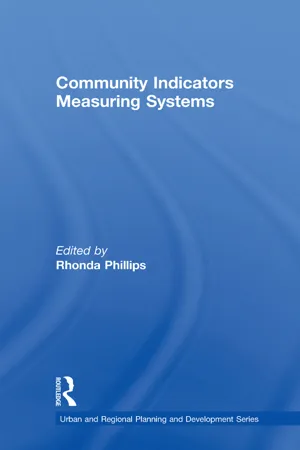
Community Indicators Measuring Systems
About this book
Community indicators measuring systems represent a mechanism to improve monitoring and evaluation in planning, incorporating citizen involvement and participation. They reflect the interplay between social, environmental and economic factors affecting a region's or community's well-being, and, as such, can be extremely valuable to planners and developers. Yet, little research has been conducted on their efficacy. This book provides a comprehensive review of how community development indicators evolved and examines their interplay with planning and development. It questions how we adequately measure concepts associated with indicators systems and whether these systems are sustainable and can best evolve. In doing so, the book allows a better understanding of the theoretical underpinnings of community indicators measuring systems, as well as how best to design and implement them.
Information
SECTION II
RELATING COMMUNITY INDICATORS TO PLANNING AND DEVELOPMENT
Chapter 3
The Sustainable Calgary Story: A Local Response to a Global Challenge
Introduction
Since 1996, the Sustainable Calgary Society has been a catalyst for education, research and action on issues of sustainability. This chapter chronicles Sustainable Calgary’s experience in identifying, researching and reporting on a set of social, ecological and economic indicators of sustainability. In telling this story, three sets of questions are often asked. First, people ask, ‘Where did sustainability indicator reporting come from; that is, what motivated this initiative?’ Second, people want to understand why community sustainability reporting is important in the larger scheme of things; ‘Why does it matter, how does it advance our thinking on the concept of sustainability? Third, people ask, What’s next; after we produce a report where do we go from there; can indicator processes actually promote action to make our communities sustainable? This chapter will address these questions by providing a contextualized account of Sustainable Calgary’s indicator project.
In short, Sustainable Calgary emerged out of a particular historical context largely defined over the past 50 years by the emergence of globalization and neo-liberal economics but countered by the rise of the environmental movement and ecological thinking as well as an increasing call for more participatory forms of democracy. Part One provides a brief characterization of globalization as well as an historical overview of the evolution of sustainability and the indicator concept.
From this backdrop of great forces of social change, a modest local initiative emerged in Calgary. Part Two tells this story. Sustainable Calgary is, in large part, a response to the dominance of neo-liberal globalization pursued at the expense of social and ecological sustainability. A small group of citizens came together in 1996 to identify a set of indicators for the community. The inclusive and participatory process used to define, research and report on the indicators was as important as the outcomes. Involving a broad cross-section of citizens in the process has shown to be an effective way to arrive at a truly meaningful set of indicators that reflect the community. The small businessperson begins to understand the ecological impacts of packaging choices, while the social worker sees new linkages among jobs, poverty, and habitat preservation. The Sustainable Calgary process explicitly sought to engage citizens rather than interest groups, stakeholders or sector representatives. The process was consciously designed to harness the diversity of knowledge, experience and expertise represented in the community rather than rely on experts.
In my experience, indicator projects are not an end in themselves but one important piece of the sustainability puzzle. They are an entre into critical discussions and explorations of what kind of a world we want. The debates they spark, the questions they raise and the opportunities for education they present are as important as the indicator reporting itself. The indicators challenge us to re-examine social, ecological and economic assumptions that are taken for granted. This is the focus of Part Three. Starting from Sustainable Calgary’s work on a select number of what we call ‘indicators in progress’, I will illustrate this point by discussing four important issues that I think are central to the challenge of community sustainability. These issues have come to the forefront during my decade of working with sustainability indicators – what does a transformational learning process look like; how do we envision the relationship of humans to the rest of nature; how do we create, nurture and reclaim a sense of local community, in a world enamoured with globalization; and how do we ‘problematize’ economic growth.
Having achieved our immediate objective by completing two State of Our City Reports, we at Sustainable Calgary stepped back to ask ourselves, ‘What next; how do indicators contribute to the ultimate goal – a sustainable Calgary?’ I take up this question in Part Four. From Jacksonville to Seattle to Hamilton, people involved in indicators processes are asking the same question – we have our indicators report, now what? How de we move from the margins to the centre? Finally, then, this chapter will discuss strategies and initiatives already underway and those still being formulated and debated in Calgary with respect to achieving this ultimate goal. This requires simultaneous bottom-up and top-down strategies a transformational education process to reach an ever-broader segment of the community as well as effective political, policy and planning mechanisms to mainstream indicators and sustainability.
Part One: The Challenge of Neo-Liberal Globalization
Globalization is a complex social, cultural and economic process. Leading social theorist Manuel Castells brought us the image of a globally networked society shaped by revolutionary communications technologies. He has documented the social problems as well as the promise of this new reality (Castells, 1999). Anthropologists Ulf Hannerz and Arjun Appadurai have written about the complex, novel, cultural mutations that are evolving from this global network of human, material and information flows and commodified relations (Hannerz, 1992; Appadurai, 1996). Each author wants to remind us that globalization is not monolithic as human and cultural agency plays a part in shaping it. Still, within the postmodernist condition described by geographer David Harvey (1989), the prime driver of globalization remains the capitalist economic system. The capitalist system harnesses new communication, transportation and production process technologies as tools to increase and concentrate capital. Harvey has demonstrated how the experience of capitalist development is qualitatively different today due to the compression of this process over space and time.
It must also be acknowledged that neo-liberal globalization has a spatial centre of gravity located in the western developed market economies, which are dominated to a large extent by the United States. As such, the specific form globalization has taken has been greatly influenced by the exhaustion of Fordism and the Keynesian welfare state in the developed market economies as well as the subsequent introduction of a neo-liberalist economic regime de-coupled from any significant system of state regulation (Peck and Tickell, 1994). The hallmarks of neo-liberal globalization include the negotiation of free trade agreements, deregulation of global financial markets, privatization of state enterprises and services, investment liberalization and international integration of production processes.
Most of the debates about globalization focus on the extent and inevitability of the transformation and whether or not the costs outweigh the benefits. The mainstream view of globalization – the one absorbed from CNN and globalization’s gurus – is of a borderless world where free markets work their magic through consumer preference, human freedom is enhanced as the nation state fades away and economic man is emancipated (Ohmae, 1996; Freidman, 2000). Opponents point out that neo-liberal globalization has resulted in negative outcomes including a corporatized global economy whereby economic control has shifted substantially to transnational corporations; increased environmental degradation; and created greater gaps between the haves and have-nots (Korten, 1995). Opponents have also outlined in some detail the process of localization as an alternative to globalization (Korten, 1997).
The environment has not escaped the juggernaut of globalization either. James O’Connor is a leading theorist of this environment-globalization nexus. From a Marxist perspective, he theorizes global environmental degradation within what he calls the second contradiction of capital, that is, the inevitable depletion of the natural resource base (the first contradiction being the overproduction of capital) upon which the capitalist system depends (O’Connor, 1998). From this perspective, it could be argued that modern environmentalism, usually traced to the publishing of Rachel Carson’s Silent Spring in 1962, arose as a response to the crisis induced by the second contradiction. Silent Spring was indicative of the growing concern over localized pollution caused by industrialization in the developed world (Carson, 1962). In 1972, the first international environmental conference in Stockholm began to address pollution at an international level. The Limits to Growth reports of the mid-1970s heralded a shift from concern over pollution to the effects of the industrial economy on global resource depletion. Since the 1990s, environmental concern has shifted to the effects of industrial growth on the global commons including issues such as global warming, ozone depletion, ocean fisheries depletion, deforestation and loss of biodiversity.
Although processes of globalization have been evolving since humans first populated the earth, the present situation is unique. For the first time in history the vast majority of the peoples of the world live under a capitalist economic system. Technological developments and fallout (e.g. communications, transportation, production technologies and genetic engineering) have created an unprecedented paradox of opportunity and risk (Beck, 2000). Human population and per capita resource demand are bringing humans up against...
Table of contents
- Cover
- Half Title
- Dedication
- Title Page
- Copyright Page
- Table of Contents
- List of Contributors
- Preface
- Acknowledgements
- Section I: Theory and Basis for Community Indicators
- Section II: Relating Community Indicators to Planning and Development
- Section III: Technological Dimensions
- Subject Index
Trusted by 375,005 students
Access to over 1.5 million titles for a fair monthly price.
Study more efficiently using our study tools.
Frequently asked questions
Yes, you can cancel anytime from the Subscription tab in your account settings on the Perlego website. Your subscription will stay active until the end of your current billing period. Learn how to cancel your subscription
No, books cannot be downloaded as external files, such as PDFs, for use outside of Perlego. However, you can download books within the Perlego app for offline reading on mobile or tablet. Learn how to download books offline
Perlego offers two plans: Essential and Complete
- Essential is ideal for learners and professionals who enjoy exploring a wide range of subjects. Access the Essential Library with 800,000+ trusted titles and best-sellers across business, personal growth, and the humanities. Includes unlimited reading time and Standard Read Aloud voice.
- Complete: Perfect for advanced learners and researchers needing full, unrestricted access. Unlock 1.5M+ books across hundreds of subjects, including academic and specialized titles. The Complete Plan also includes advanced features like Premium Read Aloud and Research Assistant.
We are an online textbook subscription service, where you can get access to an entire online library for less than the price of a single book per month. With over 1.5 million books across 990+ topics, we’ve got you covered! Learn about our mission
Look out for the read-aloud symbol on your next book to see if you can listen to it. The read-aloud tool reads text aloud for you, highlighting the text as it is being read. You can pause it, speed it up and slow it down. Learn more about Read Aloud
Yes! You can use the Perlego app on both iOS and Android devices to read anytime, anywhere — even offline. Perfect for commutes or when you’re on the go.
Please note we cannot support devices running on iOS 13 and Android 7 or earlier. Learn more about using the app
Please note we cannot support devices running on iOS 13 and Android 7 or earlier. Learn more about using the app
Yes, you can access Community Indicators Measuring Systems by Rhonda Phillips in PDF and/or ePUB format, as well as other popular books in Politics & International Relations & Comparative Politics. We have over 1.5 million books available in our catalogue for you to explore.