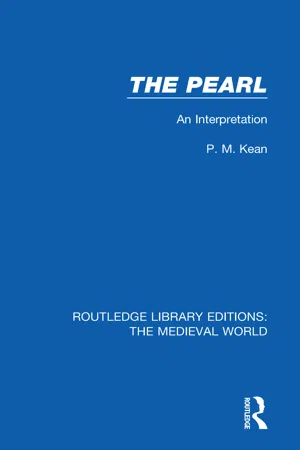
Originally published in 1967 The Pearl looks at the anonymous fourteenth century poet of Pearl. The book argues that the poem ranks in importance and interest with that of Chaucer and Langland, but suggests that it has always proved more difficult to approach to the modern reader. The aim of this book is to clear away some of the difficulty through a close examination of the material the poet had to draw on, and the poet's use of this in the organisation of the poem. The main themes are established through detailed analysis of the poem, which is seen as much more than either a lament for an individual or the mere figurative presentation of an idea.
- 254 pages
- English
- ePUB (mobile friendly)
- Available on iOS & Android
eBook - ePub
About this book
Information
Part One
PROEM
I
PURPOSE AND STRUCTURE
1
LIKE THE GREAT MAJORITY of medieval poems the Pearl is provided with an opening section which states the themes and lays down the main lines of the development. Medieval rhetorical teaching was at its weakest on the subject of structure, but it did treat of the main divisions of the work, and of these the exordium was the most important.1 Dorothy Everett has shown how Chaucer built up his exordium in the Parlement of Foules, on a pattern of rhetorical figures.2 J. A. W. Bennett pointed out how important the use of a standard literary topos also was in its structure.3 The Pearl-poet, as we shall see, uses the same methods in his exordium: he follows out a plan based on the use of the figures of rhetoric, and he also builds the opening on a familiar topos.
1 The poet of Pearl shows himself aware of the possibilities of the art of rhetoric in all his works. Cf. D. Everett, Essays on Middle English Literature (Oxford, 1955), p. 93. For the Latin treatises on the subject, see E. Faral, Les Arts Poétiques du xiie et du xiiie Siècle (Paris, 1923). For the art of the exordium, see E. R. Curtius, European Literature and the Latin Middle Ages (New York, 1953), pp. 85 ff.
2 Op. cit., pp. 103 ff.
3 The Parlement of Foules (Oxford, 1957), pp. 26 ff. On topics as a branch of rhetoric, see Curtius, op. cit., pp. 79 ff.
Like the Parlement, Pearl is, moreover, a Dream Vision, and for poetry of this sort the opening section is of special importance; not only has the foundation of the work to be laid in a general way but a relation must also be established between the problems of the waking world and the experience, usually a consolatory one, of the country of the dream. The vision, as a rule, comes at a crucial moment—when ‘Paene caput tristis merserat hora meum’, or, ‘Nel mezzo del cammin di nostra vita’, when the right way has been left behind.4 The poet is assailed by doubts before sleep overtakes him—whether there is clear cause for his grief, or whether his uneasiness, like Chaucer’s in the Parlement of Foules, is less sharply defined.
The Dream, which will follow lines indicated in the opening, will bring these problems into the foreground, subject them to examination, and suggest consolation, if not a complete solution. Chaucer solved the problem of establishing a suitable basis for an extremely complex structure in the proems of his three vision poems by the use of what Clemen has called a ‘highly complex art of allusion and reference,’ which can become, for example in the House of Fame, even an ‘art of the initiates’.5 He also uses the art of rhetoric in a particularly subtle way to provide links between one part of a work and another, and to prepare for developments to come.
4 Boethius, de Consolatione Philosophiae, I, m. i, 18. Chaucer translates ‘the sorwful houre hadde almoost dreynt myn heved’. Dante, Inferno, i, 1.
5 Chaucer’s Early Poetry (London, 1963), p. 67.
6 Sister Mary Vincent Hillmann also sees the contrast of earthly and heavenly treasure as a major theme in Pearl: see The Pearl (New Jersey, 1961), p. xiii. As will appear, I am not otherwise in agreement with her interpretation.
Chaucer’s learned references are comparatively easy to detect. In the proem of the Parlement of Foules, for example, he lays a clear trail by using the Somnium Scipionis quite overtly as the central prop of the whole system. In the same way the rhetorical structure of the opening lines is clear cut and easy to follow. He is using a familiar topos, a paradoxical statement about love which is made the basis of an argument, and which demands elaboration according to the rules of what later writers called ‘speche and eloquence’. The poet of Pearl is also, I believe, using an accepted topos—that of the contrast of earthly and heavenly riches,6 but his statement of it is less obvious, and he develops it in a different way, although he, too, draws heavily on the figures of rhetoric. One reason for this is, perhaps, his love of suspension. Throughout his poem he holds back the full meaning of what he has to say, allowing the obvious meaning to make its impact before he reveals more than a hint of other senses.
Another reason may be that Chaucer works openly under continental influence. He draws deliberately on the technique of French and Italian poetry, and in doing so avoids traditional English forms and stylistic devices. With the poet of Pearl the case is quite different. He writes within the typically, and indeed exclusively, English tradition of the alliterative technique of the fourteenth-century revival. In Pearl, it is true, the stanza form is of ultimately continental origin, as are all the stanza forms of this type in Middle English, but it is a stanza which was not uncommon in England in the fourteenth century.7
7 For a list of poems in which it is used, see E. V. Gordon, Pearl (Oxford, 1953), p. 87, n. 1.
8 It seems likely that for English poets, up to and including Chaucer, rhetoric was primarily a part of grammar, and was known through school textbooks rather than specialist treatises. Geoffroi de Vinsauf was known to Chaucer, and was often named in the fifteenth century— perhaps because he worked in England. (See J. J. Murphy, ‘A New Look at Chaucer and the Rhetoricians’, R.E.S., N.S., XV (1964), pp. 1 ff.)
The native tradition before the second half of the fourteenth century had not made much use of formal rhetoric, and certainly knew little of it as a structural principle.8 Nor had it developed the kind of allusion to a common background of knowledge and reading with which Chaucer seems so much at home. An obvious reason for this is that such allusions would have no meaning to the predominantly unlearned audiences of almost everything that was written in English verse before the second half of the fourteenth century. For a romance writer like the poet or translator of Sir Orfeo, for example, the classical story is so much straightforward narrative material: it could not occur to him to explore its ramifications into a world of ideas as Chaucer does for the story of Scipio’s dream. In the rare cases when audiences may have been more select and better-read we can sometimes detect a difference. The thirteenth-century author of the Owl and the Nightingale treats his material with a blend of seriousness and light-heartedness which is not too far from Chaucer’s own attitude in the House of Fame, and he, too, seems to have utilized new ideas and discoveries to give point and zest to his work.9 On the whole, however, a poet who, though he might be aware of the new models and newe science, still preferred to keep to the old forms would be unlikely to bring as much of his technique to the surface of his work as Chaucer was able to do. It is for this reason that it has so long been a matter of dispute whether or not the Pearl-poet really drew on Dante, whose influence is so easily traced in Chaucer’s work; or just how much use he made of the great French e...
Table of contents
- Cover
- Half Title
- Title Page
- Copyright Page
- Original Title Page
- Original Copyright Page
- Table of Contents
- Note on the Treatment of Latin Quotations
- Preface
- Part One: Proem
- Part Two: The Dream
- Part Three: The Revelation
- Part Four: Coda
- Index
Trusted by 375,005 students
Access to over 1.5 million titles for a fair monthly price.
Study more efficiently using our study tools.
Frequently asked questions
Yes, you can cancel anytime from the Subscription tab in your account settings on the Perlego website. Your subscription will stay active until the end of your current billing period. Learn how to cancel your subscription
No, books cannot be downloaded as external files, such as PDFs, for use outside of Perlego. However, you can download books within the Perlego app for offline reading on mobile or tablet. Learn how to download books offline
Perlego offers two plans: Essential and Complete
- Essential is ideal for learners and professionals who enjoy exploring a wide range of subjects. Access the Essential Library with 800,000+ trusted titles and best-sellers across business, personal growth, and the humanities. Includes unlimited reading time and Standard Read Aloud voice.
- Complete: Perfect for advanced learners and researchers needing full, unrestricted access. Unlock 1.5M+ books across hundreds of subjects, including academic and specialized titles. The Complete Plan also includes advanced features like Premium Read Aloud and Research Assistant.
We are an online textbook subscription service, where you can get access to an entire online library for less than the price of a single book per month. With over 1.5 million books across 990+ topics, we’ve got you covered! Learn about our mission
Look out for the read-aloud symbol on your next book to see if you can listen to it. The read-aloud tool reads text aloud for you, highlighting the text as it is being read. You can pause it, speed it up and slow it down. Learn more about Read Aloud
Yes! You can use the Perlego app on both iOS and Android devices to read anytime, anywhere — even offline. Perfect for commutes or when you’re on the go.
Please note we cannot support devices running on iOS 13 and Android 7 or earlier. Learn more about using the app
Please note we cannot support devices running on iOS 13 and Android 7 or earlier. Learn more about using the app
Yes, you can access The Pearl by P.M. Kean in PDF and/or ePUB format, as well as other popular books in Literature & Literary Criticism. We have over 1.5 million books available in our catalogue for you to explore.