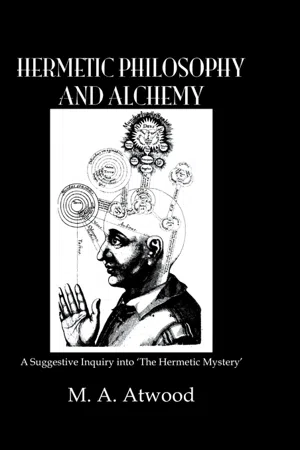
This is a reprint of the 1920 edition of an important but almost unknown work. When Atwood made her suggestive inquiry into what was termed "The Hermetic Mystery," she supposed that the adept Hieophants put the candidate into a deep trance and his soul was led into something that was for her the Supreme Oneness of everything.
- 256 pages
- English
- ePUB (mobile friendly)
- Available on iOS & Android
eBook - ePub
Hermetic Philosophy and Alchemy
About this book
Information
A SUGGESTIVE INQUIRY
INTO THE HERMETIC MYSTERY.
PART I.
AN EXOTERIC VIEW OF THE PROGRESS AND THEORY OF ALCHEMY.
A SUGGESTIVE INQUIRY
INTO THE
HERMETIC MYSTERY.
CHAPTER I.
A Preliminary Account of the Hermetic Philosophy, with the more salient Points of its Public History.
THE Hermetic tradition opens early with the morning dawn of philosophy in the eastern world. All pertaining thereto is romantic and mystical. Its monuments, emblems, and numerous written records, alike dark and enigmatical, form one of the most remarkable episodes in the history of the human mind. A hard task were it indeed and almost infinite to discuss every particular that has been presented by individuals concerning the art of Alchemy ; and as difficult to fix with certainty the origin of a science which has been successively attributed to Adam, Noah and his son Cham, to Solomon, Zoroaster, and the Egyptian Hermes. Nor, fortunately, does this obscurity concern us much in an inquiry which rather relates to the means and principles of occult science than to the period and place of their reputed discovery. Nothing, perhaps, is less worthy or more calculated to distract the mind from points of real importance than this very question of temporal origin, which, when we have taken all pains to satisfy and remember, leaves us no wiser in reality than we were before. What signifies it, for instance, that we attribute letters to Cadmus, or trace oracles to Zoroaster, or the Kabalah to Moses, the Eleusinian mysteries to Orpheus, or Free-masonry to Noah ; whilst we are profoundly ignorant of the nature and true beginning of any one of these things, and observe not how truth, being everywhere eternal, does there always originate where it is understood ?
We do not delay, therefore, to ascertain, even were it possible, whether the Hermetic Science was indeed preserved to mankind on the Syriadic pillars after the flood, or whether Egypt or Palestine may lay equal claims to the same ; or, whether in truth that Smaragdine table, whose singular inscription has been transmitted to this day, is attributable to Hermes or to any other name. It may suffice the present need to accept the general assertion of its advocates, and consider Alchemy as an antique artifice coeval, for aught we know to the contrary, with the universe itself. For although attempts have been made, as by Herman Conringius,1 to slight it as recent invention, and it is also true that by a singularly envious fate, nearly all Egyptian record of the art has perished ; yet we find the original evidence contained in the works of A. Kircher,2 the learned Dane Olaus Borrichius,3 and Robert Vallensis in the first volume of the Theatrum Chemicum4 more than sufficient to balance every objection of this kind, besides ample collateral probability bequeathed in the best Greek Authors, historical and philosophic.
In order to show that the propositions we may hereafter have occasion to offer are not gratuitous as also with better effect to introduce a stranger subject, it will be requisite to run through a brief account of the Alchemical philosophers, with the literature and public evidence of their science ; the more so, as no one of the many histories of philosophy compiled or translated into our language advert to it in such a manner as, considering the powerful and widespread influence this branch formerly exercised on the human mind, it certainly appears to deserve.
This once famous Art, then, has been represented both as giving titles and receiving them from its mother land, Cham ; for so, during a long period, according to Plutarch, was Egypt denominated, or Chemia, on account of the extreme blackness of her soil :—or, as others say, because it was there that the art of Vulcan was first practised by Cham, one of the sons of the Patriarch, from whom they thus derive the name and art together. But by the word Chemia, says Plutarch, the seeing pupil of the human eye was also designated, and other black matters, whence in part perhaps Alchemy, so obscurely descended, has been likewise stigmatized as a Black Art.5
Etymological research has doubtless proved useful in leading on and corroborating truths once suggested, but it is not a way of first discovery ; derivations may be too easily conformed to any bias, and words do not convey true ideas unless their proper leader be previously entertained. Without being able now, therefore, to determine whether the art gave or received a title from Cham, the Persian prince Alchimin, as others have contended, or that dark Egyptian earth ; to take a point of time, we may begin the Hermetic story from Hermes, by the Greeks called Trismegistus, Egypt’s great and far-reputed adeptist king, who, according to Suidas, lived before the time of the Pharaohs, about four hundred years previous to Moses, or, as others compute, about 1900 before the Christian era.6
This prince, like Solomon, is highly celebrated by antiquity for his wisdom and skill in the secret operations of nature, and for his reputed discovery of the quintessential perfectibility of the three kingdoms in their homogeneal unity ; whence he is called the Thrice Great Hermes, having the spiritual intelligence of all things in their universal law.7
It is to be lamented that no one of the many books attributed to him, and which are named in detail by Clemens Alexandrinus, escaped the destroying hand of Dioclesian ;8 more particularly if we judge them, as Jamblicus assures us we may, by those Asclepian Dialogues and the Divine Poemander, which yet pass current under the name of Hermes.9 Both are preserved in the Latin of Ficinus, and have been well translated into our language by Dr. Everard. The latter, though a small work, surpasses most that are extant for sublimity of doctrine and expression : its verses flow forth eloquent, as it were, from the fountain of nature, instinct with intelligence ; such as might be more efficacious to move the rational sceptic off from his negative ground into the happier regions of intelligible reality, than many theological discourses which, of a lower grade of comprehension, are unable to make this highly affirmative yet intellectual stand. But the subjects treated of in the books of the Pœmander and Asclepias are theosophic and ultimate, and denote rather our divine capabilities and promise of regeneration than the physical ground of either ; this, with the practical method of alchemy being further given in the Tractatus Aureus, or Golden Treatise, an admirable relic, consisting of seven chapters, attributed to the same author.10 The Smaragdine Table, which, in its few enigmatical but remarkable lines, is said to comprehend the working principle and total subject of the art, we here subjoin : from the original Arabic and Greek copies, it has been rendered into Latin by Kircher as follows:—
TABULA SMARAGDINA HERMETIS.
Verum sine mendacio certum et verissimum ; quod est superius est sicut quod est inferius ; et quod est inferius est sicut quod est superius, ad perpetranda miracula rei unius : et sicut omnes res fuerunt ab uno, mediatione unius, sic omnes res notca fuerunt ab hâc una re adaptafr’one. Pater ejus Sol est, mater vera Luna ; portavit id ventus in ventre suo, nutrix ejus terra est ; pater omnis telesmi, sive consummatio totius mundi est hic. Vis ejus Integra est si versa fuerit in terram. Separabis terram ab igne, subtile a spisso, suaviter cum multo ingenio ; ascendit a terrâ in ccelum, interumque descendit in terram, recipitque vim superior-um et injeriorum. Sic habebis gloriam totius mundi, ideb fugit a te omnis obscuritas ; hie est totius fortitudinis fortis, qui vincet omnem rem subtilem omnemque solidam penetrabit. Sicut mundus creatus est. Hinc erunt adaptationes mirabiles quarum modus est hic. Itaque vocatus sum Hermes Trismegistus, habens tres partes philosophiœ totius mundi. Completum est quod dixi de operatione Solis.
We shall have occasion to revert to this tablet and its applicability hereafter, when we come to a particular examination of the philosophic subject in its active and passive relations, and the intimate mystery of those Hermetic luminaries in conjunction. The inscription may be thus rendered.
THE SMARAGDINE TABLE OF HERMES.
True, without error, certain and most true ; that which is above is as that which is below, and that which is below is as that which is above, for performing the miracles of the One Thing ; and as all things were from one, by the mediation of one, so all things arose from this one thing by adaptation ; the father of it is the Sun, the mother of it is the Moon ; the wind carries it in its belly ; the nurse thereof is the Earth. This is the father of all perfection, or consummation of the whole world. The power of it is integral, if it be turned into earth. Thou shalt separate the earth from the fire, the subtle from the gross, gently with much sagacity ; it ascends from earth to heaven, and again descends to earth : and receives the strength of the superiors and of the inferiors—so thou hast the glory of the whole world ; therefore let all obscurity flee before thee. This is the strong fortitude of all fortitudes, overcoming every subtle and penetrating every solid thing. So the world was created. Hence were all wonderful adaptations of which this is the manner. Therefore am I called Thrice Great Hermes, having the Three Parts of the philosophy of the whole world. That which I have written is consummated concerning the operation of the Sun.
This Emerald Table, unique and authentic as it may be regarded, is all that remains.to us from Egypt of her Sacred Art. A few riddles and fables, all more or less imperfect, that were preserved by the Greeks, and some inscrutable hieroglyphics are still to be found quoted in certain of the alchemical records : but thè originals are entirely swept away. And—duly considering all that is related by the chroniclers of that ancient dynasty, her amazing reputation for power, wealth, wisdom, and magic skill;—and, even when all these had faded, when Herodotus visited the city, after the priestly government of the Pharaohs had been overthrown by Cambyses, and that savage conqueror had burned the temples and almost annihilated the sacerdotal order,—after the influx of strangers had been permitted, and civil war had raged almost to the fulfilment of the Asclepian prophecy,—the wonders then recorded by the historian of her remaining splendour and magnificence ;—what shall we now conclude, when, after the lapse of so many more destroying ages, we review the yet mightily surviving witnesses of so much glory, surpassing and gigantic even in the last stage of their decay ? Shall we suppose the ancient accounts fallacious because they are too wonderful to be conceived ; or have we not now present before our eyes the plain evidence of lost science and the vestiges of an intelligence superior to our own ? For what did the nations flock to Memphis ? For what did Pythagoras, Thales, Democritus, and Plato become immured there for several solitary years, but to be initiated in the wisdom and learning of those Egyptians ? For what else, but for the knowledge of that mighty Art with which she arose, governed, and dazzled the whole co-temporary world ; holding in strong abeyance the ignorant, profane, vulgar, until the evil day of desolation came with self-abuse, when, neglecting to obey the law by which she governed, all fell, as was foretold, and sinking gradually deeper in crime and presumption, was at last annihilated, and every sacred institution violated by barbarians, and despoiled...
Table of contents
- Cover
- Halftitle
- Title
- Copyright
- Preface
- Contents
- Introduction
- Part I. An Exoteric View of the Progress and Theory of Alchemy
- Part II. A More Esoteric Consideration of the Hermetic Art and its Mysteries
- Part III. Concerning the Laws and Vital Conditions of the Hermetic Experiment
- Part IV. The Hermetic Practice
- Appendix
Trusted by 375,005 students
Access to over 1.5 million titles for a fair monthly price.
Study more efficiently using our study tools.
Frequently asked questions
Yes, you can cancel anytime from the Subscription tab in your account settings on the Perlego website. Your subscription will stay active until the end of your current billing period. Learn how to cancel your subscription
No, books cannot be downloaded as external files, such as PDFs, for use outside of Perlego. However, you can download books within the Perlego app for offline reading on mobile or tablet. Learn how to download books offline
Perlego offers two plans: Essential and Complete
- Essential is ideal for learners and professionals who enjoy exploring a wide range of subjects. Access the Essential Library with 800,000+ trusted titles and best-sellers across business, personal growth, and the humanities. Includes unlimited reading time and Standard Read Aloud voice.
- Complete: Perfect for advanced learners and researchers needing full, unrestricted access. Unlock 1.5M+ books across hundreds of subjects, including academic and specialized titles. The Complete Plan also includes advanced features like Premium Read Aloud and Research Assistant.
We are an online textbook subscription service, where you can get access to an entire online library for less than the price of a single book per month. With over 1.5 million books across 990+ topics, we’ve got you covered! Learn about our mission
Look out for the read-aloud symbol on your next book to see if you can listen to it. The read-aloud tool reads text aloud for you, highlighting the text as it is being read. You can pause it, speed it up and slow it down. Learn more about Read Aloud
Yes! You can use the Perlego app on both iOS and Android devices to read anytime, anywhere — even offline. Perfect for commutes or when you’re on the go.
Please note we cannot support devices running on iOS 13 and Android 7 or earlier. Learn more about using the app
Please note we cannot support devices running on iOS 13 and Android 7 or earlier. Learn more about using the app
Yes, you can access Hermetic Philosophy and Alchemy by M.A. Atwood,Atwood in PDF and/or ePUB format, as well as other popular books in Social Sciences & Anthropology. We have over 1.5 million books available in our catalogue for you to explore.