- 250 pages
- English
- ePUB (mobile friendly)
- Available on iOS & Android
eBook - ePub
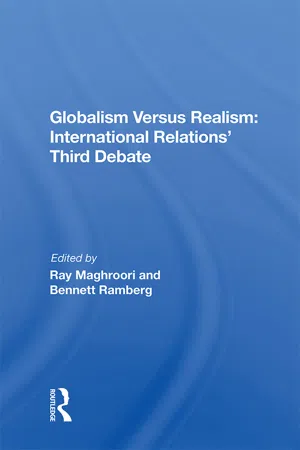
Globalism Versus Realism: International Relations' Third Debate
About this book
Since World War I, when the movement toward a comprehensive and systematic examination of international relations began, two intensive debates about the nature and methodology of the discipline have helped shape the field. The first was between the realist and the idealist schools; the second, between the traditionalists and the behavioralists. Now, a third debate has emerged, pitting state-centric conceptualizations against the globalist focus on interdependence. At issue is the nature of the international system. Is it still one in which the sovereign nation-state constitutes the dominant actor? Or has a process of global political, economic, and even social integration transformed the world into a "global village"? This text presents seminal works that define and illuminate the third debate, focused by the editors' comments prefacing each chapter and their synthesizing introductory and concluding chapters. It is designed to allow students and scholars to compare and contrast the contending approaches in order to better understand and develop the discipline of international relations. Given the consensus among both realists and globalists that our assumptions about world affairs affect how we construct theories to explain events and that the model we impose on the world directly affects the policies we prescribe, it is difficult to overemphasize the importance of the subject.
Information
1
Introduction: Major Debates in International Relations
RAY MAGHROORI
In this chapter, Maghroori explores three definitional debates that have shaped the field of international relations since it emerged as a distinct discipline over sixty years ago. The realist-idealist debate of the interwar period focused on the means of maintaining world order–power politics versus collective security. The traditionalist-behavioralist dialogue of the 1950s and 1960s addressed methodological questions, but in the late 1960s a third debate arose that continues this day. It involves "realists"– those who conceptualize world affairs in terms of power politics–and "globalists"–those who argue that political and economic interdependence and integration are transforming international politics.
The study of international relations as a distinct discipline is a relatively recent development, although such antecedents as diplomatic history and international law have long traditions. Movement toward a comprehensive and systematic examination of international relations began only with World War I.1 The war shook many of the dominant ideals about the correct conduct of global politics, and the discipline of international relations took shape during a period of profound change in attitudes about world affairs. This undoubtedly contributed to the introspection and controversy that have marked the growth of the field. Since the close of World War I, two extensive debates have taken place. The first was evidenced by the clash between the realists and the idealists. The second involved the traditionalists and the behavioralists.
The realist outlook rested on the simple proposition that the pursuit of national power was a natural drive and that those who neglected to cultivate power actually invited war. The realists further assumed that the community of states, composed of individual actors attempting to maximize their own power, influence, and fundamental security, would be naturally drawn into transitory alliances that would in turn tend to impose a certain balance of power among opposing blocs of states. Thus, the realists upheld the sovereign nation-state's right to pursue power and relied on a balance-of-power system to constrain the competition among states. The scope, duration, and social costs of World War I rendered most, if not all, of the realists' arguments unacceptable. In particular, the notion that sovereign states were entitled to unrestrained independence lost popularity, and the balance-of-power system was rejected as unserviceable. A new school of thought arose that called for the renunciation of war as a national policy, the institutionalization of an international order, and the replacement of balance-of-power politics by collective security.
The idealist approach dominated the study of international politics between World War I and World War II, even though some realists continued to cling stubbornly to their own view of the world. The first assumption of the idealists was that national self-determination within Europe would remove one of the major sources of war. Each nationality, as far as possible, was to be organized as an independent state. A second assumption was that war often resulted from secret agreements between states, and that if citizens of these states were aware of such agreements they would not be tolerated. The idealists called for an end to secret diplomacy and urged greater public participation in the conduct of foreign policy. They also argued that the creation of an international political organization would provide a forum in which states could negotiate their differences. This movement led to the founding of the League of Nations. Finally, and most importantly, the idealist program advocated abandoning the balance of power in favor of a system of international collective security that would require states to reduce their military preparedness to the lowest possible level and to rely on the combined military capability of the world community for their security against armed aggression. It also presupposed (1) that a world governing body would exist to determine whether aggression had occurred and to coordinate a global response, and (2) that states would automatically join in collective responses to aggression anywhere in the world.2
The debate between the realists and the idealists centered on the issue of collective security.3 The realists argued that collective security depended on altruistic behavior and was therefore unreliable. They criticized the idealists for assuming that states would automatically put aside their own interests to assist an aggrieved nation even when the particular act of aggression posed no immediate or imminent danger to them. The idealists argued that peace was indivisible – that aggression anywhere, at any time, against any state was a threat to all states. The realists ridiculed this view as inconsistent with national motivation. They argued that only a balance-of-power system, in which each state guarded its own security and compensated for the aggressive tendencies of other states through defensive alliances, could promote the cause of peace.
The debate, then, involved a fundamental disagreement about the nature of the international political system and the motivations behind state behavior. The idealists rejected the realist depiction of the world because they considered its consequences unacceptable. The realists countered that, like it or not, the pursuit of state power was an inescapable fact and the theory and practice of international relations must adjust to that reality. The idealists, they argued, were actually endangering peace by relying on Utopian measures to control aggression. As with most debates, the conflict was not decided by the merits of the arguments, but rather by the course of events. The inability of the League of Nations to check Japanese aggression in Manchuria, the Italians' assault on Ethiopia, and Russia's attempted subjugation of Finland strengthened the position of the realists. The outbreak of World War II was attributed to the naiveté of idealism, much as World War I had been ascribed to the fallacies of realism.
The creation of the United Nations, along with its various mechanisms for dealing with international disputes, demonstrates that aspects of the idealist outlook had influence even after World War II. But the realist perspective became the dominant outlook, especially with the breakdown in U.S.-Soviet relations and the rise of the Cold War. As Theodore Couloumbis and James Wolfe have noted, "In the 1950s the realists became the prevalent school of thought in international relations. Using the argument that only policies based on power could afford a semblance of global security, they had comparatively little difficulty in overcoming the remnants of the idealistic tradition."4
The revival of the realist school was reflected in the leading work of the period, Hans J. Morgenthau's Politics Among Nations: The Struggle for Power and Peace. As the subtitle indicates, the pursuit of state power was once again accepted as consistent with the goal of international peace. Indeed, retrospective analysis of the origins of World War II led to a belief that the appeasement of aggressive demands and the military weakness of the democracies were the primary causes of the war. In the postwar period most states returned to the realist prescription of meeting threats to peace with strength, not appeasement. Although such attitudes softened somewhat with the emergence of U.S.-Soviet detente, the realist view continues to strongly influence our understanding of the international political system.
The second important debate arose during the 1950s, when the dispute between realism and idealism was fading into the background. Unlike the disagreement between realists and idealists, which centered on the nature of the international system and the most viable approaches to the conduct of international politics, the debate between the traditionalists and the behavioralists focused on the best method of studying international relations. The realist-idealist clash had remained largely confined to the field of international relations, but the traditional-behavioral controversy involved nearly the entire discipline of political science (and some other disciplines as well). At the heart of the issue was the desire of a new generation of scholars to develop a more systematic or "scientific" study of political phenomena.
The movement to make the study of politics more rigorous so that it would meet the standards of scientific procedure developed in other fields (and thereby gain prestige as a discipline) took the form of behavioralism. As one text explains, "Behavioralism can be defined as the systematic search for political patterns through the formulation of empirical theory and the technical analysis and verification thereof. Behavioralism involves two basic emphases: 'the formulation of concepts, hypotheses, and explanations in systematic terms' and 'empirical methods of research.'"5 By contrast, the more widespread traditionalist approach relied on a variety of factors, including history, personal experience, legal formulations, and intuition, to provide the foundations for generalizing about world politics. Many traditionalist works on international relations were based on immeasurable single variables, such as the assumed universal drive for power that served as the starting point of Morgenthau's work. Behavioralists rejected the literary and philosophical approaches of the traditionalists and demanded the construction of formal models with testable hypotheses.
One of the first important behavioral works written in the field of international relations was Richard C. Snyder, H. W. Bruck, and Burton Sapin's Decision-Making as an Approach to the Study of International Politics.6 It advanced an extensive set of measurable variables by which foreign policy actions could be studied. Traditionalist critics argued that the number and complexity of the variables would make the model's application infeasible. However, later studies of the United States' decision to intervene in Korea that used the decision-making framework demonstrated quite convincingly that the model could be employed economically in case research.7 The decision-making approach, which never gained very wide acceptance, was followed by even more rigorous empirical frameworks. They included game theory, using mathematical models of probability; transnational analysis, using quantified indexes of interaction between nation-states; and linkage theory, which focused on observable relationships between intrastate variables and interstate behavior. The most enduring contribution of behavioralism to the study of international relations has been the application of statistical analysis to international phenomena. The major limitation of the approach is that significant variables in world politics do not readily lend themselves to quantification or mathematical manipulation.
In the 1950s the behavioralists expected that cumulative studies would gradually reveal general patterns of international politics and lead to a general theory. By the late 1960s, however, they increasingly recognized that although the behavioral approach had made great contributions, the insights it provided were limited and were not superior to those resulting from the traditional approach. This realizat...
Table of contents
- Cover
- Half Title
- About the Book and Editors
- Title
- Copyright
- Contents
- Order and Disorder in the Study of World Politics: Ten Essays in Search of Perspective
- 1. Introduction: Major Debates in International Relations
- 2. The Changing Essence of Power
- 3. International Politics in the 1970s: The Search for a Perspective
- 4. Interdependencies in World Politics
- 5. The Myth of National Interdependence
- 6. Interdependence: Myth and Reality
- 7. Whither Interdependence?
- 8. The Politics of Transnational Economic Relations
- 9. Transnationalism, Power Politics, and the Realities of the Present System
- 10. Globalism Versus Realism: A Reconciliation
- About the Contributors
- Index
Trusted by 375,005 students
Access to over 1.5 million titles for a fair monthly price.
Study more efficiently using our study tools.
Frequently asked questions
Yes, you can cancel anytime from the Subscription tab in your account settings on the Perlego website. Your subscription will stay active until the end of your current billing period. Learn how to cancel your subscription
No, books cannot be downloaded as external files, such as PDFs, for use outside of Perlego. However, you can download books within the Perlego app for offline reading on mobile or tablet. Learn how to download books offline
We are an online textbook subscription service, where you can get access to an entire online library for less than the price of a single book per month. With over 1.5 million books across 990+ topics, we’ve got you covered! Learn about our mission
Look out for the read-aloud symbol on your next book to see if you can listen to it. The read-aloud tool reads text aloud for you, highlighting the text as it is being read. You can pause it, speed it up and slow it down. Learn more about Read Aloud
Yes! You can use the Perlego app on both iOS and Android devices to read anytime, anywhere — even offline. Perfect for commutes or when you’re on the go.
Please note we cannot support devices running on iOS 13 and Android 7 or earlier. Learn more about using the app
Please note we cannot support devices running on iOS 13 and Android 7 or earlier. Learn more about using the app
Yes, you can access Globalism Versus Realism: International Relations' Third Debate by Ray Maghroori in PDF and/or ePUB format, as well as other popular books in Politics & International Relations & Politics. We have over 1.5 million books available in our catalogue for you to explore.