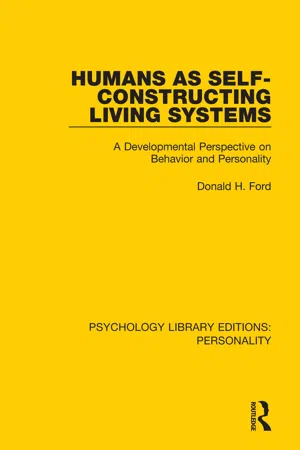
Originally published in 1987, the purpose of this title was to develop a conceptual framework for understanding individual humans as complex, functional entities. It was felt that a sound developmental theory of human personality and behaviour would help synthesize existing scientific and clinical information into a coherent representation of a person as a functional unit, guide future research, and facilitate the work of the health and human services professions. The volume is aimed at a multidisciplinary-multiprofessional audience.
eBook - ePub
Humans as Self-Constructing Living Systems
A Developmental Perspective on Behavior and Personality
- 800 pages
- English
- ePUB (mobile friendly)
- Available on iOS & Android
eBook - ePub
Humans as Self-Constructing Living Systems
A Developmental Perspective on Behavior and Personality
About this book
Information
I
THE CONCEPTUAL FRAMEWORK
1
The Nature of Humans
INTRODUCTION
How can we understand people—what they are, how they function, how they may develop or change? Some way of thinking about a person as an entity, as a unitary being, is needed (Royce, 1961). The purpose of this chapter is to establish and to place in some historical perspective the need for, the basic characteristics of, and the evolution of a view that can serve that purpose.1 These ideas are used in later chapters to outline a framework for understanding the organization, functioning, and development of persons.
One key scholarly strategy involves the use of analogies from one domain of knowledge to try to understand phenomena in a different one. Historically, attempts to study and understand humans have been significantly influenced by models borrowed from the natural sciences (e.g., the mechanistic model of Newtonian physics). What follows is an attempt to profit from new ideas developing in the larger scientific context. Capra (1977), Jantsch (1980), and Zukav (1979) provide relatively nontechnical discussions of many aspects of such emerging perspectives.
This chapter begins with the identification of basic human attributes, and an examination of the issues of units of analysis, parts, and wholes as they relate to the concept of organization. Then a brief historical perspective is provided to illustrate how different kinds of units and models of organization have influenced attempts to understand the natural world in general, and humans in particular. The utility and limitations of a mechanistic model of organization are briefly considered and compared with alternate models of organization that have been evolving in other efforts to understand humans. The concept of a system is then selected as a promising alternate model for understanding self-regulating organizations. Organisms, as a special kind of system, are referred to in this book as living systems. The methodological implications of conceiving of humans as living systems are briefly considered.
BASIC ATTRIBUTES OF INDIVIDUAL HUMANS
The first step in constructing any conceptual framework should be to clearly identify the domains of phenomena which that framework will be expected to encompass. Therefore, this section addresses the question, “What are the fundamental attributes of individual development and functioning that must be encompassed in a conceptual framework designed to represent individuals as functional units?” Eight categories of attributes are identified that may be considered “design criteria” for the creation of such a framework.
Biological Structure Makes Possible Functional or Behavioral Capabilities
Behavioral capabilities are made possible by the physical structure of each organism. For example, the structure of a bird makes flying a behavioral possibility, while a hippopotamus must plod through life on land or in water. The biological structure provides only the potential for different kinds of behavior. The extent to which behavioral potentials become effective actualities is a function of individual organisms’ interactions with their environments.
The physical structure and organization of the human body both define and limit its potential functional capabilities. For instance, the human ear and eye are designed to respond to certain sound frequencies or wavelengths of light, and not to others. Individuals may differ in their biological structure and therefore in their behavioral potentials as a result of both their genetic inheritance and their life experiences. One of the distinguishing features of humans is their capability for inventing supplementary structures to expand their functional capabilities (e.g., airplanes enable humans to fly; X-ray machines make it possible to “see” things they cannot detect with the “natural” senses; prostheses compensate for structural deficiencies).
Different Kinds of Functions and the Concept of Behavior
Life is often defined as a state that is characterized by metabolism and growth, reproduction, and internally initiated adaptations to the environment. Entities that display such properties may be called living systems (J. Miller, 1978). All life processes or functions are included under the term behavior in this book. For example, the action of a hormone on selected brain cells, a happy thought, and jogging all represent different kinds of behavior. Not everyone uses the term this broadly. Some prefer to limit it to overt actions, so that speech but not thinking would be considered behavior. But, since all human responses are functions made possible by the biological structure, the use of one term to encompass all functional capabilities seems both logical and useful.
Behavior is a many-splendored thing, and its diversity provides the constituents of the stream of life. Skinner (1966) emphasized that to identify the occurrence of an operant (or response) requires specifying some “defining property” so that responses of different kinds could be distinguished from one another. To a considerable extent, the science of psychology has been organized around different kinds of behavior or response classes, as, for example, sensation and perception, memory and cognition, and motivation and emotion.
Structural-Behavioral Organization Produces Unitary Functioning
Although a person’s functioning may be thought of as composed of many different kinds of behavior, specific responses do not occur in random relationship to one another. A person is a complexly organized array of substances, events, and processes occurring together in integrated arrangements as a functioning unit. Analytical science divides humans into pieces and parts to see “what makes them tick.” However, understanding the parts will no more reveal the nature of a person than would components of steel, lumber, stone, cement, wire, glass, and the like reveal whether they composed a school, prison, hospital, church, factory, or home. It is the way the components are organized in relationship to one another and to their larger contexts that reveals the nature of the entity of which they are a part. Therefore, understanding people requires understanding the nature both of their structural and functional parts and of their organization.
It is a property of living systems that they function to maintain and to elaborate upon their structural and functional organization. Attempts to account for this property of organization have taken several forms throughout the history of psychology (e.g., as manifested in associationism, holism, and organismic and field theories). The two most commonly used terms in psychology, stimulus and response, denote not the content of phenomena but types of relationships among phenomena, that is, their organization.
Contextual and Temporal Consistency and Variability
Two seemingly contradictory properties of human behavior are consistency (e.g., habits) and variability (e.g., change). Each person develops a physical appearance, a pattern of abilities, a personality, a manner of dress and grooming, a manner of speech, a typical occupation, a consistent pattern of personal relationships, and a characteristic biological balance. It is such structural-functional consistency across diverse situations and times that gives people their individuality and identity.
On the other hand, people seem to need and seek variability in their experience (Fiske & Maddi, 1961); human “plasticity” is a pervasive phenomenon (Lerner, 1984). Variability-seeking is represented in both everyday and scientific language by the term curiosity (e.g., Berlyne, 1960). Variability or change appears in long term behavior patterns as well. For example, an accountant who always bought black Fords with no chrome and seldom drove over 55 miles an hour retired and bought himself a race car. A woman began an active artistic career after her husband retired.
Consistency in behavior is valuable and efficient when individuals must deal with repetitive situations. Variability is valuable because it opens up new behavioral options. Consistency and change live side by side as essential interacting parts of an integrated whole (Brim & Kagan, 1980). Moreover, phenomena may appear variable at one level of analysis, and stable at another (Block, 1977; Epstein & O’Brien, 1985; Mischel, 1983). Consistency and variability are evident not only in kinds of behavior, but in other behavioral attributes such as the rate and intensity of activity, the level of alertness, and the intensity of emotions (e.g., Buss & Plomin, 1984; Cofer & Appley, 1964; Duffy, 1962). Consistency and variability are functions of environmental conditions. For example, the behavior of a child is more similar to that of other children in the same context (e.g., playground) than to his or her own behavior in different settings (e.g., playground vs. classroom) (Barker, 1968). Therefore, interindividual and intraindividual consistency and variability in behavior cannot be understood separately from their context, and are often subject to contextually embedded social evaluation (e.g., may be labeled deviant or creative) (Bronfenbrenner, 1979).
People Change Both Structurally and Functionally
It is important to distinguish between cyclical variations in functioning within limits (e.g., heart rate, hormonal secretions, rate of walking) and progressive, cumulative, relatively permanent changes in structural-functional capabilities (e.g., increases in height, learning to talk). Being (functioning) is different from becoming (development), although each influences the other. Changes in structural organization may alter functions (e.g., brain damage may produce paralysis), and functional organization may alter structure (e.g., smoking may produce cancer). Four kinds of terms—growth, maturation, learning, and development—have been used to refer to the more permanent kinds of progressive changes. Careful distinctions among such terms are essential for clarity and scientific advances, and those made by Weiss (1939) are still sound.
The term growth refers to a permanent increase in the total mass of the body via tissue accretion. Maturation typically refers to the differentiation and the elaboration of biological structures and functional capabilities resulting from the interaction of genetic and experiential factors. All humans follow essentially the same pattern and sequence of biological growth and maturation, but there are marked individual differences in the presence of some biological attributes and in the rate at which various maturational changes occur. Many “stage” theories of psychological development have their roots, at least by analogy, in the concept of maturation.
In contrast, learning is change that is also relatively enduring (in contrast to temporary performance changes such as those produced by fatigue or drugs); but it results primarily from a person’s experiential history rather than being heavily influenced by genetic or biological makeup. It is a far more flexible and variable method of development than biological maturation. Hilgard and Bower (1966, 1975) identify six sets of issues considered important in the learning process, as follows:
1. What are the limits of learning? Our culture clearly believes that people differ in their learning capabilities. It is not clear to what extent these capacities are fixed at birth or can be modified through factors of living such as diet, experience, or genetic manipulation (e.g., Barnes, 1967; Brozek, 1978; Coursin, 1967; Witkop, 1967). Nor is it clear to what extent such capacities change with age (e.g., Baltes, et al., 1978; Plemons, Willis, & Baltes, 1978; Schaie, 1979).
2. What is the role of practice in learning? Football coaches, music teachers, and theatrical directors exemplify professionals who obviously believe practice makes “better” if not “perfect.”
3. How important are drives and incentives, rewards and punishments? Every parent who criticizes, praises or spanks a child clearly believes in the value of rewards and punishments.
4. What is the place of understanding and insight in learning? Public education is obviously designed on the assumption that cognitive learning is fundamental.
5. Does learning one thing in one setting help you learn something else in another setting? This has been a particularly vexing problem to educators, psychotherapists, and behavior modifiers (Goldstein & Kanfer, 1979).
6. What happens when we remember and when we forget? Those dealing with emotionally troubled persons have developed other terms to signify memory difficulties (e.g., repression; suppression; amnesia).
Development is a fourth term referring to individual change. Until recent years, this term was usually applied to approximately the first two decades of life (Harris, 1957) and involved specific progression-related changes represented as unidirectional, sequential, qualitative, irreversible, normative, and oriented toward maturity. It was assumed that behavioral capabilities matured in a sense similar to physiological capabilities. However, the concept of life-span development recognizes that people can and do change throughout their lives. Moreover, developmental changes are now viewed as multidimensional, multidirectional, and often individualistic in timing, rate, and substance (Baltes, Reese, & Lipsitt, 1980; Baltes & Willis, 1978; Lerner, 1976). In its evolving usage, development has become a superordinate concept whose meaning encompasses growth, maturation, and learning. Terms such as to impair or to disable also refer to a kind of permanent change. Such a reduction of structural or functional capabilities (e.g., with age) is increasingly also being encompassed by the term development.
The broad issues of what changes (e.g., the content or organization of behavior, or of behavior-environment interactions), when, under what circumstances, and whether such changes are continuous, emergent, or reversible, are issues fundamental to most developmental theories and technologies (e.g., Brim & Kagan, 1980; Kitchener, 1978; Lerner, 1980; Rothenberg, 1978, 1979).
Human Behavior Both Shapes and is Shaped by the Environment
It is through transactions with the environment that a person stays alive, grows, and develops behavioral capabilities. The environment provides people with different kinds of material and information necessary for living and behaving.
Formal learning theories give major emphasis to the environment in shaping behavior, with concepts such as discriminative stimulus, reinforcer, and cue (e.g., Hilgard & Bower, 1966). The primary focus and power of Skinner’s (1953) operant conditioning approach, for example, lies in its emphasis on the notion that behavior development and functioning are under the control of environmental contingencies and consequences.
Psychotherapy theorists vary in their emphasis on situational events, from those who make them primary (e.g., Sullivan and the behavior therapists) to others who focus primarily on subjective kinds of behaviors, such as thoughts and feelings (e.g., Rogers and Rank). However, all of them use the manipulation of situational events as their primary means of therapeutic intervention, whether it is some attribute of the therapist’s behavior (e.g., Freud’s “interpretations”) or some other type of event such as a token economy (Ford & Urban, 1963, 1967). Formal education is primarily a process of exposing people to a planned and systematic array of situational events (e.g., lectures, books, pictures, sounds), and having them interact with those events.
In fact, the meaning of a person’s behavior cannot be accurately understood without knowledge of the contexts in which it occurs. For example, a graceful leap into the air may be a part of a basketball game, a ballet, or sitting on a bee. Recognition of which interpretation is correct depends upon contextual characteristics (Rank, 1961). The person-environment relation is interactive or transactional. People both seek to shape and are shaped by their environments (Altman & Wohlwill, 1978; Studer, 1970; Studer & Barton, 1974). Moreover, environments must be understood as a nested set of contingencies ranging from immediate stimuli to larger cultural patterns (Bronfenbrenner, 1979).
The Influence of Potential Futures on Current Behavior
The apparent capability of humans to intentionally direct their behavior towards preselected consequences has been a source of alternate views of humans for centuries. Terms such as teleology, vitalism, purpose, and self-direction have been associated with notions of final cause, often of supernatural or superhuman origin.
Two general views appear to be at least implicitly present in many theories about the nature of humans (Urban & Ford, 1962). Sometimes people are seen as “pilots” of their lives—choosing the destinations toward which they will sail; choosing the means of getting there with some knowledge of the characteristics of their ship and the factors that influence it such as the force of the winds, the currents of life, and the availability of essential supplies; and taking account of interesting new circumstances discovered along the way. This perspective assumes that people seek to exercise control over their behavior, and to shape or use their environments to serve their purposes. They may be seen as responsible for their own courses of action.
Another view sees people as machines or “robots” responding automatically to events which impinge upon them. In this view, the winds and currents of the sea of life carry a person’s ship wherever they may go. The nature of the design of the ship, the power of the currents, winds, and other forces to which it is subjected, determine its direction and movement. People may seem to be directing their behavior toward goals, but cannot in fundamental ways control the direction of their lives. Behavior is regarded as a function of the environment in which it occurs and determined and controlled by the situations in which people develop and live. Therefore, they cannot be considered basically responsible for their actions, any more than can any other type of machine.
Various forms and combinations of these two perspectives have dominated human thinking on this matter with first one and then another being the prevailing theme. But each theory leaves critical questions unattended, giving rise to consideration of alternate ones (von Bertalanffy, 1975). A significant problem with the reductionistic and mechanistic world view is that it cannot account for some of the most important properties of living systems. J. Miller (1978) points out that the dominant metaphors of the 19th and early 20th century concerned linear effects rather than field forces, but that currently dominant metaphors tend to be much more heavily influenced by Einstein’s relativistic field t...
Table of contents
- Cover
- Half Title
- Title Page
- Copyright Page
- Original Title Page
- Original Copyright Page
- Dedication
- Table of Contents
- Preface
- PART I: THE CONCEPTUAL FRAMEWORK
- PART II: HUMAN PERSONALITY AND THE CONTENT AND ORGANIZATION OF BEHAVIOR
- Epilogue: Social Implications of the Living Systems Framework
- References
- Author Index
- Subject Index
Trusted by 375,005 students
Access to over 1.5 million titles for a fair monthly price.
Study more efficiently using our study tools.
Frequently asked questions
Yes, you can cancel anytime from the Subscription tab in your account settings on the Perlego website. Your subscription will stay active until the end of your current billing period. Learn how to cancel your subscription
No, books cannot be downloaded as external files, such as PDFs, for use outside of Perlego. However, you can download books within the Perlego app for offline reading on mobile or tablet. Learn how to download books offline
Perlego offers two plans: Essential and Complete
- Essential is ideal for learners and professionals who enjoy exploring a wide range of subjects. Access the Essential Library with 800,000+ trusted titles and best-sellers across business, personal growth, and the humanities. Includes unlimited reading time and Standard Read Aloud voice.
- Complete: Perfect for advanced learners and researchers needing full, unrestricted access. Unlock 1.5M+ books across hundreds of subjects, including academic and specialized titles. The Complete Plan also includes advanced features like Premium Read Aloud and Research Assistant.
We are an online textbook subscription service, where you can get access to an entire online library for less than the price of a single book per month. With over 1.5 million books across 990+ topics, we’ve got you covered! Learn about our mission
Look out for the read-aloud symbol on your next book to see if you can listen to it. The read-aloud tool reads text aloud for you, highlighting the text as it is being read. You can pause it, speed it up and slow it down. Learn more about Read Aloud
Yes! You can use the Perlego app on both iOS and Android devices to read anytime, anywhere — even offline. Perfect for commutes or when you’re on the go.
Please note we cannot support devices running on iOS 13 and Android 7 or earlier. Learn more about using the app
Please note we cannot support devices running on iOS 13 and Android 7 or earlier. Learn more about using the app
Yes, you can access Humans as Self-Constructing Living Systems by Donald H. Ford in PDF and/or ePUB format, as well as other popular books in Psychology & History & Theory in Psychology. We have over 1.5 million books available in our catalogue for you to explore.