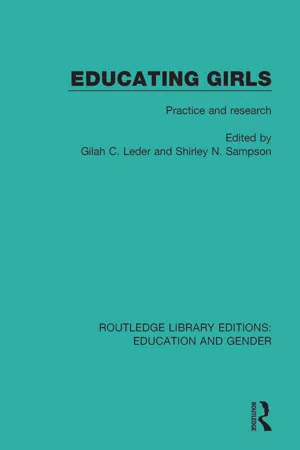
Originally published in 1989. This book addresses a number of issues integral to the education of girls in Australia. Among these are: teacher practices inside and outside the classroom, co-education versus single-sex schooling, curriculum design, students' self-esteem and long-term aspirations. Intervention programs which tackle these issues – in mathematics, science and sport – are described and evaluated. Throughout, the collection functions as a meeting ground for practice and current research.
- 180 pages
- English
- ePUB (mobile friendly)
- Available on iOS & Android
eBook - ePub
About this book
Information
1
MILLICENT E. POOLE AND DAVID G. BESWICK
Girls’ expectations
In the transition from adolescence to adulthood, possibilities for oneself are perceived in terms of the development of major life roles—choice of career, choice of marriage partners and choice of lifestyle possibilities (for example, Schaie and Willis, 1978; Anderson 1981; Poole and Low, 1985; Poole, 1985). Such notions of choice and perceptions of possibilities come from an individual’s sense of preparedness to cope with new demands and changes over the course of a lifetime (Tyler, 1978; Poole and Cooney, 1985; Poole, 1985).
Such understandings, however, are not without problems. In the emphasis on personal empowerment, possibility theories fail to take adequate account of the influence of social-structural factors, such as economic and gender inequalities, which can work to limit one’s choices and possibilities. Marxist sociologists working in the field of vocational theory, for example, are critical of psychological theories which it is claimed emphasise the issue of individual vocational ‘choice’ (e.g., Roberts, 1981; Keil, 1981). They argue for the systematic consideration of the extent to which such ‘choices’ are circumscribed by socio-economic conditions, such as the hierarchy of occupational and class structures, increasing unemployment, and the decline or increase in the demand for certain types of workers. It is not necessary, however, to adopt a Marxist framework in order to direct attention to the importance of these issues.
Recent research on the transition from school to work has also emphasised the inadequacy of models that are ‘psychological’ and ‘cognitive’ developmental explanations. A truly psychological explanation, in any case, should include effects of the current as well as the past environment. Hubner-Funk (1986), while not within a Marxist tradition, but taking as fundamentally important the influences of the environment, identified several socio-ecological influences on the passage from school to work. This socio-ecological perspective places young people in the social micro-world of particular school, neighbourhood and family as well as in the more macro settings, such as type of school attended and socio-economic class. One might equally pay attention to the continuing cultural context of attitudes and values represented by parents, teachers and peers.
This chapter explores the perception of young people aged 17 to 27 in relation to their possibilities for marriage and career. Such perceptions are considered to be both individually and socially constructed and constrained (Elder, 1980; Elder and MacInnis, 1983; Poole, 1985). Specifically in relation to career choice, Gottfredson (1981) argues that choice is determined by the interaction of occupational image and self-concept. She uses a theoretical framework that integrates a social systems perspective with a cognitive developmental approach. Overall, her argument is that occupational choices are made through, or because of, a series of compromises and limitations.
We begin by examining the existing research on marriage and career orientation in terms of changing expectations and the expansion of possibilities to choices combining career and family roles, redefining roles, and changing conceptions of self. Perceptions and possibilities are constructed and constrained by sex-role identity, vocational interests, abilities and values (Gottfredson, 1981) as well as by the range of social-structural factors referred to above According to developmental vocational models, as one’s concept of self becomes increasingly specific one’s choice of career is circumscribed by a process of elimination. Orientation to a female sex-role, for instance, limits choice of career by eliminating characteristically ‘male’ jobs. A similar process is said to occur in relation to self-perception of class and abilities, and the social status of jobs. Studies of women attempting to resolve the competing demands of family and career call for notions of conflict, compromise and negotiation to explain the effects of circumscription as proposed by Gottfredson.
The existing research on career-marriage orientation of young women concentrates on issues such as sex-role conflicts within marriage (Yogev, 1983; Goldenberg and Goldenberg, 1984; Rapoport and Rapoport, 1976), and generally the focus of such studies are the orientations of urban, professional women (House-Knecht and Macke, 1981; Gaddy, Glass and Arnkoff, 1983; Dolny, 1985; McBain and Woolsey, 1986). Goldenberg and Goldenberg, for instance, looking at dual-career couples, argue that ‘adopting a dual career lifestyle involves a greater initial departure from traditional social and marital role patterns for a woman than for a man’ (1984: p. 29). They draw attention to the personal strain and conflict experienced by women pursuing a career, a situation that can involve some fundamental questioning of the conventional perceptions of women’s role as primarily domestically oriented. Such a situation can also involve a renegotiation of men’s participation in the private sphere of domestic life. Similarly, Gaddy et al’s study of professional women explores the influence of sex-role identity on women’s decision to return to work after the birth of a child. They concluded:
Women able to draw on traditionally masculine personality characteristics and who have a relatively equalitarian marriage may have more flexibility for the pursuit of a career after childbirth. Conversely, women who are more feminine in their sex-role identity or traditional in their marriage may be expected to make greater sacrifices for their family. (p. 389)
This confirms the results of earlier research (Veroff and Feld, 1970), which found that career orientation was associated with feelings that marriage placed heavy restrictions on one’s life.
While this research is of relevance to the present study, it should be noted that Gaddy et al., like other researchers in the field (Houseknecht and Macke, 1981; Amatea, Cross, Clark and Bobby, 1986) do not question the validity or meaning of the sex-role concept, and nor do they challenge the attribution of stereotypic masculine and feminine characteristics as descriptions of motivation and behaviour. Moreover, research in this area has not adequately addressed other significant issues, such as the career-marriage orientation of non-professional, and of rural women, or the relationship between broader economic, cultural and ideological processes, and how these shape the formation of young women’s attitudes to and experience of work and family life.
While there are numerous sociological and other specifically feminist accounts of young women and work (Chisholm and Holland, 1986), and of women and family (Harper and Richards, 1981), many of the issues raised by these studies, such as changes in the labour market and how these have affected women’s employment (Aldous, 1981; Game and Pringle, 1983; Hargreaves, 1982) or the contradictory nature of the ideologies shaping young women’s lives (Taylor, 1986; Strintzos, 1984; Thomas, 1980), have received little attention in the research on the career-marriage orientation of young women cited above. Taylor examines, for instance, the impact of the economic recession and high unemployment on teenage girls’ subcultures in Australia. She is concerned with the conflicting ideologies which, on the one hand, encourage young women to pursue a traditional and romanticised feminine role of wife and mother and, on the other hand, urge them to participate in the public world of paid employment. The current economic crisis, Taylor argues, exacerbates this conflict because working class women, in particular, are likely to see ‘few alternatives to futures centred on marriage and child-rearing’ (p. 390). A focus such as Taylor’s is, however, not commonly found in the literature on career and marriage orientation. It is an area that demands further attention but which cannot be taken up here.
Of relevance to this volume is an examination by Poole and Low (1985) of the career and marriage orientations of adolescent girls aged fourteen and then at age seventeen. They argued that there was a need to take into account ‘the relative contribution of clusters of variables considered longitudinally’ (1985: p. 39). Drawing on a large sample of data collected over a three-year period, they found that girls’ marriage-career orientation does not appear to change significantly over this period. As well as identifying the type of orientation—marriage soon, mainly home-centred, partly job-centred, job-centred except for child-rearing, career oriented (p. 42)—they discussed a number of influences on the formation of such orientations. Thus the significance of role-modelling and the influence of mothers and of fathers on attitudes and values also emerges from the case-studies reviewed below. In addition, however, a wider range of issues than those found in the home-school focus of Poole and Low’s work is dealt with in this chapter, considered from a different methodological perspective.
Whereas most of the research in this area has been concerned with either psychological consequences (often seen in terms of strains in personal relationships) of conflict between career and family life, or in terms of social-structural constraints, our interest is in analysing combinations of factors that have contributed, over time, to the formation of ideas on future possibilities in life (using longitudinal data) and in understanding perceptions of conflict and compromise (using case study interviews).
What follows is part of an investigation of the career-marriage orientations of a large sample of women for whom questionnaire data are available on over 1000 cases over a ten-year period (1973-1982), and includes an intensive analysis of 34 case studies interviews. Existing case study research on women’s career-family orientations (Dunne, 1980; Gaddy et al., 1983; Arfken, 1985) needs to be extended in the Australian setting and there needs to be more research on rural and non-professional women. Our sample allows such investigations, and future studies will pursue some of these issues in greater depth. This chapter reports on initial in...
Table of contents
- Cover
- Half Title
- Title Page
- Copyright Page
- Table of Contents
- Contributors
- Introduction Shirley N. Sampson
- 1 Girls’ expectations Millicent E. Poole and David G. Beswick
- 2 Is ‘gender-inclusive’ curriculum the answer for girls? Victoria Foster
- 3 Girls, PE and sports Henny Oldenhove
- 4 Tasmanian schools co-operate San Fitzgibbon
- 5 A rural girls’ self-esteem project Lyn Martinez, Anne Diamond and Leonie Daws
- 6 Living curricula Terry Evans
- 7 Do girls count in mathematics? Gilah C. Leder
- 8 The Family Maths Project Jocelyn Vasey
- 9 A rescue operation Mary Barnes
- 10 In favour of compulsory science Lesley H. Parker and Jenny A. Offer
- 11 A science teachers’ collective The McClintock Collective
- 12 Are boys a barrier for girls in science? Shirley N. Sampson
- 13 From single-sex to coed schools Herbert W. Marsh, Lee Owens, Margaret R. Marsh and Ian D. Smith
- References
- Index
Trusted by 375,005 students
Access to over 1.5 million titles for a fair monthly price.
Study more efficiently using our study tools.
Frequently asked questions
Yes, you can cancel anytime from the Subscription tab in your account settings on the Perlego website. Your subscription will stay active until the end of your current billing period. Learn how to cancel your subscription
No, books cannot be downloaded as external files, such as PDFs, for use outside of Perlego. However, you can download books within the Perlego app for offline reading on mobile or tablet. Learn how to download books offline
Perlego offers two plans: Essential and Complete
- Essential is ideal for learners and professionals who enjoy exploring a wide range of subjects. Access the Essential Library with 800,000+ trusted titles and best-sellers across business, personal growth, and the humanities. Includes unlimited reading time and Standard Read Aloud voice.
- Complete: Perfect for advanced learners and researchers needing full, unrestricted access. Unlock 1.5M+ books across hundreds of subjects, including academic and specialized titles. The Complete Plan also includes advanced features like Premium Read Aloud and Research Assistant.
We are an online textbook subscription service, where you can get access to an entire online library for less than the price of a single book per month. With over 1.5 million books across 990+ topics, we’ve got you covered! Learn about our mission
Look out for the read-aloud symbol on your next book to see if you can listen to it. The read-aloud tool reads text aloud for you, highlighting the text as it is being read. You can pause it, speed it up and slow it down. Learn more about Read Aloud
Yes! You can use the Perlego app on both iOS and Android devices to read anytime, anywhere — even offline. Perfect for commutes or when you’re on the go.
Please note we cannot support devices running on iOS 13 and Android 7 or earlier. Learn more about using the app
Please note we cannot support devices running on iOS 13 and Android 7 or earlier. Learn more about using the app
Yes, you can access Educating Girls by Gilah C. Leder,Shirley N. Sampson in PDF and/or ePUB format, as well as other popular books in Education & Education General. We have over 1.5 million books available in our catalogue for you to explore.