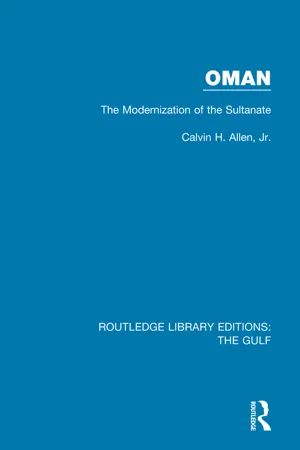
Until the 1970s Oman was an isolated, almost medieval kingdom, virtually unknown to the outside world. The 1970 palace coup that brought Sultan Qaboos b. Sa'id Al-Sa'id to power also brought Oman into the twentieth century. Development programmes made modernization a rapid process, and Oman's location at the entrance to the Straits of Hormuz gave the country an increasing importance to US security interests in the Gulf region. Yet despite modernization, Oman remains an unknown land. This book, first published in 1987, dispels some of the mystery by focusing on the land, the people and the history. It explores the influences on events of trade, foreign involvement in Omani affairs, and Ibadism (the principal sect of Islam in Oman). It also emphasizes the role of the Sultan in contemporary Oman. The architect of Oman's 'new age', Qaboos has overseen significant changes in the country's political system and rapid economic growth financed by oil exports.
- 154 pages
- English
- ePUB (mobile friendly)
- Available on iOS & Android
eBook - ePub
Oman: the Modernization of the Sultanate
About this book
Information
1
Land and People
The country of Oman, situated in the southeastern quarter of the Arabian Peninsula, has a topography, social composition, and traditional economic pattern very typical of the Middle East. The country is virtually cut off from the rest of the peninsula by the Rub al-Khali desert, and its topography is dominated by mountains. Its rough terrain and hot, dry climate, like those of the rest of the peninsula, are not well suited to a settled population; yet for thousands of years the majority of the people have tapped the land's meager water resources and practiced agriculture. Others have turned to the sea to earn a living either as fishermen or as merchants. International trade has meant that Oman has had many overseas contacts with the Indian subcontinent, Africa, and even China. These contacts have had great influence on the country's predominately Arab Muslim population, which has a tribal social organization remarkably divided along religious and ethnic lines.
The Land
The Sultanate of Oman claims a land area of 82,030 square miles (212,460 sq km; roughly the size of Kansas) bordering on South Yemen, Saudi Arabia, and the United Arab Emirates (UAE) as well as the Persian/ Arabian Gulf (hereafter referred to as "the Gulf"), the Gulf of Oman, and Arabian Sea. The country is divided into three main regions: Oman, Dhofar, and the exclave of Ru'us al-Jibal.
Oman
By far the largest, most heavily populated, and economically important region in the sultanate is Oman. This region, which has given its name to the entire country, stretches from the Gulf of Oman to the sandy wastes of the Rub al-Khali and from the UAE to the Jiddat al-Harasis. At its center are the populated areas around the Hajar Mountains, which run north to southeast in an arc from Dibba on the Shimiliyah coast to Ras al-Hadd. Oman is divided into several subregions including the Batinah coastal plain, the Western Hajar, also known as Oman Proper, the Eastern Hajar, the Capital Area, and Masira Island.
The Batinah is a 150-mile-long (240 km), narrow, low, sandy coastal plain beginning near Liwa in the north and extending to about Sib in the southeast and slowly rising inland for between 10 and 50 miles (16 to 80 km) to piedmont before reaching the Hajar Mountains. The plain is transversed by a series of wadis {dry river beds) formed by runoff from the mountains. The climate is hot and dry, although it is somewhat moderated by sea breezes along the coast, and receives only about 4 inches of rain per year, mostly in July, at the beginning of the monsoon, and in December. Natural vegetation includes some wild grasses, thorny shrubs, and the deep-rooted acacia tree. This is Oman's most densely populated area, consisting of a band of major port towns like Sohar, Khabura, Suwayq, Masna' a, Birka, and Sib and large agricultural settlements extending down the coast and inland for 1 mile (1.6 km). The Batinah also includes the uninhabited Daymaniyat Islands near Birka.
Inland from the Batinah is the Western Hajar region, also known as Oman Proper. This is the core area of Oman: the first area settled in ancient times and throughout history the area providing the focus for Omani culture. Centered on the massive Jabal al-Akhdar, actually a high (10,000 feet; 3,000 m) plateau, the Western Hajar includes several knots of settlements around the base of the mountain. On the eastern side is the Ghadaf with the towns of Rustaq, Awabi, Iffi, and Nakhl. Beginning in the north, the western side of the Jabal has the settlements of Tu'am, around the Buraimi Oasis, Sirr, including the towns of Dhank, Yanqul, and lbri, and the Jawf, with Nizwa, Bahla, Izki, and Manah. These highly populated areas nestled in the foothills give way to the Dhahirah, an uneven, gravelly, barren, lightly populated plain that disappears into the Rub al-Khali.
Western Hajar's terrain is rugged, almost lunar in its appearance. The limestone and dolomite mountains have been sharply etched, and the entire region is incised by wadis. The latter have played a very important role in the area not only as a source of water but also in facilitating communication both internally and with other regions. Three of these wadis, al-Jizzi in the north, Hawasina in the center, and the Sama'il gap in the south, have ensured that the interior and coast were closely linked. The climate of the Western Hajar differs little from that of the Batinah. The mountains result in higher average rainfall of 10 inches (25 cm), and temperatures are also higher. Natural vegetation is limited to some grasses, shrubs, and acacias and becomes progressively sparser as one moves away from the mountains.


Eastern Hajar is divided from the west by the Sama'il gap and is more rugged and lightly populated than the western mountains. The main settlement area is the Sharqiyah, which includes the towns of Samad and lbra; the more lightly populated Bidiyah and Ja'lan subregions extend to the south and west before the Western Hajar ends at the Wahiba sands, the Huqf, the Jiddat al-Harasis, and the Rub al-Khali. Topography, climate, and vegetation are the same as those in the Western Hajar. The region is served by the port of Sur.
Although technically located in the Eastern Hajar, for political, cultural, and economic reasons the Capital Area, extending from Sib to Quriyat and including the metropolitan area of Muscat-Mutrah-Ruwi and al-Fahl Island, is considered a separate subregion. The Capital Area is situated at the southeastern extremity of the Hajar Mountains where they plunge into the sea forming a number of fine, albeit small, natural harbors. The mountains have also served to isolate the Capital Area from the rest of Oman. In modem times Muscat and Matrah became the centers of commerce for Oman and attracted a large resident foreign population. Today they also serve as administrative and industrial centers and receive an overwhelmingly disproportionate share of government and private investment in development, which further differentiates them from the rest of Oman.
Masira if the largest and most important island possession of the sultanate. It lies off the barren coast of the Huqf and is 40 miles (64 km) long by about 10 miles (16 km) wide. The island is hilly with little natural vegetation and sparsely populated, with its inhabitants engaged almost entirely in fishing.
Dhofar
Dhofar, bordering on the Hadramaut region of South Yemen, the Rub al-Khali, and the sparsely populated Huqf and Jiddat al-Harasis areas, is the sultanate's second main region. Dhofar, like Oman, has a narrow coastal plain, known as the Salalah Plain or the Jurbaib, which extends about 30 miles (48 km) from Mirbat to Rakhyut and inland for about 10 miles (16 km). Several wadis, some ending in small creeks, cross the plain providing moisture for grasses. The climate is more moderate than that of the north, and Salalah receives about 6 inches (15 cm) of rain a year, all during the monsoon of July and August. The Salalah Plain is the most densely populated area in Dhofar, and most of its people live in Salalah, the sultanate's largest city, with an estimated 30,000 people.
Inland from the Salalah Plain are three mountain blocks: from west to east, Jabal Qamar, Jabal Qara, and Jabal Samhan. The southern exposures of these mountains receive approximately 30 inches (75 cm)

of rain a year, again during the monsoon when the mountains are in the cloud belt, and this precipitation is sufficient for luxuriant grasslands and stands of trees unique in Arabia. Although the northern slopes fall within the rain shadow, they do receive some rainfall. Also on the northern slopes the frankincense tree for which Dhofar is famous is found. Beyond the mountains is a gravelly plateau known as the Najd, which divides the mountains from the desert. Dhofar also includes the Kuria Muria Islands.
Ru'us al-Jibal
The final region of the Sultanate is the northern exclave of Ru'us al-Jibal, also known as the Masandam Peninsula. Ru'us al-Jibal is a mountainous promontory extending from Bayah, on the Gulf of Oman, north into the Straits of Hormuz, and then south to Sh' am on the Gulf and is divided from Oman by the UAE. The northern extension of Ru'us al-Jibal, the Masandam Peninsula Proper, is separated off by the Ghubbat al-Ghazira (Malcolm Inlet) and Khawr al-Sham (Elphinstone Inlet) with the narrow Maqlab Isthmus between them. All the terrain of Ru'us al Jibal is rugged mountains extending right to the coast with precipitous overhanging cliffs and only small bays at the mouths of drowned valleys. All the main settlements, including Limah, Kumzar, Bukha, and Khasab, are located on sails or outwash fans at the mouths of wadis running into the sea. Rainfall is negligible, and natural vegetation, save for the omnipresent acacia, is almost nonexistent. Several uninhabited islands of strategic importance are located at the northern end of Ru'us al-Jibal in the Straits of Hormuz. These include Ghanam (Goat) Island, Masandam Island, and Salamat wa Banatha (the Quoins). The main shipping route in the straits passes through the 6-mile-wide channel between the last and the Omani mainland.
Society and Culture
For a country with an estimated 1 million people, Oman exhibits an incredible ethnic diversity. Although Arabs dominate numerically and culturally, minority groups have flourished, from the Shihuh in Ru'us al-Jibal, to Indians and Baluchis in Muscat, to Jibalis in Dhofar. Furthermore, the Arab population itself is not homogeneous but is divided by religious and tribal distinctions.
Tribal Organization
Oman is an Arab state in which traditional Arab tribal organization serves as the basis of society. Oman's Arab population is divided into hundreds of tribes of varying size and cohesiveness with such factors

as genealogical origins, traditional alliances, religion, and economic patterns (settled versus nomadic), all contributing to intertribal solidarity or division. In Oman the tribe has regulated social, territorial, economic, and political relationships.
A tribe is simply a clan or group of clans that is usually organized around a common ancestor, although there is no formal determinant of whom that ancestor must be and it is not even completely necessary that a common ancestor be recognized. In practice all members simply agree that they are a tribe and have obligations to one another. The tribe is a pragmatic institution that can lead to either divisiveness, with tribes claiming only a few members, or unity, with others counting several thousand followers. Tribes can become fragmented and can split into two or more when there is a loss of consensus about an ancestor, as was the case with the Na'im and AI Bu Shamis in the nineteenth century. Conversely, two or more tribes may join together to form a single tribe, as in the Al-Khalili tribal affiliation with the Bani Ruwaha.
Omani tribes have historically had a great deal of local autonomy. All have a formal structure led by a shaikh (sheikh) whose chief duties are to mediate disputes within the group and to lead it when conflict arises with outsiders. The office is not strictly hereditary, but shaikhs are normally selected from an elite family within the tribe. That family's choice is then presented to the other members of the tribe for acceptance. Consensus rather than formal election is the rule. Legitimacy is conferred through continued satisfaction with the manner in which duties are performed.
Tribes with many clans or tribes especially important politically usually have a paramount shaikh, known as tamimah. The duties of the tamimah are roughly those of the shaikh, and the selection process is the same, although in practice the position of tamimah is hereditary. Tamimahs have always tended to be involved with "national" affairs rather than purely tribal ones, leaving those to the shaikhs of the individual clans. Five tamimahs, in particular, the Hirth, Bani Riyam (from the Nabahina family), the Bani Ruwaha (from the Al-Khalili), the Hinawi, and the Al Bu Sa'id (from the Al-Sa'id), are most important and have dominated Omani politics for the past two hundred years.
The Imamate
In addition to this tribal structure, the Arabs have also contributed Oman's dominant religious belief, Islam. Omani Islam is distinct in that it is primarily Ibadism, a branch of the Kharijite schism that broke with orthodoxy during the sixth century over the question of leadership within the Muslim community. For Ibadis, eligibility to be the leader, which they call the imam, is based on merit alone and does not require membership in Muhammad's tribe (the Sunni view) or his immediate family (the Shi'a view).
Ibadism, which takes its name from Abdallah b. Ibad, one of the sects founders, developed in Basra where it was organized by Jabir b. Zaid, a native of Firq (near Nizwa). Differing from more radical Kharijite groups over the question of the proper relationship with non-Kharijites (Ibadis do not believe that these people can be killed legally, and they allow intermarriage), the Ibadis were able to live in relative peace under the early Umayyad Caliphate. During the governorship of al-Hajjaj, however, the group was persecuted, and many of its leaders were imprisoned or, like Jabir b. Zaid, sent into exile in Oman. After the death of al-Hajjaj Ibadism experienced a renaissance in Basra and began sending out missionaries both to spread the religion and to promote revolution for the establishment of an ideal state under a properly elected imam. Converts were gained in North Africa in Algeria and Tunisia and eastern Iran, but the movement met with its greatest success in Oman and actually began electing imams.
The imamate is based on the theory, established at the death of Muhammad, that the Muslim community selects the man that the members of the community consider best able to serve as their leader. Any mature adult male possessing all physical and mental capabilities who is religiously knowledgeable can be considered for the office. Birth gives no special advantage; eligibility must be earned through study. Authority is based on the acceptance and continued satisfaction of the community that the imam is doing a proper job. If the community is no longer satisfied with the imam's performance, authority is lost, and the imam can be deposed. However, revolt against a just imam is considered the worst of crimes. There is also some question as to whether an imam is requisite. The Ibadis believe in the practice of kitman (secrecy) when political conditions might require that the existence of an imam be concealed.
The selection process of the imam is not clearly described and has been the cause for much dispute within the sect. The preferred method is election, although even the electing body is poorly defined. By tradition in Oman, the main tribal and religious leaders serve as an electoral college with their candidate presented to the general public, which theoretically has a veto over the choice. Major debates have occurred, sometimes resulting in civil wars, throughout Omani history over the appropriateness of electors. Ibadi theory also makes provision for the acceptance of a leader as an imam without formal election. If the community is satisfied that a ruler is just, no further action is necessary. The imam's authority is recognized simply by the possession of that authority.
Imams combine political and religious functions; there is no separation of church and state. The imam is responsible for the supervision of the tax collections and the distribution of state revenues, and he appoints governors and qadis (judges), enforces the sharia (Muslim law), provides for the social welfare of the people, and organizes and commands the army. The imam's powers are not absolute though because one of the lbadi community's greatest fears is tyranny and authoritarian rule. All functions are derived from the sharia, and the imam has no legislative power. Furthermore, the imam is expected to confer with the ulema (religi...
Table of contents
- Cover
- Half Title
- Title
- Copyright
- Original Title
- Original Copyright
- Contents
- List of Illustrations
- Preface
- Notes to the Reader
- 1 Land and People
- 2 Ancient and Medieval History
- 3 Oman's Imperial Age
- 4 Imamate and Sultanate
- 5 Challenges to Unity
- 6 Political Development
- 7 Economic and Social Development
- 8 Oman and the World
- 9 Oman to 2000
- Bibliographic Essay
- Glossary of Foreign Words
- Index
Trusted by 375,005 students
Access to over 1.5 million titles for a fair monthly price.
Study more efficiently using our study tools.
Frequently asked questions
Yes, you can cancel anytime from the Subscription tab in your account settings on the Perlego website. Your subscription will stay active until the end of your current billing period. Learn how to cancel your subscription
No, books cannot be downloaded as external files, such as PDFs, for use outside of Perlego. However, you can download books within the Perlego app for offline reading on mobile or tablet. Learn how to download books offline
Perlego offers two plans: Essential and Complete
- Essential is ideal for learners and professionals who enjoy exploring a wide range of subjects. Access the Essential Library with 800,000+ trusted titles and best-sellers across business, personal growth, and the humanities. Includes unlimited reading time and Standard Read Aloud voice.
- Complete: Perfect for advanced learners and researchers needing full, unrestricted access. Unlock 1.5M+ books across hundreds of subjects, including academic and specialized titles. The Complete Plan also includes advanced features like Premium Read Aloud and Research Assistant.
We are an online textbook subscription service, where you can get access to an entire online library for less than the price of a single book per month. With over 1.5 million books across 990+ topics, we’ve got you covered! Learn about our mission
Look out for the read-aloud symbol on your next book to see if you can listen to it. The read-aloud tool reads text aloud for you, highlighting the text as it is being read. You can pause it, speed it up and slow it down. Learn more about Read Aloud
Yes! You can use the Perlego app on both iOS and Android devices to read anytime, anywhere — even offline. Perfect for commutes or when you’re on the go.
Please note we cannot support devices running on iOS 13 and Android 7 or earlier. Learn more about using the app
Please note we cannot support devices running on iOS 13 and Android 7 or earlier. Learn more about using the app
Yes, you can access Oman: the Modernization of the Sultanate by Calvin H. Allen, Jr in PDF and/or ePUB format, as well as other popular books in Ciencias sociales & Estudios regionales. We have over 1.5 million books available in our catalogue for you to explore.