1
Women’s work
An overview
The twentieth century saw three significant eras of radical reform of the agriculture that drastically changed the lives of peasant women. The first significant change came with the Decree on Land of 1917 that stipulated an equal redistribution of land among peasants (and by default also the confiscation of land from those who had more than the allowed norm). The second change came with the forced collectivization during the campaigns of the 1930s, which were marked by the significant use of force and the destruction of prevailing lifestyles, and even mentality, in the countryside. The final drastic change came in the midst of the Soviet Union’s breakup and post-Soviet transformation in the early 1990s. The final campaign sought to alter the Soviet system of agricultural production that was deemed “failed.” Yet this was precisely the system that had become familiar to collective farmworkers who were born and raised into it. At the very least, these rural residents became accustomed to and counted on an extensive social security network that existed in the last decades of the Soviet power.
The most dramatic change of the three, undertaken by Stalin in the 1930s, was immediately labeled by the state as “a revolution from above, [also] supported from below.” The goal of the economic reforms of the 1930s was to achieve the modernization and rapid industrialization of the country, but in order for this to happen the state had to rely on the village (for example, to finance industrialization by producing agricultural surplus for export). The interests of the rural population were never taken into account throughout the Soviet era, but the collectivization campaigns were unmatched in their brutality and in excesses that the campaign permitted to its individual players. Nearly 15 million people became victims of repressions in the later 1920s and into the early 1930s, and the repressions affected every third family in the countryside. The horrors and abuses of the collectivization campaign that claimed 8 million lives (most of which were rural),1 were “not to be forgotten till death,” as a famous Soviet writer Mikhail Sholokhov wrote to Stalin.2 Typical of all Soviet repressions, the government classified all people according to distinct categories, and those people who were labeled kulaks of the first category (presumably the wealthiest peasants) were sentenced to death. They added their share, estimated at almost 400,000 people, to all death sentences carried out in the Soviet 1930s.3 Kulaks who were assigned to the second category, were exiled to faraway and underdeveloped regions of the Soviet Union in order to be “educated by labor.” From the 1930s to 1950s, of 6 million people who were sentenced to “re-education by labor,” 2.5 million were a part of the kulak deportations.4 But the state-sponsored repression against the rural residents continued even after the end of the collectivization campaign; in fact, repressions existed in one form or another throughout the entire Soviet era.
The pronounced Communist Party doctrines and resulting campaigns systematically affected the Soviet countryside more than Soviet urban centers. The repressive policies of the state were, of course, applicable to all Soviet citizens. But there were always special resolutions or decrees just for the rural dwellers who until the 1960s still comprised the majority of the population. Also most reforms that aimed to “build the socialism in one country” depended on the successes or failures of these reforms in the countryside. For most of its history, the Soviet agricultural sector produced food and supported the urban residents for minimal to no pay, and villagers also had significantly fewer rights and provisions than other Soviet citizens. Thus, again up until the 1960s, collective farmworkers had no passports (which were required for travel, relocation, and employment); no social security systems; and no guaranteed wages or incomes. They worked for the state, which often used the free and nearly free labor of its agricultural workers to achieve its grandiose goals. But even villagers called themselves “the second class citizens” and derevenshchina (a derogatory term for “uncultured villagers”) who could get by in their “less than perfect lives as long as they could somehow make the ends meet.”5
From the first days of the universal existence of the collective farms, every aspect of rural life was regimented by the three Codes: the Code of 1935, the “socially-oriented” Code of 1969, and the “democratic” Code of 1987. All everyday questions and concerns were also spelled out in the Rules for the Internal Regulation of the Collective Farm.
The state initiative to build the rural life around collective agricultural production was indeed supported by some villagers, or specifically by the rural poor, who saw an opportunity to improve their lot at the expense of better-off neighbors. Many kulaks who were deported and at times executed suffered not only from the Soviet decrees; they were also victims of envy of their neighbors and were singled out by the community itself, which despised these people’s successes. The former “wealthy” peasants learned to live in remote steppe regions; they survived and at times even fared relatively well in the context of their unfortunate lot. But the remaining rural people who were not singled out in the collectivization campaigns faced unusual challenges. They “inherited” all the property—land, houses, mills, barns, along with equipment and livestock that these kulaks possessed—yet they were poorly prepared to handle it and to do so effectively. For most parts, the people who remained had little practical experience of running large households; they were typically hired by those wealthy kulaks who had the knowledge and the expertise to oversee the farm work but who were now exiled to Siberia. At best, the remaining peasants had small plots that they used to grow grain and foods for personal consumption; after all, anyone who had had more was already gone. But the state also saw no need for a personal initiative from these peasants, as they were supposed to be united by a common socialist goal and a common collective farm existence.
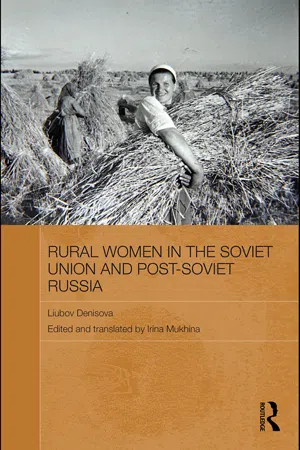
These collectivization campaigns were the starting point at which the village was systematically altered and even pillaged, most importantly of its manpower. Facing the growing shortage of manpower, Stalin started to praise the female collective farmworkers, labeling peasant women “the great force in the collective farms” on more than one occasion. Women were in the majority in the countryside, and they also performed the bulk of the manual labor on which the agricultural production depended so much. Stalin wanted to rebuild Soviet agriculture on the back of this predominantly female labor force, and to do so by first cleansing it of its “religious opium.” But in practice, with the exception of young and radically predisposed female party workers who internalized all Soviet ideology at face value, peasant women could not and did not want to embrace the numerous reforms of the Soviet state. Bab’i bunty demonstrated many times over again peasants’ preferences for individual household farming. The village turned to collective farming only because of the repressive measures of the Soviet state.
For the Soviet Union as a whole, female employment rates were high, as over 90 percent of all women worked outside home. In the countryside, women constituted at least half the workforce, and at times even more. The Soviet Union had one of the highest rates of female employment in the world.6 Yet at the same time, as subsequent chapters will demonstrate, women were solely responsible for all or the bulk of the household chores and child rearing. Even though the social services, such as nearly-free daycare centers and common eating facilities, were meant to alleviate some of these hardships, these services were not always universally available, and even when available they never completely substituted for a woman’s role in the family. As a consequence, women worked long hours due to a combination of their double burden of public employment and domestic duties, and a rural woman often worked more than her urban counterpart.7
Women remained the main labor force and the backbone of the countryside during the entire Soviet period, in terms of both agricultural production and the social aspects of life. Yet the role women played in everyday life and the leverage they had in the decision-making process, as well as informal power that they welded in the community, often depended on such factors as male outer migration and subsequent sex-ratio imbalance (more women, more power); an individual choice of redistributing time between the collective farm work and household chores; the type and level of education and training that these women had; and the state policies, especially those aimed towards the protection of motherhood and childhood in the countryside.8
Peasant women worked equally alongside men in the collective farms and systematically outpaced men in terms of the labor days that they worked (a common measure of employment in the Soviet days) and in terms of human hours that they invested. It is important to note here that rural women rarely if ever assumed leadership positions and were under-employed in skilled jobs that implied higher training but also higher pay. Instead, they were routinely employed in low-paying manual jobs, especially in animal wards and milking where women represented nearly the entire workforce. This division of labor along the gender lines persisted throughout the Soviet era.
The public opinion that the rural, collective farm life was “of second class” was created and promoted by those former peasants who managed to move to cities and remained there for life. New urban residents, who felt that they had made their dreams come true by landing the job of a tram conductor or a bus driver in a big city, did not want to return to their roots. They often spoke of their fellow villagers and rural life in derogatory and diminutive ways, thus reinforcing the image of a backward countryside. This image was so remarkably pervasive because the Soviet Union was on the move in its first decades and experienced massive migration from rural regions to urban centers. In that sense, the city was formed and shaped by the countryside and by all those former peasants that resented their prior lifestyle and their prior experiences. And even though some “kept dreaming of motherland at night, [and of] their village with which they are bounded in heart for life,” many more were ashamed of their rural past.9
Other factors also reinforced such notions of backwardness. “Russian village” and “collective farm” were not identical terms that could be used interchangeably, but all people who lived in the countryside were still termed as “peasants.” So some peasants loved their village and their traditional lifestyle but resented the collective farm system. Yet they had no alternative to the system, and because they resented it, they by extension and out of lack of choice came to reject all facets of the rural lifestyle. It is a tempting hypothesis to consider what might have happened to the Soviet village had the state allowed, even in limited ways, for traditional village life to survive. The collective farm often contradicted the mentality of the village life, and hence at least some rural dwellers felt as if they had become internal self-imposed exiles who could neither go back to collective farms nor find a replacement for their home in large urban centers. This internal craving for a rural lifestyle also helps explain why the outer migration, though substantial, nonetheless did not include all those who resented the collective farm system. Peasants could not part with their community even in opposition and protests to the state and instead opted to wait out until better times came.
This rural lifestyle had many unique features to it but primarily implied a slow pace of life during most seasons with minimal if any stress; it had wide-open spaces of the steppes and fields; and it was centered on a small, tightly-knit community that shared every joyous or tragic event of one’s life. The community was a place where everyone shared a common set of values, a common set of concerns and difficulties, and where one could be understood without words. Rural life also left some room for people to feel like they were in control of their own lives; they were the heads of their households and masters of their own gardening plots, if nothing else. The fact that nearly all members of these village communities knew each other, were born in close proximity to each other, and grew up playing together, gave peasants an extra special sense of an extended family, with all its pros and cons. None of the above could be replicated in cities. That is why when the younger generation, born under the Soviet power, went to cities to study and stayed there for good, very few of their parents wanted to join them, even when the living conditions would have been better. Peasants who lived their entire lives in the countryside found that when it came to cities, “it is nice to visit, yes, but no, not to live there.”10 The sense of unity with the great outdoors was also significant as the rural life offered an opportunity to “live in harmony with nature.”
The collective farm was a product of the Soviet system and went underwater along with it. The reform of village life that was attempted without people’s understanding of what the reform entailed, did not solve the country’s food problem. Instead, by undermining the producing sector, it exacerbated the problem and caused massive man-made famines. The collective farms created in the 1930s could not fulfill hyper-optimistic hopes for what they could produce. Yet they managed to level out every peasant to a mediocre average of socialist equality. Hence when peasants speak today about their nostalgia for the good Soviet days, they do not crave the collective farm. What they yearn for is the sense of security that the Soviet system made possible, thanks to its extensive social security web and various social guarantees.
For Russia, the agricultural question was always of major importance, not the least because the majority of the population up until the 1960s lived in the countryside. Even at the beginning of the twenty-first century, a third of all Russian citizens continue to live in rural parts of Russia, a percentage that is high relative to most oth...