- 432 pages
- English
- ePUB (mobile friendly)
- Available on iOS & Android
eBook - ePub
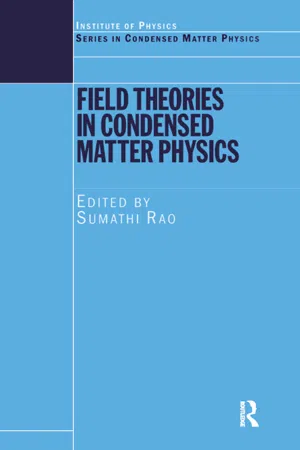
Field Theories in Condensed Matter Physics
About this book
The application of field theoretic techniques to problems in condensed matter physics has generated an array of concepts and mathematical techniques to attack a range of problems such as the theory of quantum phase transitions, the quantum Hall effect, and quantum wires. While concepts such as the renormalization group, topology, and bosonization h
Trusted by 375,005 students
Access to over 1.5 million titles for a fair monthly price.
Study more efficiently using our study tools.
Information
Topic
Physical SciencesSubtopic
Condensed MatterChapter 1
Quantum Many Particle Physics
Harish-Chandra Research Institute
Chhatnag Road, Jhusi
Allahabad – 211 019
This set of lectures focuses on some problems in itinerant Bose and Fermi systems. The first lecture will be an introduction to many-particle physics. In the second we will discuss phase transitions and symmetry breaking and the mean field approach to condensation in Bose systems. In the third we will look at strong interactions in ‘normal’ Fermi systems. The final lecture will be on strong coupling superconductivity which involves both strong interactions and symmetry breaking.
1.1 Preamble
‘Statistical field theory’ encompasses all the applications of quantum field theory to statistical physics. In the context of these notes, it is interpreted as the study of ‘statistical mechanics of quantum many particle systems, employing the methods of field theory’. In this interpretation we are closer to the classic text of Abrikosov, Gorkov and Dzyaloshinski [1], than to the more modern approaches of Parisi [2] or Itzykson and Drouffe [3]. These lectures cover only quantum systems, fermions and bosons; other lectures in the school covered applications of field theory to problems in classical statistical mechanics and spin systems.
These lectures are meant to provide an introduction to itinerant quantum systems and discuss a few model problems. There is no claim at originality! The material is readily available in the literature [4, 5, 6, 7] and anyone interested should consult the references for a more comprehensive and rigorous coverage.
1.2 Introduction
We begin our survey of methods available for handling interacting many particle systems. There is no single method that is valid in all cases. We may tentatively classify the approaches as:
1. Exact solution!
2. ‘Mean field’ theory for symmetry broken states.
3. Perturbation theory; weak coupling.
4. Strong coupling expansion (if/when possible).
5. Renormalisation group calculations.
6. Exact numerical calculations.
7. Large dimension expansion.
This is not an exhaustive list. Special techniques exist, for instance in one dimensional problems, as discussed elsewhere in the text. The emphasis here is on general applicability.
Of these methods ‘exact solutions’ are not generic [8]. For itinerant fermions only the simplest interacting model (the Hubbard model) can be solved in one dimension (Id). There are no exactly solvable models in two or higher dimensions. Renormalisation group calculations are discussed elsewhere, in the context of classical systems and for Id fermions and quantum impurity models. Exact numerical calculations, for instance Quantum Monte Carlo (QMC) or exact diagonalisation methods, are powerful and quite generally applicable but lie beyond the scope of our discussion.
The large dimension, d → ∞, approach to lattice models is a promising new meth...
Table of contents
- Cover
- Half Title
- Title Page
- Copyright Page
- Table of Contents
- Preface
- Introduction
- 1 Quantum Many Particle Physics
- 2 Critical Phenomena
- 3 Phase Transitions and Critical Phenomena
- 4 Topological Defects
- 5 Introduction to Bosonization
- 6 Quantum Hall Effect
- 7 Low-dimensional Quantum Spin Systems
Frequently asked questions
Yes, you can cancel anytime from the Subscription tab in your account settings on the Perlego website. Your subscription will stay active until the end of your current billing period. Learn how to cancel your subscription
No, books cannot be downloaded as external files, such as PDFs, for use outside of Perlego. However, you can download books within the Perlego app for offline reading on mobile or tablet. Learn how to download books offline
Perlego offers two plans: Essential and Complete
- Essential is ideal for learners and professionals who enjoy exploring a wide range of subjects. Access the Essential Library with 800,000+ trusted titles and best-sellers across business, personal growth, and the humanities. Includes unlimited reading time and Standard Read Aloud voice.
- Complete: Perfect for advanced learners and researchers needing full, unrestricted access. Unlock 1.5M+ books across hundreds of subjects, including academic and specialized titles. The Complete Plan also includes advanced features like Premium Read Aloud and Research Assistant.
We are an online textbook subscription service, where you can get access to an entire online library for less than the price of a single book per month. With over 1.5 million books across 990+ topics, we’ve got you covered! Learn about our mission
Look out for the read-aloud symbol on your next book to see if you can listen to it. The read-aloud tool reads text aloud for you, highlighting the text as it is being read. You can pause it, speed it up and slow it down. Learn more about Read Aloud
Yes! You can use the Perlego app on both iOS and Android devices to read anytime, anywhere — even offline. Perfect for commutes or when you’re on the go.
Please note we cannot support devices running on iOS 13 and Android 7 or earlier. Learn more about using the app
Please note we cannot support devices running on iOS 13 and Android 7 or earlier. Learn more about using the app
Yes, you can access Field Theories in Condensed Matter Physics by Sumathi Rao in PDF and/or ePUB format, as well as other popular books in Physical Sciences & Condensed Matter. We have over 1.5 million books available in our catalogue for you to explore.