Originally published in 1975 this book analyses the factors making for success and failure in agricultural development among black Zimbabweans during the 20th century. A detailed analysis is given of 2 tribal trust lands, including government policies and administrative control of these areas, voluntary and forced adjustment to land shortage and the economic resources and productivity of peasant cultivators. Settlements under individual land tenure are examined, as are government policies to these, the internal transofrmation of these communities and their economic resources and productivity. There is also a section on irrigation schemes and the reaction of people to irrigation farming. This is an indispensable book in understanding the present-day situation of agriculture in Zimbabwe.
eBook - ePub
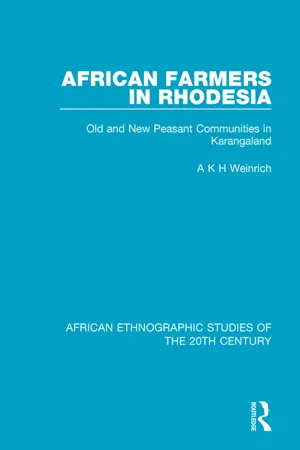
African Farmers in Rhodesia
Old and New Peasant Communities in Karangaland
- 356 pages
- English
- ePUB (mobile friendly)
- Available on iOS & Android
eBook - ePub
About this book
Information
CHAPTER 1
EVOLUTION AND REVOLUTION IN AFRICAN AGRICULTURE
(1) 1890–1923: EXPROPRIATION OF AFRICAN LAND
In 1889 the British South Africa Company was granted a Royal Charter to settle in, and administer, the land north of the Limpopo river. In 1890 Cecil Rhodes sent a pioneer column from South Africa, which crossed the Limpopo and established the town of Salisbury, the future capital of the new country.
Immediately after occupation, the company granted large tracts of land to the pioneers and to syndicates without taking into account the distribution of the African population.1 Within a short time some 15 million acres out of 96 million were given to Europeans.2 This land alienation, accompanied by harsh administrative practices by company agents, caused bitter frustration among the African people and when in 1893 the pioneers invaded the country of the Ndebele, a tribe living to the west of the newly occupied territory, war broke out. This war was won by the superior weapons of the European settlers and Ndebeleland came under the control of the British South Africa Company.
After the war, in 1894, a Land Commission was set up to find a solution to the conflicting interests of Africans and European settlers in Ndebeleland. The commission recommended that land be set aside for exclusive African occupation. The British South Africa Company accepted this suggestion and allocated to the Ndebele two large tracts of land, the Gwaai and Shangani reserves, which covered an area of over two million acres. But this land was waterless, had never been inhabited by the Ndebele and the Ndebele refused to settle there. The Ndebele homeland on the high veld was declared a European area.3 This division of land between Europeans and Africans established an important principle which still dominates life in Rhodesia.
The 1894 settlement did not satisfy the Ndebele. They saw in white occupation a threat to their very subsistence and in 1896 rose in rebellion and were soon followed by their eastern neighbours, the Shona. Both rebellions were crushed by superior white force. In 1898 Mashonaland was united with Matabeleland and the whole country became known as ‘Southern Rhodesia’, in honour of Cecil Rhodes. The provisions of the 1894 Order-in-Council were extended to the whole territory.1 In addition to the right of Africans to land in special reserves, the so-called ‘Cape Clause’ which had formerly applied to Mashonaland only,2 became valid for the whole of Rhodesia. It stated that Africans had the right to hold or dispose of land on the same conditions as non-Africans outside the reserved land.
To implement the Order-in-Council, native commissioners, that is administrative officers placed over the indigenous African population, were asked to demarcate African areas throughout Rhodesia. This was a difficult task because native commissioners did not know what land had been alienated to Europeans. Only a small section of the alienated land had been used for crop production and ranching; the rest was lying idle and was indistinguishable from African land. By 1902 suggestions for reserve boundaries reached the Executive Council and in 1908 these were approved by the Colonial Secretary ‘with the important reservation that they were to be regarded as provisional and be subject to possible further considerations’.3
In 1907 a party of the British South Africa Company directors toured Rhodesia and in 1908 they established an estates department designed to promote European settlement.4 The estates department found that it needed more land to promote white settlement and requested readjustment of the original land distribution, arguing that some reserves were too large and some too small. These readjustments were to be made for the benefit of the European, rather than the African community, and the administrative officials were aware of this. One of them, the acting Native Commissioner of Chilimanzi, wrote: ‘Because there are a few thousand acres of good ground there is no reason why the whole (Serima) reserve should be thrown open and the natives turned out of their homes, where they have been living ever since we occupied the country.’5
The aims of the estates department, as well as the African population increase from, 500,000 at the turn of the century to an estimated 712,000 in 1913, caused uneasiness in government circles and led to the establishment by the British Government of the Southern Rhodesia Native Reserve Commission in 1914.1 This commission, however, came under the direct pressure of the estates department. In its final report it suggested numerous alterations to the existing 20.5 million acres of reserve land: it advocated that more than 5.6 million acres be added and slightly less than 6.7 million acres be deducted from the African area, reducing it by about 1.1 million acres.2 The head of the estates department commented favourably that the commission had ‘shown a willingness to meet the view of this Department wherever possible’, and that ‘the greater part of the land … recommended [for inclusion into African reserves] is of...
Table of contents
- Cover
- Half Title
- Title Page
- Copyright Page
- Table of Contents
- List of Illustrations
- Preface
- Introduction
- Chapter 1 Evolution and Revolution in African Agriculture
- Part 1 Peasant Communities in the Tribal Areas of Karangaland
- Chapter 2 Government Policy and Administrative Control in Tribal Areas
- Chapter 3 Forced and Voluntary Adjustment to Land Shortage in Tribal Areas
- Chapter 4 Economic Resources of Peasant Cultivators in Tribal Trust Lands
- Chapter 5 Productivity of Tribal Trust Lands
- Chapter 6 Profiles of Peasant Cultivators
- Part II Individual Land Tenure
- Chapter 7 Government Policy and Peasant Response to Individual Land Tenure
- Chapter 8 The Internal Transformation of Peasant Communities
- Chapter 9 Economic Resources of Peasant Farmers in Purchase Areas
- Chapter 10 Agricultural Productivity of Purchase Areas
- Chapter 11 Profiles of Peasant Farmers
- Part III Irrigation Schemes
- Chapter 12 Government Policy and Administrative Control
- Chapter 13 Plotholders on Irrigation Schemes
- Chapter 14 Economic Resources of Plotholders on Irrigation Schemes
- Chapter 15 Agricultural Productivity of Irrigation Schemes
- Chapter 16 Profiles of Plotholders on Irrigation Schemes
- Conclusion
- Appendix
- Bibliography
- Index
Trusted by 375,005 students
Access to over 1.5 million titles for a fair monthly price.
Study more efficiently using our study tools.
Frequently asked questions
Yes, you can cancel anytime from the Subscription tab in your account settings on the Perlego website. Your subscription will stay active until the end of your current billing period. Learn how to cancel your subscription
No, books cannot be downloaded as external files, such as PDFs, for use outside of Perlego. However, you can download books within the Perlego app for offline reading on mobile or tablet. Learn how to download books offline
Perlego offers two plans: Essential and Complete
- Essential is ideal for learners and professionals who enjoy exploring a wide range of subjects. Access the Essential Library with 800,000+ trusted titles and best-sellers across business, personal growth, and the humanities. Includes unlimited reading time and Standard Read Aloud voice.
- Complete: Perfect for advanced learners and researchers needing full, unrestricted access. Unlock 1.5M+ books across hundreds of subjects, including academic and specialized titles. The Complete Plan also includes advanced features like Premium Read Aloud and Research Assistant.
We are an online textbook subscription service, where you can get access to an entire online library for less than the price of a single book per month. With over 1.5 million books across 990+ topics, we’ve got you covered! Learn about our mission
Look out for the read-aloud symbol on your next book to see if you can listen to it. The read-aloud tool reads text aloud for you, highlighting the text as it is being read. You can pause it, speed it up and slow it down. Learn more about Read Aloud
Yes! You can use the Perlego app on both iOS and Android devices to read anytime, anywhere — even offline. Perfect for commutes or when you’re on the go.
Please note we cannot support devices running on iOS 13 and Android 7 or earlier. Learn more about using the app
Please note we cannot support devices running on iOS 13 and Android 7 or earlier. Learn more about using the app
Yes, you can access African Farmers in Rhodesia by A K H Weinrich in PDF and/or ePUB format, as well as other popular books in Social Sciences & Anthropology. We have over 1.5 million books available in our catalogue for you to explore.