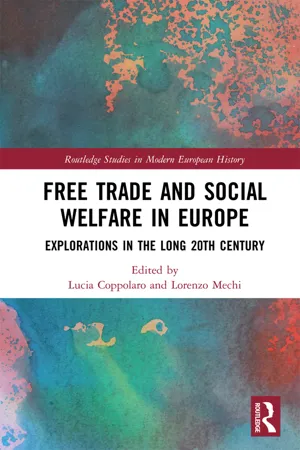
This book deals with the historical relationship between international trade liberalisation – one of the backbones of globalisation – and the development of social welfare. In Europe the issue has regularly been at the centre of the political debate for at least two centuries, and still nowadays it continues to inspire decisions of the highest order, as in the recent case of Brexit. Analysing a number of particularly meaningful episodes and moments, the eight chapters of this edited volume provide an overview of how the liberalisation/welfare nexus has been addressed in Europe since the end of the 19th century. Describing the oscillations from phases in which state, non-state and transnational actors saw the two elements as widely conflicting, to others in which more harmonious visions prevailed, the book uncovers the political complexity of the issue and contributes to clarifying its connections with the current economic situation, political balances and general social conditions.
eBook - ePub
Free Trade and Social Welfare in Europe
Explorations in the Long 20th Century
- 188 pages
- English
- ePUB (mobile friendly)
- Available on iOS & Android
eBook - ePub
Free Trade and Social Welfare in Europe
Explorations in the Long 20th Century
1 The state fights back
Protecting the people, protecting the economy (1880–1914)
The industrial revolution caused widespread anxieties, yet by 1880, industrialisation was deemed both necessary and desirable by all the main political elites. However, given the de-stabilising potential of capitalism, it was widely felt that it was necessary to build popular legitimacy. In different ways and in different countries, various strategies were deployed, including welfarism (to ensure that there would be few losers) and protectionism (to protect national capitalism from foreign competition). In the period of the first modern globalisation, this could be done only by state intervention, thus departing from what was (wrongly) believed to be the British model of free trade and minimum state.
In the West, the period between 1880 and 1914 was a period of peace characterised by four aspects:
- 1 Growing prosperity.
- 2 The spread of welfare programmes in Europe.
- 3 An economic crisis, mistakenly referred to as the Long Depression (1873–96).
- 4 Protectionism.
Before the First World War, the evolving consensus around capitalism was constructed largely on constantly growing prosperity. Keynes, writing in 1919, mused that perhaps a day might come when there would be enough to go around. In that day overwork, overcrowding, and underfeeding would come to an end, and people, secure of the comforts and necessities of the body, could proceed to the nobler exercise of their faculties.1
Even earlier, an American economist, Simon Patten, in his 1905 Kennedy Lectures, noted the remarkable improvements in the condition of the working class and assumed that it would be possible to eliminate poverty in a few decades. He did not deny that workers were ‘ill paid, that employment is uncertain, housing is bad, sickness frequent, and that the abnormally short working life ends in an old age of poverty and fear’, yet no one, he claimed, could deny the evidence of growing prosperity.2
In the years between 1880 and 1914, at least in Europe or in countries settled by Europeans, such as Australia and New Zealand (but not in the US), modern welfare took off. The state began to intervene: accident insurance, sickness insurance, old age insurance and unemployment insurance.3 In this, the US (and Canada) lagged behind: most capitalist countries had nationwide insurance against industrial accidents before the First World War; Americans and Canadians had to wait until the 1930s.4 In vain did President Theodore Roosevelt try to convince employers to pay for injuries suffered by their workers, declaring (31 January 1908) that congressional reluctance to approve such legislation was an ‘outrage’ and ‘humiliation’ for the United States and that ‘In no other prominent industrial country in the world could such gross injustice occur … as the working man is entitled to his wages, so he should be entitled to indemnity for the injuries sustained in the natural course of his labour’.5
National health insurance schemes were introduced before 1914 in European countries, including Austria, Italy, France, Sweden, Belgium, Switzerland, Norway and the United Kingdom. Between 1914 and 1945, such schemes were introduced in Australia, New Zealand, Spain and the Netherlands and much later in Finland, Canada and Portugal. The US still lacks a universal health insurance scheme.
It is sometimes suggested that public welfare was introduced as a response to growing social unrest. Yet, at the time, the organised labour movement was not particularly interested in public assistance since its members were, prevalently, employed working men. Unions much preferred to fight for higher wages, the suffrage and the eight-hour day than the welfare demands contained in the 1889 programme of the Second International. Much of the social legislation in Britain was achieved thanks to conservatives: the Ten Hours Act and the Mines and Collieries Act 1842, which banned the employment of women and young children in mines.
Nordic nations were no more troubled by radicalism than others, yet by the end of the 19th century, they had established the foundation for the substantial Scandinavian welfare state of the 20th century. This early welfare legislation was the outcome of a political conflict between a rising agrarian bourgeoisie and, in Peter Baldwin’s words, ‘entrenched, but declining, bureaucratic and urban élites’.6 In other words the early welfare legislation was a victory for the middle classes of the countryside. Danish farmers, who wished to avoid paying for the local poor, favoured a new pension system, which, being non-contributory, was in fact a state subsidy for both workers and employers. This is why Denmark produced, in 1891, an all-inclusive, non-contributory, tax-financed pension, the Alderdomsunderstøttelsen (Old Age Compensation Act). All Danish citizens over the age of 60 and in need of help would be entitled to a pension. New Zealand followed in 1898, Australia in 1901 and England in 1908. The first truly universal pension involving all citizens over 67 or unable to work because of disability became law in Sweden in 1913 after a long campaign initiated in 1884 by liberals.7
The best-remembered early welfare state, however, was Germany’s, probably because of the centrality of the Reich in Europe. It elicited widespread admiration among social reformers. In England, William Harbutt Dawson in his Bismarck and State Socialism (1890), was full of praise for Bismarck, regarded as the first European politician who set out a grand strategy for resolving the ‘social question’.8 Bismarck was not quite as enthusiastic about social reforms as Dawson makes out, but he certainly did not oppose them: nation-building was never far from his mind, but his welfare legislation, widely regarded as his most significant domestic achievement, did not receive a single mention in his memoirs.9
The Reich social welfare policies, particularly in the sphere of pensions, had the advantage of strengthening both financially and politically the central government at the expense of the German states (since some of the funding would be through national federal taxes).10 In June 1883, a means-tested health insurance scheme was introduced that would pay medical expenses (two-thirds of the cost to be paid by the workers). In July 1884, a law on industrial accidents was passed whereby employers would be obliged to pay the full contribution. Finally, in 1889, the Invalidity and Old-Age Insurance Law provided old age and disability pensions for all those over 70 (few people lived much longer than that at the time, so it did not cost much).11 The three schemes were consolidated in 1911 in the so-called National Insurance Code.
By 1890, Germany was ahead of Britain in social legislation and had caught up in the industrial race while the rate of German emigration had slowed down remarkably.12 Bismarck’s successor, Leo von Caprivi, banned the employment of children under 13, restricted the number of hours worked by 13–18-year-olds and by women, established a minimum wage and mandated arbitration in industrial disputes (with trade union representatives), but he further alienated farming interests by lowering duties on imported grain.
Reformers everywhere were particularly exercised by the housing question. The dismal housing conditions and the dangers that this posed for the stability of society had been discussed throughout much of Europe for much of the 19th century, particularly in highly urbanised and industrialised countries. According to a French government survey of 1910, workers spend between one-tenth and one-fifth of their earnings in rent for dwellings deprived of simple hygiene. A Labour Ministry survey (1906) noted that 95% of working-class people’s homes in Lille and 83% in Rouen were without toilets.13
In Britain even the conservative Lord Salisbury, an opponent of the extension of the suffrage, was perturbed by the housing question. In November 1883 (when leader of the opposition), in a lengthy article published in the National Review, Salisbury denounced the overcrowding in working-class housing, which caused ‘grave injury, both to morality and health’, for the thousands of families who ‘have only a single room to dwell in, where they sleep and eat, multiply, and die’.14 He advocated not only cheap government loans but also the regulation of speculative builders. The liberal Manchester Guardian denounced Salisbury’s proposals as ‘State Socialism pure and simple’.15 Salisbury was not deterred, and as prime minister in 1885, he introduced the Housing of the Working Classes Act (1885). He was moved by a mix of Christian charity, fear of the masses and moral outrage at the idea of people living in promiscuity.16 Further reforms were facilitated by the problems facing the United Kingdom in the Boer War (1899–1902) in southern Africa against the Dutch settlers who resisted the British annexation of the Transvaal. It was believed that British soldiers had been poor fighters because of the impoverished conditions in which they had been raised. The Boer War and its outcome helped to stir the Conservatives towards the Conciliation Act 1896, the foundation stone of a voluntary arbitration service between employers and unions on industrial relations. The Liberal Party, having suffered a spectacular defeat in 1895 and having been out of power for ten year...
Table of contents
- Cover
- Half Title
- Series
- Title
- Copyright
- Contents
- List of tables
- List of contributors
- Acknowledgements
- List of abbreviations
- Introduction: free trade and social welfare in a long-term perspective
- 1 The state fights back: protecting the people, protecting the economy (1880–1914)
- 2 From cradle to grave: the German trade union federation’s wage, welfare and competitiveness programme for the Weimar Republic
- 3 Social security versus global security: early debates about the International Trade Organisation: liberalisation and full employment, 1945–48
- 4 A precondition for economic integration? European debates on social harmonisation in the 1950s and 1960s
- 5 The International Chamber of Commerce: the organisation of free-trade and market regulations from the interwar period to the 1960s
- 6 Creating a social Europe or completing the Single Market? Debates within the European Economic Community (1973–86)
- 7 Resisting globalisation? The TUC, the CBI and the politics of protectionism in the UK textile industry in the 1970s
- 8 Surfing (in and out of ) the globalisation wave: labour standards during the GATT/WTO trade negotiations (1947–99)
- Conclusions: the European social dimension in search of a frame
- Bibliography
- Index
Trusted by 375,005 students
Access to over 1.5 million titles for a fair monthly price.
Study more efficiently using our study tools.
Frequently asked questions
Yes, you can cancel anytime from the Subscription tab in your account settings on the Perlego website. Your subscription will stay active until the end of your current billing period. Learn how to cancel your subscription
No, books cannot be downloaded as external files, such as PDFs, for use outside of Perlego. However, you can download books within the Perlego app for offline reading on mobile or tablet. Learn how to download books offline
Perlego offers two plans: Essential and Complete
- Essential is ideal for learners and professionals who enjoy exploring a wide range of subjects. Access the Essential Library with 800,000+ trusted titles and best-sellers across business, personal growth, and the humanities. Includes unlimited reading time and Standard Read Aloud voice.
- Complete: Perfect for advanced learners and researchers needing full, unrestricted access. Unlock 1.5M+ books across hundreds of subjects, including academic and specialized titles. The Complete Plan also includes advanced features like Premium Read Aloud and Research Assistant.
We are an online textbook subscription service, where you can get access to an entire online library for less than the price of a single book per month. With over 1.5 million books across 990+ topics, we’ve got you covered! Learn about our mission
Look out for the read-aloud symbol on your next book to see if you can listen to it. The read-aloud tool reads text aloud for you, highlighting the text as it is being read. You can pause it, speed it up and slow it down. Learn more about Read Aloud
Yes! You can use the Perlego app on both iOS and Android devices to read anytime, anywhere — even offline. Perfect for commutes or when you’re on the go.
Please note we cannot support devices running on iOS 13 and Android 7 or earlier. Learn more about using the app
Please note we cannot support devices running on iOS 13 and Android 7 or earlier. Learn more about using the app
Yes, you can access Free Trade and Social Welfare in Europe by Lucia Coppolaro, Lorenzo Mechi, Lucia Coppolaro,Lorenzo Mechi in PDF and/or ePUB format, as well as other popular books in History & World History. We have over 1.5 million books available in our catalogue for you to explore.