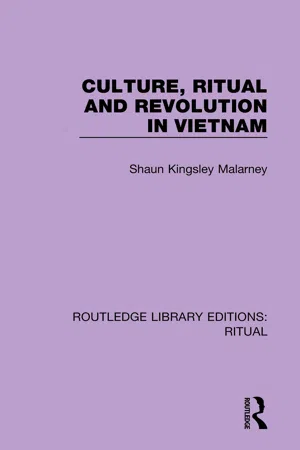
Originally published in 2002 Culture, Ritual and Revolution in Vietnam is a study of the history and consequences of the revolutionary campaign to transform culture and ritual in northern Vietnam. Based upon official documents and several years of field research in Thinh Liet Commune, a Red River delta community near Hanoi, it provides the first detailed account of the nature of revolutionary cultural reforms in Vietnam as how those reforms continue to animate contemporary socio-cultural life. The study examines the key foci of revolutionary cultural change, such as the articulation of a new moral system, the attempts to eliminate explanations that invoke supernatural causality, the creation of socialist weddings and funerals, and the development of innovation ties to commemorate war dead. By examining debates over culture, ritual, and morality that have emerged between residents, notably between men and women, and party members and non-party members, the study shows how ideas and values that preceded the revolution have entered into a creative dialogue with those that were articulated by the revolution, and how this has produced an innovative set of ritual and other practices, particularly since the relaxation of the cultural reform agenda in the post-1986 period.
- 268 pages
- English
- ePUB (mobile friendly)
- Available on iOS & Android
eBook - ePub
Culture, Ritual and Revolution in Vietnam
About this book
Information
▪ PART ONE ▪
Revolution Comes to Thinh Liet
▪ CHAPTER ONE ▪
The Land Reform
Redefining Society and Space
The Vietnamese revolution officially began with the August Revolution of 19 August 1945 when the Vietnamese Communists and their supporters overthrew the Japanese administration that then ruled Indochina. Over the next year they began the revolutionary transformation of northern Vietnamese society through such measures as the installation of new party-controlled ‘Resistance Administration Committees’ (Uy Ban Hanh Chinh Khang Chien) to administer the countryside and the initial propagation of revolutionary cultural policies. Although significant, these early efforts were tempered first by the necessity of working with other political groups opposed to the French, and then by the French reconquest of large areas of northern Vietnam in late 1946 and early 1947. During the following eight year war, the Communistled resistance, known as the Viet Minh, continued to implement revolutionary policies, though primarily in areas under its control. Areas under French control, such as Thinh Liet commune, saw these efforts basically stop, except in a disorganized, behind-the-scenes fashion.
Thinh Liet came under revolutionary control again in late 1954, but the decisive event that marked the beginning of its revolutionary transformation was the commencement of its land reform (Cai Cach Ruong Dat) in December 1955. This chapter’s purpose is to examine the conduct and consequences of Thinh Liet’s land reform. Similar to the experiences of countless other northern Vietnamese communities, the land reform was a turbulent period in the commune as land reform cadres overturned the former elite, broke up land holdings, and redistributed land and property in a more equitable fashion. These events were important and will be discussed. Equally important was the land reform’s ideological dimension. In carrying out their campaign, the cadres propagated a new theory of society that included new definitions and evaluations of people in the community, as well as new readings of the past and how they arrived at their present. They did the same with local ideas associated with space as they assumed control over all space, advanced new definitions of it, and then employed these to carry out their policies. As will be shown, the land reform, beyond simply redistributing land and disrupting previous structures of exploitation, introduced into Thinh Liet life a new way of thinking and talking about their society and the spaces around them; however, these ideas still had to cope with those that existed before the revolution.
Part 1: Recasting Local Society
The Land Reform Comes to Thinh Liet
The first land reform cadres arrived in Thinh Liet, or Unity Commune (Xa Doan Ket) as the revolutionary authorities had renamed it the year before, in late December. The Thinh Liet land reform, like that of the rest of Hanoi’s outskirts, belonged to Wave 5 of the campaign. Wave 1 had begun a year and half earlier in Thai Nguyen, Thanh Hoa, and other areas under Viet Minh control. Over the succeeding months, the campaign had slowly worked its way toward the capital and other areas that had been under French control. The campaign’s diverse objectives were evident in the legislation that had been passed to formalize the land reform. In April 1953 the government had passed Decree 149-SL that stated that the policy’s goal was to ‘foster the mental and material strength of the peasantry, increase production, and intensify the resistance war’ (Vietnam, Government Gazette 1953:47) through such methods as a rent reduction and the redistribution of commual or abandoned land to the needy. A significant change appeared on 4 December 1953 when the National Assembly passed the Land Reform Law (Luat Cai Cach Ruong Dat) that declared that one of its primary goals was the ‘elimination of the feudal landholding system of the landlord class’ (Section 1:1). The law detailed how to deal with landlords and the assorted enemies of the people and revolution. Land reform was no longer a policy only designed to create an equitable distribution of land in the countryside. It had become a direct assault on the former elite and the system that had supported them.
The Thinh Liet land reform began in a general climate of fear and anxiety. The land reform’s previous waves had been marked by numerous excesses, or ‘deviations,’ and news of these had been filtering back to the Hanoi area. Land reform cadres had exhibited extreme overzealousness that had resulted in bogus denunciations, errant classifications, and unwarranted executions. The main cause of the deviations was the highly-charged environment in which land reform was carried out. The land reform cadre’s primary function was to elucidate the class struggle and the wickedness of the exploiting classes for the unknowing masses. Cadres were quick to indict individuals as landlords or enemies of the revolution, even if they lacked sufficient evidence. As Edwin Moise noted, ‘It was considered a great “achievement” to expose as a reactionary plotter or a landlord someone who had not previously seemed to be one’ (Moise 1983:232). For many cadres the land reform campaign also carried the spirit of a paranoid scientific exercise. Every village was to have certain fixed percentiles of the different social classes and the job of the cadre was to smoke out the cagier members until the necessary percentiles were reached (see Moise 1983:216). On both of these points, the cadres’ exuberance was assisted by local political machinations as old scores were settled, political opponents eliminated, and those associated with the former elite ostracized, humiliated, and in some cases executed. Working at a different level was the general atmosphere of terror and suspicion the campaign created. Both the cadres’ conduct and the participation of the villagers required extreme zeal as the unenthusiastic risked being accused of ‘lacking revolutionary spirit’ (thieu tinh than cach mang). Such charges, although possibly groundless, could result in grave consequences for the accused as once such an accusation was made, one was generally powerless in refuting it. Trapped in this climate of excess reinforcing excess, villagers who lived through the period coined the adage, ‘First the cadres, second the heavens’ (Nhat doi, nhi troi).
Several other factors complicated the Thinh Liet land reform. During the French war, the loss of members killed in battle or by French security forces had severely weakened the party apparatus around Hanoi. The local party structure needed significant strengthening if it was to successfully meet its objectives. Another problem was the economic structure of Hanoi’s outskirts (Ngoai Thanh Ha Noi). Waves 1 through 4 had taken place in predominantly agricultural areas. The regions around Hanoi maintained an agricultural base, but a large number of surrounding communities, like Thinh Liet, were extensively involved in other economic activities, such as fishing, handicraft production, and a host of other pursuits ranging from growing flowers to producing rice cakes. Many individuals from neighboring villages also worked in Hanoi as traders, clerks, laborers, or factory workers. This economic diversity complicated the land reform agenda because many who lived outside of the city did not fit exactly into the land reform’s classificatory scheme. Others presented a different problem in that they controlled resources or businesses that officials did not want to disrupt for fear it would either create panic in the city or retard the development of North Vietnam’s economy. In order to develop the north’s industrial base, the party wanted to preserve the integrity of the integrated city-country economy. The cities were to provide the nucleus for future industrial expansion and the role of the outskirts was to ‘produce directly to meet the needs of the city’ (Hanoi, Land Reform Committee 1956:32). The committee needed to ensure that this relationship remained intact and therefore implemented a set of regulations designed to moderate the land reform in Hanoi’s outskirts.1
When the cadres from Nghe An and Thanh Hoa settled into the spacious, two story brick house that a colonial-era canton chief donated for use as the commune’s People’s Committee, one of first tasks before them was the propagation in Thinh Liet society of an entirely new theory of local society. Appropriating Marxist-Leninist theory, the Communists asserted the dominant characteristic of rural society was class conflict manifest in relations of oppression and exploitation imposed by the elite on the poor and dispossessed. Previous conceptualizations of society in Thinh Liet had divided the community into such groups as the mandarins (quan vien) and commoners (bach dinh), or poor families (nha ngheo), wealthy families (nha giau), Confucian families (nha Nho), trading families (nha buori) and others. The Communists installed a new system of classification derived from political and economic considerations. The most stigmatized group in the new system were the landlords (dia chu). One set of regulations from 1957 concisely described the essential characteristics of the landlords when it stated, ‘landlords are people who own large amounts of land and do not personally engage in labor, either of the primary or secondary variety. The main source of their livelihood derives from the exploitation of peasants through either land rentals or wage labor. There are landlords who concurrently lend money for a profit, or have industrial or commercial concerns, but the primary and most common form of exploitation of the landlords is renting out land’ (Vietnam, Prime Minister’s Office 1957:4). Another Vietnamese scholar commented, ‘Landlords generally do not engage in labor but instead live and get rich by exploiting peasants through land rents, loans, and wage labor’ (Tran Phuong 1967:36). Party ideology asserted that the landlord class maintained itself through a system of ‘feudal’ relations that were predicated upon their control over land and their ability to collect land rentals. Landlords, in official characterizations, were non-productive citizens who lived off the sweat and toil of others.
The landlords were the main antagonist in the land reform. Official propaganda during the campaign dwelled on the evils of the landlord class, and both the print and spoken media dazzled the population with tales of rape, cruelty, murder and aggression committed by the landlords against the peasantry. For example, one official source, The Victory of the Land Reform in the Outskirts of Hanoi (Thang Loi Cai Cach Ruong Dat O Ngoai Thanh Ha Noi) noted that in the period stretching back to the Japanese occupation of Vietnam in the early 1940s, the thirty four landlords in Co Nhue commune had killed sixty seven people (including thirty two soldiers and guerrillas), assisted in the capture by Japanese and French authorities of sixty one people, beaten twenty two people to the point of crippling, beaten another 189 less severely, burned three houses, made ten people disappear, and raped eight women. And this did not include their economically exploitive activities, the conspiracies they hatched to kill cadres or hinder the land reform, or their convincing of large numbers of people to migrate to South Vietnam (Hanoi, Land Reform Committee 1956:76). Moise accurately summarized the party’s attitude in his quotation of an editorial in the Party daily Nhan Dan, ‘The more we study, the more clearly we see that all the disagreements and divisions in the rural areas are caused by the landlords’ (Moise 1983:198).
Despite the aggressive policies and rhetoric against the landlords, the party also showed a certain ambivalence toward them. This tendency was most visible in the different types of landlord classifications. The worst type of landlord was the ‘cruel and despotic landlord’ (dia chu cuong hao gian ac). Individuals in this category had reputedly committed murder, rape, or actively opposed the people or revolutionary policies. Such people were often said to have a “Mood debt’ (no mau) with the people. Below them were the ‘regular landlords’ (dia chu thuong), who received their classification as a result of meeting the criteria listed above. Slightly below them were the ‘administrative landlords’ (dia chu quan ly), people who did not necessarily own large amounts of land, but who served as a landlord’s agent in administering his or her lands. Finally, in the most acceptable category, were the ‘resistance landlords’ (dia chu khang chien). The existence of this category illustrated the types of compromises the party was willing to make at the local level. Resistance landlords had the same characteristics as the regular landlords, but in the period since the August Revolution, they or their children had supported the revolution by either serving in the military, as cadres, or by giving assistance and shelter to cadres and guerrillas. Regular landlords who were active in the revolution, but whose children were not, could receive the ‘democratic personalities’ (nhan si dan chu) classification if they had long abandoned all ‘feudal exploitive relations,’ or the ‘patriotic personalities’ (than si yeu nuoc) classification if they had not completely abandoned such relations but were still vigorous in their support of the revolution. People with these latter three types of classifications received much better treatment than the other landlords, a compromise that helped prevent the complete alienation of those who supported the revolution but had questionable class backgrounds.
The rest of the party’s class system broke down into four main categories. Just below the landlords came the ‘rich peasants’ (ghu nong). Like landlord families, rich peasants often rented out land and hired wage laborers, but what differentiated them from the landlords was that rich peasants participated directly in production. In practice, differentiating between the two classes could be difficult. Cadres therefore employed a formula in which, in principle, a family needed to rent out a multiple of the amount of land they worked (either two or three times, depending on the circumstance) in order to receive a landlord classification. The next group was the ‘middle peasants’ (trung nong). The members of this group engaged directly in production, often owned modest amounts of land, and sometimes supplemented those lands with rentals. The final two categories were the ‘poor peasants’ (ban nong) and the ‘laborers’ (co nong). These families represented the poorest segments of Vietnamese society who depended upon sporadically-available and poorly-paid wage labor. The latter group owned no land except that on which their houses stood. Thinh Liet residents recall that the members of these groups were so poor that they were usually unable to secure land rentals because they lacked sufficient collateral. But unlike the stigmatized landlords, it was the people in these latter two categories that the revolution valorized most highly. In carrying out the land reform, the government instructed cadres to ‘Rely completely on poor peasants and laborers, unite with the middle peasants, make allies of the rich peasants, and definitively overturn the landlords, traitors, reactionaries, and cruel despots’ (Dua han vao ban co nong, doan ket chat che voi trung nong, lien hiep phu nong, danh do dia chu Viet gian phan dong va cuong hao gian ac) (Tran Phuong 1967:115). The land reform sought to overturn rural social structure by placing the former paramounts at the bottom of the new order and the formerly dispossessed on the top.
Party ideology asserted that one main goal of the land reform was the elimination of exploitation, but at a deeper level the campaign also carried with it a rejection of the elite stigmatization of manual labor that had characterized the pre-revolutionary period. In overturning the social order, the party deliberately championed manual labor as a glorious and honorable activity, while simultaneously ridiculing those who avoided labor. The glorification of labor linked to its role in creating the new Vietnam. Following the Leninist creed that the development of heavy industry was essential for the creation of a fully socialist society, the party exhorted Vietnamese in all manual occupations, such as agriculture, light, and heavy industry, to selflessly devote themselves to production to achieve this goal. Labor became a patriotic duty, and those who worked hard could even receive such high government praise as a ‘Hero of Labor’ (anh hung Iao dong) award. Unsanctioned labor, such as the stigmatized ‘small peasant production,’ remained vilified, but to work for the benefit of the nation was a marker of respect and dignity. The overturning of the stigma of labor illustrates the subtle understandings that officials had regarding the nature of inequality in rural Vietnam.
Overturning Thinh Liet’s Landlord Class
After a brief stay at the People’s Committee, the land reform cadres began the Thinh Liet campaign by moving into the homes of the poorest local villagers to practice the ‘Three Togethers’ (ba cung) of the land reform, ‘Eat together, live together, work together’ with the peasantry. The cadres stayed in the poorest homes for three reasons. First, the cadres needed to determine the structures of exploitation and the party felt that the former elite would undoubtedly attempt to manipulate events in their favor (the elimination of this bias was also the reason why non-resident cadres conducted the land reform across Vietnam). Second, the cadres needed to begin ‘mass mobilization’ (ghat dong quan chung). In carrying out the land reform, cadres needed to demonstrate to the people the rectitude of their social vision, as well as their diagnosis of Vietnam’s social ills, and then spur the masses to action. Moise describes this phase well when he comments,
A cadre would go into a poor peasant’s or l...
Table of contents
- Cover
- Half Title Page
- Title Page
- Copyright Page
- Original Title Page
- Original Copyright Page
- Epigraphy
- Dedication
- Table of Contents
- List of Illustractions
- Preface
- Introduction
- Part One: Revolution Comes to Thinh Liet
- Part Two: The Consequences of Revolution
- Conclusion: Morality and Meaning in a Changing World
- Notes
- Bibliography
- Index
Trusted by 375,005 students
Access to over 1.5 million titles for a fair monthly price.
Study more efficiently using our study tools.
Frequently asked questions
Yes, you can cancel anytime from the Subscription tab in your account settings on the Perlego website. Your subscription will stay active until the end of your current billing period. Learn how to cancel your subscription
No, books cannot be downloaded as external files, such as PDFs, for use outside of Perlego. However, you can download books within the Perlego app for offline reading on mobile or tablet. Learn how to download books offline
Perlego offers two plans: Essential and Complete
- Essential is ideal for learners and professionals who enjoy exploring a wide range of subjects. Access the Essential Library with 800,000+ trusted titles and best-sellers across business, personal growth, and the humanities. Includes unlimited reading time and Standard Read Aloud voice.
- Complete: Perfect for advanced learners and researchers needing full, unrestricted access. Unlock 1.5M+ books across hundreds of subjects, including academic and specialized titles. The Complete Plan also includes advanced features like Premium Read Aloud and Research Assistant.
We are an online textbook subscription service, where you can get access to an entire online library for less than the price of a single book per month. With over 1.5 million books across 990+ topics, we’ve got you covered! Learn about our mission
Look out for the read-aloud symbol on your next book to see if you can listen to it. The read-aloud tool reads text aloud for you, highlighting the text as it is being read. You can pause it, speed it up and slow it down. Learn more about Read Aloud
Yes! You can use the Perlego app on both iOS and Android devices to read anytime, anywhere — even offline. Perfect for commutes or when you’re on the go.
Please note we cannot support devices running on iOS 13 and Android 7 or earlier. Learn more about using the app
Please note we cannot support devices running on iOS 13 and Android 7 or earlier. Learn more about using the app
Yes, you can access Culture, Ritual and Revolution in Vietnam by Shaun Kingsley Malarney in PDF and/or ePUB format, as well as other popular books in Social Sciences & Anthropology. We have over 1.5 million books available in our catalogue for you to explore.