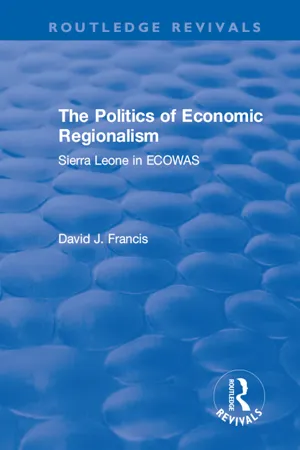
This title was first published in 2001: The primary objective of this book is to provide an analytical understanding of the nature, dynamics and complexity of the politics of economic regionalism through the prism of Sierra Leone in the Economic Community of West African States (ECOWAS). The book also discusses the following issues: the evolution of economic regionalism in West Africa and the conceptual framework for analysis; the expansion of the economic regionalism; developments within the West Africa sub-region with that of the transformation of the global economy and international political system; political, economic and security developments within ECOWAS; and the civil war in Sierra Leone.
eBook - ePub
The Politics of Economic Regionalism
Sierra Leone in ECOWAS
- 276 pages
- English
- ePUB (mobile friendly)
- Available on iOS & Android
eBook - ePub
About this book
Information
1 Economic Regionalism in West Africa
Introduction
The phenomenon of economic regionalism has been a prominent feature of contemporary international politics. It became a major development concern in the post-Second World War period. The European integration experiment which started with the creation of the European Coal and Steel Community (ECSC) and later the European Economic Community (EEC) in 1957 became an attractive example for political and economic leaders in the Third World. The 1960s and 1970s saw a proliferation of regional economic integration and co-operation groupings in Africa, Asia and Latin America. The United Nations, through its regional economic commissions, such as the Economic Commission for Latin America (ECLA) and the Economic Commission for Africa (ECA) played a leading role in promoting the idea of regional integration and co-operation as a viable mechanism for generating economic development and progress in the Third World.
The majority of the newly independent African states perceived economic regionalism and co-operation as an alternative development strategy that would generate welfare creation, industrialisation and trade expansion at continental and intra-regional levels. Economic regionalism and co-operation became a ‘fashionable’ ideology for African states which they perceived as a means of reducing their marginalisation in the international division of labour and power. The interest of African leaders in economic regionalisms was based on the recognition that the ‘economic integration of the continent is a pre-requisite for the realisation of the objectives of the OAU’. A variety of regional integration and functional co-operation projects were established in Africa. According to a World Bank report, sub-Saharan African has undertaken the most extensive experimentation in regional integration and co-operation than any region in the developing world.1 The most ambitious economic integration and co-operation projects in Africa include:
i. | Common Market for East and Southern African States (COMESA), formerly the Preferential Trade Area (PTA) for East and Southern Africa. |
ii. | Arab Maghreb Union. |
iii. | Economic Community of Central African States (ECCAS). |
iv. | Southern African Development Community (SADC), formerly Southern African Development Co-ordination Conference (SADCC). |
v. | Economic Community of West African States (ECOWAS). |
These economic regionalisms were intended to serve as the foundation for the creation of a continent-wide Common Market, as envisaged in the Lagos Plan of Action of 1980. The Lagos Plan sought to promote the long-term economic development and industrialisation of Africa through the creation first of large sub-regional markets, followed by a continent-wide market through merging the sub-regional markets.2 In pursuit of this continental objective, the African Economic Community (AEC) was established in 1991.
The West African sub-region is littered with a variety of technical and economic groupings. It is therefore not surprising that the region has been referred to as the ‘graveyard’ of regional integration projects. This chapter therefore addresses the political economy of West Africa and the evolution of the Economic Community of West African States (ECOWAS).
Political Economy of West Africa
The ‘geographical expression’ that is West Africa occupies a land area of some 6.5 million sq. kms., with an estimated population of 225 million people (2000). West Africa accounts for approximately 32 per cent of Africa’s population. It comprises sixteen independent states, which stretch from Mauritania in the north-west to Niger in the north-east, Nigeria in the south-east, and the gulf of Guinea in the south and south-west. The political map of West Africa consists of three land-locked states of Mali, Burkina Faso and Niger; the island state of Cape Verde, and twelve coastal states of Sierra Leone, Liberia, Guinea, Ghana, The Gambia, Togo, Benin, Nigeria, Senegal, Côte d’Ivoire, Guinea Bissau and Mauritania. The definition of West Africa however seems to defy geographical precision in that Cameroon and Chad are sometimes regarded as part of West Africa. This rather imprecise political geography is at the heart of the diversity and complexity of the West African sub-region. West Africa as a ‘region’ consists of geographically proximate and contiguous states, emerging as a distinct entity or more precisely, a territorial sub-system.
West Africa exhibits a diverse range of historical, ethnic, cultural, political, economic, religious, ecological, and linguistic differences. The region has a trilingual cultural heritage, i.e., Anglophone, Francophone and Lusophone, a product of European imperialism in Africa. The Berlin Congress of 1885 effectively divided West Africa into different spheres of influence, subsequently known as British West Africa, French West Africa, Portuguese West Africa and German West Africa. European colonialism and partition bequeathed to West Africa the most heterogeneous group of states in Africa. The arbitrary demarcation of political frontiers in West Africa cut across ethnic, linguistic and cultural borders. Thus, the Via speaking people are divided between Sierra Leone and Liberia, the Ewe, between Togo and Ghana, and the Yuroba, between Benin and Nigeria. The map of West Africa therefore presents a picture of uneven states, both in size and resource endowment. For example the size, population and resource endowment of such countries as Nigeria, Ghana, Senegal and Côte d’Ivoire are sharply contrasted with such states as The Gambia, Benin, Cape Verde and Togo. It therefore seems that the most distinguishing feature of West Africa is that the differences between the states are greater than the similarities.
In spite of these differences, the states in West Africa share certain similar characteristics. The general characteristic is that these states can be categorised as least developed and underdeveloped in that they share the common features of low life expectancy, high infant mortality, high levels of illiteracy, low growth rates and per capita incomes, and increasing poverty. However, not all states in West Africa conform to this essentially economic criteria. What is obvious is that West African states are at different levels of development.
The territorial boundaries and organisational structures of West African states are a product of European colonialism. The only African exception is Liberia, which was never formally colonised. The politico-administrative units of these states are a legacy of colonial rule. For example, Sierra Leone’s political and administrative structures are patterned on that of the British, whilst Senegal’s are the replica of the French. Modem state power in these countries is to a very large extent a reflection of the colonial state power based on bureaucratic control and exploitation of trading and production relations by the ruling and governing class in post-colonial West Africa. Therefore, in the majority of post-colonial states, political ethnicity continues to play a significant role in the nature of domestic politics and the struggle for the control of state power. Another similarity is that the majority of West African states had their political independence in a relatively peaceful manner through political agitation and the mobilisation of nationalist fervour against colonial rule. The only exception is that of Guinea Bissau which had to undertake an armed struggle led by the PAIGC (Partido Africano da Indepêndncia da Guiné e Cabo Verde) against Portuguese imperialism.
Another common feature is that contact with European imperialism incorporated West African economies into the capitalist world system, primarily as producers of raw materials. As export economies, they do not have control over the externally determined market prices, which explains their peripheral status in the world economy and the corresponding limitation to independent socio-economic development. The uneven economic development within West African territories is reflected in the urban and coastal focus of the majority of these economies. This urban-coastal focus also accounts for the patterns of intra-regional migration and some of the regional conflicts of economic interests within and amongst these states.3
West African economies are based on:
i. | Cash crop economies: agricultural products are the principal foreign exchange earners for most of these states. The products include coffee, palm oil, piassava, pineapples, groundnuts (Senegal and The Gambia are leading producers), and cocoa (Ghana and Côte d’Ivoire are leading world producers). |
ii. | Extractive-based economies: the West African sub-region is richly endowed with strategic resources such as oil (Nigeria is the sixth-largest producer), bauxite, iron ore, tin, zinc, copper, uranium (Niger), gold, manganese, diamonds and rutile (Sierra Leone, the leading producer). |
Industrialisation efforts in West Africa have been a means of diversifying the economic base of the sub-region. These efforts have been hindered by the lack of technological development and manufacturing expertise. West African economies had to rely on Multinational Corporations (MNCs) and bilateral economic co-operation with Western governments for the extraction of these strategic resources. The region’s trading pattern is dependent on the outside world, with less than 10 per cent of official trade being intra-regional. This external-dependent nature of West African economies means that they are often in competition with each other for external trading partners, markets, foreign capital and technology. Strategic minerals such as oil, particularly in the post-1973 oil crisis, gave countries like Nigeria important political, economic and diplomatic leverage in international affairs. Ironically, West Africa is a region of poverty and underdevelopment in spite of its huge natural resources. Most of the countries have an annual GNP which economists regard as below the poverty line. The GDP of West African states by 1990 amounted to US $72.53 billion, and has been growing at an annual rate of only 1.6 per cent over the previous ten years.
At independence in the 1960s and 1970s, West African economies generally had a healthy economic growth rate. In the 1980s and 1990s, a combination of external and domestic factors produced unfavourable economic conditions and underdevelopment. It forced most West African governments to implement IMF/World Bank Structural Adjustment Programmes (SAPs) with specific economic objectives and stringent conditionalities. The experiment with SAPs has not generated economic growth and development that is felt in tangible terms for the peoples of West Africa. West Africa therefore has some of the world’s poorest nations. The intervention of the IMF and World Bank gave these institutions the opportunity to serve as de facto economic and finance ministers of weak West African economies. The IMF/World Bank programmes only exacerbated the debt burden of these states, which by 1997 totalled US $73.206 billion.4 The 1999 UN Human Development Report shows that all the countries in West Africa (with the exception of Ghana and Cape Verde, which are middle-income) are in the low human development category.
In political terms, the immediate post-independence experiment with democratic pluralism, largely based on the political systems of former colonial powers, were to be replaced by centralisation of power through one-party rule and military dictatorships. West Africa has produced a variety of regimes ranging from one-party dictatorship and military juntas to multi-party democracies (Senegal), Socialist and Marxist-Leninist regimes (Guinea, Mali, Ghana [Kwame Nkrumah], Benin) and revolutionary and popularist regimes (Jerry Rawling’s Ghana and Thomas Sankara’s Burkina Faso). West Africa alone accounts for a large share of military coups in Africa. About 41 successful military coups have taken place in the member states of West Africa between 1963 (Togo) and 1999 (Côte d’Ivoire). Single party politics and military dictatorships heralded the centralisation of power and personalised leadership wherein political power was monopolised by the ‘strong man’ who controlled state power and its resources. The president became identified as the state for example, Kwame Nkrumah’s Ghana, Siaka Steven’s Sierra Leone and Houphout-Boigny’s Côte d’Ivoire. This trend changed in the late 1980s and 1990s with the ‘Third Wave’ of démocratisation which heralded political liberalisation and multi-party politics in the majority of West African states. The tidal wave of political liberalisation in post-Cold War West Africa, supported by Western governments and international financial institutions such as the IMF and World Bank, swept away one-partyism and some of the autocratic regimes. In some West African states such as Liberia, Mali, Sierra Leone and Guinea Bissau, the effects of the end of the Cold War and the nature of domestic politics in these states led to bloody civil wars and the collapse of the state. State implosion in West Africa and its effects on regional peace and security have led some writers such as Robert Kaplan to paint a rather apocalyptic vision of post-Cold War West Africa in that:
West Africa is becoming the symbol of world wide democratic, environmental and societal stress, in which criminal anarchy emerges as the real ‘strategic’ danger. Disease, overpopulation, unprovoked crime, scarcity of resources, refugee migrations, the increasing erosion of nation-states and international borders, and the empowerment of private armies, security firms, and international drug cartels are now most tellingly demonstrated through a West Africa prism.5
Although Kaplan’s ‘Coming Anarchy’ raised some serious security issues facing West Africa, it is however an exaggerated account. What is obvious is that post-Cold War West Africa exhibits contradictory elements of reversal (civil wars, poverty, economic underdevelopment etc.) and renewal. Far from ‘reverting to the Africa of the Victorian atlas’ portrayed by Kaplan, West Africa has re-invented itself by taking responsibility for solving some of its regional problems, though with qualified success.
The political economy analysis of West Africa illustrates the fact that West Africa is marginalised in both the international divisions of labour and of power. As primary producers, West African countries continue to perform their traditional function as ‘hewers of stone and drawers of water’ in the international economic system. As developing or least developed nations, they operate within a set of international rules and regulations fashioned by the dominant capitalist economies.6 The economic and political vulnerabilities of West African states explain their propensity for external dependence. These states therefore have to devise strategies of coping in an unfavourable international economic and political system. For instance, the categorisation of West African states as Least Developed Countries (LDCs) provides opportunity for preferential economic and trading agreements with developed regions. Anna Dickson argues that the principle of ‘self-election’ i.e., electing to remain in the LDCs category, becomes a political ploy to extract preferential trading treatment from the international economic system.7
Evolution of the Economic Community ...
Table of contents
- Cover
- Half Title
- Title Page
- Copyright Page
- Dedication
- Table of Contents
- List of Maps
- List of Tables
- Acknowledgements
- List of Abbreviations
- Introduction
- 1 Economic Regionalism in West Africa
- 2 Security Regionalism in West Africa
- 3 ECOWAS and the New Regionalism
- 4 Sierra Leone in ECOWAS
- 5 Civil War in Sierra Leone: Interpretations
- 6 Political Economy of Diamonds and Trans-border Regionalisation
- 7 Political Implications of Sierra Leone’s ECOWAS Regionalism
- 8 Economic Implications of Sierra Leone’s ECOWAS Regionalism
- Conclusion
- Bibliography
- Index
Trusted by 375,005 students
Access to over 1.5 million titles for a fair monthly price.
Study more efficiently using our study tools.
Frequently asked questions
Yes, you can cancel anytime from the Subscription tab in your account settings on the Perlego website. Your subscription will stay active until the end of your current billing period. Learn how to cancel your subscription
No, books cannot be downloaded as external files, such as PDFs, for use outside of Perlego. However, you can download books within the Perlego app for offline reading on mobile or tablet. Learn how to download books offline
Perlego offers two plans: Essential and Complete
- Essential is ideal for learners and professionals who enjoy exploring a wide range of subjects. Access the Essential Library with 800,000+ trusted titles and best-sellers across business, personal growth, and the humanities. Includes unlimited reading time and Standard Read Aloud voice.
- Complete: Perfect for advanced learners and researchers needing full, unrestricted access. Unlock 1.5M+ books across hundreds of subjects, including academic and specialized titles. The Complete Plan also includes advanced features like Premium Read Aloud and Research Assistant.
We are an online textbook subscription service, where you can get access to an entire online library for less than the price of a single book per month. With over 1.5 million books across 990+ topics, we’ve got you covered! Learn about our mission
Look out for the read-aloud symbol on your next book to see if you can listen to it. The read-aloud tool reads text aloud for you, highlighting the text as it is being read. You can pause it, speed it up and slow it down. Learn more about Read Aloud
Yes! You can use the Perlego app on both iOS and Android devices to read anytime, anywhere — even offline. Perfect for commutes or when you’re on the go.
Please note we cannot support devices running on iOS 13 and Android 7 or earlier. Learn more about using the app
Please note we cannot support devices running on iOS 13 and Android 7 or earlier. Learn more about using the app
Yes, you can access The Politics of Economic Regionalism by David Francis,David J Francis in PDF and/or ePUB format, as well as other popular books in Social Sciences & Sociology. We have over 1.5 million books available in our catalogue for you to explore.