- 320 pages
- English
- ePUB (mobile friendly)
- Available on iOS & Android
eBook - ePub
Rioting in the UK and France
About this book
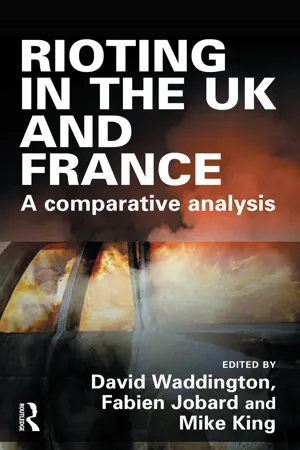
The broad aim of this book is to provide a general basis for comparatively analysing and understanding the French riots of October/November 2005 and the corresponding Bristish disorders which occurred in the spring/summer of 2001. The first of the French riots broke out on 27 October in the north Parisian banlieue (suburb) of Clichy-sous-Bois when two teenage youths of Muslim heritage were electrocuted in a substation while fleeing from the police. The two youths had apparently become unwittingly involved, together with their friends, in a police investigation of a break-in. It is not clear whether they had actually been chased by police officers. Nevertheless, a rumor to this effect quickly circulated the locality, provoking violent confrontation between youths and police. Three more weeks of rioting then ensued in neighbouring Parisian suburbs and other major French cities with similar concentrations of ethnic minorities. The riots invariably involved thousands of youths from poorer areas who confronted the police, set fire to local buildings and ignited hundreds of motor vehicles. Further rioting - though not on the same scale as in 2005 - occurred subsequently in 2006 and 2007. England and Wales have had their own counterparts to the French riots. In the early and mid 1980s, there were a number of clashes between police and African-Caribbean youths in inner-city areas. Further, in 2001 rioting broke out in the northern mill towns and cities of Bradford, Burnley, Leeds and Oldham. All of these later instances involved youths from Pakistani or Bangladeshi descent. In contrast to the riots that occurred in France though, a contributing factor to 2001 riots was the activities of white neo-Fascists. Many official reports and academic studies followed each wave of disorder, each questioning the effectiveness of Britain's 'multicultural' society, in addition to other possible factors such as the marginalisation and 'criminalisation' of minority ethnic youth, and their relations with the police. Such issues were again on the agenda after more rioting occurred in the Lozells area of Birmingham in 2005. Unlike the previous disorders, this entailed conflict between South Asian and African-Caribbean youths, following a rumor that a young African girl had been gang-raped by South Asians. British attempts to analyse and remedy the underlying causes of the riots constitute a potentially valuable resource to French academics, practitioners and policy makers. In turn, the French experience provides a fertile basis for re-applying, testing and enhancing existing British theory and policy. The book consists of a highly coherent, theoretically rich and thematically comprehensive collection of papers which provide an unparalleled description and comparative analysis of the French and British riots, along with social policy recommendations to help to address the underlying issues.
Information
Part I
Setting the Scene
Chapter 1
Introduction and overview: the British and French riots
David Waddington, Mike King and Fabien Jobard
The French riots and their predecessors
Academics and journalists have resorted to various forms of metaphor in attempting to characterise and explain the French riots of October to November 2005, which saw youths and police confronting one another nationwide against a seemingly constant backdrop of blazing cars and buildings. Some commentators alluded to natural or even supernatural phenomena in order to capture the essence of such drama. Schneider (2008), for example, likened the disorders to a ‘maelstrom’, while Wallerstein (2005) described them as exploding ‘like a phoenix’. Others evoked unsettling comparisons with recent natural disasters – describing the disorders as ‘France’s Hurricane Katrina’ (Murray 2006) and a ‘tsunami of inchoate youth rebellion’ (Ireland 2005). Like countless other riots in history, they were triggered off by a ‘banal confrontation’ (Brown 2007) on the afternoon of 27 October when police officers intercepted nine male youths thought to have been involved in the break-in of a shed on a housing estate in the Parisian town of Clichy-sous-Bois.
What transformed this innocuous affair into an incident of such international significance was the tragedy befalling a trio of the youths who had become unwittingly implicated in the encounter with the police. The three teenagers concerned (one of Turkish descent, the other two of African heritage) had been returning home from playing football in their school holidays when they were apprehended along with the other youths. Evidently fearing capture, or desperate at least to avoid the regular rigmarole of having their identity papers checked, the youths fled and took refuge in an electricity substation located to the rear of a nearby cemetery. This intensely dangerous environment quickly took its toll: the two Africans were fatally electrocuted, though the Turk somehow survived while still incurring extremely serious burns.
Rumours of this incident rapidly circulated the neighbourhood and, inside two hours, around 100 local youths embarked on a highly destructive ‘rampage’, setting fire to 23 vehicles in the process (Brown 2007). This action, and the two further nights of intermittent rioting that followed, occurred amidst a highly charged political atmosphere:
During the hours following the incident the Minister of Interior, Nicolas Sarkozy, accused the three youngsters of involvement in a burglary but denied that they had been chased. Three days earlier, visiting Argenteuil, another town of the banlieue, he had declared he would ‘rid them of the racaille’ (riff-raff), employing a term youths would use to insult each other. A few months before, commenting on the death of a child shot dead by a youth in the infamous Cité de 4000 in La Courneuve, Sarkozy had brutally announced that he would ‘cleanse the neighbourhood with a Kärcher’ (high-pressure hose) … Neither the government nor the police made any gesture of compassion or respect towards the grieving parents and relatives of the boys. (Fassin 2006: 1)
It seems probable that a widely reported secondary incident was responsible for spreading the conflagration. Reports emphasise that the rioting had actually been calming down by the night of 29/30 October following a silent march by 500 mourners and protesters, many of whom wore t-shirts proclaiming ‘Dead for nothing’ in honour of the two dead boys (Mucchielli 2009). However, on the evening of 30/31 October, police officers pursuing a group of local youths fired a tear gas grenade into a local mosque where worshippers were saying prayers for Ramadan. Scores of those present were asphyxiated but Mr Sarkozy denied that the police had been guilty of any wrongdoing (Schneider 2008). This incident and Sarkozÿ s denial had a catalytic effect, causing rioting to spread initially to other ZUSs (sensitive urban areas) in the 93rd Department of Seine-Saint-Denis. Its subsequent progress was inexorable. By 7 November, conflict had spread to some 280 cities nationwide, causing the French Prime Minister to declare a state of emergency. The rioting continued with decreasing levels of intensity until 17 November, by which time it petered out.
The 20-day period of disorder resulted in no further loss of life immediately linked to the collective violence – indeed, the only serious injuries sustained were those caused to a disabled woman who was severely burned when the bus she had boarded in Seine-Saint-Denis was petrol-bombed by youths. There were few reports of looting, either. Nevertheless, the physical damage done was far from insignificant: a reported 201 police and 26 firefighters were injured in the riots, and as many as 10,000 private vehicles and 30,000 rubbish bins were deliberately ignited. Further damage was done to 250 public buildings, raising the total cost of urban destruction to an estimated €200 million. The legal consequences of the rioting were equally far-reaching: 5,200 people were arrested, of whom 4,800 were placed in police custody and 600 subsequently imprisoned (Jobard 2008; Mucchielli 2009). Since the disorders of 2005, France has experienced further occasional instances of rioting, as in the Parisian banlieue of Villiers-le-Bel in November 2007, Grigny in May 2007, and little-known small towns such as Saint-Dizier (in October 2007) and Vitry-le-François and Romans-sur-Isère (in June and October 2008, respectively).
Though certainly unprecedented in scope and duration, the French riots are a far from novel phenomenon. In the quarter of a decade predating the 2005 riots, French society was affected by a catalogue of major urban disorders (e.g. Bonelli 2007; Oberti 2008). Zauberman and Levy (2003: 1073) note how, even by the late 1990s, a particular pattern had emerged:
These incidents may result from police shootings – whether lawful, unlawful or accidental. More often, they result from lethal traffic accidents occurring during a police chase of youth trying to escape an arrest in a stolen vehicle. Riots are also triggered by the outcomes of judicial investigations or trials, when local youth feel that the police officers involved have been unjustly cleared or too leniently sentenced.
It is evident that the incident that first triggered the 2005 riots was entirely consistent with this recent French tradition.
Making sense of the riots
During the 2005 riot period and in its aftermath, numerous possible explanations were put forward for the violence and destruction. Some political and media pundits argued that the disorders had been deliberately provoked by ‘Islamic fundamentalist extremists’, were the consequence of provocative hip-hop lyrics, or were a byproduct either of the dysfunctionally polygamus Muslim families or inherent criminality of the ‘riff-raff’ inhabiting the French banlieues (Laachir 2007; Mucchielli 2009; Waddington 2008). The view that the allegedly ‘contagious’ dispersal of the riots was due to the ‘copycat’ effect of television coverage also gained widespread political currency (Waddington op. cit.).
On the opposite side, it was generally asserted that the riots (émutes) constituted a nationwide révolte (or ‘rebellion’) by the socially disaffected youth residents of the banlieue. There was little here to distinguish the views of such diverse organs as the pro-Sarkozy French weekly newspaper, Le Journal du Dimanche, whose editorial of 6 November 2005 spoke of ‘forgotten generations’ of geographically concentrated youths telling of their ‘hatred’ and ‘despair’ towards French society, and the left-leaning British daily, the Guardian, whose feature writer, Jonathan Freedland, expressed the opinion that:
The riots themselves are not hard to fathom; several French commentators have said the only mystery is why they didn’t break out 15 years earlier. If you corral hundreds of thousands of the poor and disadvantaged into sink estates and suburbs in a misery doughnut around the city, expose them to unemployment rates of up to 40%, and then subject them to daily racial discrimination at the hands of employers and the police, you can hardly expect peace and tranquillity. Cut public spending on social programmes by 20% and you will guarantee an explosion. All you have to do is light the fuse. (9 November 2005)
Political and media debate also focused in part on the relative merits of the British and French approaches to incorporating ethnic diversity (Guardian, 12 November 2005). The British model of multiculturalism is supposed to encourage diverse communities to develop semi-autonomously while preserving their own, unique identities. The corresponding French assimilatory model demands, as its name suggests, the incorporation of its migrant populations into a French way of life in which everyone is accepted as ‘equal and the same’ as soon as French citizenship and nationality have been conferred upon them (Favell 1998; Garbaye 2005; Weil and Crowley 1994).
Murray (2006: 37) points out that the French and British appear to harbour a mutual disdain for each other’s primary model of society. He maintains that the French are apt to perceive the British model as a ‘multitude of ethnic and religious ghettos’. In the wake of the London bombings of July 2005, French newspapers like Le Monde asserted that it was due to the robustness of the French model that there had been no such terrorist attacks in France (Laachir 2007: 50). British commentators reacted just as censoriously to the events of November 2005. For instance, the Chair of the British Commission for Racial Equality (CRE) graphically asserted how: ‘The hundreds of cars that have now been burnt in French streets are pyres that mark the passing of a French delusion – that the incantation of “liberté, égalité, fraternité” would somehow mask the réalité of life for non-white French men and women: repression, discrimination, segregation’ (Observer, 6 November 2005).
What is certainly evident, even from this brief review, is that more systematic and considered sociological analysis is required of such matters as the social profiles of the rioters and the precise nature of their grievances; the background conditions against which the riots occurred; the manner in which they broke out and spread across the 300 towns that were eventually involved; the possible roles in all this of authoritative institutions like the police and media; and the possible importance of race and ethnicity. It is on these and related issues that contributors to this book will be focusing their attention.
The British riots,1980–2005
British observers of the French riots already had the benefit of a 35-year experience of recent rioting in their own country on which to formulate their ideas. In the early and mid-1980s, there were recurring confrontations in crumbling UK inner-city areas involving police and, predominantly, African-Caribbean youths. First to appear was the 1980 St Paul’s (Bristol) riot where, ‘Greatly outnumbered and unprepared for the anger of the community, the police were forced to withdraw, after attempting to confront the youth with military-style tactics for two hours. For four hours while the police awaited reinforcements, St Paul’s was a “no-go” area’ (Muncie 1984: 85). Though initially dismissed as a ‘social aberration’, the Bristol riot was actually a portent of the more widespread rioting occurring one year later in major inner-city areas like Brixton (London), Moss Side (Manchester), Handsworth (Birmingham), Toxteth (Liverpool) and Chapeltown (Leeds). The earliest and most serious of these was the Brixton riot of 10 to 12 April 1981, which saw black youths overturning cars and using petrol bombs against the police. Twenty-eight buildings were set alight and a total of 279 police officers reported injured (Lea 2004).
In 1991 and again in 1992, it was the turn of white working-class youths on the run-down and heavily stigmatised council housing estates of places like Cardiff, Oxford, Coventry and Newcastle to run riot in their localities. Such disorders constituted ‘street battles’ between youth and local police officers intervening in response to various forms of ‘car crime’, such as ‘hotting’ (performing acrobatic stunt driving on local streets) or ‘joyriding’ stolen cars (Campbell 1993; Lea 2004; Power and Tunstall 1997). There were four confrontations of this nature in 1991 and a further nine one year later.
Closest in similarity to the French disorders were the riots occurring in a handful of former mill towns and cities in West Yorkshire and East Lancashire in the spring and early summer of 2001. Following a minor disturbance in Bradford (West Yorkshire) on 14–15 April, more serious disorders occurred in Oldham (Greater Manchester), Burnley (Lancashire) and then in Bradford once again. The central participants in each of these riots were the police and British-born youths of Pakistani and Bangladeshi origin. In all cases the disorder broke out in close proximity to areas chiefly occupied by Asian Muslims, following the trouble-causing activities of white racists (Kalra 2002). To briefly summarise,
In Oldham on 26–29 May around 500 people were involved, injuring 2 police officers and 3 members of the public with damage estimated at ã1.4 million. In Burnley about 400 were involved on 24–26 June, with 83 police officers and 28 members of the public injured, and damage estimated at over ã0.5 million. Finally, in Bradford up to 500 people were involved in ‘riots’ over the weekend of 7–9 July. The injured included 326 police officers and 14 members of the public with estimates of damage to property ranging up to ã10 million … Around 400 people have been arrested in relation to the disturbances in Bradford, Burnley and Oldham. (Bagguley and Hussain 2003: 1)
The Oldham riot occurred when, following an argument between a 36-year-old white woman and pair of Asian youths, members of a white racist organisation (Combat 18 or C18) carried out retributive attacks on nearby Asian residents and their properties. Thereafter, a more serious and prolonged confrontation developed between the police and Asian young men who accused the former, not only of failing to adequately respond to the fascist attacks, but of actually providing protection to the white assailants (Waddington 2007).
A more complic...
Table of contents
- Cover
- Half Title
- Full Title
- Copyright
- Contents
- Tables and figures
- Acknowledgements
- Notes on contributors
- Glossary
- Part I Setting the Scene
- Part II The British Riots, 2001-2005
- Part III The French Riots, 2001-2008
- Part IV Other International Comparisons
- Part V Conclusions
- References
- Index
Trusted by 375,005 students
Access to over 1.5 million titles for a fair monthly price.
Study more efficiently using our study tools.
Frequently asked questions
Yes, you can cancel anytime from the Subscription tab in your account settings on the Perlego website. Your subscription will stay active until the end of your current billing period. Learn how to cancel your subscription
No, books cannot be downloaded as external files, such as PDFs, for use outside of Perlego. However, you can download books within the Perlego app for offline reading on mobile or tablet. Learn how to download books offline
Perlego offers two plans: Essential and Complete
- Essential is ideal for learners and professionals who enjoy exploring a wide range of subjects. Access the Essential Library with 800,000+ trusted titles and best-sellers across business, personal growth, and the humanities. Includes unlimited reading time and Standard Read Aloud voice.
- Complete: Perfect for advanced learners and researchers needing full, unrestricted access. Unlock 1.5M+ books across hundreds of subjects, including academic and specialized titles. The Complete Plan also includes advanced features like Premium Read Aloud and Research Assistant.
We are an online textbook subscription service, where you can get access to an entire online library for less than the price of a single book per month. With over 1.5 million books across 990+ topics, we’ve got you covered! Learn about our mission
Look out for the read-aloud symbol on your next book to see if you can listen to it. The read-aloud tool reads text aloud for you, highlighting the text as it is being read. You can pause it, speed it up and slow it down. Learn more about Read Aloud
Yes! You can use the Perlego app on both iOS and Android devices to read anytime, anywhere — even offline. Perfect for commutes or when you’re on the go.
Please note we cannot support devices running on iOS 13 and Android 7 or earlier. Learn more about using the app
Please note we cannot support devices running on iOS 13 and Android 7 or earlier. Learn more about using the app
Yes, you can access Rioting in the UK and France by David Waddington,Fabien Jobard,Mike King in PDF and/or ePUB format, as well as other popular books in Sciences sociales & Criminologie. We have over 1.5 million books available in our catalogue for you to explore.