eBook - ePub
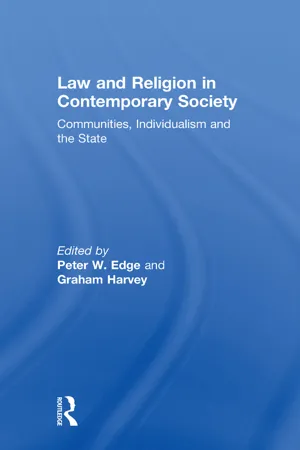
Law and Religion in Contemporary Society
Communities, Individualism and the State
- 214 pages
- English
- ePUB (mobile friendly)
- Available on iOS & Android
eBook - ePub
Law and Religion in Contemporary Society
Communities, Individualism and the State
About this book
The relationship between law and religion has traditionally been analysed according to two basic paradigms. One has focused on the relationship between religious communities and the State (the Church/State paradigm), while the other has concentrated on the relationship between the State and the individual (the liberal-individualist or civil liberties paradigm). This book enriches the analysis of law and religion in society by emphasising a third and complementary analytical dimension involving the relationship between religious communities and religious individuals. In particular, the contributors explore the various facets of the multiple tensions that exist in the legal relationships between religious organisations, State and adherents in the period leading up to the third Christian millennium. Against the background of the complex and sometimes contradictory responses of religious organisations and the State to the Human Rights Act, this interdisciplinary collection draws on contributions from leading scholars active in the field of religious rights and the interaction of law and religion based in the UK, USA, Canada, New Zealand and elsewhere, and makes a timely and significant contribution to international debates in a variety of academic disciplines. Contributors explore international concerns over religious liberty, focusing particularly on the boundaries of ethnicity and religious community, the status of the 'established' Churches in the UK, and the proper place for religious organisations under generally applicable legal regimes of non-discrimination. Themes discussed are closely related to wider interests within legal and socio-legal studies involving gender, discrimination, equality, community and the nature and limits of individualism and individual legal rights.
Information
PART 1
CONTEXT
Chapter 1
Religion and Law in Great Britain at the End of the Second Christian Millennium
The traditional British attitude to the legal protection of civil liberties and human rights has been one where no overarching constitutional protection has been afforded to those liberties and rights (Dicey, 1968: 165). This failure to develop a constitutional notion of rights is in keeping with ‘the general English preference for precedent over principle… [and] the more general preference for the pragmatic over the theoretic’ (Atiyah, 1987: 33). Whatever the overall merits of such an approach it has had a disproportionately damaging effect on both the legal protection of religious minorities within Great Britain and the academic analysis of that protection as compared the same situation for other minority (and, indeed, non-minority) groups. In the case of groups such as women, ethnic minorities and children, bodies of law have arisen which have the function of protecting the liberties and rights of the group to which they apply. However, within Great Britain there are very few rules of common law and very few statutes that seek to offer protection or exemption to religious minorities. There are, however, very many rules of law, both of statutory and common law origin, which make the everyday lives of sincere and obdurate religious adherents more difficult and even, at times, impossible (Bradney, 1993). The lack of constitutional protection has meant that such adherents usually lack a legal means to use the courts as a forum in which they can protest about their treatment. In turn this has meant that legal academics have not been given a bounteous supply of their usual primary material, reported cases, as a source for arguments about the appropriate ways to protect religious minorities.
Prima facie the new Human Rights Act seems destined to change the traditional position. It will give members of faith groups a route to the courts and the resultant cases will afford commentators raw material for an endless stream of analysis. This essay will consider to what extent that will in fact be the case, seeking to put the possible effect of the introduction of the Act into the context of the changing attitude of the British courts to the position of religious minorities, the changing attitude of the senior judiciary to the nature of the judicial function and the continuing gap between the secular liberalism that prevails in the British legal and political structures and the religiosity that those structures see in many faith traditions now found within Great Britain.
The World Turned Upside Down?
Writing about the Canadian Charter of Rights and Freedoms, Arthurs notes that:
[i]n the first edition of P.W. Hogg, Constitutional Law of Canada (1977), the leading Canadian text, section III covering materials on civil liberties took up 7 per cent; by the time of the fourth edition (1996), section III covering materials on civil liberties and Charter issues, accounts for 41 per cent. (Arthurs, 1998: 25)
By contrast, during the passage of the Human Rights Act through Parliament, one Law Lord sought to rebut notions of the Act being a legal revolution, observing that he did not think that ‘they [the provisions of the Human Rights Act] will turn our world upside down’.1 Other Law Lords and retired Law Lords took a similar stance. Lord Scarman, for example, said ‘[t]he Bill is modest’.2 Academic commentators have, in general, seen the advent of the Human Rights Act as being the harbinger of a new legal future (Wade, 1998). The British judiciary seem somewhat less convinced. Even a judge whose extra-judicial writings have shown a clear sympathy for notions of rights and the implementation of rights through the courts has been less than wholly confident about the judiciary’s ability to take on board the spirit of the Human Rights Act (Sedley, 1998). This judicial caution highlights the importance of the question ‘Does the Human Rights Act in reality presage a new future for religious groups in Great Britain?’.
The Context for Analysing the Impact
Religion is literally a minority issue in Great Britain. ‘The United Kingdom has the lowest rate of active Church membership (15 per cent) of countries surveyed in Europe’ (Social Trends, 1994: 145).
In 1991 forty per cent of people questioned in a British Social Attitudes Survey said that their religious beliefs made no difference in their lives. In 1993 25 per cent of people questioned in a British Social Attitudes Survey said they never or virtually never attended church, or meetings associated with their religion. (Social Trends, 1996: 225)
Nonetheless, despite the minority status of religious adherents within Great Britain, a sizeable number of the population still consider their religion to be an important matter in their personal lives. The total population of the United Kingdom in 1994 was 58.4 million people (Social Trends, 1997: 16). The 15 per cent of that 58.6 million who were active Church members in that year equates to a figure of 8.76 million. For those people religion is part of their identity and for some of them religion is the sole source of their identity, taking precedence over matters such as ethnic origin or nationality (Knott and Khokher, 1993). Even when one discounts the number of children included in this figure the calculation still indicates a considerable body of people who might be interested in using the 1998 Act’s new provisions to protect their freedom of religion. Thus the effect of the new Act depends not on whether there will be potential litigants but on the attitude of the judiciary to the Act.
The Changing Judicial Attitude Towards Religion
Examination of reported judgments through this century suggests a changing judicial attitude towards the relevance of the religion of litigants appearing before the courts. Early dicta simply state the irrelevance of religious affiliation to the courts. ‘It is, I hope, unnecessary to say that the Court is perfectly impartial in matters of religion.’3 ‘As between different religions the law stands equal.’4 Implicit in these dicta is the idea that the judiciary stands aside from the religion of litigants before them, considering the people but not the believers before them. Judges with such an attitude would see little, if any, role for the Human Rights Act with respect to religion. If religions are equal before the law what task would there be for the Human Rights Act? Whether or not this notion of neutrality ever adequately reflected the reality of the judicial attitude towards religion is not the subject of this essay. What is clear is an overt change in the attitude of the judiciary towards the subject of the religious beliefs of litigants; a change which arguably allows for some purchase for the Human Rights Act in this area.
Child custody cases, where the religion of a parent becomes a factor in the trial, serve as illustrative examples of the change in the judicial attitude towards religion. In 1973 Lord Justice Lawton gave judgment in a child custody case which concerned a Jehovah’s Witness mother. In denying custody of the children to the mother, Lawton said:
The isolation the mother suffered was accentuated by the fact that she was a member of the Jehovah’s witnesses… [Ms their children were growing up they would be different from the children around them… The differences were likely to increase as they got older. They would not suffer from this disadvantage if they were with the father.5
The case is typical of its time. The judicial attitude is one of neutrality towards belief but hostility to the practice of that belief where the belief is different from what the judge considers mainstream religious beliefs.6 A decade later the judicial attitude was somewhat different. In 1981 in a similar child custody case involving a Jehovah’s Witness Lord Justice Scarman said:
We live in a tolerant society. There is no reason at all why the mother should not espouse the beliefs and practices of the Jehovah’s Witnesses. It is conceded that there is nothing immoral or socially obnoxious in the beliefs and practices of this sect.7
In this case custody of the children was awarded to the witness mother. In a similar case reported in the same year, Mr Justice Sheldon said:
[I]t would be quite wrong for anyone to assume, in any dispute between two parents of whom one is and the other is not a Jehovah’s Witness, that the custody and care and control of their child will necessarily, or even more often than not, be given to the latter.8
Once again, custody of the child was awarded to the witness mother. The contrast in the language of these cases is as striking as the contrast in the result. In the early cases social practices which stem directly from the religion are regarded as being sufficient reason for denying custody of children to believing parents even though most of the other factors in the cases point to the award of such custody (Bradney, 1979). In later cases believers are given custody of children. In early cases the judiciary are implicitly hostile towards the practice of particular religions. In later cases the judiciary take the opportunity of giving judgment to underscore the social acceptability of a religion which once provoked hostility.
The change in the judicial attitude towards religion cannot be seen simply as a change over time with judgments in the 1970s being hostile and judgments in the 1980s being more positive. In 1985 Mr Justice Latey gave judgment in a child custody case which involved a Scientologist parent. In that judgment he said, inter alia:
Scientology is both immoral and socially obnoxious. Mr Kennedy did not exaggerate when he termed it ‘pernicious’. In my judgment it is corrupt, sinister and dangerous. It is corrupt because it is based on lies and deceit and has as its real objective money and power for Mr Hubbard, his wife and those close to him at the top. It is sinister because it indulges in infamous practices both to its adherents who do not toe the line unquestioningly and to those outside who criticize or oppose it. It is dangerous because it is out to capture people, especially children and impressionable young people, and indoctrinate them so that they become the unquestioning captives and tools of the cult, withdrawn from ordinary thought, living and relationships with others.9
Given the dicta it is not surprising to see that custody was awarded to the non-Scientologist parent. The hostility of the tone of the dicta in Re B and G contrasts strongly with the approach of Lord Justice Ward in the much more recent unreported case of Re ST.10
Re ST concerned not Scientology but The Family. In his judgment Lord Justice Ward started by saying that:
I must not fall into the trap of attributing collective responsibility to The Family as a group when faults and failings are those of an individual or individuals or even a commune or more than one commune.
Later in the judgment he noted that:
The members of The Family live communally. Communal life breaks down unless the members accept a large measure of discipline and refrain from carping criticism because it is destructive. I understand that. Every institution needs its rules and regulations and depends upon members’ compliance be it at school, in the army or in a learned profession. So it is with The Family.
Elsewhere in the judgment he observed that:
[o]ne cannot have listened, as I have listened to over 30 members of The Family without being impressed by and in many ways filled with admiration for their total dedication to their discipleship, to their beliefs in the teachings of their Master, Jesus Christ, and to their spreading of His Gospel.
Comparison of the dicta in Re B and G and Re ST is valuable because of the close similarities in the public and media attitude towards the religions involved in the case. The popular view of Scientology is amply illustrated by Mr Justice Latey’s dicta. The Family (previously known as the Children of God) have been associated in the public eye with a variety of practices including child abuse and prostitution. In the case of both religions academic evidence has shown that the public perception of the religion rests on varying degrees of misperception, misunderstanding and simple prejudice (Wallis, 1976; Lewis and Melton, 1994). Nonetheless, however inaccurate, these perceptions formed the backdrop to the decisions in the cases. In Re B and G the backdrop becomes the foreground and indeed the whole picture. In Re ST the judicial tone is both more measured and considerably more positive.
The change in the judicial attitude towards the religious beliefs of litigants should not be overstressed. First, although the cases cited above do constitute evidence of a change in attitude, the weight of that evidence is not that great. The total number of cases that could be used in support of the arguments above, whilst larger than those referred to in this essay, is still comparatively small. Moreover those cases are drawn from only a limited area of law which some may regard as being atypical. Equally the tenor of the judgments in the cases in this area of law does not point unequivocally in one direction. Thus, for example, although the Court of Appeal upheld Mr Justice Latey’s decision in Re B and G Dunn L.J. was somewhat critical of the tone of his judgment.11 Even individual cases can show both a positive and a negative attitude towards the religion of litigants. In Re H whilst Mr Justice Sheldon was assuring Jehovah’s Witnesses that there was no reason to think that they would normally not get custody of their children Mr Justice Hollings was worrying about whether or not witness children would be ‘indoctrinated’ into the witness faith.12 In cases which involve religions which are perceived by the judiciary to be more mainstream, such as Roughley v Roughley and Re M where the religion in question was Roman Cathol...
Table of contents
- Cover
- Half Title
- Title Page
- Copyright Page
- Table of Contents
- List of Contributors
- Introduction
- Part 1: Context
- Part 2: Religious Organisations and the State
- Part 3: Communalism in the Law
- Part 4: Conclusion
- Index
Trusted by 375,005 students
Access to over 1.5 million titles for a fair monthly price.
Study more efficiently using our study tools.
Frequently asked questions
Yes, you can cancel anytime from the Subscription tab in your account settings on the Perlego website. Your subscription will stay active until the end of your current billing period. Learn how to cancel your subscription
No, books cannot be downloaded as external files, such as PDFs, for use outside of Perlego. However, you can download books within the Perlego app for offline reading on mobile or tablet. Learn how to download books offline
Perlego offers two plans: Essential and Complete
- Essential is ideal for learners and professionals who enjoy exploring a wide range of subjects. Access the Essential Library with 800,000+ trusted titles and best-sellers across business, personal growth, and the humanities. Includes unlimited reading time and Standard Read Aloud voice.
- Complete: Perfect for advanced learners and researchers needing full, unrestricted access. Unlock 1.5M+ books across hundreds of subjects, including academic and specialized titles. The Complete Plan also includes advanced features like Premium Read Aloud and Research Assistant.
We are an online textbook subscription service, where you can get access to an entire online library for less than the price of a single book per month. With over 1.5 million books across 990+ topics, we’ve got you covered! Learn about our mission
Look out for the read-aloud symbol on your next book to see if you can listen to it. The read-aloud tool reads text aloud for you, highlighting the text as it is being read. You can pause it, speed it up and slow it down. Learn more about Read Aloud
Yes! You can use the Perlego app on both iOS and Android devices to read anytime, anywhere — even offline. Perfect for commutes or when you’re on the go.
Please note we cannot support devices running on iOS 13 and Android 7 or earlier. Learn more about using the app
Please note we cannot support devices running on iOS 13 and Android 7 or earlier. Learn more about using the app
Yes, you can access Law and Religion in Contemporary Society by Peter W. Edge,Graham Harvey in PDF and/or ePUB format, as well as other popular books in Teologia e religione & Religione. We have over 1.5 million books available in our catalogue for you to explore.