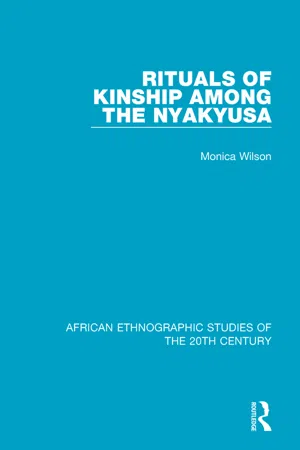
Originally published in 1957, analyses the rituals celebrated by groups of kinsmen on the occasion of births, marriages and deaths within the age villages of the Nyakyusa. the connection between the form of the rituals and the kinship structure is examined. The symbolism of the rituals throws great light on the psychological reactions of this African people to death and birth, sin and misfortune, expiation and reconciliation.
- 296 pages
- English
- ePUB (mobile friendly)
- Available on iOS & Android
eBook - ePub
Rituals of Kinship Among the Nyakyusa
About this book
Information
CHAPTER III
FAREWELL TO THE DEAD
AFTER spending three or four days weeping, and feasting, and dancing, the main body of mourners scatter to their homes, but the close kinsmen remain for a week or two sleeping at the home of the deceased, awaiting the ritual of farewell. The Nyakyusa themselves distinguish three main events in it: the ‘picking up of pumpkin-seeds’ (ukusala inyungu) when the chief mourners first begin to wash; the ‘shaving of the sprouting hair’ (ukutemela ilite-melo) when the beer of inheritance is brewed and the estate divided; and the ‘ritual of the gasping cough’ (ingotolo) when the widows, having lain with the heir, go to visit their parents. The details differ appreciably between Selya and MuNgonde on the one hand, and Kukwe country on the other, and we describe them separately.
1. IN SELYA AND MUNGONDE
(a) The events
i. ‘Picking up pumpkin-seeds’ The picking up of pumpkin-seeds begins with the formal recognition of the heir, if the deceased was a married man. The heir and widows are suddenly seized and hustled, resisting, into the mourning hut. If they go willingly ‘it seems as if they wished their relative to die’. The officiant smears their chests with ash and puts a strand of the ilingolongofwa creeper on each one’s right shoulder. These are both signs of mourning, and the creeper is also ‘a sign that we have given him the inheritance’. After a few minutes the heir and widows are formally summoned to come out of the hut, and they go off to wash away the ash and creeper in the stream. But first, the flowering head of a banana is buried in the courtyard near the door of the mourning hut and the grave of the deceased. If he was not a married man and there are no widows to be inherited, the ritual begins with this. The banana flower is explicitly identified with the corpse: it must face in the direction from which the ancestors came, as the corpse does; if the deceased is a male the flowering head is from a plantain (itoki); if a female from a sweet banana (injali or indefu or iselya); and it is wrapped in a leaf (of the same species as the flower) which represents a blanket. The symbolism is interpreted in terms of the habit of growth. A trunk of plantain or sweet banana flowers and fruits only once, then dies and is pruned away, being replaced by a sucker from the same root, hence the association between the flower and the corpse. Ilitoki is a large variety of plantain, eaten when it is green and hard; injali is a smallish banana eaten when it is ripe and sweet, and it takes nine months to develop. ‘When an injali stem forms and a woman conceives a child at the same time, the bananas will be ripe and the woman bear her child together.’ No one hesitated about this identification of plantain with male, sweet banana with female; it is as obvious in Nyakyusa as the associations of ‘breeches’ and ‘petticoats’ in English.
The officiant sprinkles a powdered medicine on to the earth of the grave and all the participants (that is, the heirs, widows, children, and certain siblings of the deceased) rub themselves in it. They rub forehead, right elbow, right knee, and right toe in the pile of earth. Only chiefs and their close relatives and twins refrain, for they have been drinking medicines, and such close contact with a corpse would ‘spoil their medicine’: ‘The medicine would go rotten if they touched the grave which contains medicine,’ so the chief’s forehead, etc., must not touch the grave. He merely touches the earth with a finger-tip.
Having touched the earth, all the participants go to wash in a stream, and when they return they wash again ritually in the doorway of the mourning hut, the doctor pouring out medicated water from a small calabash and each participant catching the water in his hands and rubbing them and his mouth and knees with it. Then they oil themselves. Until this ritual they must remain dirty and dishevelled with the mud and ash of mourning on them, and any who steal away to wash are fined by the other relatives.
Next the officiant takes roasted bananas and sticks into each one or more pumpkin-pips (inyungu) and one or more lentils (inandala).1 She half-buries these in the earth at the doorway of the hut, or sits in the doorway holding a banana near the ground, and each participant approaches in turn and stoops and bites off the banana, and eats it.
The ulufumbo (the litter of dry banana leaves on which the mourners sat) is sprinkled with powdered medicine and carried out by the officiant and burnt, or thrown away under the bananas. If the deceased has been buried elsewhere still a bunch of banana leaves representing the ulufumbo is taken out. ‘Until then the rubbish (imindu) is kept in the house and not swept out because they are grieving—a person cannot be clean, it would seem as if he did not grieve.’
Next the officiant takes an old pot and, holding it, circles round the hearth while her assistant drops pumpkin-seeds, beans, lentils and cowpeas into it and the participants sing: ‘The croaking bird, the croaking bird (ilinwanwa).’ The food is transferred to another pot and put on the fire and the officiant touches the hearth with different parts of her body (or makes gestures as if to do so), she and the participants saying as she does so: ‘The knee is also put on (the fire), the heel is also put on, the backs of the knees are also put on, the loins are also put on, the belly is also put on, the back of the head is also put on.’ Then she stamps noisily on the hearth, and the participants sing: ‘It startles him. …’
Relatives and village neighbours are expected to bring small gifts of millet at this ritual and these are formally received by the officiant, who sits outside the mourning hut with two large baskets beside her and acknowledges each gift as it is brought and emptied into one or other of them. The one is for the millet of kinsmen, the other for that of neighbours. She addresses each giver in terms of his or her relationship to the deceased, announcing: ‘Your grandchild has brought a measure, your daughter has brought a measure, your fellow (i.e. neighbour) has brought a measure, etc. …’ This is spoken of as ‘measuring the measures’ (ukugela imigelo); it is ‘to greet the shade’, and if millet is not available at the time the ritual is performed it is done symbolically.
A fresh piece of bark is stripped from the species of ficus used for making bark-cloth, hammered a little and placed on a fresh banana leaf and sprinkled with powdered medicine. A grindstone is lifted on to it and the officiant grinds some of the millet just presented and allows it to fall on the bark. During the grinding the officiant says: ‘The knee is also ground, the heels are also ground,’ and so on, mentioning the belly and loins. From the time of the death until this ritual, hammering of bark-cloth in the home of the deceased is taboo (mwiko), for hammering bark-cloth is a symbol of sexual intercourse and ‘the hammer belonged to him who died’. The first millet ground is made into a paste and later smeared on the heads of the participants as a preparation for shaving ‘the hair of the corpse’ (inwili sya nifirnba), the rest is made into porridge.
The participants stand in a line in the mourning hut while the officiant sweeps the dust (imindu) on to their legs, and they begin to wail and sing the farewell dirge: ‘Good-bye, So-and-so, goodbye. …’ The other mourners join in the dirge and the women weep. The participants are then told to stand with their legs apart and the officiant pushes a winnowing basket of millet, mixed with a few pumpkin-seeds and lentils,1 between their legs. She crawls along the ground to do this and then puts the basket on to the head of each participant in turn, and a pinch of the millet flour on each one’s shoulder. She takes banana leaves and, after touching her own body in various places with them, she girds them round the waists of the participants. She puts down a stem of bananas2 and a hen (or a bunch of feathers representing a hen) and each participant in turn sits on them. She holds a banana sapling across the doorway and as each participant passes out of the hut, stooping, he bumps his head against it. Another line is formed in the courtyard and again the basket of millet is put on the head of each participant. Some grains of millet are thrown over them and some sprinkled on the ground. They sing a song, the leader starting: ‘The rubbish *(Hindu) …’ and the others replying in chorus: ‘The rubbish, we were startled at the rubbish (tunyomwike Hindu)’ and they dance the stamping dance for a few minutes.
Then they go off to bathe, taking with them the stem of bananas and the hen and the bark on which the millet was ground. The leaves they wear and the bananas are thrown away in the stream; the bark and hen are dipped in the stream and taken home by the officiant as her perquisite. They separate to bathe, the men from the women, the older from the younger.
Returning home, they all run into the mourning hut and out again, one by one, as the officiant pours water, mixed with powdered medicine, on the thatch above the doorway, and the water drops on their bodies. Then each sits down in the doorway and is washed again with water and medicine by the officiant.
A mash of beans and banana is made, and a few pumpkin-seeds and lentils are mixed in. Some of it is salted, some left unsalted. A little of the unsalted mash is handed to each participant to eat, but the salted is mixed in a ball with the millet porridge previously prepared, and plastered against the wall of the hut and on the hearthstones, whence the participants must bite it off. They compete for it, jostling one another. Sometimes the officiant also puts some watery porridge in a leaf of the bark-cloth tree and squeezes it into a basket. Again the participants fight to take a little each.
Some of the millet paste, previously prepared, is smeared on the head of each participant in the form of a cross, drawn from the forehead and the nape of the neck to the crown, and from each ear to the crown. The officiant then shaves each of them, beginning with the lines along which she smeared them. As she does so she says: ‘Alas, he (or she, if the deceased was a woman) stole. … They cut his head.’
If the family is wealthy at least one cow is killed by the heir— Kasitile insisted that a sacrifice is essential at the pumpkin-seed ritual—and the authority of the heir is ac...
Table of contents
- Cover
- Half Title
- Title Page
- Copyright Page
- To Whom Do They Pray
- Acknowledgement
- Table of Contents
- List of Illustration
- I. Introduction
- II. Burial Rites
- III. Farewell to The Dead
- IV. The Ritual of Puberty and Marriage
- V. The Ritual of Birth
- VI. The Ritual of Abnormal Birth
- VII. Rituals of Misfortune
- VIII. The Participants
- IX. The Nyakyusa Conception of Reality
- X. The Sociological Analysis of The Rituals of Kinship
- Select Records
- Index
Trusted by 375,005 students
Access to over 1.5 million titles for a fair monthly price.
Study more efficiently using our study tools.
Frequently asked questions
Yes, you can cancel anytime from the Subscription tab in your account settings on the Perlego website. Your subscription will stay active until the end of your current billing period. Learn how to cancel your subscription
No, books cannot be downloaded as external files, such as PDFs, for use outside of Perlego. However, you can download books within the Perlego app for offline reading on mobile or tablet. Learn how to download books offline
Perlego offers two plans: Essential and Complete
- Essential is ideal for learners and professionals who enjoy exploring a wide range of subjects. Access the Essential Library with 800,000+ trusted titles and best-sellers across business, personal growth, and the humanities. Includes unlimited reading time and Standard Read Aloud voice.
- Complete: Perfect for advanced learners and researchers needing full, unrestricted access. Unlock 1.5M+ books across hundreds of subjects, including academic and specialized titles. The Complete Plan also includes advanced features like Premium Read Aloud and Research Assistant.
We are an online textbook subscription service, where you can get access to an entire online library for less than the price of a single book per month. With over 1.5 million books across 990+ topics, we’ve got you covered! Learn about our mission
Look out for the read-aloud symbol on your next book to see if you can listen to it. The read-aloud tool reads text aloud for you, highlighting the text as it is being read. You can pause it, speed it up and slow it down. Learn more about Read Aloud
Yes! You can use the Perlego app on both iOS and Android devices to read anytime, anywhere — even offline. Perfect for commutes or when you’re on the go.
Please note we cannot support devices running on iOS 13 and Android 7 or earlier. Learn more about using the app
Please note we cannot support devices running on iOS 13 and Android 7 or earlier. Learn more about using the app
Yes, you can access Rituals of Kinship Among the Nyakyusa by Monica Wilson in PDF and/or ePUB format, as well as other popular books in Social Sciences & Anthropology. We have over 1.5 million books available in our catalogue for you to explore.