Many polymers derived from various marine sources and microorganisms possess some important biological properties such as biocompatibility, biodegradability, and bioadhesivity that make them attractive as pharmaceutical excipients in various pharmaceutical dosage forms. Moreover, these polymers can be modified physically and/or chemically to improve their biomaterial properties.
In this volume, Natural Polymers for Pharmaceutical Applications, Volume 2: Marine- and Microbiologically Derived Polymers, looks at how these polymers have been explored and exploited for pharmaceutical uses, such as in tablets, microparticles, nanoparticles, ophthalmic preparations, gels, emulsions, suspensions, etc. Some commonly used marine- and microbiologically derived polymers used as pharmaceutical excipients include alginates, agar-agar, gellan gum, carrageenan; chitosan, xanthan gum, and others. The book focuses on important recent advances from experts around the world on marine-derived polysaccharides and pharmaceutical applications of alginates, agar-agar, gellan gum, carrageenan, chitosan derivatives, xanthan gum.
DILIPKUMAR PAL,1 SUPRIYO SAHA,2 AMIT KUMAR NAYAK,3 and MD SAQUIB HASNAIN4
1Department of Pharmaceutical Sciences, Guru Ghasidas Vishwavidyalaya (A Central University), Bilaspur, C.G., 495 009, India
2Department of Pharmaceutical Sciences, Sardar Bhagwan Singh University, Balawala, Dehradun – 248001, Uttarakhand, India
3Department of Pharmaceutics, Seemanta Institute of Pharmaceutical Sciences, Mayurbhanj, 757086, Odisha, India
4Department of Pharmacy, Shri Venkateshwara University, NH-24, Rajabpur, Gajraula, Amroha, 244236, U.P., India
ABSTRACT
Alginate, carrageenan, and chitosan (CS) are the principle marine polysaccharides obtained from algae, sea sponge, sea horse, seaweed, and shrimps, etc. and observed with pharmaceutical applications. Alginate is used as a carrier molecule for controlled release of anticancer drugs, antiviral agents and also used as a wound healer. Carrageenan is used in controlled release carrier for curcumin, methotrexate, and also applied as intestine directed, vaginal insert and oral insulin delivering agent. CS is a marine polysaccharide, used as controlled release carrier of sunitinib, 5-fluorouracil, coumarin, and also observed with wound healing, trypanocidal, and mosquito larvacidal effects. This chapter provides detailed information about the pharmaceutical application of different marine polysaccharides.
1.1 INTRODUCTION
Marine polysaccharides are the natural polysaccharide derived from marine sources, such as algae, sponge, fish, seaweed, etc. (Rasummnen et al., 2007; Montaser et al., 2011). The principle importance of marine polysaccharides is that they are biologically compatible with low extraction cost. The characteristics of polymer were regulated by salt effect, temperature, pressure, presence of microbes, and viruses (Ahmad et al., 2014; Kim et al., 2008). Alginate, carrageenan, and chitosan (CS) are the main types of polysaccharides obtained from marine sources. Alginate is the sodium or calcium salt of alginic acid, an anionic polysaccharide obtained from Laminaria hyperborea, Laminaria digitata, Laminaria japonica, Ascophyllum nodosum, and Macrocystis pyrifera. Alginate is a polysaccharide developed upon the reaction of mannuronic acid and guluronic acid with biodegradability for promoted cell survival rate. The solubility and water retention capacity of alginate depends upon pH, molecular mass, and ionic strength of the polymer (Lee et al., 2012; Sachan et al., 2009). Carrageenan is a marine polysaccharide extracted from Rhodophyceae seaweed family having sulfur-containing polygalactan and has several types such as kappa, lambda, iota, epsilon, etc. as per its solubility in potassium chloride solution. Though lambda carrageenan is not capable of forming a gel, but iota carrageenan is able to form a right-handed helix. Carrageenan is mainly used as inflammation initiator in rat and responsible for anticoagulant, antithrombotic, antiviral antitumor, and other immuno-modulatory activities (Necas et al., 2013; Tobackman et al., 2001). CS is a heteropolymer composed of glucosamine and n-acetyl glucosamine (Randy et al., 2015; Shweta et al., 2015; Nayak et al., 2011, 2012a). CS is extracted from chitin and mainly obtained from shells of lobster, shrimp, and crabs and treated with alkali or reacted with papain, CS is extracted (Nayak et al., 2012b, 2012c, 2014a, 2014b, 2014c). Hydrolytic cleavage of acetamide group, chitin is converted into CS with a greater degree of deacetylation (Nayak et al., 2015a, 2015b, 2016). In this chapter, we mainly emphasized on the pharmaceutical application of marine polysaccharides.
1.2 PHARMACEUTICAL APPLICATION OF ALGINATE
1.2.1 pH-RESPONSIVE ALGINATE HYDROGEL FOR DELIVERY OF PROTEIN MOLECULE
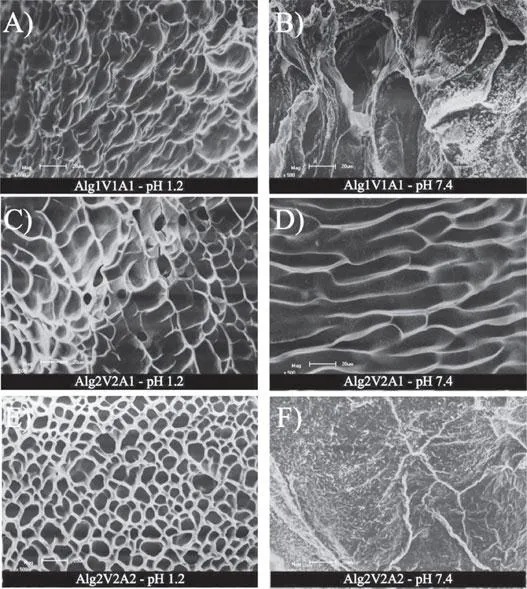
Lima et al., developed alginate-based hydrogel for the delivery of protein molecule (bovine serum albumin (BSA)). The formulation was developed by reaction of sodium alginate, glycidyl methacrylate, N-vinyl pyrrolidone, and sodium acrylate using tetramethylethylenediamine as catalyst (Table 1.1). FTIR, SEM, and NMR techniques were used to chemically characterize the hydrogel. Cytotoxicty evaluation against epithelial colorectal adenocarcinoma cells (HT-29) and swelling characteristic by gel permeation technique were evaluated for the formulation. SEM data revealed that at pH 7.4 formulations were more porous than pH 1.2. Cell viability data greater than 70% correlated with no inhibition of cell growth. At pH 1.2, formulation frequently achieved the pseudo-equilibrium state with loss of water molecules, and a pseudo Fickian distribution was observed with one of the formulations (Figure 1.1). This data clearly stated the importance of pH on the activity profile of the hydrogel for the delivery of BSA (Lim et al., 2018).
TABLE 1.1 Contents of Alg-GMA, VP, and SA Used in the Hydrogel-Forming Suspensions
FIGURE 1.1 Micrographs of hydrogels with different amounts of GMA-Alg, N-vinylpyrrolidone, and sodium acrylate taken from samples freeze-dried after being swollen to equilibrium in water.
1.2.2 PLATINUM-ALGINATE NANOPARTICLES FOR THE TREATMENT OF HEPATIC CARCINOMA
Wang et al., developed a platinum (Pt IV) conjugated alginate nanoparticles for the treatment of hepatic carcinoma. The formulation was formulated by the reaction of alginate-tetrabutylammonium hydroxide, diammonium dihydroxy platinum (IV) dichloride, 2-Chloro-1-methylpyridinium iodide, ammonium glycyrrhetinic acid under nitrogen gas atmosphere at 0°C temperatures. FTIR, TEM, dynamic light scattering, and zeta potential were used to evaluate the chemical nature of the formulation. Drug loading efficiency, amount of glycyrrhetinic acid in formulation, MTT assay against HepG2 cell line and in vitro drug release were used as a pharmacological parameter to evaluate formulation. The characterization data obtained from TEM showed 141.9 nm of mean hydrodynamic diameter with spherical structure and –38.4 mV of zeta potential and total 120 h was needed to complete release of drugs. The MTT assay showed 8.73 µg/ml (IC50). These data clearly confirmed the effectivity of nanoparticle in hepatic carcinoma (Wang et al., 2019).
1.2.3 SILICA-ALGINATE AEROGEL BEAD AS CONTROLLED RELEASE FORMULATION
Bugnone et al., developed an aerogel bead composed of silica and alginate by internal emulsion forming techniques. The formulation was developed by using the reaction of tetramethyl orthosilicate and sodium alginate solution, and the mixture was poured into the oil phase (paraffin and span 40 mixtures) in the presence of glacial acetic acid. After proper propelling and addition of deionized water, the hydrogel was developed, which was loaded with ketoprofen. Calcium-alginate or silica along with hydroxypropyl methylcellulose (HPMC) was used to coat the aerogel. Particle size distribution, drug loading, and in vitro drug release were the characterization parameters of formulations. The outcomes revealed that viscosity was gradually increase with tetramethyl orthosilicate and it was also observed that uncoated aerogel showed 95% release efficiency after 10 min, calcium alginate-hydroxypropylmethylcellulose with 80% efficiency in 35 min, silica-hydroxypropylmethylcellulose with 48% in 15 min; these data not satisfied with the release of ketoprofen release. Whereas in case of aerogel with hydrophobic silica coating, 60% release was observed after 30 min with good release kinetics of ketoprofen; which resembled this formulation with hydrophobic silica coating would become a good pharmaceutical carrier (Bugnone et al., 2018).
1.2.4 ALGINATE-HYALURONAN SPONGE AS DRESSING MATERIAL FOR POSTEXTRACTIVE ALVEOLAR WOUNDS
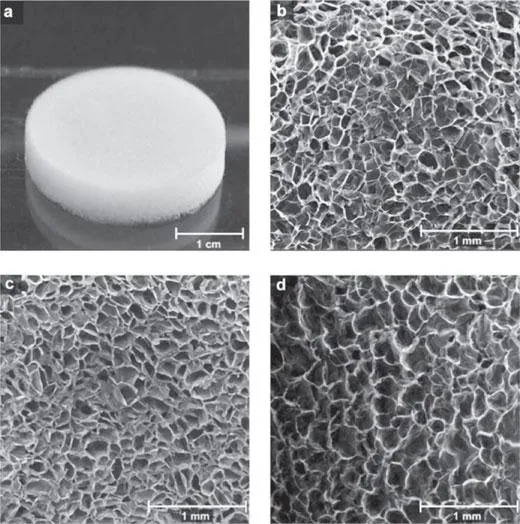
Catanzano et al., developed alginate-hyaluronan composite for the delivery of tranexamic acid for the dressing of post-extractive alveolar wounds. The formulation was developed by the reaction of macroporous alginate and hyaluronan (10% and 20%) embedded with tranexamic acid. The formulation was characterized by morphology, porosity, in vitro drug release and in vitro dynamic whole blood clotting parameters (Figure 1.2). The outcomes revealed that (300–500) µm particle size diameter with interconnected pores, fastest drug release, and blood-clotting index was 40% as compared to negative control. These data clearly stated the importance of alginate-hyaluronan sponge on the post-extractive alveolar wounds (Catanzano et al., 2017).
FIGURE 1.2 Image of an ALG/HA20 sponge after freeze-drying (scale bar 1/4 1 cm) (a). SEM images of ALG (b), ALG/HA10 (c), and ALG/HA20 (d) (scale bar 1/4 1 mm).
6. Pharmaceutical Application of Chitosan Derivatives
7. Pharmaceutical Applications of Xanthan Gum
Index
Trusted by 375,005 students
Access to over 1.5 million titles for a fair monthly price.
Study more efficiently using our study tools.
Frequently asked questions
Yes, you can cancel anytime from the Subscription tab in your account settings on the Perlego website. Your subscription will stay active until the end of your current billing period. Learn how to cancel your subscription
No, books cannot be downloaded as external files, such as PDFs, for use outside of Perlego. However, you can download books within the Perlego app for offline reading on mobile or tablet. Learn how to download books offline
Perlego offers two plans: Essential and Complete
Essential is ideal for learners and professionals who enjoy exploring a wide range of subjects. Access the Essential Library with 800,000+ trusted titles and best-sellers across business, personal growth, and the humanities. Includes unlimited reading time and Standard Read Aloud voice.
Complete: Perfect for advanced learners and researchers needing full, unrestricted access. Unlock 1.5M+ books across hundreds of subjects, including academic and specialized titles. The Complete Plan also includes advanced features like Premium Read Aloud and Research Assistant.
Both plans are available with monthly, semester, or annual billing cycles.
We are an online textbook subscription service, where you can get access to an entire online library for less than the price of a single book per month. With over 1.5 million books across 990+ topics, we’ve got you covered! Learn about our mission
Look out for the read-aloud symbol on your next book to see if you can listen to it. The read-aloud tool reads text aloud for you, highlighting the text as it is being read. You can pause it, speed it up and slow it down. Learn more about Read Aloud
Yes! You can use the Perlego app on both iOS and Android devices to read anytime, anywhere — even offline. Perfect for commutes or when you’re on the go. Please note we cannot support devices running on iOS 13 and Android 7 or earlier. Learn more about using the app
Yes, you can access Natural Polymers for Pharmaceutical Applications by Amit Kumar Nayak, Md Saquib Hasnain, Dilipkumar Pal, Amit Kumar Nayak,Md Saquib Hasnain,Dilipkumar Pal in PDF and/or ePUB format, as well as other popular books in Business & Industria farmaceutica, biotecnologica e sanitaria. We have over 1.5 million books available in our catalogue for you to explore.