eBook - ePub
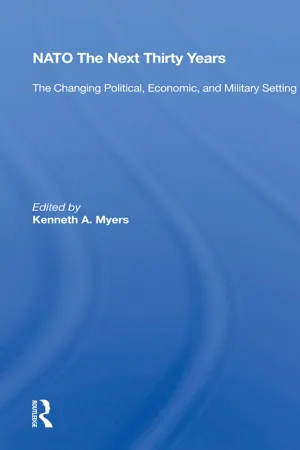
Nato--the Next Thirty Years
The Changing Political, Economic, And Military Setting
- 494 pages
- English
- ePUB (mobile friendly)
- Available on iOS & Android
eBook - ePub
About this book
The survival of NATO as a viable alliance is currently challenged by a shift in the strategic balance of power, as well as by global events and contingencies that extend far beyond NATO's boundaries. In the face of these challenges, existing institutional mechanisms are proving inadequate to respond effectively. The distinguished contributors to this volume draw on their vast political and diplomatic experience to identify and analyze the problems confronting NATO for the remainder of the twentieth century. They make clear the need for a trans-Atlantic communication network among policymakers, scholars, and others-a network that will allow an ongoing process of analysis and assessment of NATO's strategic, economic, and political problems, along with the identification of appropriate reactions.
Trusted by 375,005 students
Access to over 1.5 million titles for a fair monthly price.
Study more efficiently using our study tools.
Information
Part 1
The Future of NATO
1
The Future of NATO
Henry A. Kissinger
Since the early 1960s, every new American administration that has come into office promises a new look at Europe, a reappraisal and a reassessment. Each of these efforts has found us more or less confirming what already existed and what had been created in the late 1940s and early 1950s, with just enough alliance adaptation to please the endlessly restless Americans who can never restrain themselves from new attempts at architecture.
Without going into which of these proposals were right, or if any of these specific proposals were necessary, I think the fact that in the late 1970s we are operating an alliance machinery and a force structure under a concept more or less unchanged from the 1950s should indicate that we have been depleting capital. Living off capital may be a pleasant prospect for a substantial period of time, but inevitably a point will be reached where reality dominates. And my proposition to this group is that NATO is reaching a point where the strategic assumptions on which it has been operating, the force structures that it has been generating, and the joint policies it has been developing, will be inadequate for the 1980s.
I have said in the United States, in my SALT testimony, that if present trends continue, the 1980s will be a period of massive crisis for all of us. We have reached this point not through the mistakes of any single administration. Just as the commitment to NATO is a bipartisan American effort, the dilemmas that I would like to put before this group—admittedly in a perhaps exaggerated form—have been growing up over an extended period, partly as the result of American perceptions, partly as a result of European perceptions.
Nor is this to deny that NATO, by all of the standards of traditional alliances, has been an enormous success. To maintain an alliance in peacetime without conflict for a generation is extremely rare in history. And it is inherent in a process in which an alliance has been successful, in which deterrence has worked, that no one will be able to prove why it has worked. Was it because we conducted the correct policy? Was it because the Soviet Union never had any intention to attack us in the first place? Was it because of the policies of strength of some countries, or the policies of accommodation of other countries? So, what I say should not be taken as a criticism either of any particular American administration (even granting that there was one period of eight years in the past in which no mistakes were made) nor of any specific policies of European nations, but rather as an assessment of where we are today.
The Global Environment
Let me first turn to the strategic situation. The dominant fact of the current military balance is that the NATO countries are falling behind in every significant military category, with the possible exception of naval forces where the gap in our favor is closing. Never in history has it happened that a nation achieved superiority in ail significant weapons categories without seeking to translate it at some point into some foreign policy benefit. It is, therefore, almost irrelevant to debate whether there is some magic date at which Soviet armies will head in some direction or another. I am willing to grant that there is no particular master plan nor is there any specific deadline; I do not even consider that the present Soviet leaders are superadventurous. That is fundamentally irrelevant.
In a world of upheaval and rapid changes, enough opportunities will arise in which the relative capacity and the relative willingness of the two sides to understand their interests and to defend their interests will be the key element. I do not believe the Soviet Union planned Angola, or created the conditions for intervention in Ethiopia, or necessarily had a deadline for the revolution in Afghanistan. But all of these events happened to the detriment of general stability. I would consider it a rash Western policy that did not take into account that in the decade ahead we will face simultaneously an unfavorable balance of power, a world in turmoil, a potential economic crisis, and a massive energy problem. To conduct business as usual is to entrust one's destiny to the will of others and to the self-restraint of those whose ideology highlights the crucial role of the objective balance of forces.
This is my fundamental theme. And I would now like to discuss this in relation to specific issues.
The Shifting Strategic Balance
First, at the risk of repeating myself, let me state once again what I take to be the fundamental change in the strategic situation as far as the United States is concerned, and then examine the implications for NATO.
When the North Atlantic Treaty Organization was created, the United States possessed an overwhelming strategic nuclear superiority. That is to say, for a long period of time we were likely to prevail in a nuclear war, certainly if we struck first and for a decade perhaps even if we struck second; we were in a position to wipe out the Soviet strategic forces and to reduce any possible counterblow against us to an acceptable level. And that situation must have looked more ominous to the Soviet Union even than it looked favorable to us.
If we think back to the Cuban Missile Crisis of 1962, which all the policymakers of the time were viewing with a consciousness of an approaching Armageddon, one is almost seized with nostalgia for the ease of their decisions. At that time the Soviet Union had about 70 long-range missiles that took 10 hours to fuel, which was a longer period of time than it would take our airplanes to get to the Soviet Union from forward bases. Even at the time of the Middle East crisis of 1973 (the alert), we had a superiority of about eight to one in missile warheads. If one compares this with the current and foreseeable situation, we are approaching a point where it is difficult to assign a clear military objective to American strategic forces in a strategic nuclear exchange.
In the 1950s and for much of the 1960s, NATO was protected by a preponderance in American strategic striking power which was capable of disarming the Soviet Union, and by a vast American superiority in theatre nuclear forces although, as I will discuss, we never had a comprehensive theory for using theatre nuclear forces. Since all intelligence services congenially overestimate the rationality of the decision-making process which they are analyzing, it is probable that the Soviet Union made more sense out of our nuclear deployment in Europe than we were able to make ourselves. In any event, it was numerically superior. And it was in that strategic framework that the allied ground forces on the continent were deployed.
No one disputes any longer that in the 1980s—and perhaps even today, but surely in the 1980s—the United States will no longer be in a strategic position to reduce a Soviet counterblow against the United States to tolerable levels, indeed, one can argue that the United States will not be in a position in which attacking the Soviet strategic forces makes any military sense, because it may represent a marginal expenditure of our own strategic striking force that does not help greatly to ensure the safety of our forces.
Since the middle 1960s the growth of the Soviet strategic force has been massive. It grew from 220 intercontinental ballistic missiles in 1965 to 1,600 around 1972-1973. Soviet submarine-launched missiles grew from negligible numbers to over 900 in the 1970s. And the amazing phenomenon which historians will ponder is that all of this has happened without the United States attempting to make a significant effort to rectify that state of affairs. One reason was that it was not easy to rectify. But another reason was the growth of a school of thought to which I myself contributed, and many around this conference table also contributed, which considered that strategic stability was a military asset, and in which the historically amazing theory developed that vulnerability contributed to peace and invulnerability contributed to risks of war.
Such a theory could develop and be widely accepted only in a country that had never addressed the problem of the balance of power as a historical phenomenon. And, if I may say so, only also on a continent that was looking for any excuse to avoid analysis of the perils it was facing and that was looking for an easy way out. When the administration with which I was connected sought to implement an antiballistic missile program inherited from our predecessors, it became the subject of the most violent attacks from those who held the theory that it was destabilizing, provocative, and an obstacle to arms control; initially the ABM could be sold only as a protection against the Chinese and not against the Soviet threat. In any case, the ABM was systematically reduced by the Congress in every succeeding session to the point where we wound up with a curious coalition of the Pentagon and the arms controllers, both finally opposed to it: the Pentagon because it no longer made any military sense to put resources into a program that was being systematically deprived of military utility, and the arms control community because they saw in the strategic vulnerability of the United States a positive asset. It cannot have occurred often in history that it was considered an advantageous military doctrine to make your own country deliberately vulnerable.
Now we have reached that situation so devoutly worked for by the arms control community: we are indeed vulnerable. Moreover our weapons had been deliberately designed, starting in the 1960s, so as to not threaten the weapons of the other side. Under the doctrine of "assured destruction," nuclear war became not a military problem but one of engineering; it depended on theoretical calculations of the amount of economic and industrial damage that one needed to inflict on the other side; it was therefore essentially independent of the forces the other side was creating.
This general theory suffered two drawbacks. One was that the Soviets did not believe it. And the other is that we have not yet bred a race of supermen that can implement it. While we are building "assured destruction" capabilities, the Soviet Union was building forces for traditional military missions capable of destroying the military forces of the United States. So in the 1980s we will be in a position where (1) many of our own strategic forces, including all of our land-based ICBMs, will be vulnerable, and (2) such an insignificant percentage of Soviet strategic forces will be vulnerable as not to represent a meaningful strategic attack option for the United States. Whether that means that the Soviet Union intends to attack the United States or not is certainly not my point. I am making two points: First, that the change in the strategic situation that is produced by our limited vulnerability is more fundamental for the United States than even total vulnerability would be for the Soviet Union because our strategic doctrine has relied extraordinarily, perhaps exclusively, on our superior strategic power. The Soviet Union has never relied on its superior strategic power. It has always depended more on its local and regional superiority. Therefore, even an equivalence in destructive power, even "assured destruction" for both sides, is a revolution in the strategic balance as we have known it. It is a fact that must be faced.
I have recently urged that the United States build a counterforce capability of its own for two reasons. One, the answer of our NATO friends to the situation that I have described has invariably been to demand additional reassurances of an undiminished American military commitment. And I have sat around the NATO Council table in Brussels and elsewhere and have uttered the magic words which had a profoundly reassuring effect, and which permitted the ministers to return home with a rationale for not increasing defense expenditures. And my successors have uttered the same reassurances. And yet if my analysis is correct, these words cannot be true indefinitely; and if my analysis is correct we must face the fact that it is absurd in the 1980s to base the strategy of the West on the credibility of the threat of mutual suicide.
One cannot ask a nation to design forces that have no military significance, whose primary purpose is the extermination of civilians, and expect that these factors will not affect a nation's resoluteness in crisis. We live in the paradoxical world that it is precisely the liberal, human, progressive community that is advocating the most bloodthirsty strategies and insisting that there is nothing to worry about as long as the capacity exists to kill 100 million people. It is this approach that argues that we should not be concerned about the vulnerability of our missile forces, when, after all, we can always launch them on warning of an attack. Any military man at this conference will tell you that launching strategic forces on warning can be accomplished only by delegating the authority to the proverbially "insane colonel" about whom so many movies have been made. Nobody who knows anything about how our government operates will believe that it is possible for our presidents to get the secretary of state, secretary of defense, chairman of the Joint Chiefs of Staff, and director of the CIA to a conference called in the 15 minutes that may be available to make a decision, much less issue an order that then travels down the line of command in the 15 minutes. So the only way you can implement that strategy is by delegating the authority down to some field commander who must be given discretion so that when he thinks a nuclear war has started, he can retaliate. Is that the world we want to live in? Is that where "assured destruction" will finally take us?
And therefore I would say—what I might not say in office — that our European allies should not keep asking us to multiply strategic assurances that we cannot possibly mean or if we do mean, we should not want to execute because if we execute, we risk the destruction of civilization. Our strategic dilemma is not solved by verbal reassurances; it requires redesigning our forces and doctrine. There is no point in complaining about declining American will, or criticising this or that American administration, for we are facing an objective crisis and it must be remedied.
Theatre Nuclear Forces
The second part of this problem is the imbalance that has grown up in theatre nuclear forces. In the 1950s and 1960s we put several thousand nuclear weapons into Europe. To be sure, we had no very precise idea of what to do with them, but I am sure that Soviet intelligence figured out some purpose for these forces; and in any event it was a matter for their disquiet. Now one reason we did not have a rational analysis for the use of these forces was the very reason that led to the strategic theory of "assured destruction." Let us face it: the intellectually predominant position in the United States was that we had to retain full control of the conduct of nuclear war and we therefore had a vested interest in avoiding any "firebreak" between tactical nuclear weapons and strategic nuclear weapons. The very reasoning that operated against setting a rational purpose for strategic forces also operated against giving a military role to tactical nuclear forces. And this was compounded by the fact that —to be tactless—the secret dream of every European was, of course, to avoid a nuclear war but, secondly, if there had to be a nuclear war, to have it conducted over their heads by the strategic forces of the United States and the Soviet Union. Be that as it may, the fact is that the strategic imbaiance that I have predicted for the 1980s will also be accompanied by a theatre imbalance in the 1980s. How is it possible to survive with these imbalances in the face of the already demonstrated inferiority in conventional forces?
If there is no theatre nuclear establishment on the continent of Europe, we are writing the script for selective blackmail in which our allies will be threatened, and in which we will be forced into a decision whereby we can respond only with a strategy that has no military purpose but only the aim of destruction of populations.
I ask any of you around this conference table: If you were secretary of state or security adviser, what would you recommend to the president of the United States to do in such circumstances? How would he improve his relative military position? Of course he could threaten a full-scale strategic response, but is it a realistic course? It is senseless to say that dilemma shows that Americans are weak and irresolute. This is not the problem of any particular administration, but it is a problem of the doctrine that has developed.
Therefore, I believe that it is urgently necessary either that the Soviets be deprived of their counterforce capability in strategic forces, or that a U.S. counterforce capability in strategic forces be rapidly built. It is also necessary that either the Soviet nuclear threat in theatre nuclear forces against Europe be eliminated (which I do not see is possible), or that an immediate effort be made to build up our theatre nuclear forces. Just as I believe it is necessary that we develop a military purpose for our strategic forces and move away from the senseless and demoralizing strategy of massive civilian extermination, so it is imperative that we finally try to develop some credible military purposes for the tactical and theatre nuclear forces that we are building.
The Role of Ground Forces
And third, it is time that we decide what role exactly we want for our ground forces on the continent. These forces were deployed in the 1950s when American strategic superiority was so great that we could defend Europe by the threat of general nuclear war. And they were deployed in Europe, as I have often said, as a means of ensuring the automaticity of our response. Our forces were in Europe as hostages. Everybody had a vested interest in not making the forces too large. We wound up with the paradox that they were much too large for what was needed for a tripwire yet not large enough for a sustained conventional defense. I tried for the years that I was in office to get some assessment of just what was meant by the 90-day stockpile that we were supposed to have, and what the minimum critical categories were. I know that my friend whom I admire enormously, General Alexander Haig, has done enormous work in improving the situation; nevertheless I would be amazed if even he believed that we can now say that our ground forces by themselves can offer a sustained defense without massive, rapid improvements.
The Political Context
Everything that I have said about the military situation would be difficult enough to remedy, but the situation is compounded by theories to which, again, I myself have no doubt contributed. In 1968, at Reykjavik, NATO developed the theory—which I believe is totally wrong — that the alliance is as much an instrument of detente as it is of defense. I think that that is simply not correct. NATO is not equipped to be an instrument of detente; for example, every time we attempted to designate the secretary general of NATO as a negotiating partner with the Warsaw Pact, it was rejected. But this is a minor problem, and detente is important. It is important because, as the United States learned during Vietnam, in a democracy you cannot sustain the risk of war unless your public is convinced that you are committed to peace. Detente is important because we cannot hold the alliance together unless our allies are convinced that we are not seeking confrontation for its own sake. Detente is important because I can...
Table of contents
- Cover
- Half Title
- Title
- Copyright
- Contents
- Figures and Tables
- Preface
- Contributors
- Acronyms
- Part 1 The Future of NATO
- Part 2 Strategic and Military Problems of the Alliance
- Part 3 Political and Economic Problems of the Alliance
- Part 4 Organizational and Leadership Problems of the Alliance
- Index
Frequently asked questions
Yes, you can cancel anytime from the Subscription tab in your account settings on the Perlego website. Your subscription will stay active until the end of your current billing period. Learn how to cancel your subscription
No, books cannot be downloaded as external files, such as PDFs, for use outside of Perlego. However, you can download books within the Perlego app for offline reading on mobile or tablet. Learn how to download books offline
Perlego offers two plans: Essential and Complete
- Essential is ideal for learners and professionals who enjoy exploring a wide range of subjects. Access the Essential Library with 800,000+ trusted titles and best-sellers across business, personal growth, and the humanities. Includes unlimited reading time and Standard Read Aloud voice.
- Complete: Perfect for advanced learners and researchers needing full, unrestricted access. Unlock 1.5M+ books across hundreds of subjects, including academic and specialized titles. The Complete Plan also includes advanced features like Premium Read Aloud and Research Assistant.
We are an online textbook subscription service, where you can get access to an entire online library for less than the price of a single book per month. With over 1.5 million books across 990+ topics, we’ve got you covered! Learn about our mission
Look out for the read-aloud symbol on your next book to see if you can listen to it. The read-aloud tool reads text aloud for you, highlighting the text as it is being read. You can pause it, speed it up and slow it down. Learn more about Read Aloud
Yes! You can use the Perlego app on both iOS and Android devices to read anytime, anywhere — even offline. Perfect for commutes or when you’re on the go.
Please note we cannot support devices running on iOS 13 and Android 7 or earlier. Learn more about using the app
Please note we cannot support devices running on iOS 13 and Android 7 or earlier. Learn more about using the app
Yes, you can access Nato--the Next Thirty Years by Kenneth A. Myers in PDF and/or ePUB format, as well as other popular books in Politics & International Relations & Politics. We have over 1.5 million books available in our catalogue for you to explore.