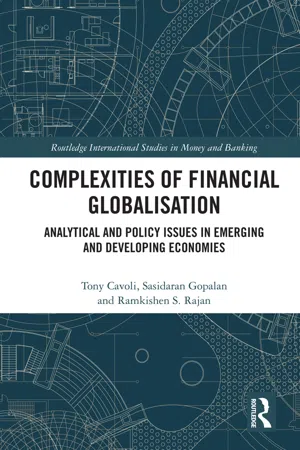
Complexities of Financial Globalisation
eBook - ePub

Complexities of Financial Globalisation

Analytical and Policy Issues in Emerging and Developing Economies

  1. 308 pages
  2. English
  3. ePUB (mobile friendly)
  4. Available on iOS & Android
eBook - ePub

Complexities of Financial Globalisation

Analytical and Policy Issues in Emerging and Developing Economies

About this book

Since the 1990s, several emerging market and developing economies (EMDEs) have, to varying degrees, embraced the process of financial globalisation, broadly defined as a set of policies that involve allowing for greater openness to cross-border capital flows as well as greater market access to foreign financial institutions. This book provides a systematic empirical analysis on the complex interactions between financial sector development, macroeconomic and financial stability in EMDEs in general and those in the Asian region in particular.

The book consists of three sections pertaining to monetary and exchange rate policies under financial globalisation; financial inclusion and macroeconomic policies in the context of financial liberalisation; and finally, the dynamics of foreign direct investment flows and their real impacts in EMDEs. Each of the chapters analyse important economic policy issues of contemporary relevance and is informed by data and rigorous empirical analysis.

The book will be appealing to anyone interested in exploring the implications of a key set of issues emanating from financial globalisation on EMDEs in a rigorous but readable manner.

Trusted by 375,005 students

Access to over 1.5 million titles for a fair monthly price.

Study more efficiently using our study tools.

Information

Publisher
Routledge
Year
2020
Print ISBN
9780367421748
eBook ISBN
9781000067477
Subtopic
Finance

Part I
Monetary and exchange rate policies

1 How have exchange rate policies evolved in an era of financial globalisation?1

1.1 Introduction

Despite registering rapid growth rates over the last 15 years, several emerging market and developing economies (EMDEs) across the world still find themselves highly vulnerable to the cycle of sustained capital inflows and their sharp reversals. These ebbs and flows of capital have complicated macroeconomic policy management for all EMDEs regardless of whether they have adopted flexible or managed exchange rate regimes.
The well-known “impossible trinity” states that countries can only pursue two of three policy objectives completely – capital controls, fixed exchange rates or monetary policy autonomy. This implies that should policymakers opt not to restrain capital movements despite high and volatile capital flows, the policy choice becomes one where authorities have to decide between opting for exchange rate flexibility and monetary policy autonomy.
However, there are questions about whether monetary policy autonomy does in fact exist to any reasonable extent due to pervasive factors such as global liquidity and risk spillovers. Specifically, Rey (2013) proclaimed that in the era of financial globalisation a country with an open capital account would remain highly susceptible to the global financial cycle, independent of the exchange rate regime. She has highlighted the role of the VIX (the Chicago Board Options Exchange Market Volatility Index which is used as a measure of uncertainty and market risk aversion) and the US Fed funds rate in impacting global capital flows, bank leverage and asset prices which have a strong common component (i.e. they are highly correlated across countries). According to this thesis, the global financial cycle could explain how EMDEs have imported the ultra-loose monetary conditions in the US and were faced with a huge run-up in credit and asset prices regardless of the exchange rate regime. In other words, exchange rate flexibility has not offered much benefit by way of greater interest rate policy autonomy as suggested by received wisdom. Based on this line of reasoning, the global financial cycle has transformed the trilemma into a “dilemma” in the sense that the only way a peripheral country can hope to maintain independent interest rate policy is by compromising its capital account openness.2
This presents a possible incentive to manage exchange rates as, under th...

Table of contents

  1. Cover
  2. Half Title
  3. Series
  4. Title
  5. Copyright
  6. Dedication
  7. Contents
  8. List of figures
  9. List of tables
  10. List of contributors
  11. Preface
  12. Acknowledgements
  13. Part I Monetary and exchange rate policies
  14. Part II Financial inclusion and macroeconomic policies
  15. Part III Foreign direct investment flows and real impacts
  16. Subject Index

Frequently asked questions

Yes, you can cancel anytime from the Subscription tab in your account settings on the Perlego website. Your subscription will stay active until the end of your current billing period. Learn how to cancel your subscription
No, books cannot be downloaded as external files, such as PDFs, for use outside of Perlego. However, you can download books within the Perlego app for offline reading on mobile or tablet. Learn how to download books offline
Perlego offers two plans: Essential and Complete
  • Essential is ideal for learners and professionals who enjoy exploring a wide range of subjects. Access the Essential Library with 800,000+ trusted titles and best-sellers across business, personal growth, and the humanities. Includes unlimited reading time and Standard Read Aloud voice.
  • Complete: Perfect for advanced learners and researchers needing full, unrestricted access. Unlock 1.5M+ books across hundreds of subjects, including academic and specialized titles. The Complete Plan also includes advanced features like Premium Read Aloud and Research Assistant.
Both plans are available with monthly, semester, or annual billing cycles.
We are an online textbook subscription service, where you can get access to an entire online library for less than the price of a single book per month. With over 1.5 million books across 990+ topics, we’ve got you covered! Learn about our mission
Look out for the read-aloud symbol on your next book to see if you can listen to it. The read-aloud tool reads text aloud for you, highlighting the text as it is being read. You can pause it, speed it up and slow it down. Learn more about Read Aloud
Yes! You can use the Perlego app on both iOS and Android devices to read anytime, anywhere — even offline. Perfect for commutes or when you’re on the go.
Please note we cannot support devices running on iOS 13 and Android 7 or earlier. Learn more about using the app
Yes, you can access Complexities of Financial Globalisation by Tony Cavoli,Sasidaran Gopalan,Ramkishen S. Rajan in PDF and/or ePUB format, as well as other popular books in Business & Finance. We have over 1.5 million books available in our catalogue for you to explore.