- 544 pages
- English
- ePUB (mobile friendly)
- Available on iOS & Android
eBook - ePub
About this book
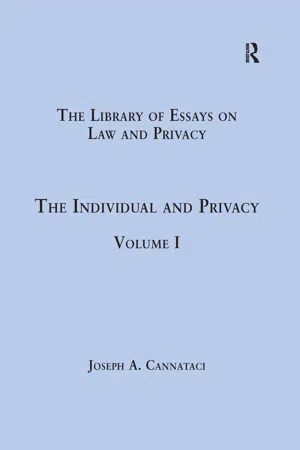
The essays selected for this volume reflect the many paths followed to develop a new, more robust methodology (idMAPPING) for investigating privacy. Each article deals with the three dimensions of time, space and place by addressing a number of questions such as: who? Which individual? When? How? Is privacy viewed from the perspective of legal theory, or of information science? Or from the viewpoint of sociology, social psychology, philosophy, information ethics or data protection law? The reader is offered a multi-disciplinary overview of the subject, a mosaic made up of several snapshots taken at different times by different scholars with different points of view. The detailed introduction increases clarity in parts of the picture where the way that the pieces fit together may not be immediately apparent, and concludes by challenging internet-era fallacies. Taken together, the articles demonstrate an innovative approach to evidence-based policy-making, and show privacy scholarship at its best.
PART I
The Time Dimension: Perspectives from History and Anthropology through Philosophy to Religion and Technology Law
[1]
Privacy in Eighteenth-Century Aleppo: the Limits of Cultural Ideals
On the night of May 26, 1762, several residents of the Syrian city of Aleppo entered a house in their neighborhood uninvited. The owners were not in, but several unveiled women sitting in male company were there to greet them. If the scene proved less compromising than the intruders expected, it did confirm their suspicion that the house was a meeting place for illicit relations. The following day they turned in the owners, a man and his mother, to the court and secured the qadi’s consent to have them expelled from the neighborhood.
Some six years earlier, a local woman brought before the judge a concern of a different sort. Her four-year-old daughter had accidentally fallen off a stairwell, landed on one of her wooden clogs, and lost her virginity. The anxious mother wanted an official document certifying the facts of the incident, and had a group of neighbors ready on hand to confirm the story from hearsay.
A week before this incident another local man came to the court to notarize the purchase of a dwelling. What he acquired was a segment of a courtyard house that gave him two rooms to himself and his family: the yard, main entranceway, and indoor amenities he had to share with the other occupants.
These events were not related, nor were they of memorable importance in Aleppo’s history. Were it not for the recording of daily business by the city’s Islamic law (sharica) court they would surely have gone unchronicled.1 Yet, judging from the multitude of similar cases scattered through the court’s books, occurrences of this sort were hardly unusual in the eighteenth century. What renders them noteworthy are the questions they raise about the meaning of privacy in this society. How important could domestic and personal privacy have been if private citizens could invade their neighbors’ homes with impunity, if numerous people shared dwellings with other households, if parents deliberately involved the public in the delicate details of their daughters’ virginity, and if women flouted the taboos by baring themselves and entering into compromising contact with men?
These questions have particular pertinence in the case of a Middle Eastern community bound by the norms of Islamic law and culture. Muslim societies enjoy a reputation for attitudes and conduct exceptionally protective of privacy. The strict dress code, the high walls and the enclosed courtyards of houses, the abundance of cul-de-sacs and neighborhood gates are often taken as expressions of this sensitivity. So, too, are the elaborate restrictions on relations between the sexes, which set up, particularly around women, private spheres immune from public observation and unlicensed contact. If Aleppo was one such privacy–conscious society how do we account for the incompatible evidence in its judicial records?
The contradiction is more apparent than real; we are looking at different aspects of a phenomenon that has not really been studied carefully in any pre-modern Middle Eastern community. Privacy describes the state of limited access to the person, attitudes, and experiences of an individual; it is expressed in a variety of possible restrictions, affecting access to personal information as well as observation, intrusion, and physical exposure. The practices and norms of Aleppo’s townspeople in these different areas suggest that flat statements about their preoccupation with privacy need correction in two basic respects.
First, there were forms of privacy, primarily those involving personal information, which people simply did not value. Residents pried on their neighbors and expelled them from their midst as part of a legally sanctioned system of social control, and people readily made public all sorts of personal and familial information. The familiar Islamic norms touching directly on the protection of body, home, and women formed only one component in their conception of privacy. Alongside them was a whole range of attitudes and ideals linked with that world’s notions of morality and decency, social distance and intimacy, personal autonomy and individualism, authority and community. Not all of them were supportive of privacy. Second, the prized forms of privacy were not necessarily attained or protected in practice. Poverty, for one, forced upon many individuals compromising domestic conditions; offensive violations widened further the gap between ideals and realities. How much privacy people actually enjoyed was not determined solely by their aspirations and norms. A whole set of variable factors—domestic living arrangements, neighborhood and group life, the level of government intrusiveness, population densities, communications technology, social structure, the distribution of wealth—affected the actual access to privacy and its distribution in the population.
The distinction between the cultural conceptions of privacy and its actual manifestations in social situations is an important one to bear in mind. It points to two conceptual levels at which the subject may be approached, each calling for a particular mode of inquiry guided by distinct concerns. From a historical perspective, however, both aspects form part of the same reality, and tend to illuminate that reality best when seen in their interplay rather than separately. The relationship between them reveals not only the discrepancies between ideals and actual conditions but also the forces which shaped realities and attitudes. Such is the approach which guides this study of privacy in eighteenth-century Aleppo. Its first two parts describe what was desirable and accessible in the areas of physical privacy and privacy of information. On the basis of evidence from the middle decades of the century they piece together the practices and attitudes of the townspeople in a variety of social contexts. The final part presents an interpretative analysis of the multitude of observed experiences. It attempts to make sense of the norms, realities, and dynamics of privacy by fitting the story into the larger processes of Aleppo’s society.
As a historical theme privacy poses some particular difficulties. The phenomenon itself is of unusual conceptual complexity, as the growing literature on the subject illustrates.2 Its pursuit in the vanished world of eighteenth-century Aleppo encounters problems of inadequate evidence, impenetrable intimate worlds of thought and behavior, questionable assumptions about Islam and Middle Eastern society, and intricate causal relationships between culture and social conditions. The larger context must be invoked constantly to render observations more intelligible; privacy is the story not of one idea, institution, or social group but of a phenomenon inseparable from the cultural vision and social processes of the community at large.
Because of the broader linkages of privacy, however, the questions of methodology and interpretation raised in the study acquire some wider historical relevance. They point to useful avenues for the explanation of behavior and change in Middle Eastern society. In this respect Aleppo makes a good case for study. A major metropolis of some 120,000 people, the administrative capital of an Ottoman province, a renowned center of trade and industry, and a seat of culture, learning, and luxury, it was of course hardly representative of all regional communities. But precisely because of the elaborate and dynamic character of its society the city can conveniently display the effects of many factors on local conditions. Its highly differentiated population, which included a large body of non-Muslims (some 20,000 Christians and 4,000 Jews), lived in a world where sharp contrasts of lifestyle and personal circumstances were common, and the vagaries of nature, the marketplace, and human pursuits governed daily existence.
PHYSICAL PRIVACY
During the eighteenth century Aleppo experienced much upheaval. Violent factional strife, bitter religious disputes, economic crises, and a succession of frightful famines and plagues left few people unaffected. Privacy, however, was not among the burning public issues of the day. For all its turmoil the period produced no new values and expectations in this area. The people who appeared in court to assert violated rights and the moralists who urged the public to observe hallowed standards essentially reaffirmed a set of traditional attitudes and norms. Interestingly enough, they never invoked privacy as their guiding value. Their Arabic language had no specific term to denote the concept, nor did their legal system recognize an overarching ideal of privacy with a validity in its own right. Their norms were actually derivatives of more specific cultural preferences; they argued and enforced them in the name of modesty, sexual morality, civility, respect, honor, and other prized values.
When speaking of privacy in this society we are therefore describing a cluster of attitudes and norms which the local mind did not unite in a single conceptual construct of the sort familiar to the modern observer. As expressions of diverse ideals these norms tended to attract varying levels of public concern. Indeed, a basic asymmetry underlies them, one which mirrors the moral priorities of the culture. Their overwhelming thrust was the protection of physical privacy; the privacy of personal information, at the center of modern concern and legislation, ranked as a matter of secondary interest.
The particular weight attached to questions of bodily and domestic privacy derived primarily from the fact that they were inseparably linked with the community’s fundamental position on modesty and sexual morality. And that position was itself a central ingredient in a well-defined vision of what the moral, orderly, and God-fearing society ought to be. It was in this area, not in matters touching on privacy of information, that Islamic law and doctrine defined explicit norms and brought their full weight to bear on their enforcement. This legal- religious backing was aimed not simply at protecting the rights and immunities of individuals. In contrast with the obsessive harping on individualism, freedom, and personal autonomy in modern thought, the stress here was very much on the fulfillment of social obligations and mandatory practices necessary to guarantee the moral fabric of society as a whole.
In addition to being strict, the standards involved heavy reliance on external physical mechanisms of protection and particularly rigid restrictions on women. Inherited from a long line of past generations, they were quite familiar to the townspeople and encountered no organized challenge or public protest. Nevertheless they had to be upheld and enforced continually. A measure of laxity and violation was normal, inviting intervention by the religious and civil authorities. This process served ultimately to reaffirm the values.
The norms of modesty required that people maintain their body and limbs covered all year round. Even in the public bath houses, which almost the entire population visited regularly, one was expected to remain robed while in the company of others. Muslim women were even required to bathe separately from Christian and Jewish women. A qadi who affirmed these arrangements in 1762 invoked the opinions of distinguished jurists to prove that for a Muslim woman to expose herself before a non-Muslim female was as sinful as baring herself before a man.3 Islamic law prohibited the forcible exposure of the body of others or its violation by assault or sexual molestation. Sexual and excretory acts were also regarded as strictly private. Most of the houses in the city were provided with indoor privies, and the public latrines consisted of individual booths with doors.
In practice, the level of public conformity to the rules never satisfied the moralists. They were particularly exercised by behavior in the baths, where an attitude too relaxed for their liking prevailed. In 1768 the judge reprimanded the operators of the city’s bath houses for providing their customers with towels and robes too small to give proper bodily cover. The issue had come up just six years earlier, when the operators pledged solemnly to supply larger robes. Arrangements to ensure separate use of the baths by women of different religious affiliation also had to be reinforced periodically.4 Th...
Table of contents
- Cover Page
- Title Page
- Copyright Page
- Table of Contents
- Acknowledgements
- Series Preface
- Introduction
- PART I The Time Dimension: Perspectives from History and Anthropology through Philosophy to Religion and Technology Law
- PART II The Space Dimensions in Privacy Perspectives and Methodologies: From Early Days in Sociology through Social Psychology to the Socio-Legal Approach and the Cognitive Sciences in the Twenty-First Century
- PART III The Cultural Dimension: Conceptualizations of Privacy and Personality around the World
- Name Index
Trusted by 375,005 students
Access to over 1.5 million titles for a fair monthly price.
Study more efficiently using our study tools.
Frequently asked questions
Yes, you can cancel anytime from the Subscription tab in your account settings on the Perlego website. Your subscription will stay active until the end of your current billing period. Learn how to cancel your subscription
No, books cannot be downloaded as external files, such as PDFs, for use outside of Perlego. However, you can download books within the Perlego app for offline reading on mobile or tablet. Learn how to download books offline
Perlego offers two plans: Essential and Complete
- Essential is ideal for learners and professionals who enjoy exploring a wide range of subjects. Access the Essential Library with 800,000+ trusted titles and best-sellers across business, personal growth, and the humanities. Includes unlimited reading time and Standard Read Aloud voice.
- Complete: Perfect for advanced learners and researchers needing full, unrestricted access. Unlock 1.5M+ books across hundreds of subjects, including academic and specialized titles. The Complete Plan also includes advanced features like Premium Read Aloud and Research Assistant.
We are an online textbook subscription service, where you can get access to an entire online library for less than the price of a single book per month. With over 1.5 million books across 990+ topics, we’ve got you covered! Learn about our mission
Look out for the read-aloud symbol on your next book to see if you can listen to it. The read-aloud tool reads text aloud for you, highlighting the text as it is being read. You can pause it, speed it up and slow it down. Learn more about Read Aloud
Yes! You can use the Perlego app on both iOS and Android devices to read anytime, anywhere — even offline. Perfect for commutes or when you’re on the go.
Please note we cannot support devices running on iOS 13 and Android 7 or earlier. Learn more about using the app
Please note we cannot support devices running on iOS 13 and Android 7 or earlier. Learn more about using the app
Yes, you can access The Individual and Privacy by Joseph A. Cannataci in PDF and/or ePUB format, as well as other popular books in Law & Public Law. We have over 1.5 million books available in our catalogue for you to explore.