1.1Overview of Fossil Fuels
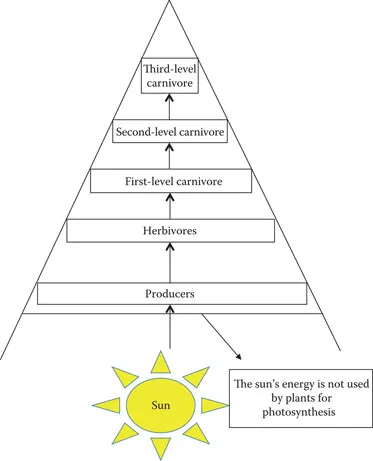
The sun is the supreme source of energy for all planets including earth. Earth receives the sun energy in the form of electromagnetic radiation. A producer converts sun energy into bioenergy by the photosynthesis process, which is a biological process transforming sunlight with carbon dioxide taken from the atmosphere and water in plant cells into energy stored in the plant cell. A plant converts solar energy into biomass with carbon dioxide and water, as shown in Equation 1.1. Subsequently, the energy flows from plant to herbivore, carnivore, and scavenger, as shown in Figure 1.1. The livestock except plant are in dynamic motion.
Figure 1.1Energy flow (pyramid) from the sun to all organisms.
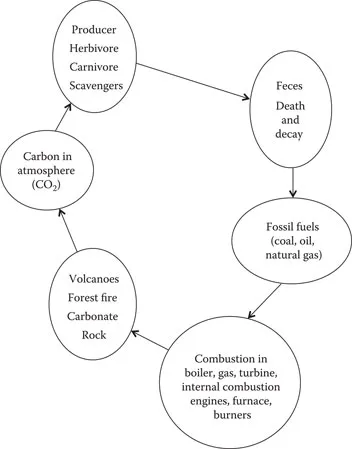
The plant, herbivore, and carnivore eventually die due to aging or other causes including disease, forest fires, and natural disasters (cyclones, floods, tsunamis, and earthquakes). Then, their remains start to decay and become buried under the earth. The remains are composed of carbon and hydrogen, and the process of decay and decomposing proceeds through several decades, resulting in changes to the molecular structure. Then, after centuries, the structure converts from larger molecules into smaller molecules that have energy potential called fossil fuels, which include coal, oil, and natural gas. Thus, fossil fuels are generally formed under the earth. The carbon in the organism is recycled from one to another, as shown in Figure 1.2.
The formation mechanism of coal, petroleum oil, and natural gas is explained as follows.
Coal is formed under the earth mostly in terrestrial regions as it is mostly being explored in the coal mining located in lithosphere. The total proved coal reserve at the end of 2015 with reasonable certainty was about 891.53 billion tonnes. It may be noted that the reserve-to-production ratio of coal in the world in a typical business scenario is about 114 and this indicates that the world’s coal reserve would disappear at the beginning of the next century (BP Energy Outlook, 2015). A typical piece of coal has an amorphous molecular structure consisting of carbon, hydrogen, and inorganic compounds including sulfur. Coal is used exclusively as the fuel in steam turbine power plants for electricity generation. In addition, coal is used as fuel for heating sources in areas such as the cement industries and chemical processes. However, coal as a fuel cannot be used in internal combustion (IC) engines because ash formation (due to an inorganic element/compound embedded in coal) during combustion inhibits its use in the engines. Synthetic or reformed coal as internal combustion engine fuel has received more attention in recent years than other synthetic fuels. Coal can be reformed into synthetic fuels such as methanol and dimethyl ether (DME) through gasification and synthesis processes called coal to liquid (CTL) fuel. For countries such as India and China, which have high reserves of coal, CTL fuels (coal reformed fuel) can be a viable option to reduce import of their crude oil.
Petroleum Oil: Petroleum oil is formed in both terrestrial and aquatic systems. The total proved coal reserve at the end of 2015 with reasonable certainty was about 114 billion tonnes. The reserve-to-production ratio of oil in the world in a typical business scenario is about 50.7 and oil reserves would disappear in the middle of the current century (BP Energy Outlook, 2015). The main elements of raw crude oil include carbon, hydrogen, and sulfur. Crude oil contains different hydrocarbon compounds. As the fuel quality of raw crude is not desirable as IC engine fuel, crude oil properties are refined using atmospheric and vacuum distillation methods in oil refineries and the distilled fuel’s molecular structure and chain length are reformed using a number of chemical processes, including catalytic cracking, polymerization, and isomerization, whereas sulfur-embedded crude oil is removed using a desulfurization process according to the desired fuel quality requirement. High octane number fuels, including gasoline and liquefied petroleum gas (LPG) obtained from petroleum refineries, are used as fuel in spark-ignition engines whereas high cetane number fuels, such as diesel, are used as fuel in compression-ignition engines. Fuel quality is being upgraded further in order to meet the current stringent fuel quality norms. For example, the octane number of gasoline is in the range of 85 to 91, but must be increased fur...