- 166 pages
- English
- ePUB (mobile friendly)
- Available on iOS & Android
eBook - ePub
About this book
Describing Motion: The Physical World provides the quantitative description of a variety of physically important motions. Starting with simple examples of motion along a line, the book introduces key concepts, such as position, velocity, and acceleration, using the fundamental rules of differential calculus. Topics include the free-fall motion of m
Information
Chapter 1 Motion along a line
1 From drop-towers to Oblivion — some applications of linear motion
We have all experienced that momentary feeling of lightness when an elevator begins its downward motion. It is almost as if our weight had suddenly been reduced or, conceivably, that the pull of the Earth’s gravity had decreased for a moment. But imagine what it would be like if the lift cable had suddenly snapped and the lift, with you in it, had plummeted downward. Apart from stark terror, what else do you think you would experience during your fall? What would the physical experience of such a disaster be like?
Well, it would be just like jumping from a high tower. If your descent was unimpeded by the resistance of the air, almost all sense of weight would vanish while you were falling. You would feel weightless, just as though you were an astronaut in outer space.
Not surprisingly, scientists who want to know how equipment will behave under the conditions found in spacecraft are keen to simulate the same conditions here on Earth. One way in which they can do this is by dropping their equipment from the top of a tower, or down a vertical shaft. There are a number of research centres around the world where drop facilities of this kind are available. These are specialized facilities where steps are taken to avoid or overcome the effects of air resistance: simply dropping an object in the Earth’s atmosphere is not a satisfactory way of simulating the environment of outer space.

Figure 1.1 The 140m drop-tower in Bremen, Germany.
Figure 1.1 shows the 140 m drop-tower in Bremen, Germany. The tower is airtight, so all the air can be pumped out. Equipment under test is placed inside a specially constructed drop-vehicle and monitored by closed-circuit TV as it falls from the top to the bottom of the tower. About five seconds of free fall can be achieved in this way. During those few seconds, within the falling drop-vehicle, the effects of gravity are reduced to a tiny fraction of their usual value, a condition known as ‘microgravity’.
In the USA, at the Lewis Research Center in Ohio, NASA operates a 143 m drop-shaft, as part of its Zero Gravity Research Facility. Microgravity investigations conducted at the research facility have concerned the spread of fire, the flow of liquids, and the feasibility of space-based industrial processes that would be impossible under normal terrestrial conditions. Figure 1.2 shows the facility’s bullet-shaped drop-vehicle being given a soft landing at the end of a drop, to avoid destroying the expensive equipment that it contains.
At the time of writing, the world’s longest drop-shaft is in Japan. The Japan Microgravity Center (JAMIC) has a 700 m drop housed in a disused mine shaft. It would be impossible to evacuate the air from such a big shaft, so in this case the rocket-shaped test capsule is propelled down the shaft by gas-jets with a thrust that is designed to compensate for air resistance. Inside this capsule, there is a second capsule and the space between the capsules is a vacuum. The experiments are carried out in the inner capsule which, to a very good approximation, is in free fall. The two capsules decelerate during the final 200 m of the fall.
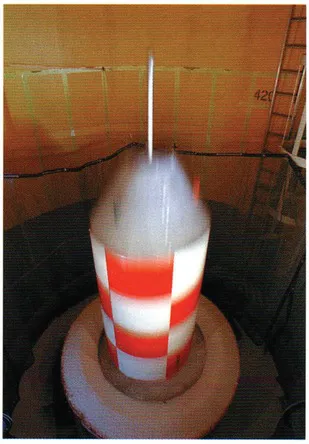
Figure 1.2 The linear motion of a falling test vehicle is stopped safely at the NASA Lewis Zero Gravity Research Facility in Ohio, USA.
By the time you finish this chapter you should be able to work out the duration of the fall in the JAMIC facility, and the highest speed attained by the capsule. You should also be able to work out the length of shaft that would be required to produce any given duration of microgravity.
If all this sounds a bit esoteric you might prefer to consider a different kind of drop-facility. Figure 1.3 shows Oblivion, a ride at the Alton Towers Adventure Park, UK. Oblivion is described as ‘the world’s first vertical-drop roller-coaster’. It will not simulate the space environment, but it will produce a few seconds of terror from a simple application of linear motion.
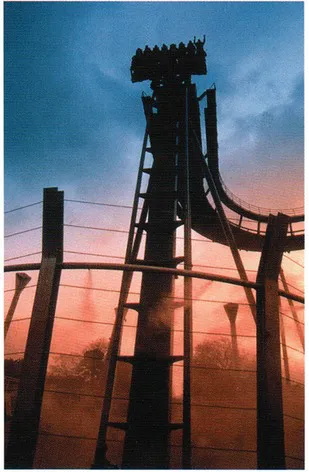
Figure 1.3 Oblivion, the vertical-drop roller-coaster at the Alton Towers Adventure Park, UK.
2 Positions along a line
2.1 Simplification and modelling
Everyday experience teaches us that unconfined objects are free to move in three independent directions. I can move my hand up or down, left or right, backwards or forwards. By combining movements in these three directions I can, at least in principle, move my hand to any point in space. The fact that there are just three independent directions, and that these suffice to reach any point, shows that the space in which my hand moves is three-dimensional.
The motion of a large object, such as an aeroplane, moving in three-dimensional spa...
Table of contents
- Cover
- Title Page
- Copyright Page
- Table of Contents
- Introduction
- Chapter 1 Motion along a line
- 2 Motion in a plane and in space
- Chapter 3 Periodic motion
- Chapter 4 Consolidation and skills development
- Answers and comments
- Acknowledgements
- Index
Trusted by 375,005 students
Access to over 1.5 million titles for a fair monthly price.
Study more efficiently using our study tools.
Frequently asked questions
Yes, you can cancel anytime from the Subscription tab in your account settings on the Perlego website. Your subscription will stay active until the end of your current billing period. Learn how to cancel your subscription
No, books cannot be downloaded as external files, such as PDFs, for use outside of Perlego. However, you can download books within the Perlego app for offline reading on mobile or tablet. Learn how to download books offline
Perlego offers two plans: Essential and Complete
- Essential is ideal for learners and professionals who enjoy exploring a wide range of subjects. Access the Essential Library with 800,000+ trusted titles and best-sellers across business, personal growth, and the humanities. Includes unlimited reading time and Standard Read Aloud voice.
- Complete: Perfect for advanced learners and researchers needing full, unrestricted access. Unlock 1.5M+ books across hundreds of subjects, including academic and specialized titles. The Complete Plan also includes advanced features like Premium Read Aloud and Research Assistant.
We are an online textbook subscription service, where you can get access to an entire online library for less than the price of a single book per month. With over 1.5 million books across 990+ topics, we’ve got you covered! Learn about our mission
Look out for the read-aloud symbol on your next book to see if you can listen to it. The read-aloud tool reads text aloud for you, highlighting the text as it is being read. You can pause it, speed it up and slow it down. Learn more about Read Aloud
Yes! You can use the Perlego app on both iOS and Android devices to read anytime, anywhere — even offline. Perfect for commutes or when you’re on the go.
Please note we cannot support devices running on iOS 13 and Android 7 or earlier. Learn more about using the app
Please note we cannot support devices running on iOS 13 and Android 7 or earlier. Learn more about using the app
Yes, you can access Describing Motion by Robert Lambourne,Alan Durrant in PDF and/or ePUB format, as well as other popular books in Physical Sciences & Calculus. We have over 1.5 million books available in our catalogue for you to explore.