- 346 pages
- English
- ePUB (mobile friendly)
- Available on iOS & Android
eBook - ePub
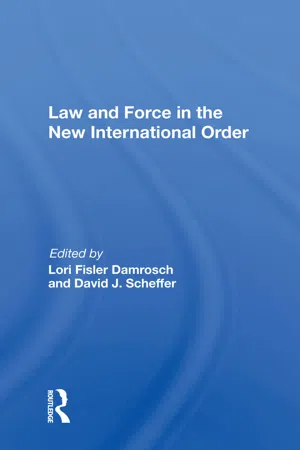
Law and Force in the New International Order
About this book
Momentous events of recent years have shown the tremendous potential for developing and applying international law, even in the area that has always presented the greatest challenge to the rule of law—the use of force. The collaborative response by the United States, the Soviet Union, and other major powers to the Iraqi army's invasion and occupation of Kuwait showed unprecedented unity on the relevance of international law, its rules, and its enforceability through decisions of the UN Security Council. What explains this historic convergence of views? What differences remain about the legality of using armed force in the new international order that is emerging with the end of the Cold War? Law and Force in the New International Order offers a timely and comprehensive inquiry into the growing number of situations where the temptation or necessity to use military force confronts the tenets of international law. Distinguished American and Soviet legal scholars and practitioners explore the idea of the primacy of law over politics, the notion held by some that U.S. military force may be applied for the sake of democracy at a time when Moscow has rejected the Brezhnev Doctrine, the tension between collective security and collective self-defense during the Iraq-Kuwait crisis, and the prospects for the use of force being authorized by the United Nations and regional organizations. The contributors also examine the vexing legal issues raised by interventions to protect human rights, to overthrow "illegitimate" regimes, and to combat international terrorism and drug trafficking; the restraints on the use of force promised by new arms control agreements; and the future role of the World Court and other tribunals in preventing or settling disputes involving the threat or use of force.
Information
Part One
Self-Defense
1
The Use of Force in the Persian Gulf
Abram Chayes
One of the most serious, relevant, and fateful questions concerning the use of force under international law is what actions were open—and under what circumstances—to the forces of the United States and other countries arrayed against Iraq in the Persian Gulf region in 1990. The unspoken assumption of high government officials and certain commentators in the early months of the Iraq-Kuwait crisis was that the United States and its coalition partners, even in the absence of a further attack by Iraq or authorization of the Security Council, remained legally free to take military action upon their own decision. That was the position taken in early August 1990 by the United States on the question of the use of naval force in the Persian Gulf to enforce the U.N. sanctions. The U.S. Secretary of State and others said that such action was permissible as an exercise of the right of collective self-defense of Kuwait under Article 51 of the U.N. Charter, and thus required no further Security Council action.1
Cooler heads prevailed. U.S. naval vessels fired shots across the bows of two Iraqi tankers, but took no further action when the ships continued on course.2 The Security Council was convened to consider the question, and in short order passed Resolution 665, calling on
...Member States co-operating with the government of Kuwait which are deploying maritime forces to the area to use such measures commensurate to the specific circumstances as may be necessary under the authority of the Security Council to halt all inward and outward maritime shipping in order to inspect and verify their cargoes and destinations and to ensure strict implementation of the provisions related to such shipping laid down in Resolution 661 (1990) [the sanctions resolution].3
Interception and boarding of vessels proceeding to or from Iraq was carried out under the authority of that resolution.
To understand the legal situation, some background on the factual developments of the Iraq-Kuwait crisis and Security Council action is necessary. When Iraq invaded Kuwait on August 2, 1990, the United States and some other nations immediately blocked funds and imposed other economic countermeasures.4 The Security Council met promptly and condemned the invasion.5 On August 6, "acting under Chapter VII of the Charter of the United Nations," the Council adopted Resolution 661, imposing comprehensive economic sanctions against Iraq. By virtue of Article 25 of the Charter, these measures are binding on all members of the United Nations. The sanctions later were expanded to include the interruption of air traffic to and from Iraq.6 U.S. officials and others indicated that compliance with these decisions was satisfactory.7
On August 9, Iraq announced that it had annexed Kuwait, and the Security Council promptly declared the annexation null and void.8 It also adopted resolutions dealing with hostages held by Iraq and the attacks by Iraq against embassies in Kuwait.9 In all of these resolutions, the Council noted its decision to keep the matter on its agenda for further action as needed.
Also in early August, in the face of widespread reports that Iraqi troops were massing on the southern border of Kuwait, the government of Saudi Arabia invited the deployment of U.S. troops on its territory to deter a possible attack by Iraq.10 President Bush promptly dispatched ground and air elements, stating that the purpose of the deployment was "to deter further Iraqi aggression." He declared that the mission of the troops "is wholly defensive...They will not initiate hostilities, but they will defend themselves, the Kingdom of Saudi Arabia and other friends in the Gulf."11 Over the next seven weeks, these initial deployments were increased to about 140,000 troops. Other countries, including a number of Arab states, sent significant contingents to join the U.S. forces.12
Some U.S. naval forces were already in the Persian Gulf at the time of the invasion, and these were significantly augmented. On the sea too, the U.S. fleet was joined by ships of other countries.13 As noted above, for a short time the United States maintained that these forces could be used to blockade Iraq as a means of enforcing the sanctions, but, except for the ineffectual shots across the bow, they took no action until the Security Council authorized it.
By the fall of 1990, there were two situations in winch we could expect substantially universal agreement among international lawyers (Iraqi partisans aside, perhaps) that the use of force against Iraq would have been permissible:
First, under the authority of an Article 42 resolution of the Security Council. Article 42 of the U.N. Charter does not require that the Security Council should direct or order members to use force. An authorizing resolution will do, as in the case of Resolution 665 on the use of naval force to enforce the sanctions against Iraq and a similar action in 1966, authorizing the British to interdict oil tankers bound for Beria in Mozambique in violation of the sanctions that had been ordered against Rhodesia.14 Furthermore, neither the text of the Charter nor such practice as there is suggests that the Security Council's power is contingent on any prior action by the Military Staff Committee or on the activation of procedures under Article 43 for advance agreement on the numbers and types of forces a member undertakes to put at the disposal of the Security Council.
Second, use of force also would be permitted (subject to limitations as to proportionality) in response to a large-scale armed action by Iraqi forces against Saudi Arabia, the coalition forces deployed there, or the naval contingents in the Persian Gulf.
Beyond these propositions lies a considerable area of disputed terrain. Among the most important of the controverted questions—not because it was necessarily the most probable but because it throws the issues into sharpest relief—was the suggestion noted earlier that the United States was free, even in the absence of further provocation by Iraq or authorization by the Security Council, to use force against Iraq by virtue of some continuing right of collective self-defense emanating from the original attack on Kuwait. In other words, so the argument runs, the original deployments in Saudi Arabia and the Persian Gulf region were made in response to the armed attack on Kuwait and thus could be seen as an exercise of the inherent right of collective self-defense. The Security Council could be said to have acknowledged this position in its reference in Resolution 665 to "Member States co-operating with the government of Kuwait which are deploying maritime forces to the area." It rests with each of those states, perhaps in consultation with Kuwait and others whose forces were also at risk, to decide whether the measures taken in response to the Iraqi aggression were sufficient, and if not, what further action would be needed.
The textual argument against this position, it seems to me, is very strong. Article 51 is not an affirmative grant of a right of self-defense but a statement of the situations in which the exercise of an "inherent right" is not precluded by the Charter. But those situations are subject to a limit of time. They endure only "until the Security Council has taken the measures necessary to maintain international peace and security."
Who is to judge whether measures authorized by the Security Council are sufficient to maintain international peace and security? Again, the text of the Charter argues strongly that the function belongs to the Security Council. Article 39 says the Council shall "decide what measures shall be taken in accordance with Articles 41 and 42 to maintain or restore international peace and security." The same phrase, "measures necessary to maintain international peace and security," is the key to the temporal limitation on the inherent right of self-defense in Article 51. Even more telling is Article 42, the article that empowers the Security Council to adopt measures involving the use of force, which begins: "Should the Security Council consider that measures provided for in Article 41 [i.e., diplomatic and economic sanctions] would be inadequate or have proved to be inadequate...." It seems clear that all of these provisions of Chapter VII—which is entitled "Action with Respect to Threats to the Peace, Breaches of the Peace, and Acts of Aggression"—are interlocking and that the critical phrase, "measures necessary to maintain international peace and security," carries the same meaning in all of them.
In the larger scheme of the Charter, it is the Security Council that has "primary responsibility for the maintenance of international peace and security,"15 which is recognized as primarily a political rather than a legal task. To carry out that responsibility, the Council, once seized of a matter under Chapter VII, must have the authority to make the political judgments as to the requirements of the situation and the measures necessary to deal with it. Security Council preemption, moreover, reinforces the fundamental objective of Article 2(4) and Article 51 to confine the permissible occasions for the unilateral use of force to the narrowest possible range, where it is immediately and universally apparent that armed response is required.16
During the Cold War, when the Security Council was immobilized by reciprocal vetoes, the argument was perhaps available that a state acting in individual or collective self-defense could not be expected to forgo continuing action simply because the Council was debating the situation, with no likelihood of a serious substantive outcome. This also would be the case if the Council's action is plainly incommensurate with the seriousness of the situation. In those instances it would be a plausible argument that the Council was simply not exercising its functions, so that the preemption contemplated by Article 51 when the Council was truly addressing the situation does not come into operation.17
From the beginning of the Iraq-Kuwait crisis, as has been widely acknowledged, the Security Council worked "as it was supposed to work" according to the design of its framers.18 It cannot be argued that the Council failed to address the situation with appropriate gravity or to adopt measures with real impact or to strengthen those measures as the need became apparent. If the United Nations works as intended, judgments as to the ultimate objectives of U.N. action, the sufficiency of the measures to be taken, how long to wait for the sanctions to take effect, and the like are consigned to the Council, which acts by a majority of nine out of fifteen members, including the concurring or abstaining votes of the permanent members. In the process of reaching those decisions the United States necessarily has a very important voice. Indeed, there is both scope and need for American leadership. The United States can ensure by use of the veto that the Council will not act against its interests. But if the United States cannot induce the necessary number of other Security Council members to agree that additional measures involving the use of force are necessary, the Charter would clearly seem to preclude unilateral action.
"Realists" often portray this kind of analysis as an effort to impose abstract legal constraints on action that is otherwise sound, wise, and effective. And lawyers bearing responsibility for advice to a political leader are understandably reluctant to reduce the available options or otherwise tell him that he cannot do something he wants to do. In the Persian Gulf situation, however, as is true more often than not, the international legal analysis highlights the practical realities of the situation.
Visions of surgical strikes and costless decapitating attacks may dance in the heads of armchair strategists and Pentagon planners, but in real life they almost never come off, except perhaps in the Caribbean. A large-scale attack on Iraq without immediate provocation, even if "successful," entailed very high risks of significant casualties (including many non-combatants in Iraq and elsewhere), destruction of major oil installations, severely negative long-term impacts on the U.S. position with the Arab states, and escalation to a general Middle Eastern war.
As a practical matter, in the fall of 1990, it was no longer possible for the United States to use force in the Persian Gulf without the concurrence of those engaged with it. Because these coalition states joined in the U.N. effort, they too became exposed to the military, political, and economic consequences of any military action the United States took. Indeed, the first consequence of such action would have been to shatter the international consensus that gave legitimacy and strength to the enterprise. Among the first to withdraw could well have been the Arab states upon whose request the U.S. presence in the region was based in the first place, and without whose continuing support it could not be sustained.
Between the two poles of a substantial attack by Iraq on the forces deployed against it, and no further aggressive action, lay an almost infinite spectrum of lesser provocations. They included:
- more limited uses of armed force against a variety of targets and with a variety of means;
- assaults against the hostages, again with a broad potential range in terms of extent and brutality;
- terrorist actions, also with a host of potential targets, linkages to the Gulf theater and severity;
- covert or open armed action against a third state such as Israel; and
- preparations, open or secret, to use chemical weapons or other weapons of mass destruction.
In such circumstances as these, opinion, at least among American scholars, has been far from unanimous. The range of factual cont...
Table of contents
- Cover
- Half Title
- Title
- Copyright
- Contents
- Preface
- Acknowledgments
- About the Contributors
- PART ONE SELF-DEFENSE
- PART TWO COLLECTIVE SECURITY
- PART THREE INTERVENTION
- PART FOUR ARMS CONTROL AGREEMENTS
- PART FIVE JUDICIAL PROCEDURES
- About the Book and Editors
- Index
Trusted by 375,005 students
Access to over 1.5 million titles for a fair monthly price.
Study more efficiently using our study tools.
Frequently asked questions
Yes, you can cancel anytime from the Subscription tab in your account settings on the Perlego website. Your subscription will stay active until the end of your current billing period. Learn how to cancel your subscription
No, books cannot be downloaded as external files, such as PDFs, for use outside of Perlego. However, you can download books within the Perlego app for offline reading on mobile or tablet. Learn how to download books offline
Perlego offers two plans: Essential and Complete
- Essential is ideal for learners and professionals who enjoy exploring a wide range of subjects. Access the Essential Library with 800,000+ trusted titles and best-sellers across business, personal growth, and the humanities. Includes unlimited reading time and Standard Read Aloud voice.
- Complete: Perfect for advanced learners and researchers needing full, unrestricted access. Unlock 1.5M+ books across hundreds of subjects, including academic and specialized titles. The Complete Plan also includes advanced features like Premium Read Aloud and Research Assistant.
We are an online textbook subscription service, where you can get access to an entire online library for less than the price of a single book per month. With over 1.5 million books across 990+ topics, we’ve got you covered! Learn about our mission
Look out for the read-aloud symbol on your next book to see if you can listen to it. The read-aloud tool reads text aloud for you, highlighting the text as it is being read. You can pause it, speed it up and slow it down. Learn more about Read Aloud
Yes! You can use the Perlego app on both iOS and Android devices to read anytime, anywhere — even offline. Perfect for commutes or when you’re on the go.
Please note we cannot support devices running on iOS 13 and Android 7 or earlier. Learn more about using the app
Please note we cannot support devices running on iOS 13 and Android 7 or earlier. Learn more about using the app
Yes, you can access Law and Force in the New International Order by Lori Fisler Damrosch in PDF and/or ePUB format, as well as other popular books in Politics & International Relations & Politics. We have over 1.5 million books available in our catalogue for you to explore.