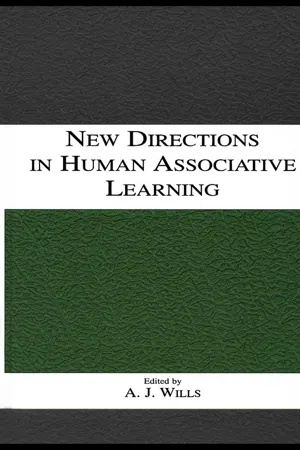
The editor and authors of this book present a synthesis of work on human associative learning, tracing some of its historical roots but concentrating mainly on recent developments. It is divided into three sections: an introduction to the recent data and controversies in the study of human associative learning; recent developments in the formal theories of how associative learning occurs; and applied work on human associative learning, particularly its application to depression and to the development of preferences. The book is designed to be accessible to undergraduates, providing a clear illustration of how principles most commonly introduced in animal cognition courses are relevant to the contemporary study of human cognition.
- 282 pages
- English
- ePUB (mobile friendly)
- Available on iOS & Android
eBook - ePub
New Directions in Human Associative Learning
About this book
Information
Publisher
Psychology PressYear
2005Print ISBN
9780415650434
9780805850819
Edition
1eBook ISBN
9781135609641
Chapter 1
Association and Cognition
A. J. Wills
In April 1903, Pavlov presented his early work on the conditioned reflex to the International Congress of Medicine, Madrid (Pavlov, 1903/1928a).
Two of the, no doubt numerous, events that celebrated the centenary of this event were the Spring meeting of the Experimental Psychology Society at Exeter (for which I was the local organizer) and the annual Associative Learning Symposium organized by Professors Rob Honey and John Pearce of Cardiff University.
Two of the, no doubt numerous, events that celebrated the centenary of this event were the Spring meeting of the Experimental Psychology Society at Exeter (for which I was the local organizer) and the annual Associative Learning Symposium organized by Professors Rob Honey and John Pearce of Cardiff University.
As the date of the Experimental Psychology Society (EPS) conference approached, my thoughts turned increasingly to the nature of the man and the work we were about to celebrate, and how both were considered today. I repeatedly recalled a conversation with a colleague about a year earlier that started with him saying, “Associative learning … isn’t that something they did in the 1950s when they thought pigeons could be trained to guide missiles?”
It’s probably best that this particular opinion remains anonymous but, in less extreme forms, it probably reflects the attitude of a considerable minority of today’s professional psychologists. Breaking down the opinion into its constituents, it seems to center on the ideas that the study of associative learning is (a) entirely concerned with nonhuman animals, and is (b) part of an episode in the history of psychology that ended with the “cognitive revolution” of the 1960s and 1970s. Both components of this opinion are fundamentally incorrect, as I indicate later in this chapter. However, first there is a need to define terms.
WHAT IS ASSOCIATIVE LEARNING?
In some senses, there is a tension in talking about Pavlov and “associative learning” in the same breath. The term associative was in use throughout Pavlov’s career, but it was not a term that he favored. For example, in his Madrid lecture he deliberately eschews the term associative, stating that “habits and associations…are also reflexes, but conditioned reflexes” (Pavlov, 1903/1928a). This perhaps explains, in part, the reaction of another one of my to-remain-anonymous colleagues. I asked her whether she thought Pavlov would have approved of a human associative learning symposium being held in his honor, particularly given that much of his work was with nonhuman animals. Her reply was, “Human testing no problem, I’d guess. It’s the arty-farty cognitive empire-building ‘conditioning is just one corner of the empire of associative learning’ that he might balk at.”
This concern can, I think, be partially addressed by a proper definition of terms. In the context of the title and content of this book, “associative learning” is intended to be a description of a class of problem facing the organism. It is not a statement about the nature of the internal processes by which the organism solves that problem. It is also not a statement about the suitability or otherwise of particular theoretical constructs to explain the organism’s behavioral reactions. For example, in 1932 Pavlov concluded a discussion of teaching a dog to raise its paw in response to a verbal command in the following way: “Why this is merely simple association, as psychologists usually assume, and by no means not an act of intelligence, of ingenuity-even if of elementary things-remains unclear to me” (p. 124).
In this statement, Pavlov is presumably using the term simple association to refer to certain specific process theories discussed earlier in that paper. Hence, the term association is being used to describe a specific theory of which he is critical. However, there seems little doubt that the appropriate behavior of the dog in this situation is contingent upon it detecting a reliable associative relationship between a particular type of sound emitted by the trainer and the action that is rewarded. In this manner, the situation Pavlov describes necessarily involves associative learning, but may or may not involve the formation of the “simple associations” assumed by a particular process theory. The confusion inherent in using such similar terms for such different concepts perhaps leads to the conclusion that a more distinct terminology should be used. The preferred nomenclature of this volume is to use “associative learning” to describe a class of problem facing the organism, and to use (somewhat) more theoretically specific terms to describe and differentiate process accounts (e.g., connectionist models, controlled processes).
Associative Learning and Humans
Let’s return to the misconception that the study of associative learning is wholly concerned with nonhuman animals. There can be absolutely no doubt that Pavlov considered his work to be of great importance to the understanding of the human condition. Perhaps the most striking manifestation of this view was the 2 months in the summer of 1918 that Pavlov spent studying psychiatric patients. This work resulted in a tentative theory of catalepsy derived by analogy to experiments he had previously performed with dogs (Pavlov, 1919/1928c). A large part of his last 7 years of research were also dedicated to the application of his findings to psychiatry. Another example of Pavlov’s direct interest in human behavior is his article on the “reflex of purpose” (Pavlov, 1916/1928d). In this he suggests that activities such as stamp collecting are natural results of this reflex (Pavlov was a keen stamp collector, by the way). Pavlov also suggests that suicide can result from the chronic inhibition of the reflex of purpose. Against a context of such liberal extrapolations, it would seem unlikely that Pavlov could have had a principled objection to the study of associative learning in humans.
More generally, a minimal knowledge of the history of psychology draws one to the inevitable conclusion that the study of associative learning has always been deep at the heart of human experimental psychology. From early examples such as the “Little Albert” experiments of Watson and Rayner (1920), through studies of the modification of the galvanic skin response (Cook & Harris, 1937), the learning of preferences (Razran, 1938), simulated medical diagnosis (Smedslund, 1963), stereotype formation (Hamilton & Gifford, 1976), right up to recent work on causal reasoning (Cheng, 1997) and the complexities of retrospective revaluation (e.g., Dickinson & Burke, 1996), psychology has seldom strayed far from the consideration of this basic form of activity.
“Associative” (Connectionist) Theories of Human Behavior
If one accepts that associative learning is, and is likely to remain, a topic of core interest in psychology, this does not necessarily mean that “associative” theories (recall our earlier distinction) are of any current use in the explanation of human behavior. One of the most overstated and misunderstood aspects of the history of psychology is the idea that there was a kind of “cognitive revolution” in the 1960s and 1970s. In the “dark ages” that preceded this revolution, behaviorists ruled with an iron first, disallowing any explanation of behavior that hinted at the presence of an internal state. After the revolution, psychologists were once again free to invoke any mental states and processes they liked and everyone was much happier and more productive. It sometimes seems to be assumed that associative theories vaporized at around that time. Recent histories of psychology sometimes add a final chapter. In this part of the story, everyone reads McClelland and Rumelhart’s Parallel Distributed Processing (Rumelhart, McClelland, & the PDP Research Group, 1986) and has another conversion experience because here is an approach that permits internal states but that is constrained by certain types of neurophysiological data.
This caricatured history is wrong in every important respect. For example, it combines the experimental methodology of behaviorism (reliance on observable behavior) with its philosophy (inappropriateness of mental states as a subject for study). A cursory glance at any modern textbook of cognitive psychology will demonstrate that the methodol- ogy of behaviorism survived the cognitive revolution. Similarly, when Pavlov explains that his approach focuses the whole of attention “upon the correlation between external phenomena and the reaction of the organism” (Pavlov, 1903/1928a, p. 50), it is the methodology rather than the philosophy that he is endorsing. This distinction is supported by the clear line he draws between his approach and that of investigators such as Watson: “The practical American mind … found that it is more important to be acquainted with the exact outward behavior of man than with guesses about his internal states … I and my co-workers hold another position” (Pavlov, 1903/1928a, p. 40).
What was Pavlov’s position on internal states? One clear illustration can be found in the article “Natural Science and the Brain” (Pavlov, 1909/1928b). In this, he proposed that the conditioned reflex developed through the action of two types of brain process. The first of these was a “temporary union, i.e., the establishment of a new connection in the conducting paths” (p.). This idea is foreshadows the concept of the “associative link” or “connection weight” employed in many contemporary connectionist (or “associative”) models. The second type of brain process was the action of “analyzers.” The concept of analyzers corresponds closely to the “nodes” of a contemporary connectionist system.
It’s worth just underlining the implications of this article. In 1909, Pavlov (1909/1928b) proposed a theory of associative learning that is recognizably a form of connectionist theory—the sort of approach that a caricatured history of psychology attributes to postcognitive research almost 80 years later. One standard response to this objection is that although associative theories were popular for a time, the work of Minsky and Papert (1969) led to psychologists abandoning associative theory until Rumelhart, Hinton, and Williams (1986) invented back-propagation. One minor problem with this account is that back-propagation was discovered at least 12 years earlier (Werbos, 1974). A more major problem is the simple fact that associative theories were not abandoned. One can trace a steady development of associative theory from Thorndike (1898) and Pavlov, through (to name but a few) Spence (1936), Hull (1943), Konorski (1948), Hebb (1949), Rescorla and Wagner (1972), Mackintosh (1975), Grossberg (1976), Pearce and Hall (1980), Wagner (1981), and Pearce (1987). Much of this theoretical work predates Parallel Distributed Processing and even some much later work (e.g., Kruschke, 1992, 2001).
“I Tell My Students Pavlov Was a Genius and They Just Gape at Me”
This is another quote from a colleague. I think it reflects a lack of understanding (on the students’ part) of the nature and extent of Pavlov’s contribution to cognitive psychology. Pavlov was one of the pioneers of the objective, scientific study of associative learning. He was also a pioneer of a theoretical approach to explaining behavior that eventually be- came known as connectionism. This combination alone makes him a critical figure in the development of cognitive psychology as we know it today. Additionally, people tend to forget the breadth of phenomena within classical conditioning that are attributable to him. Pavlov’s body of work goes far beyond the basic demonstration of the development of a conditioned response. Pavlov also demonstrated extinction, and showed through reminder treatments that extinction was not simply unlearning. He provided experimental demonstrations of generalization decrement, context-specificity, and the importance of contiguity. All of this appears in his first public presentation in 1903. By 1912 he had developed the contemporary concept of conditioned inhibition (although his tests for the presence of conditioned inhibition are now generally acknowledged as inadequate).
What makes this all the more remarkable is the fact that Pavlov was over 50 before he started work on the conditioned reflex. In fact, it was not until he was 21 that he decided against becoming a priest, and started to train as a physician. He became a physician at 30, a professor of pharmacology at 41, and a professor of physiology at 46. He won the Nobel prize at 55 for his work on the digestive glands. His most famous book, The Conditioned Reflexes (Pavlov, 1927), was published when he was 78.
There is not the space in this volume to provide a detailed biography (Gantt, 1928, provides an excellent introduction). Nevertheless, some aspects of Pavlov’s personality are worth mentioning briefly. In one respect, Pavlov was a stereotypical academic. He is reported to have had extraordinarily poor dress sense and that on the rare occasions he bought his own clothes “his choice of colors … made his friends laugh and his family angry” (Gantt, 1928, p. 14). In other respects, he is much harder to pigeonhole. Pavlov was a keen gymnast in his youth, a keen gardener throughout his life, and a proponent of the importance of physical exercise. He had a very high level of manual dexterity, being a highly accomplished surgeon, and he also had an exceptionally good memory. He was widely regarded as a clear, energetic, and popular lecturer. This comes across in his collected lectures (Gantt, 1928) despite the barriers of the intervening century and the translation from Russian into English. Within the context of his times, Pavlov was also distinguished by his regard for animal welfare, pioneering postoperative care for experimental animals and developing alternatives to vivisection. In 1924, he resigned his professorship in protest at student expulsions. He didn’t smoke o...
Table of contents
- COVER PAGE
- TITLE PAGE
- COPYRIGHT PAGE
- PREFACE
- ACKNOWLEDGMENTS
- CONTRIBUTORS
- CHAPTER 1: ASSOCIATION AND COGNITION
- CHAPTER 2: MENTAL MODELS OF CAUSATION: A COMPARATIVE VIEW
- CHAPTER 3: ON THE ROLE OF CONTROLLED COGNITIVE PROCESSES IN HUMAN ASSOCIATIVE LEARNING
- CHAPTER 4: ASSESSING (IN)SENSITIVITY TO CAUSAL ASYMMETRY: A MATTER OF DEGREE
- CHAPTER 5: CONNECTIONIST MODELS OF HUMAN ASSOCIATIVE LEARNING
- CHAPTER 6: INTEGRATING ASSOCIATIVE MODELS OF SUPERVISED AND UNSUPERVISED CATEGORIZATION
- CHAPTER 7: THE ROLE OF ASSOCIATIVE HISTORY IN HUMAN CAUSAL LEARNING
- CHAPTER 8: ELEMENTAL REPRESENTATION AND ASSOCIABILITY: AN INTEGRATED MODEL
- CHAPTER 9: APPLICATIONS AND EXTENSIONS
- CHAPTER 10: SIGNAL–OUTCOME CONTINGENCY, CONTIGUITY, AND THE DEPRESSIVE REALISM EFFECT
- CHAPTER 11: LEARNING TO LIKE (OR DISLIKE): ASSOCIATIVE LEARNING OF PREFERENCES
Trusted by 375,005 students
Access to over 1.5 million titles for a fair monthly price.
Study more efficiently using our study tools.
Frequently asked questions
Yes, you can cancel anytime from the Subscription tab in your account settings on the Perlego website. Your subscription will stay active until the end of your current billing period. Learn how to cancel your subscription
No, books cannot be downloaded as external files, such as PDFs, for use outside of Perlego. However, you can download books within the Perlego app for offline reading on mobile or tablet. Learn how to download books offline
Perlego offers two plans: Essential and Complete
- Essential is ideal for learners and professionals who enjoy exploring a wide range of subjects. Access the Essential Library with 800,000+ trusted titles and best-sellers across business, personal growth, and the humanities. Includes unlimited reading time and Standard Read Aloud voice.
- Complete: Perfect for advanced learners and researchers needing full, unrestricted access. Unlock 1.5M+ books across hundreds of subjects, including academic and specialized titles. The Complete Plan also includes advanced features like Premium Read Aloud and Research Assistant.
We are an online textbook subscription service, where you can get access to an entire online library for less than the price of a single book per month. With over 1.5 million books across 990+ topics, we’ve got you covered! Learn about our mission
Look out for the read-aloud symbol on your next book to see if you can listen to it. The read-aloud tool reads text aloud for you, highlighting the text as it is being read. You can pause it, speed it up and slow it down. Learn more about Read Aloud
Yes! You can use the Perlego app on both iOS and Android devices to read anytime, anywhere — even offline. Perfect for commutes or when you’re on the go.
Please note we cannot support devices running on iOS 13 and Android 7 or earlier. Learn more about using the app
Please note we cannot support devices running on iOS 13 and Android 7 or earlier. Learn more about using the app
Yes, you can access New Directions in Human Associative Learning by Andy J. Wills in PDF and/or ePUB format, as well as other popular books in Psychology & History & Theory in Psychology. We have over 1.5 million books available in our catalogue for you to explore.