Soils and sediments influence current processes, preserve evidence of past processes, indicate evolutionary phases in landscapes and provide a basis for relative and absolute chronologies. They provide an important key to the integration of short-term process studies and investigation of longer-term landform evolution. This book, first published in 1985, has been arranged to provide wide temporal and spatial coverage, with studies ranging from historic to geologic time scales and micro- to macro-spatial scales. The interdisciplinary nature of the subject is reflected in contributions from soil scientists, engineering geologists, hydrologists and geomorphologists.
- 456 pages
- English
- ePUB (mobile friendly)
- Available on iOS & Android
eBook - ePub
Geomorphology and Soils
Part I
SOILS AND LANDFORMS
1
Soil properties, slope hydrology and spatial patterns of chemical denudation
T. P. Burt and S. T. Trudgill
Introduction
For more than two decades, a major focus of attention for fluvial geomorphologists has been the hillslope runoff system. Following Hewlett (1961), who first emphasised subsurface flow as the mechanism providing ‘partial’ source areas for stream runoff, numerous studies have investigated the types and source areas of runoff processes on hillslopes. This preoccupation with process has, to some extent, led hillslope geomorphologists to neglect the erosional development of landforms. Similarly, links between geomorphology and soil science have tended to emphasise soil-water physics rather than pedogenesis. Although the study of runoff processes is a necessary prerequisite, processes of solute uptake must also be investigated to improve understanding of the pattern of chemical denudation on a hillslope and the associated pattern of soil profile development. Given a knowledge of solute processes, two timescales exist for investigation.
In the short term, spatial variations of solute sources and rates of removal may be studied. Current process activity may be defined by examining stream solute levels, nutrient cycling and leaching, and solute yields, with much potential for interdisciplinary work by geomorphologists, soil scientists, plant ecologists, hydrologists and geochemists. Over longer timescales, chemical denudation rates and their relationship to soil and slope profile evolution are the primary concern of the geomorphologist, but such studies of landform evolution must clearly be firmly based in process theory if rigorous explanation is to be achieved. Thus, detailed exposition of solute removal processes must precede consideration of landform response, whether that response is to current process activity or longer-term evolution. It is therefore logical to begin with consideration of hillslope runoff processes, which nevertheless represent the first rather than the final goal of the hillslope geomorphologist.
Subsurface flow processes on the hillslope
It is normal to assume that infiltration is vertical flow into the soil. However, Zaslavsky (1970) has shown that any initiation of a soil profile will impart some degree of anisotropy such that lateral hydraulic conductivity (Ks) will exceed vertical hydraulic conductivity (Ky), and there will be a tendency for water to flow downhill. The horizontal flow component will be proportional to slope angle and the degree of anisotropy. Figure 1.1 shows the components of flow for infiltration into a sloping anisotropic soil; flow normal to the soil layers is qy and flow parallel to the soil layers is qs. Zaslavsky (1970) showed that for steady state infiltration, when there is no change in pore water pressure with depth,

where U is the degree of anisotropy (U = Ks/Ky). It can be shown that qs only equals zero where the land surface is horizontal; elsewhere it must be positive and infiltration is not normal to the surface. The flux vector will be vertical where the soil is isotropic (U = 1). The angle β between the soil surface and the flux vector can be expressed as

It is clear that β decreases as tan α and U increase, so that even for low slope angles and limited anisotropy, the horizontal flow distance will greatly exceed the vertical flow depth of infiltrating water. Figure 1.2 shows the angle of infiltration streamlines for an anisotropy of U = 5. Flowlines tend to converge on concave slope profile elements, and whilst divergence occurs on convex elements, this may reinforce the tendency for convergence lower down the slope. When three-dimensional hillslope topography is considered, the effect of flow convergence is accentuated, since it has been shown that soil water movement is parallel to the line of maximum slope gradient (Anderson & Burt 1978). Thus, in a hillslope hollow where both plan and profile are concave, there will be marked convergence of flow into the hollow, particularly where soil anisotropy is also marked.
Many field investigations have defined the factors controlling development of subsurface runoff (reviewed, for example, by Dunne 1978). Soil anisotropy, caused by a less permeable soil horizon at depth or by impermeable bedrock, is, however, crucial to the generation of lateral subsurface flow. A reduction in hydraulic conductivity of several orders of magnitude represents a very large value of U, and thus a flux vector essentially parallel to the hillslope. Particularly important is the build-up of a saturated zone (or ‘wedge’, since it is usually thickest at the slope base) above the impeding layer (Weyman 1973). Since hydraulic conductivity is maximal when the soil is saturated, such a condition maximises the rate of subsurface runoff. In addition, the saturated layer has important implications for solutional processes in the soil. Simple storage models demonstrate that soil saturation will build upwards from the impeding layer when input exceeds output (Kirkby 1978). Inputs may be from vertical infiltration (Knapp 1978), lateral flow down slope (Burt & Butcher 1984), or both. Kirkby and Chorley (1967) identified three zones where maximum subsurface flow will occur: (a) areas of streamline convergence, (b) zones at the slope base, and (c) areas of reduced soil moisture storage. In certain cases, the zone of saturation may reach the soil surface, causing saturation-excess overland flow. Where the excess is due to lateral flow, it is termed ‘return flow’, and is important since it should be rich in solutes, being ‘old’ soil water that has been displaced down slope (Anderson & Burt 1982). The input of solute-rich soil water into a stream during a period of storm runoff may be especially important in controlling the overall solute load of the stream. Clearly, therefore, there is a direct link between the source of storm runoff and its chemical composition.
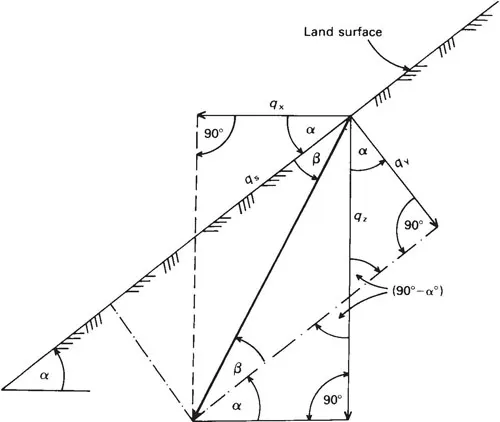
Figure 1.1 Components of flow for infiltration into a sloping anisotropic soil (after Zaslavsky 1970).
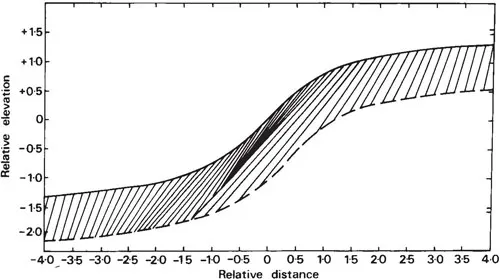
Figure 1.2 Flowlines on a convexo-concave slope for an anisotropy of U = 5 (after Zaslavsky 1970).
The presence of macropores in the soil (i.e. pores above capillary size) influences the timing, rate and solute load of hillslope runoff. Macropores effectively increase the bulk hydraulic conductivity of a soil layer at a scale releva...
Table of contents
- Cover
- Half Title
- Title Page
- Copyright Page
- Table of Contents
- Preface
- Acknowledgements
- List of tables
- List of contributors
- Introduction
- PART I SOILS AND LANDFORMS
- 1 Soil properties, slope hydrology and spatial patterns of chemical denudation
- 2 Duricrusts and landforms
- 3 Pre-Quaternary weathering residues, sediments and landform development: examples from southern Britain
- 4 Soil erosion and landscape stability in southern Iceland: a tephrochronological approach
- PART II SOIL PROPERTIES AND SLOPE PROCESSES
- 5 Aggregate stability, runoff generation and interrill erosion
- 6 Soil properties and subsurface hydrology
- 7 Soil creep: a formidable fossil of misconception
- 8 Soil mechanics and natural slope stability
- PART III SOIL PROPERTIES AND PROCESS RECONSTRUCTION
- 9 Scanning electron microscopy and the sedimentological characterisation of soils
- 10 Soil particle size distribution and mineralogy as indicators of pedogenic and geomorphic history: examples from the loessial soils of England and Wales
- 11 Geomorphological applications of soil micromorphology with particular reference to periglacial sediments and processes
- 12 The mineralogy and weathering history of Scottish soils
- 13 Geomorphological linkages between soils and sediments: the role of magnetic measurements
- PART IV SOILS AND DATING
- 14 Radiocarbon dating of surface and buried soils: principles, problems and prospects
- 15 Soil chronosequences on Neoglacial moraine ridges, Jostedalsbreen and Jotunheimen, southern Norway: a quantitative pedogenic approach
- 16 A Late Pleistocene – Holocene soil chronosequence in the Ventura basin, southern California, USA
- 17 Pedogenic and geotechnical aspects of Late Flandrian slope instability in Ulvådalen, west-central Norway
- 18 Palaeosols and the interpretation of the British Quaternary stratigraphy
- PART V SOIL-GEOMORPHIC APPLICATIONS
- 19 Soil degradation and erosion as a result of agricultural practice
- 20 Forecasting the trafficability of soils
- 21 Geotechnical characteristics of weathering profiles in British overconsolidated clays (Carboniferous to Pleistocene)
- Index
Trusted by 375,005 students
Access to over 1.5 million titles for a fair monthly price.
Study more efficiently using our study tools.
Frequently asked questions
Yes, you can cancel anytime from the Subscription tab in your account settings on the Perlego website. Your subscription will stay active until the end of your current billing period. Learn how to cancel your subscription
No, books cannot be downloaded as external files, such as PDFs, for use outside of Perlego. However, you can download books within the Perlego app for offline reading on mobile or tablet. Learn how to download books offline
Perlego offers two plans: Essential and Complete
- Essential is ideal for learners and professionals who enjoy exploring a wide range of subjects. Access the Essential Library with 800,000+ trusted titles and best-sellers across business, personal growth, and the humanities. Includes unlimited reading time and Standard Read Aloud voice.
- Complete: Perfect for advanced learners and researchers needing full, unrestricted access. Unlock 1.5M+ books across hundreds of subjects, including academic and specialized titles. The Complete Plan also includes advanced features like Premium Read Aloud and Research Assistant.
We are an online textbook subscription service, where you can get access to an entire online library for less than the price of a single book per month. With over 1.5 million books across 990+ topics, we’ve got you covered! Learn about our mission
Look out for the read-aloud symbol on your next book to see if you can listen to it. The read-aloud tool reads text aloud for you, highlighting the text as it is being read. You can pause it, speed it up and slow it down. Learn more about Read Aloud
Yes! You can use the Perlego app on both iOS and Android devices to read anytime, anywhere — even offline. Perfect for commutes or when you’re on the go.
Please note we cannot support devices running on iOS 13 and Android 7 or earlier. Learn more about using the app
Please note we cannot support devices running on iOS 13 and Android 7 or earlier. Learn more about using the app
Yes, you can access Geomorphology and Soils by K.S. Richards,R.R. Arnett,S. Ellis in PDF and/or ePUB format, as well as other popular books in Physical Sciences & Geography. We have over 1.5 million books available in our catalogue for you to explore.