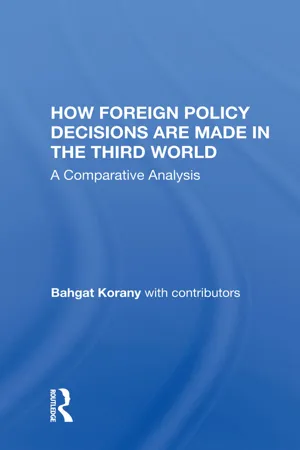
This textbook analyzes eight crucial foreign policy decisions of the 1970s and 1980s, emphasizing how decision-making is influenced by the social characteristics of Third World states and their position in the global system. Chapter 1 situates the Third World in the global system and traces the evolu
eBook - ePub
How Foreign Policy Decisions Are Made In The Third World
A Comparative Analysis
- 232 pages
- English
- ePUB (mobile friendly)
- Available on iOS & Android
eBook - ePub
About this book
Information
1
Coming of Age Against Global Odds
The Third World and Its Collective Decision-Making
Bahgat Korany
Introduction
Students and scholars interested in the Third World face a series of problems at the very outset. First, they must face the multiplicity of terms used to describe the same group of countries. Second, they must decide on the ratio of factors of assimilation to those of differentiation among Third World countries: On the one hand, how many factors are in common within these countries and, on the other, how many set them apart and separate, say, India from Lesotho, or Bangladesh from Kuwait? Finally, some might even ask whether the Third World actually exists in the first place. Related questions may follow: How and when did "Third Worldism" (i.e., the idea of a Third World collective identity and the corresponding belief in its common interests) emerge in the postwar period? What is the structure of the group (or groups) representing it? How does this group function (i.e., what are the characteristics of its decision-making process)?
In dealing with these issues, we shall first examine the plethora of labels used in the field and attempt to sort out the defining characteristics of the Third World as an object of study. Then we will trace the evolution of the different groups (the Afro-Asians, the Nonaligned group, and the Group of 77) and investigate the relationship of possible hierarchy, cooperation, or competition among them. Last, we shall turn to a discussion of the various attempts made to institutionalize the Third World and examine how these attempts influence the Third World's collective decision-making process.
The Third World as an Object of Study
Labels
In Third World analyses, elastic labels abound: nonaligned states, underdeveloped countries, the world periphery. "In the interests of readability," Hill (1977: 11) tells us in an introductory chapter that "the terms 'developing countries,' 'new states,' 'Third World,' 'unmodemised states' and occasionally, 'LDCs' [Less Developed Countries] are used interchangeably." Such practice leads many to wonder when these labels were coined and whether they guide—or mislead—analysis of the Third World.
Even the first use of such a standard term as nonalignment is in doubt. Krishna Menon, India's distinguished political leader, affirmed that he had used the term for the first time in the UN and that Nehru had not liked it. But Nehru himself had already used the term during a debate on foreign affairs on March 28, 1951 (Nehru's Speeches, n.d.: 191-203).
The phrase underdeveloped countries was probably first used officially in the 1951 UN document "Measures for Economic Development of Underdeveloped Countries (E/198Q ST/ECA of 10/3 May 1951) (Wolf-Phillips, 1979: 105-117). It was soon to be regarded as a derogatory term by the governments of these countries. Developing or less developed was preferred, leading Gunnar Myrdal to qualify this change in labels in his Asian Drama as "diplomacy by terminology."
The term Third World came to the English language from the French Tiers Monde. In fact, the French phrase was used in italics in English writings until books such as those of Peter Worsley (1964) and J.B.D. Miller (1966) popularized the term. But English users tended to respect its French connotation as expounded by the French demographist A. Sauvy when he employed it at the height of the cold war in the mid-1950s to refer (by analogy with the French Tiers Etat) to noncommunist countries that purported to remain outside the Western system of alliances. In this sense of political nonalignment, tiers-monde was used by African leaders (such as Kwame Nkrumah) when they suggested the formation of a "nonnuclear Third World" between the two world blocs.
Tracing the use of labels does not help to establish a consensual use of their meaning. Writing in the early 1960s on this subject, P. Lyon (1963) quoted diverse authorities and concluded that "neutralism has been used so often by so many people, in such different circumstances and with such different intentions, that its meaning seems to change, chameleon-like, depending on the context in which it appears."
Twelve years later the Legal Committee of the Group of Experts on the Establishment of the Solidarity Fund for Economic and Social Development in Nonaligned Countries (Kuwait, January 14-15, 1975) could not resolve the problem of definition of nonalignment and had to adopt an ad hoc solution: "An understanding was reached" the Legal Experts affirmed, "that a country which is invited to attend a Conference of the Heads of States or Governments of the nonaligned countries pursuant to a decision of the latter should be regarded as a nonaligned country for purposes of this convention" (Jankowitz and Sauvant, 1978, vol. Ill: 1727). The labels as well as their definitions are increasingly related to one of the biggest controversies in contemporary social science Literature: development and underdevelopment. The controversy proliferates not only into articles and books but also into theories and paradigms (Chilcote, 1984; Gendzier, 1985; Oxaal, 1975; Roxborough, 1979). The debate over labels, definitions, and approaches will undoubtedly continue.
In a chapter on Latin America, Edy Kaufman (1977: 131-164) attracted attention to the overhomogenizing aspect of the term Third World and stressed the differences between Afro-Asia and Latin America. This emphasis on differences is in keeping with what E. Williams (1969: 342-353) had done eight years earlier when he analyzed religion, the role of the church, and interest groups as well as other conventional political development indicators (e.g., per capita income, literacy, and energy consumption) to emphasize the distance separating Latin America from Afro Asia and to draw the conclusion that Latin America is a connecting link between Europe and Afro-Asia. In trying to get the "Labels Straight" among "Third, Fourth, and Other Worlds," Rothstein (1977: 42-70), too, drew attention to the differences between Latin America and Afro-Asia:
On the broadest level, there are so many underdeveloped countries, and there are so many differences between them, that any single label is bound to be misleading. Whatever indicator we choose to highlight, the range of variation is enormous: level of development, per capita income, political forms, culture, historical experience, or ideology. In fact, the variations among underdeveloped countries are probably much wider than those among developed countries, if only because of the absence of the advanced technology and heavy industriahzation that tend to create similar institutional patterns and problems (p. 48).
Even Third World sociologists committed to the Third World both as an object of study and as a reference group are forced to agree, as expressed by this most recent example (Hermassi, 1980: 170):
The term "Third World" almost defies conceptual analysis. It is elusive for several reasons.... The issues covered by the term "Third World" have rarely seemed clear enough to be taken as objects of discriminant thought and judgement. Thus, instead of providing mature generalizations, those involved in Third World affairs have presented grand schemes and intensely held personal opinions, which, in the absence of a fixed object, cannot be sustained for long.
Indeed, after all this emphasis on intra-Third World differences by serious specialists, is it not legitimate to ask if the Third World really exists? "No one raised the question in the 1950's and through much of the 1960's," Rothstein tells us (1977: 47).
Defining Characteristics of the Third World
During the 1950s and much of the 1960s, in fact, the literature was dominated by a "power assumption" that divided all countries into "big powers" and "small states." These latter were analysed—much like any related phenomenon at the heyday of the cold war would have been—as a function of the dominant East-West conflict, as objects or pawns in the superpowers' competition. Such a "Prussian historical school" mentality, with its emphasis on the strength of the state, resulted in a negative assessment of the small state (Amstrup, 1976: 163-182). Thus, for instance, Mergenthau classified the foreign policies of newly independent states into three categories: "escapism pure and simple," "moral indifference," and "surreptitious alignment with the Soviet bloc" (Morgenthau, 1961: 76-77). Briefly, "small states" could not be conceptualized as having purposeful and self-contained foreign policies.
The emphasis on the small/great power dichotomy followed an established tradition in the analysis of eighteenth- and nineteenth-century European politics. Some students of the European scene manifested interest in the small state as representing both a political phenomenon and an attractive alternative to the big absolutist state, but they fell victim to the problem surrounding the concept of size (Amstrup, 1976: 163). We can identify at least six approaches, manifesting various degrees of arbitrariness, in defining the size factor. They range from the view shared by Annette Baker Fox (1968-1969: 751-764) and David Vital (1967) that a strict definition is, after all, unnecessary or irrelevant, to R. Vayrynen's five-dimension classificatory scheme of small-state status (1971: 91-120).
Not only political scientists but also economists (Khalaf, 1971; Lloyd, 1968; Robinson, 1960), who have been more successful in refining and operationalizing the size concept, could not reach conclusive findings. After analyzing economic data from eighty countries, Khalaf (1971: 232) summarized his conclusions:
Size does not have any clear impact on economic stability nor on economic growth and development. "Smallness" is not a source of extra instability, nor is smallness necessarily an obstacle to economic growth and development. The impact of size on dependence on trade and concentration in trade is relatively less ambiguous. In some instances significant inverse relationships were observed between size and concentration in trade. These relationships, however, were not as significant as is often claimed or suggested by plausible a priori reasoning. But regardless of the strength of these relationships, both dependence on trade and concentration in trade turned out to be neither sources of extra instability nor important obstacles to economic growth and economic development.
Social scientists realized at last that size as a variable suffered from a case of overdetermination, from a monovariable approach to explanation. Indeed, if size is analyzed in isolation, out of context, the result is an aberrational categorization of the kind that puts Sweden and Switzerland in the same basket as Kampuchea and Zimbabwe, since these countries are roughly equivalent in respective population (one of Vital's criteria of size). Many social scientists are also beginning to realize the qualitative differences between "small" but old European countries and equally "small" but new states in Afro-Asia and, consequently, have started to stress these differences in their analyses. To start with, clear differences exist in the problem supposedly facing all "small" states, that of security. But there is much more to consider than these differences in security, especially at the structural-societal level, as Rothstein (1977: 43) has suggested:
The European small countries ... shared political tradition and political language with the European Great Power. Their leaders came from the same social class, they were committed to the same ideas about the necessary primacy of foreign policy, and they did not question the value of preserving the existing international system. The Afro-Asian small countries could hardly be more different: Western forms of government have been loosely imposed on much different indigenous political traditions, the leaders of the new states do not come from a single social class (and they are frequently much younger than their counterpart in the industrial world), domestic politics is more important than foreign policy, and there is little commitment to the preservation of an international system identified with imperialism and exploitation.
Accordingly, analysts switched the focus of their inquiry in the 1970s from "smallness" to "weakness" (East, 1973: 556-576). The title of M. Singer's 1972 book, The Weak in the World of the Strong, is significant in this respect. The switch is even more revealing in Rothstein's case: His 1968 book on the subject, Alliances and Small Powers, emphasized smallness, but he replaced this term with weakness in one of his titles ten years later. Both Singer and Rothstein equated "weak" with underdeveloped countries, and Rothstein (1977: 47) explained that he was concerned in his book "solely with underdeveloped countries." The "weakness" label, then, should be limited to underdeveloped countries, not only as an economic datum but also as a structural (objective) and perceptual (subjective) characteristic. Rothstein, in agreement, emphasized the general (objective) common characteristics that make of the underdeveloped countries a proper object of study—namely, "the dominance of subsistence production and self-employment, low per capita incomes and unequal distribution of incomes, imperfect markets, low productivity, dependence on export earnings and foreign capital flows, and small public sectors and minimal modern industrial sectors" (1977: 50). But the subjective elements are equally important. They are two: (1) "a strongly felt sense of deprivation and resentment against the developed countries and a growing conviction that the rules of the international system are deliberately against them— so much so that fair treatment is impossible without a fundamental restructuring of the principles of world order" (Rothstein, 1977: 31); and (2) the common psychological attitudes that this situation engenders. J. Scott's analysis of Malaysian civil servants and Pye's study of the Burmese elite substantiate this view. Tanzania President Julius Nyerere's metaphor is much more to the point: "Small nations are like indecently dressed women. They tempt the evil-minded." Similarly, in their interviews with Weinstein (1976), Indonesian political elites came back again and again to the pretty-girl image to emphasize danger to their country.
Global Pressures and the Emergence of the Third World Collectivity
Notwithstanding national variations (although they are very important), this context of vulnerability—that is, previous colonial domination and present weakness, poverty, and insecurity—tends to cement the Third World countries together and to make of them an eligible object of study and analysis. Indeed, it is this global-systemic context that accounts for their various regroupings into the categories of Afro-Asians, Nonaligned, and Group of 77.
The Afro-Asian group reached its zenith in April 1955 when twenty-nine states from Africa and Asia convened their first (and only) summit in Bandung, Indonesia, and made this Javanese town world-famous overnight. The first summit of the Nonaligned group took place not in Africa or Asia, but in Europe when twenty-five like-minded states (albeit mostly African and Asian) met in September 1961 in Belgrade. In March 1983, the Nonaligned group assembled its seventh summit in New Delhi with a membership of one hundred one countries—an increase of over 400 percent. As for the Group of 77 (G-77), the year of its creation seemed to be less clear-cut (1963? 1964? 1967?) but it was more specific in its object: the economic sphere. It came into being with the convening of UNCTAD I (the United Nations Conference on Trade and Development, Geneva, March-June 1964). However, a group of sorts was already present in the UN in 1963 and seemed to be behind the convening of UNCTAD, but this group included the non-Third World New Zealand. As New Zealand had little in common with these developing countries, it dropped out in 1964 when the Group of 77 coalesced much more concretely during UNCTAD I. The G-77 took an independent form when it convened in Algiers in October 1967 to codify a common Third World position in international economic negotiations, which were to take place shortly afterward within UNCTAD II in 1968 in New Delhi. At the Algiers Conference, G-77 published its charter, which contains the basics of the Third World position in North-South negotiations up to the present time. By 1984, the membership of the Group of 77 had grown to 126 countries, but the name has been retained.
During the thirty-year span between Bandung (1955) and the present, Third World meetings have mushroomed (Mortimer, 1980; Jankowitz and Sauvant, 1978; Sauvant, 1981), membership has increased (with greater numbers of Latin Americans and, especially, of Africans), fields of concern ranging from "pure" politics to political economy have multiplied, particularly give...
Table of contents
- Cover
- Half Title
- Title
- Copyright
- Contents
- List of Illustrations
- Preface
- 1 Coming of Age Against Global Odds: The Third World and Its Collective Decision-Making
- 2 Foreign Policy Decision-Making Theory and the Third World: Payoffs and Pitfalls
- 3 The Political Economy of Decision-Making in African Foreign Policy: Recognition of Biafra and the Popular Movement for the Liberation of Angola
- 4 The Glory That Was? The Pan-Arab, Pan-Islamic Alliance Decisions, October 1973
- 5 The Primacy of Politics: Comparing the Foreign Policies of Cuba and Mexico
- 6 Decision-Making in a Nonstate Actor—OPEC
- 7 The Findings, the Two Asian Giants, and Decision-Making Theory
- Bibliography
- About the Contributors
- Index
Trusted by 375,005 students
Access to over 1.5 million titles for a fair monthly price.
Study more efficiently using our study tools.
Frequently asked questions
Yes, you can cancel anytime from the Subscription tab in your account settings on the Perlego website. Your subscription will stay active until the end of your current billing period. Learn how to cancel your subscription
No, books cannot be downloaded as external files, such as PDFs, for use outside of Perlego. However, you can download books within the Perlego app for offline reading on mobile or tablet. Learn how to download books offline
Perlego offers two plans: Essential and Complete
- Essential is ideal for learners and professionals who enjoy exploring a wide range of subjects. Access the Essential Library with 800,000+ trusted titles and best-sellers across business, personal growth, and the humanities. Includes unlimited reading time and Standard Read Aloud voice.
- Complete: Perfect for advanced learners and researchers needing full, unrestricted access. Unlock 1.5M+ books across hundreds of subjects, including academic and specialized titles. The Complete Plan also includes advanced features like Premium Read Aloud and Research Assistant.
We are an online textbook subscription service, where you can get access to an entire online library for less than the price of a single book per month. With over 1.5 million books across 990+ topics, we’ve got you covered! Learn about our mission
Look out for the read-aloud symbol on your next book to see if you can listen to it. The read-aloud tool reads text aloud for you, highlighting the text as it is being read. You can pause it, speed it up and slow it down. Learn more about Read Aloud
Yes! You can use the Perlego app on both iOS and Android devices to read anytime, anywhere — even offline. Perfect for commutes or when you’re on the go.
Please note we cannot support devices running on iOS 13 and Android 7 or earlier. Learn more about using the app
Please note we cannot support devices running on iOS 13 and Android 7 or earlier. Learn more about using the app
Yes, you can access How Foreign Policy Decisions Are Made In The Third World by Bahgat Korany in PDF and/or ePUB format, as well as other popular books in Politics & International Relations & International Relations. We have over 1.5 million books available in our catalogue for you to explore.