What makes Darjeeling tea, Pashmina shawl, Monsooned Malabar Arabica coffee and Chanderi saree special? Why is it that some goods derive their uniqueness through their inherent linkage to a place? In a pioneering study, this book explores this intriguing question in the Indian context across 199 registered goods with geographical indications, linked with their place of origin. It argues that the origin of these goods is attributed to a distinctive ecology that brews in a particular place. The attributes of their origin further endorse their unique geographical indications through legal channels.
Drawing from a variety of disciplines including geography, history, sociology, handicrafts, paintings, and textiles, the author also examines the Geographical Indications Act of 1999, and shows how it has created a scope to identify, register and protect those goods, be they natural, agricultural, or manufactured. The work presents a new perspective on the indigenous diversities and offers an original understanding of the geography and history of India.
Lucid and accessible, with several illustrative maps, this book will be useful to scholars and researchers in the social sciences, environmental studies, development studies, law, trade and history.
The Geographical Indications Act received the concurrence of the President of India on 30 December 1999. Among the hundreds of ‘Acts’ in India this alone names the discipline of geography in its title. Soaked in a true appreciation of geography, the Act has created a scope to identify, register and protect those goods, be they agricultural, natural or manufactured which draw a definite character from their ‘place’ of origin within India. Using legal armour, the Act states ‘geographical indication…is where a given quality, reputation or other characteristics of goods is essentially attributable to its geographical origin….’ (Section (1) (3) (e) of the Geographical Indications of Goods (Registration and Protection) Act, 1999). To gain protection under the Act, goods have to check in at the Geographical Indications Registry which was established by the Central Government at Chennai, with an all India jurisdiction, on 15 September 2003. The Controller General of Patents, Designs and Trade Marks is the administrator of the Geographical Indications Act. Most Geographical Indications carry the name of the place of origin of the goods, for example Darjeeling tea, Mysore Sandal Soap and Assam tea. But names such as Feni for the cashew drink or Alphonso for a type of mango are also eligible for protection since they fulfil the condition of carrying the characteristics of their place of origin.
The Geographical Indications Act plays an important role for both the producer and the consumer. On the one hand, it shields the genuine producers of agricultural and industrial goods from other producers who deceptively claim a place-based identity, and on the other, it protects consumers from being deceived by any good which makes a false claim about its origin. The Act is designed to break through the clutter of misleading messages about the origin of a good and connect customers with those goods which carry an authentic hallmark of Geographical Indications. It thus, prevents the unaccredited users from ‘passing off’ their goods as those of the registered users, and so it also ensures premium price to the genuine producers of the goods, especially in the export market. The Act ensures monetary compensation against violators and imposes fines or imprisonment and thus grants and protects the rights of the authorised users of Geographical Indications. There was no specific legislation in India before 1999 to register and regulate Geographical Indications for the Made Only in India. Being a legal cover there is a procedure for seeking registration of goods under the Act.
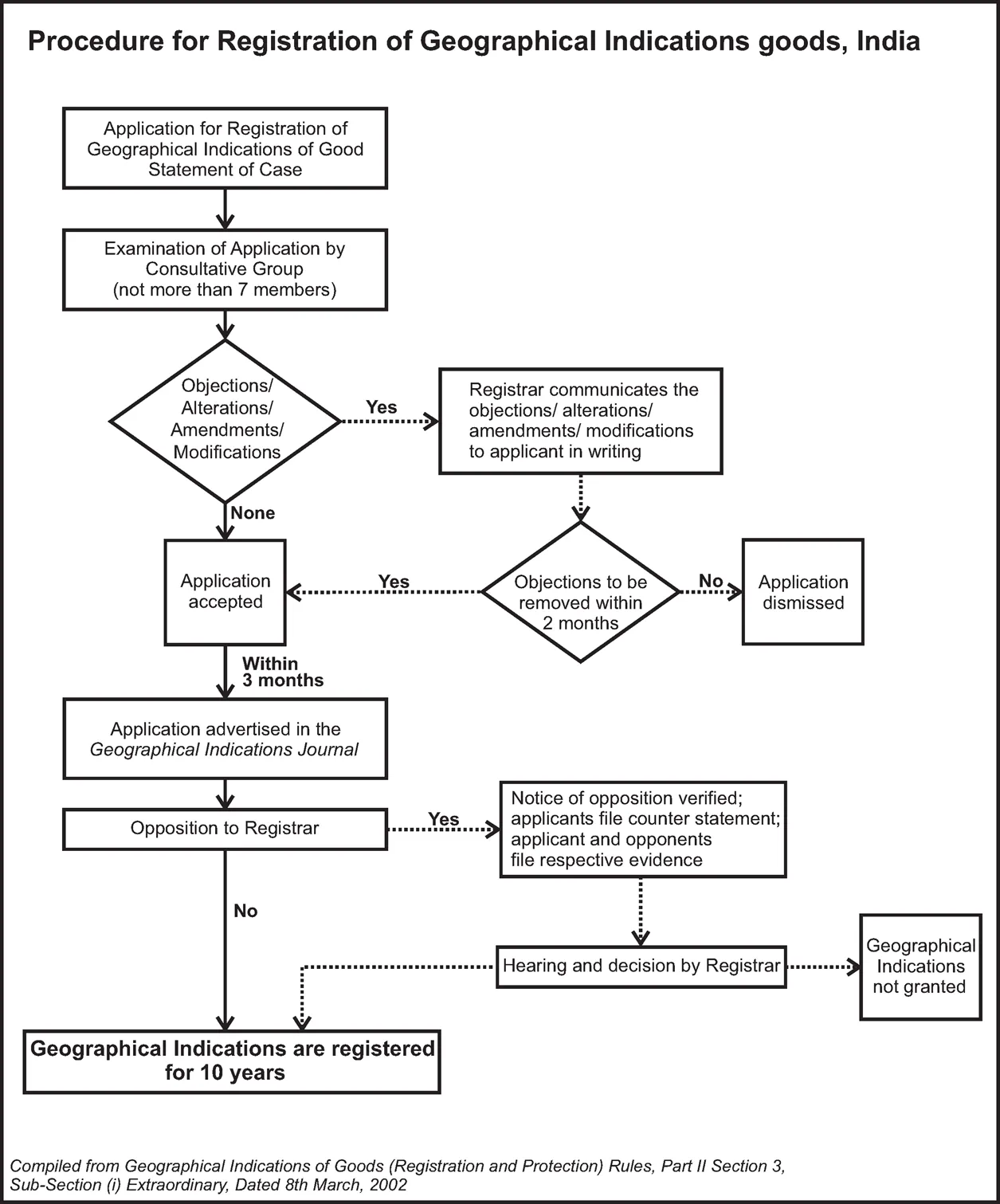
Registration of Geographical Indications goods: The procedure for registration for Geographical Indications involves filing an application which carries a series of questions ranging from the origin of the good, background of the producers and description of the territory of production. Since Geographical Indications are being sought, a map or at least a detailed description of the demarcated area has to accompany the application (Figure 1.1).
What has to be spelt out is the role of the geographical environment in terms of both its inherent natural and human factors and production, processing or preparation in such a geographical location. Field inspections are undertaken to the region to confirm if the good in question carries properties associated with its place of origin. A visit to the area is an integral component of the process as it allows a verification of the facts presented in the application.
Each good seeking Geographical Indications is an individual. To authenticate the contents of the application, a seven-member team of experts well versed in knowledge about the good in question and also in the law of indications is constituted. The goods that seek registration are so diverse that bringing together a meaningful team at times is one difficult aspect of the process. In the case of Alphonso mango the team included three horticulturalists, the Director, Regional Food Research, and three mango growers along with the Registrar of the Geographical Indications Registry. For Patan Double Ikat Patola sarees the team included the Registrar and Assistant Registrar of the Geographical Indications Registry, Director, Market Research (Ministry of Textiles), Faculty of the National Institute of Design, Ahmedabad, and a Professor of Textile and Apparel Designing from the College of Rural Home Science, Dharwad. For Nirmal painting, apart from the Registrar and Assistant Registrar of the Geographical Indications Registry, the team consisted of a former High Court Judge, a former Vice Chancellor of Tamil Nadu Agricultural University, Coimbatore, and a member from the Craft Council of India.
Drawing a team of experts from diverse backgrounds with specific expertise ensures that the authenticity of the good and its origin is inspected, checked and verified. The consultative group submits a report to the
Figure1.1 Procedure for registration of Geographical Indications goods, India
Registry with various queries, doubts and questions. When the questions raised in the report are satisfactorily responded to and removed by the applicant, the report is published in the Geographical Indications Journal. The latter is a bimonthly, bilingual (English and Hindi) statutory publication. This circulation of information in the public domain gives other manufacturers a chance to raise objections and submit them if there is any false claim of the origin or associated attributes of the good to a place. Any person can oppose the application in writing within a specified time period of three months or, if needed, four months. The process of dissemination through this journal ensures that the Geographical Indications label is given to the rightful producers of the good. Considering the chain of checks and verifications, there is no fixed time for the completion of the process of registration; it can vary from a few months as in the case of Chanderi sarees to six years as for the Payyannur Pavithra ring. The initial registration is for a period of ten years, after which the applicant has to apply for a renewal.
The Geographical Indications Journal in India was first published on 1 July 2004, and till May 2014, the Registry had published 58 journals. Till May 2014 the Registry received 482 applications for registration of goods. Of these 482, 228 goods received a certification of origin and can lay a claim to bond with place. Of the 228, 219 goods belong to India and 9 belong to a foreign country. According to the Geographical Indications rules an applicant seeking registration for a good and logo needs to file two separate applications. There were 15 such cases with a dual registration of goods, one for the good and the other for the registration of a logo (Table 1.1).
Among the total goods that were registered with Geographical Indications, two criteria were used for selecting the goods that were to become the focus of research. First, goods which belong to India were sorted and
Table1.1 Status of registration of goods for Geographical Indications, 2004–2014 *
Status of Registration
Total Applications
Indian
Foreign
Not Registered
254
150
104
Withdrawn/Refused/Abandoned
10
10
0
Opposed
1
1
0
Preexamination and new applicants
243
118
125
Registered
228
219
9
More than one applicant for goods
5
5
0
Logos of registered goods
15
15
0
Single applicants for goods
208
199**
9
Total Applicants
482
369
113
* July 2004-May 2014 ** The total goods registered were 228. Of these the following 29 applications were excluded -foreign goods (9), more than one applicant for the goods (5), and logos of registered goods (15). Therefore of the total registered goods 199 have been selected for study. Based on Geographical Indications Journal No. 1 to 58
among these the ones which had ‘passed’ the test for registration were included. The first criterion is justified by the fact that the book is on India, while the ones with registration ensures that the goods have been scrutinised for being the Made Only in India. Among these were goods which had a dual registration one for the good and other the logo. In this case, though a good and its logo are officially registered separately it was decided to treat both as one, because the logo belongs to the good and vice versa and, so to speak, is not a different entity. Following these criteria, goods belonging to India, registered goods and excluding logos, meant that of the 228 goods certified with a Geographical Indications tag, this research focuses on a total of 199 goods.
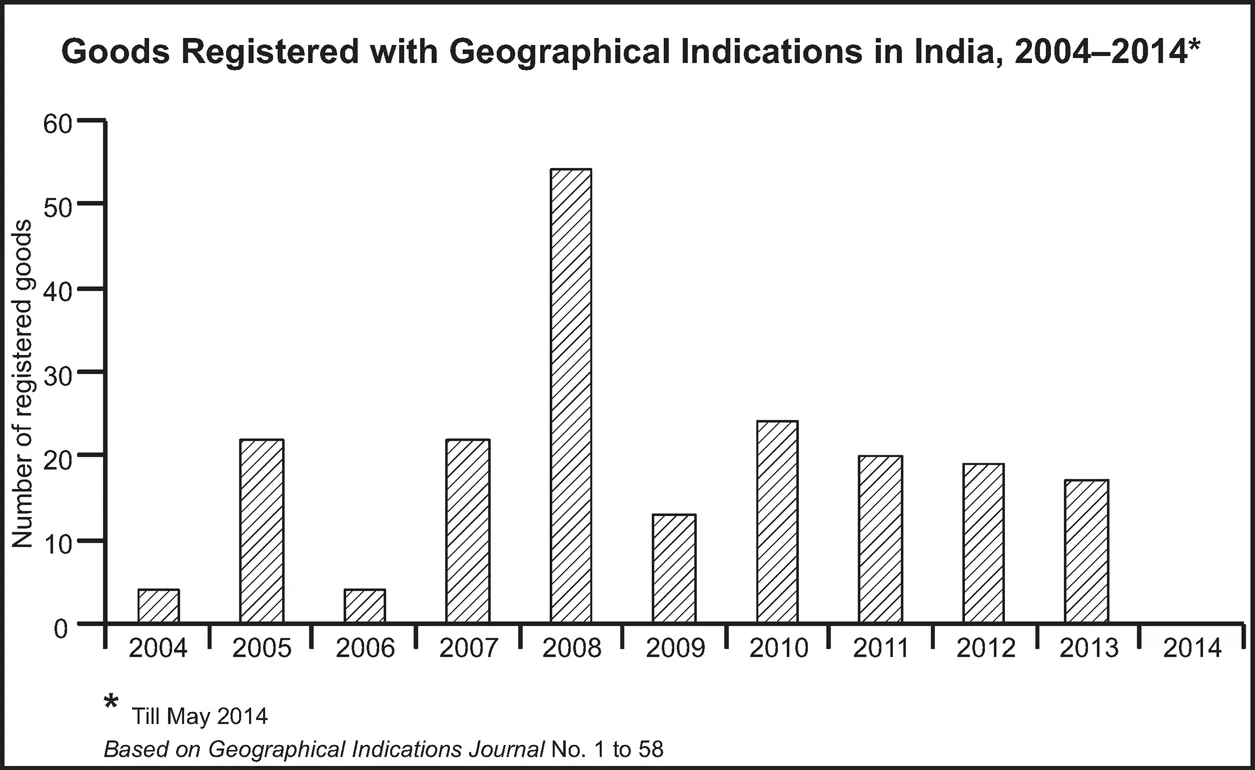
Growth and spatial distribution: Darjeeling Tea was the first to be bestowed the status of Geographical Indications in India on 1 July 2004. Close on its heels came the Chanderi sarees, Pochampally Ikat and Aranmula Kannadi (mirror) in the same year (Figure 1.2, Appendix 1).
With these as pioneers, other goods soon joined the queue and the number peaked in 2008 when 54 goods bagged a position in the rolls of the Registry.
Though there has been an addition of about 15–20 goods each year, the spatial pattern of registration has been rather skewed. Spatially, of the 29 states and 7 union territories of India, only 22 have contributed to the
Figure1.2 Goods registered with Geographical Indications in India, 2004–2014
pool of goods with Geographical Indications. The states of South India have shown a keen interest in registering their goods. Karnataka takes the lead with 32 goods followed by Kerala and Tamil Nadu with 23 and 22, respectively. Together these three states have a 40 per cent share of the registered goods. Another 20 per cent belongs to Andhra Pradesh, Odisha and Uttar Pradesh.
Absent from the list are states like Jharkhand, Uttarakhand, Haryana and union territories like Andaman and Nicobar Islands, Lakshadweep and Chandigarh, which have not enrolled a single good. What is interest...
Table of contents
Cover Page
Half Title Page
Title Page
Copyright Page
Table of Contents
List of figures
List of tables
Foreword
Preface
Acknowledgements
1 The Geographical Indications Act: place matters
2 Bonding: place goods
3 Nurturing: place goods
4 Destroying: place goods
5 Resurrecting: place goods
6 Searching: place goods
7 Concerns for place goods
8 Geographical Indications: place gathers
Appendices
Bibliography
Index
Trusted by 375,005 students
Access to over 1.5 million titles for a fair monthly price.
Study more efficiently using our study tools.
Frequently asked questions
Yes, you can cancel anytime from the Subscription tab in your account settings on the Perlego website. Your subscription will stay active until the end of your current billing period. Learn how to cancel your subscription
No, books cannot be downloaded as external files, such as PDFs, for use outside of Perlego. However, you can download books within the Perlego app for offline reading on mobile or tablet. Learn how to download books offline
Perlego offers two plans: Essential and Complete
Essential is ideal for learners and professionals who enjoy exploring a wide range of subjects. Access the Essential Library with 800,000+ trusted titles and best-sellers across business, personal growth, and the humanities. Includes unlimited reading time and Standard Read Aloud voice.
Complete: Perfect for advanced learners and researchers needing full, unrestricted access. Unlock 1.5M+ books across hundreds of subjects, including academic and specialized titles. The Complete Plan also includes advanced features like Premium Read Aloud and Research Assistant.
Both plans are available with monthly, semester, or annual billing cycles.
We are an online textbook subscription service, where you can get access to an entire online library for less than the price of a single book per month. With over 1.5 million books across 990+ topics, we’ve got you covered! Learn about our mission
Look out for the read-aloud symbol on your next book to see if you can listen to it. The read-aloud tool reads text aloud for you, highlighting the text as it is being read. You can pause it, speed it up and slow it down. Learn more about Read Aloud
Yes! You can use the Perlego app on both iOS and Android devices to read anytime, anywhere — even offline. Perfect for commutes or when you’re on the go. Please note we cannot support devices running on iOS 13 and Android 7 or earlier. Learn more about using the app
Yes, you can access Made Only in India by Anu Kapur in PDF and/or ePUB format, as well as other popular books in Law & Intellectual Property Law. We have over 1.5 million books available in our catalogue for you to explore.