eBook - ePub
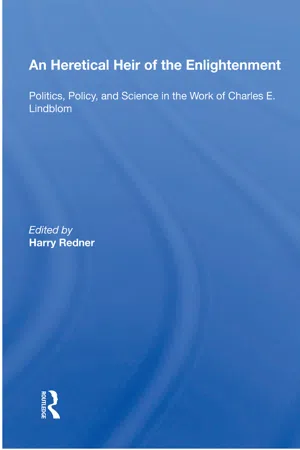
An Heretical Heir of the Enlightenment
"Politics, Policy, and Science in the Work of Charles E. Lindblom"
- 392 pages
- English
- ePUB (mobile friendly)
- Available on iOS & Android
eBook - ePub
An Heretical Heir of the Enlightenment
"Politics, Policy, and Science in the Work of Charles E. Lindblom"
About this book
This is primarily, but not exclusively, a book on Lindblom. All the pieces in it bear on his work, either as direct commentary on it or criticism of it, or as extensions of his ideas. But at the same time every piece follows the trajectory of its own ideas into the subject matter in which it delves. And these subjects are many and varied. Indeed, the prime purpose of this volume is to make the broad public aware of the full scope and amplitude of Lindblom' s thought and to convey something of the inner coherence that governs it. Anyone who has previously encountered Lindblom only in one manifestation of his multifaceted mind might be surprised to learn that there are so many other facets as well. Merely to list the disciplines to which he has contributed threatens to extend into an academic catalogue of ships. But the truth is that his work is not docilely academic, it refuses to lie down neatly and supinely into the procrustean beds of the established disciplines. Like his closest predecessor, Veblen, he offers a comprehensive treatment of social reality as a whole -- together with something of the same heretical thrust against the academic establishment.
Information
Part One
Studies in Lindblomian Theory
Chapter 1
Bold Critic, Cautious Reformer, Skeptical but Hopeful Rationalist
Robert A. Dahl
Looking back over four decades of Lindblom's work, I am struck by the persistence of certain underlying feat ures in his way of understanding and interpreting the world. A short-hand summary might run like this: He is unusually bold and creative as a critic of existing institutions; but he believes that given the present state of our knowledge most proposed solutions are likely to be unsatisfactory. As a result, he is cautious about endorsing large changes in policies or structures. Finally, though he is skeptical about our capacities for making rational collective decisions and doubtful whether we can overcome the socially created limits on our understanding, he has been consistently hope ful, from his earliest work to his latest, that human intelligence might be more effect ively employed for solving our problems.
Bold Critic
The main elements were already visible in his first book, Unions and Capitalism (1949). Indeed, in this work (perhaps the least well known of all his books) many of his later substantive concerns and arguments are clearly foreshadowed. Of these the most conspicuous is his view that the market is a relatively efficient and, on balance, highly desirable mechanism for allocating resources.1 Yet here, as in all his later work, he is also a critic of the market.
The central argument of the book is this. (1) Unions are inc<>nsistent with a competitive price system. (2) Among the consequences of unionism are monopoly, misallocation of labor, unemployment, the shrinking of management's domain of decisions, and the abuse of power by a minority consisting of union leaders or members. (3) Yet none of the proposed solutions - restoring competition, industrial democracy, responsible unionism, government regulation, and so on — can solve the conflict between unionism and a competitive price system. The conflict between unions and capitalism — or more accurately, between unions and a competitive price system — appears to Lindblom as essentially irremediable.2 (4) Nonetheless, a more enlightened and aware public opinion, particularly among union members themselves, might lead to greater discussion and thereby help the public "to find its way out of this dilemma" (p. 253). Exhibiting his usual caution in endorsing solutions, Lindblom does not say what such a way might be.
A careless reader of this book might conclude that Lindblom is, or was, a conse rvative defender of capitalist institutions -- or perhaps a Marxist!3 But the attentive reader will notice his frank statement in the preface:
In so far as ethical values are embedded in the analysis and to the extent that they can be identified with the loose opposites, "liberal" and "conservative," I am a liberal. I think highly of the social reformer - not, of course, the crank with his panacea but the imaginative thinker who combines a concern for the general welfare with a conviction that Man within limits can intelligently plan his social structure (p. vi).
Here, I believe, is the quintessential Lindblom, as he was then and as he has remained.
To put Lindblom's seeming "attack" on trade unions in historical perspective, it is important to recall that in 1949 the desirability of trade unions was an all but unquestioned assumption among American liberals, who then as later were a predominant if highly disparate group in academia, particularly in the social sciences. Legal protection for unions and collective bargaining had been a central element in the New Deal; in asserting those rights in the late 1930s, union members had fought hard and sometimes bloodly battles; by 1949 the battles were by no means over; and the trade union movement was an essential element of the New Deal coalition, which still existed though its days were already numbered. Thus Lindblom was attacking one of the most sacred cows of the liberals — the intellectual establishment, so to speak.
In his later work he criticized other sacred cows, both liberal, radical, and conservati ve: central planning, pluralism, the privileged position of businessmen in a capitalist order, corporations, the capacity of citizens to understand their own best interests.4 An unwary reader of Politics and Markets (1977) might even conclude that Lindblom had little commitment to modern representative democracy or polyarchy: the privileged position of businessmen together with "circularity" in ideas from elites to masses appears to make modern democracy, in Lindblom's view, something of the sham that Leninists (like Fascist and Nazi theorists) had long insisted it was.5 In Inquiry and Change (1990) he develops even more fully his view that ordinary citizens are greatly impaired in their ability to understand their situation, their alternative possibilities, and their interests; and he sees these "impairments" not as inevitable results of our inherently limited rationality but as socially determined, and beneficial to the interests of the privileged.
Because of his obvious discontent with so much of the existing state of affairs, the vigor of his criticism, and the rigor with which he pushes it, his readers are sometimes mistaken (if not baffled) as to where he stands. As with Unions and Capitalism, Lindblom's intellectual style makes it difficult to pin down his ideological convictions. Conservatives no doubt took comfort from that book, despite his disclaimers; but their rejoicing did not make him a conservative. Some Marxists concluded that in Politics and Markets Lindblom had finally seen the light - their light; but they could not have been more mistaken. Lindblom's criticisms of pluralism, together with his view of the privileged position of business, were sometimes intepreted as an outright repudiation of pluralism.6 But in Inquiry and Change, after citing some of the criticisms of pluralist interpretations, Lindblom confounds readers who had interpreted him as having rejected pluralism. In characteristically Lindblomian fashion, he writes:
In short, the objections raised against existing pluralist practices do not seem to constitute a reason for abandoning pluralism as here defined. Instead, these objections turn attention to the possibilities of restructuring or otherwise improving pluralism. Prospects for reforms adequate to reduce the force of the objections to pluralism seem slim in view of the effective political opposition by advantaged groups. Yet there exists no alternative, given the necessity of multiplism and the dependence of multiplism on group identifications and affiliations. The reforms might well include attempts to dampen some group identifications and to restructure the relations between organized groups and branches or agencies of the state. But the core of the reform has to reconstitute pluralism, not eliminate it (p. 228).
Not exactly a ringing defense of pluralism, yet very far from a re pudiation.
Lindblom's criticisms of existing institutions and the beliefs supporting them have probably been sharpened by his judgment that they are insufficiently challenged, especially in the United States, and that it is the task of scholars to engage in the critical scrutiny that ordinary citizens are unable to achieve, in part because of the socially imposed "impairment" of their critical understanding. His concern for widening the spectrum of criticism and opening up new possibilities also helps to explain his appeal to political scientists -- and other social scientists as well -- to be more sympathetic to the alternative views presented in "Marxist and other radical thought on liberal or bourgeois democracy."7
Cautious Reformer
We have come to expect powerful critiques of the status quo to be accompanied by strong recommendations for change -- new policies, fundamental reforms, new structures, possibly revolution. A sharp critic of capitalism is expected to advocate an alternative -- socialism, say. A critic of pluralism, we tend to assume, must intend to offer some structural alternative. But Lindblom has steadily refused to endorse radical alternatives. Indeed, to the extent that he has any recommendations to make at all, they are usually cautious and lacking in specifics.
As I pointed out earlier, this pattern was already present in Unions and Capitalism. A reader of Politics and Markets might expect that Lindblom would suggest a structural alternative to existing polyarchy, pluralism, and capitalism that would overcome, or at least mitigate, the inequalities, the privileged position of business, the Gramscian circularity in the formation of beliefs in market systems, and so on. But the careful reader who pursues Lindblom through the final pages hopeful for solutions will find almost no comfort. The argument of the concluding pages is, in fact, rather pessimistic -- reminiscent of the "final considerations" by Robert Michels in his Political Parties in which he presents the inevitable subordination of the masses to their leaders, and thus the impossibility of democracy, as a tragedy, a "cruel game... without end."8 Striking a note less tragic and more prosaic, Lindblom's final words are: "The large private corporation fits oddly into democratic theory and vision. Indeed, it does not fit" (p. 356).
So, too, a reader may approach the end of Lindblom's last book, Inquiry and Change, with the hope of finding proposals for overcoming the "impairment" of vision and understanding to which so many citizens, in Lindblom's view, are subject -- a hope strengthened perhaps, by the title of the final chapter "Reducing Impairment." To such a reader it may then come as a disappointment that Lindblom's radical diagnosis is not followed by an equally radical prescription. Indeed, his prescriptions are extraordinarily modest.
. . . [N]ot even the most liberated of societies have probed impairment well enough and long enough to have clarified and created required possible institutional reforms... If these societies are as severely impaired as here described, they lack competence at present to devise institutional reforms (and so do I) (p. 286).
Most of that final chapter can be read, in fact, as warning against the easy conclusion that the problem of impairment can be solved in the foreseeable future.
Skeptical Rationalist
Lindblom's unwillingness to offer much in the way of solutions to the problems he poses probably has many sources. One of these, perhaps the most important -- and in any case the one I want to emphasize here - is his belief that we simply do not know enough about most problems to enable us to provide anything close to comprehensive solutions. The implicit implication is that by jumping into the dark we may do more harm than good. If Lindblom does not attempt to tell us what the best solutions might be, he has had much to say about how we might best go about solving collective problems. It is in showing us the how of collective problem solving, then, rather than the what of concrete solutions that Lindblom has made some of his most important and influential contributions. An underlying theme of these contributions is his unswerving commitment to the belief that despite all its limits and defects, human reason can help us to find better ways to live our lives together.
A summary, doubtless too schemat ic, of his views on collective proble m-solving might look like this:
1. Modern societies are extraordinarily complex, far too complex to be managed rationally by any single group of human beings, however gifted or public spirited they may be. (And as a practical matter, they probably won't be all that gifted or public spirited anyway.)
2. Consequently we must pursue strategies of limited rationality.9
3. Among the most promising of such strategies are "muddling through", incrementalism, and partisan mutual adjustment10
4. In addition, professional inquiry, particularly by social scientists, can make a modest though important contribution to problem-solving.11
5. Finally, despite the obstacles and our ignorance about the most effective means for doing so, surely the "impairments" of ordinary citizens can be reduced, thereby enabling them to participate more fully in a self-guiding society.
A Skeptical Child of the Enlightenment?
Lindblom is aware of the seeming discrepancy between the severity of his criticisms of existing institutions and the cautious and limited nature of his solutions. Shortly after the publication of Politics and Markets, he wrote in 1988 that Albert Hirschman (an old friend)12
... asked me how I had come, or could have come, from incremental policy making to the argument of that book...I see now in retrospect that [my own work] has a pattern, but its development was not the fulfillment or implementation of a design. Ex ante, it never seemed clear to me what I should next study; only ex post do I see the pattern...
Do I believe ...
Table of contents
- Cover
- Half Title
- Title
- Copyright
- Contents
- Preface
- About the Contributors
- Introductory Comment: The Pattern in the Work
- PART ONE Studies in Llndblomian Theory
- PART TWO Studies in Policy-Making
- PART THREE Studies in Polity and Economy
- Concluding Comment: A Case Study of the Practice of Social Science
- Bibliography of Lindblom's Scholarly Publications
Trusted by 375,005 students
Access to over 1.5 million titles for a fair monthly price.
Study more efficiently using our study tools.
Frequently asked questions
Yes, you can cancel anytime from the Subscription tab in your account settings on the Perlego website. Your subscription will stay active until the end of your current billing period. Learn how to cancel your subscription
No, books cannot be downloaded as external files, such as PDFs, for use outside of Perlego. However, you can download books within the Perlego app for offline reading on mobile or tablet. Learn how to download books offline
Perlego offers two plans: Essential and Complete
- Essential is ideal for learners and professionals who enjoy exploring a wide range of subjects. Access the Essential Library with 800,000+ trusted titles and best-sellers across business, personal growth, and the humanities. Includes unlimited reading time and Standard Read Aloud voice.
- Complete: Perfect for advanced learners and researchers needing full, unrestricted access. Unlock 1.5M+ books across hundreds of subjects, including academic and specialized titles. The Complete Plan also includes advanced features like Premium Read Aloud and Research Assistant.
We are an online textbook subscription service, where you can get access to an entire online library for less than the price of a single book per month. With over 1.5 million books across 990+ topics, we’ve got you covered! Learn about our mission
Look out for the read-aloud symbol on your next book to see if you can listen to it. The read-aloud tool reads text aloud for you, highlighting the text as it is being read. You can pause it, speed it up and slow it down. Learn more about Read Aloud
Yes! You can use the Perlego app on both iOS and Android devices to read anytime, anywhere — even offline. Perfect for commutes or when you’re on the go.
Please note we cannot support devices running on iOS 13 and Android 7 or earlier. Learn more about using the app
Please note we cannot support devices running on iOS 13 and Android 7 or earlier. Learn more about using the app
Yes, you can access An Heretical Heir of the Enlightenment by Harry Redner in PDF and/or ePUB format, as well as other popular books in Politics & International Relations & Politics. We have over 1.5 million books available in our catalogue for you to explore.